Request a Callback

+971 4380 1666
 Nov 12, 2026
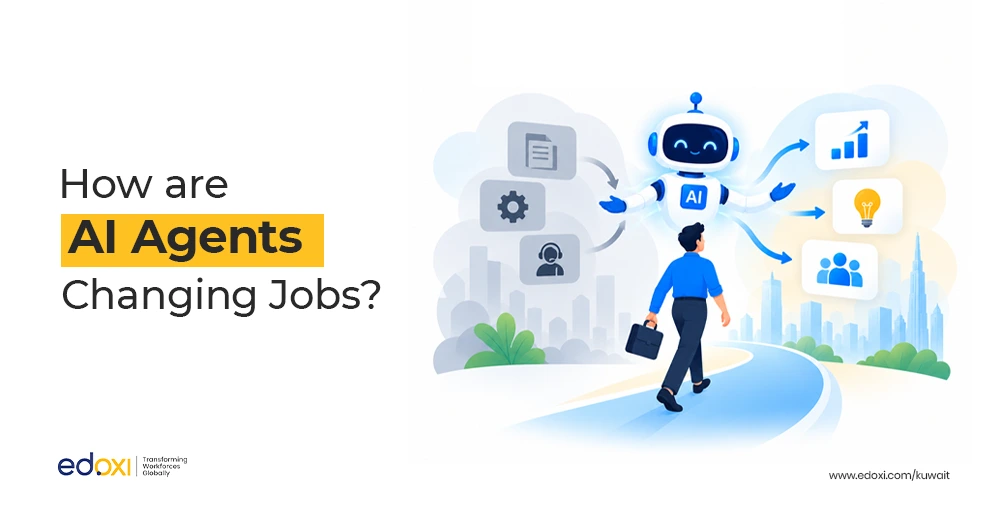
AI agents are changing jobs by taking over parts of multi-step work, such as sorting requests, drafting reports, or scheduling tasks, within limits people set.
Research suggests AI is more likely to transform jobs by automating selected tasks than to remove whole occupations. The impact varies by role and industry.
Imagine a Monday morning at a Kuwait City office. Before anyone arrives, a piece of software has read 200 emails, sorted the urgent ones, booked two meetings, and drafted three replies. Nobody told it how. It got a goal and worked out the steps.
That is the idea behind an AI agent. It is not a robot taking your desk. It is closer to a new kind of coworker that handles the routine parts quickly.
This blog explains how AI agents are changing jobs, in plain words. You will get research with dates, local context from Kuwait, and clear next steps.
Table of Contents
| Nos | Contents |
|---|---|
| 1 | What Are AI Agents, and How Are They Different From Chatbots? a) How Do AI Agents Differ From Traditional Automation? |
| 2 | How Are AI Agents Changing Jobs Right Now? a) How Do AI Agents Affect Customer Service and IT Support? b) How Do AI Agents Affect Software Development and Data Analysis? c) How Do AI Agents Affect Marketing and Finance? d) How Do AI Agents Affect Project Management and Administration? |
| 3 | Will AI Agents Replace Jobs or Only Tasks? a) What Does the Research Say? b) How Can You Tell If a Task Is Safe to Hand to an Agent? |
| 4 | Which Human Skills Become More Valuable With AI Agents? a) What Is AI Literacy, and Why Does It Matter? b) What Are the Benefits and Risks of AI Agents at Work? |
| 5 | What Is Kuwait Doing About AI and Jobs? |
| 6 | How Can Employees and Companies Prepare for AI Agents? a) How Can Employees Adapt to AI Agents at Work? b) How Can Companies Add AI Agents Without Replacing Employees? |
| 7 | Key Takeaways |
| 8 | FAQs: How Are AI Agents Changing Jobs? |
An AI agent pursues a goal across several steps, uses tools like email or software, and adjusts as it goes, within permissions people set. Chatbots andgenerative AItools often do less on their own, but the lines overlap.
Each tool is built for a different job. A chatbot is built to hold a conversation. A generative AI tool is built to create text, images, or code.
An agent is built to finish a goal. Say "book the client visit," and it can check calendars, send invites, and fix clashes.
The lines blur, though. Some chatbots now connect to other tools. Some generative AI models sit inside agent workflows as the "brain." So think of a scale, not three separate boxes.
The more a tool plans, acts, and adapts on its own, the more agent-like it is.
| Feature | Basic chatbot | Generative AI tool | AI agent |
|---|---|---|---|
| Built to | Answer questions in a chat | Create content from a prompt | Complete a goal over several steps |
| Acts on its own? | Limited | Limited, unless built into a workflow | Yes, within set permissions |
| Uses other tools? | Sometimes | Sometimes | Usually (email, calendar, software) |
| Human role | Reads the reply | Reviews the output | Sets limits and reviews results |
Be careful with labels. Gartner has warned about "agent washing," where vendors rebrand chatbots and assistants as agents without real agentic features.
Traditional automation follows fixed rules. Agents can handle changes and unclear inputs, but they still need guardrails.
A rule-based script breaks when a form layout changes. An agent can often read the new layout and carry on.
That is why businesses use AI agents to automate workflows that once needed a person watching. To work well with them, start with theseAI skills for professionals.
Agents are starting to handle routine, multi-step tasks in customer service, software development, marketing, finance, data analysis, IT support, project management, and administration.
People shift toward review, strategy, and client care. How far this goes depends on the role and the company.
AI agents can resolve common requests from start to finish and hand harder cases to people.
In February 2024,Klarnareported that its OpenAI-powered assistant handled 2.3 million chats in its first month. That was about two-thirds of its customer service chats.
The assistant manages tasks like refunds and returns, and Klarna said resolution time dropped from 11 minutes to under two.
These are company-reported figures, and Klarna calls the tool an assistant, not a fully independent agent. Still, it shows what task-level automation looks like at scale.
In IT support, an agent can spot a problem, run a standard fix, and log the ticket. The team then studies root causes and security.
AI Agents can write, test, and fix code, and clean and summarise data. Humans set direction and check quality.
A coding agent can take a task, edit files, and run tests. An analyst can get clean data and a first-draft chart. Someone still has to ask the right question and catch a wrong number.
The debate onAI and software engineersshows the pattern: the tasks change, and the need for judgment stays.
AI agents can draft campaigns, build reports, match invoices, and flag odd payments. People own strategy, brand, and risk decisions.
A marketing agent can pull results, write ad variations, and report what worked. A finance agent can match invoices and chase late payments. A person still signs off on money decisions.
Banking and retail are among theindustries affected by AIearly.
AI agents can schedule, track tasks, and write meeting notes. People still manage conflict, priorities, and trust.
TheILO's 2025 studyfound that clerical occupations have the highest exposure to generative AI. Exposure means many tasks could be automated. It does not mean those jobs will disappear.
The WEF's 2025 employer survey does list clerical and administrative roles among those expected to decline.
Our list ofjobs at risk of AI replacementexplains which roles need to adapt first.
The tasks that AI agents take on, and jobs that humans still have hold of, are presented in the infographics below:
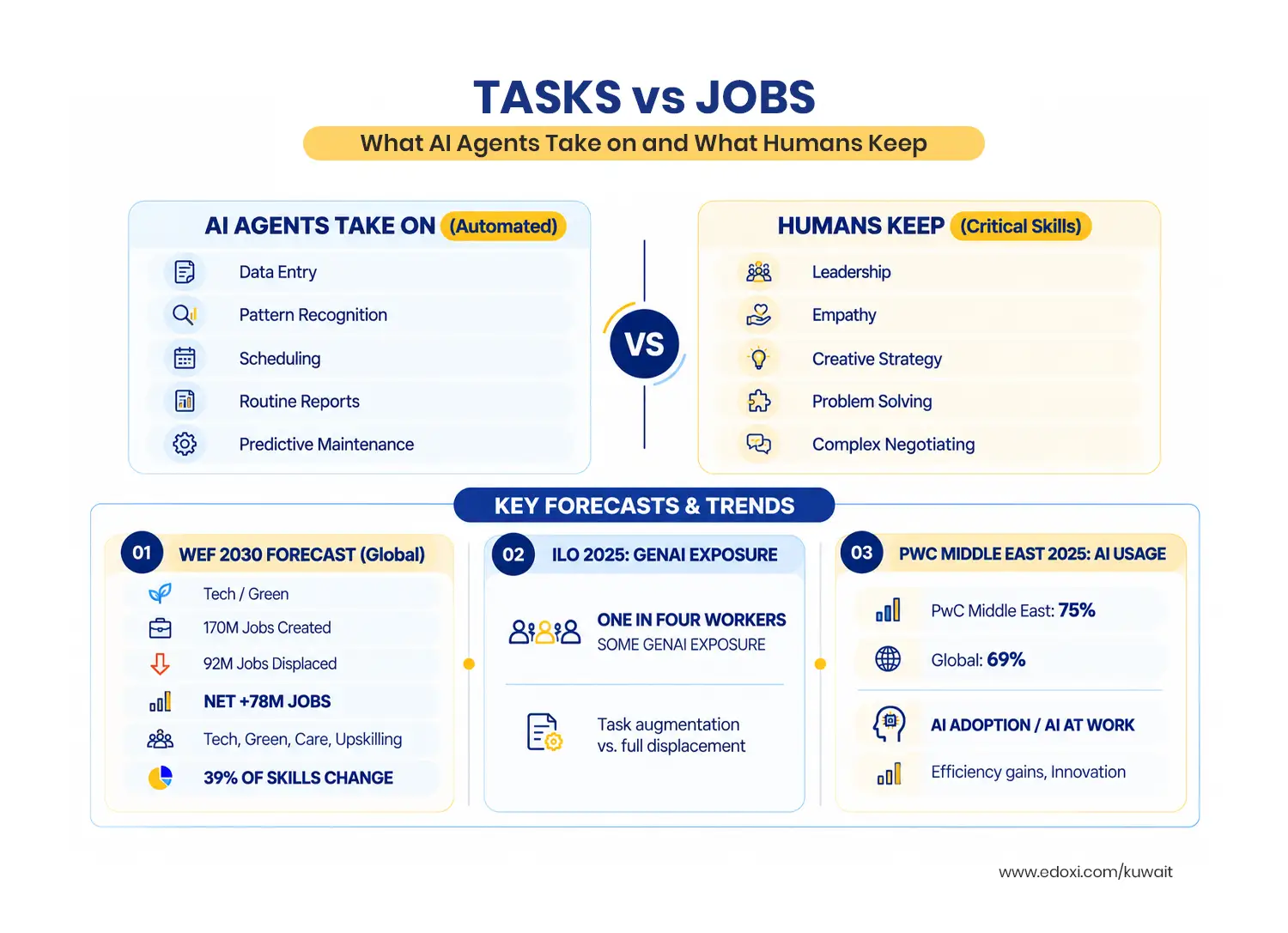
AI is more likely to transform many jobs by automating selected tasks than to eliminate entire occupations, although the impact varies by role and industry. A job is a bundle of tasks, and agents may take over some of them.
Business consultantAbdulilah Annousmade the same point in Kuwait Times on 5 September 2026. He urged companies to focus on tasks, not whole professions: "Automate the task before eliminating the person." (Kuwait Times)
He added that AI may automate some tasks in a job while making the rest more valuable.
Research from the WEF, ILO, Gartner and PwC highlights how AI may reshape jobs, workplace skills and business decisions, while distinguishing forecasts and AI exposure from actual job losses and agent adoption.
| Source | Key finding | What it means |
|---|---|---|
| WEF, Future of Jobs 2025 | 170 million jobs created and 92 million displaced by 2030. 39% of workers’ skills will change. | AI and other trends will reshape jobs and skills. |
| ILO–NASK, 2025 | One in four workers has some exposure to generative AI. Clerical jobs are most exposed. | Many tasks may change, but exposure does not mean job loss. |
| Gartner, 2025 | 15% of daily work decisions could be made autonomously by AI agents by 2028. Over 40% of agentic AI projects could be cancelled by 2027. | AI agents may grow, but implementation risks remain. |
| PwC Middle East, 2025 | 75% of regional respondents used AI at work, compared with 69% globally. | Workplace AI use is growing, but this does not measure agent adoption. |
Read more on the widerfuture of workif you want the bigger picture.
Hand over tasks that repeat, follow clear rules, and carry low risk. Keep tasks with high stakes, emotion, or ethics.
| Task | Give to an agent? | Why |
|---|---|---|
| Password resets | Yes | Repeated and low risk |
| Weekly report draft | Yes, with review | Fast, but needs a check |
| Client complaint | Human leads | Needs empathy |
| Large payment approval | Human decides | Money and accountability |
| Hiring decision | Human decides | Fairness and ethics |
Critical thinking, communication, problem-solving, AI literacy,prompt engineering skills, domain expertise, and decision-making. These skills help people direct agents, check their work, and own the outcome.
Critical thinking: Agents can be wrong in a confident voice. Someone must question the result.
Communication: Explaining, persuading, and calming a client keeps you human.
Problem-solving: Agents follow steps. People handle messy problems with no clear steps.
AI literacy: You need to know what agents do well and where they fail.
Domain expertise: Knowing your field lets you judge the output.
Decision-making: Agents suggest. People answer for the result.
Annous argues that verification may become the scarce skill. In Kuwait, where much work is done in Arabic, people who can check AI output in both Arabic and English could be especially valuable.
PwC'sKhalid AlShatti, Kuwait Country Senior Partner, wrote in February 2026 that the priority is making sure ambition "translates into workforce outcomes."
AI literacy means knowing what AI can do, where it fails, and how to check its work.
You do not need to code. You need to write clear instructions, spot errors, and protect private data.
Employers see the gap too: the WEF found 63% name skills gaps as a major barrier to change, and you can see how AI helpsidentify skills gapsin modern teams.
Agents can raise productivity on routine work, but gains depend on good setup. The bigger risks are failed implementation and uneven effects on workers.
AI Agents at Work: Productivity Benefits, Implementation Risks and Workforce Impact
| Productivity gains | Implementation risks | Workforce risks |
|---|---|---|
| Faster routine work | Confident but wrong outputs | Some tasks and roles shrink |
| Fewer copy-and-paste errors | Cost and unclear value | Fewer junior learning tasks |
24/7 coverage | Data privacy and security gaps | Skills gaps widen |
Gartnerexpects over 40% of agentic AI projects to be cancelled by the end of 2027, citing rising costs, unclear value, or weak risk controls.
Annous raised a quieter risk. Junior staff learn by doing routine work, so if AI takes that work, companies must rebuild the training path on purpose.
Kuwait is investing in AI skills through the Kuwait Skills programme, and it has aNational AI Strategy (2025-2028)that Kuwait Times reports is still publicly labelled a draft.
Kuwait Skillswas announced on 2 November 2025 with Microsoft and the Central Agency for Information Technology (CAIT).
Microsoft'sCharles Nahassaid it aims to train over 30,000 employees, 4,000 technical experts, and 350 leaders, and enable 100,000-plus users on Copilot tools.
Minister of State for Communications AffairsOmar Al-Omarcalled advanced skills "essential for positioning Kuwait as a leader in the digital and knowledge economy."
Sheikh Dr Meshaal Jaber Al-Ahmad Al-Sabah, Director General of KDIPA, has also said AI and human capital sit at the heart of Kuwait's investment priorities, citing a 10-year Microsoft partnership.
Annous noted that around 80% of employed Kuwaitis work in the public sector. In his view, AI could move staff from paperwork toward analysis and service roles. If you are wondering where to begin, seewho should learn AI in Kuwait.
Start small, learn by doing, reskill early, and keep humans in the review seat.
List your tasks, hand off the routine ones, and grow human skills.
Write down your weekly tasks.
Mark the repeated ones.
Try an approved AI tool on one of them.
Check every result.
Spend the saved time on skills agents lack.
If you want to go further, here is how tobuild a career in artificial intelligence
Pick one workflow, train the team first, define where human approval is required, and measure results before scaling.
Annous warned that adding AI to a messy process only automates the mess faster. Fix the process and the data first. Train people, protect junior learning paths, and track results. Our guide to buildingAI-ready teamsshows how.
AI agents changing jobs is a story about work being split differently between people and software. The research points to transformation more than disappearance, though results will differ by role and industry.
People who learn to direct agents and check their work will be in the strongest position. Start with one task this week and build from there.