Request a Callback

+971 4380 1666
 Nov 12, 2026
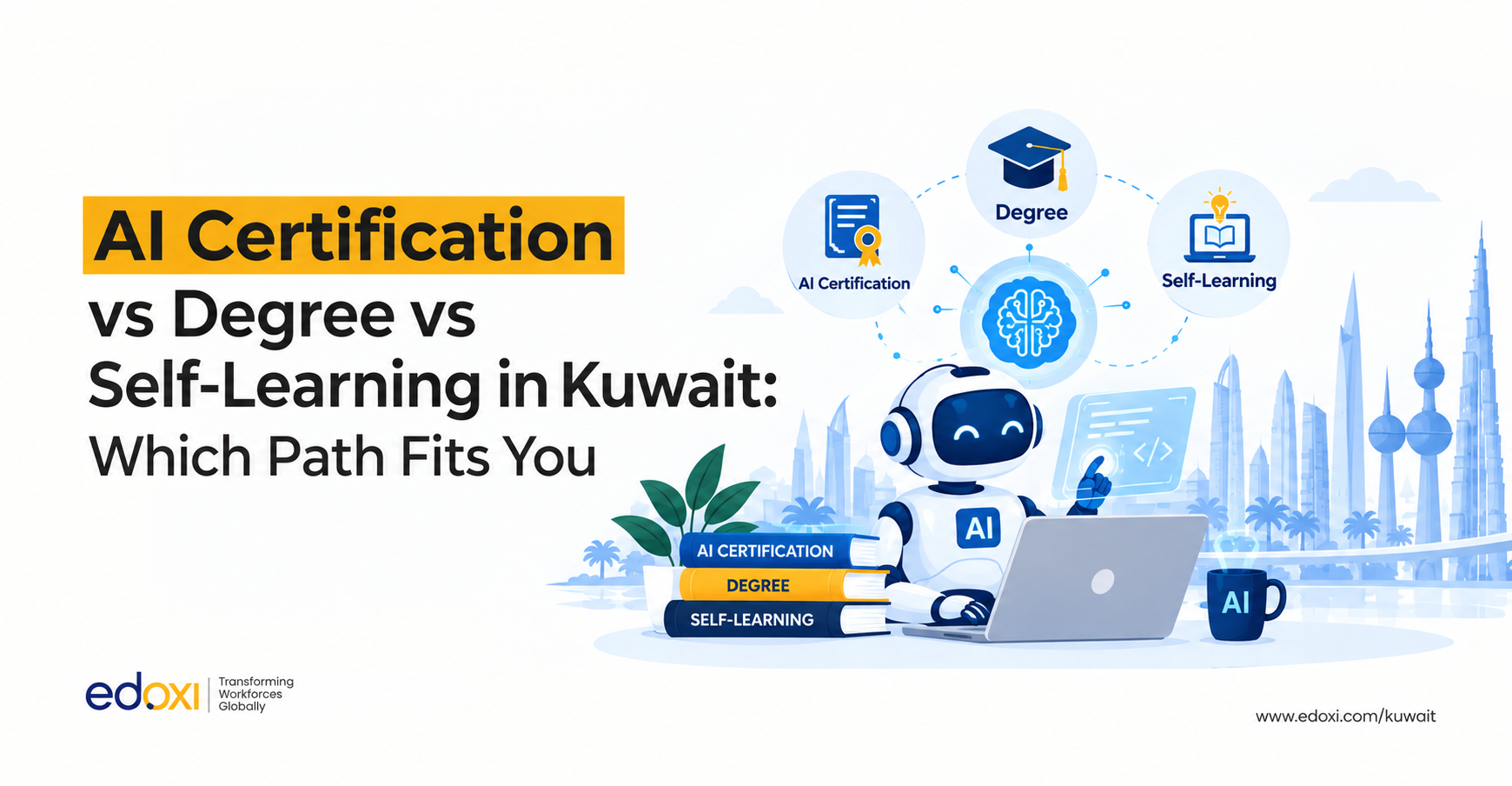
If you want to learn AI, you will meet three options almost immediately: earn a certification, study for a degree, or teach yourself with free resources. Online forums are full of the same worries. Are certificates worth it? Do employers care? Is a free course enough? What should I take after "AI for Everyone"? Is this course a scam?
If you are in Kuwait, the choice also depends on your work schedule, how employers view qualifications, and the study formats available locally. This guide compares all three paths with Kuwait learners in mind.
This guide answers those questions directly, compares the three paths honestly, and helps you choose based on your background, budget and goal.
There is no single best path. The right one depends on your goal:
Choose a certification or structured course if you want a guided, faster route into practical AI skills, especially as a working professional or career switcher.
Choose self-learning if you are disciplined, budget-conscious, and comfortable building your own plan
Combine them. Many learners start with free self-study, add a structured certification, and build projects throughout. Whatever you choose, projects you can show matter as much as the credential
For most learners in Kuwait, especially working professionals, a guided certification combined with practical projects is the fastest way to build job-ready AI skills, while a degree suits long-term specialist and research careers
AI courses now range from short introductions to full technical programs, so choosing an AI course in Kuwait starts with understanding your goal, your schedule and the level of AI training you need.
|
Factor |
Certification / Structured Course |
Degree |
Self-Learning |
|---|---|---|---|
|
Time |
Weeks to months, depending on the program |
Usually several years |
Flexible, but depends on your discipline |
|
Cost |
Free to moderate; varies widely by provider |
Typically the highest |
Free to low |
|
Structure |
Guided syllabus, often with deadlines or mentors |
Full academic curriculum |
You build your own |
|
Depth |
Focused on practical skills |
Deepest theory and math |
Varies; can be deep or patchy |
|
Credential |
Certificate of completion or an exam-based certification |
Recognized academic qualification |
None unless you add a certificate |
|
Best for |
Career switchers, working professionals, non-tech managers |
Researchers, specialists, long-term technical careers |
Self-motivated learners, students testing interest |
|
Main risk |
Low-quality or overpriced programs |
Time and cost; content may lag fast-moving tools |
Gaps in knowledge and lack of feedback |
Sometimes, but a certificate alone rarely decides a hiring outcome. This is one of the most debated questions on Reddit, Quora and LinkedIn, and the honest answer has layers.
Employer expectations in Kuwait differ by sector and role. Check the job advertisement, ask the employer's HR team, and for government roles confirm the requirements with the hiring entity
Requirements vary by role, company and country, so check actual job descriptions for the roles you want rather than relying on general opinions.
Much of the confusion in forums comes from treating all certificates as equal. They are not.
A common beginner mistake is assuming a free course also includes a free certificate. Frequently the learning content is free (or free to audit) while the certificate or exam costs money. Always read the fine print.
Some AI courses focus on core concepts, while others cover newer areas such as Generative AI, which includes tools that create text, images and code from prompts.
A structured course gives you a syllabus, a sequence, and often feedback from instructors or peers.
If you prefer instructor-led classroom or live online training with a fixed schedule and mentoring, professional training institutes such as Edoxi offer this kind of format. Review the current syllabus, tools covered, project work and trainer profiles before enrolling in any program, and compare at least two or three options.
A degree in computer science, data science, statistics, mathematics or a dedicated AI program gives the deepest foundation.
Best for: students choosing a first degree, people targeting research or advanced engineering roles, and those who want the strongest long-term credential.
Self-learning is realistic because strong free material exists: university lectures, official documentation, open-source libraries, community courses and public datasets.
Complete beginner with no tech background. Start with a free non-technical introduction to understand the vocabulary, then decide whether to go deeper. A structured course helps if you need guidance.
Student choosing what to study. If you are still deciding your degree, a computer science, data science or related degree keeps the most doors open. Add short courses and projects alongside it.
Working professional or manager (non-technical). Focus on practical AI use, workflow automation, prompting and AI strategy. You do not need to code to use AI well in many business roles. A short, structured program may fit your schedule better than a degree.
Founder or business owner. Prioritize understanding what AI can and cannot do for your business, choosing tools, and managing risk. Practical, business-oriented courses and hands-on tool experiments usually beat deep technical training.
Career switcher into a technical role. Combine a structured program (for sequence and accountability) with a portfolio of projects. Add Python and basic statistics early.
Developer or IT professional. You can often skip the basics. Use official documentation, vendor learning paths, and exam-based certifications if your employer or target roles value them.
Researcher or aspiring specialist. A degree, particularly at postgraduate level, is usually the most appropriate path.
AI skills are useful across banking and finance, oil and gas, telecom, government services, retail and logistics in Kuwait
This question appears repeatedly in the DeepLearning.AI community. The right next step depends on your direction.
Pick one direction instead of taking every course; finishing one path with a project beats starting five.
When comparing providers in Kuwait, ask for the full fee in Kuwaiti dinars (KWD), including exam fees, materials and retakes
The best test is simple: does the program teach practical skills you will actually use, and can you see examples of what past learners built?
Before paying for any program, check for these red flags:
How to verify a program: look up the issuing organization on its own website, read independent reviews on more than one platform, ask for the syllabus and sample material, and check whether certificates link to a verification page.
Beginners often ask whether certifications from big technology companies are worth it, and whether specific ones exist.
Always confirm current details on the official provider page. Forum posts and social media lists are often outdated.
For non-technical roles (strategy, management, marketing, operations): no coding or advanced math is needed to use AI effectively. Understanding concepts, limitations and risks matters more.
For technical roles (machine learning engineer, data scientist): you will need Python, basic statistics, some linear algebra and probability. You can learn these progressively rather than all at once.
Ask yourself:
If your answers point to guidance, speed and structure, a certification program fits. If they point to depth and long-term credentials, consider a degree. If they point to flexibility and low cost, begin with self-learning and add a certificate later if needed.
Generative AI is now used in Kuwait workplaces for drafting documents, summarising reports, customer-service support and data analysis, so many professionals add it to their AI training even if they are not in technical roles
A certificate, a degree and self-study are tools, not guarantees. The strongest profiles combine learning with proof of skill: projects, clear communication and a basic understanding of how AI works. Pick the path that fits your time, budget and goal, verify every program before paying, and start building something small this week.
Learning AI in Kuwait? Speak to Edoxi's Kuwait team for guidance on the right course for your background and schedule, and explore current options on the Edoxi Kuwait page.
It can be, if it gives you structure, practical skills and a credible credential. It is most valuable when combined with projects, and it should not be treated as a guarantee of a job
In some applied roles, yes, if you can demonstrate skills through projects and experience. Some specialist and research roles typically expect a degree. Check the requirements of the jobs you want
Acceptance varies. A free certificate of completion shows you learned something but is not an independent skills test. Employers usually weigh your projects and demonstrated ability more heavily
A short, non-technical introduction is the safest start, such as AI for Everyone or Elements of AI. Choose after that based on whether you want a technical or non-technical direction
Non-technical learners can move to generative AI for work and AI strategy courses. Technical learners should add Python and then an introductory machine learning course
It depends on your goal and the time you can invest. Basic AI literacy can take a few weeks, while job-ready technical skills usually take considerably longer and need project practice
The concepts are approachable, and the technical side becomes manageable if you progress step by step. Many people find the math and coding parts the hardest, so start with fundamentals
Yes, for non-technical roles and AI tool use. For roles that build models, coding is required.
A degree offers depth and a formal qualification, while a certification offers speed and practical focus. The better choice depends on your goal, time and budget
Some learning material is free, but certificates or exams are often paid. Check the official page for current terms
Offers from AI companies change quickly. Check the company's official website for any current programs, and be careful with unofficial sellers
Verify the issuer, request a syllabus, check independent reviews, read the refund policy, and avoid promises of guaranteed jobs
t can be, if you follow a structured plan and build visible projects. Adding feedback, mentorship or a recognized credential can strengthen your profile
For technical paths, yes. Basic Python is the usual starting point. For non-technical use of AI tools, it is optional.