Request a Callback

+971 4380 1666
 Nov 28, 2026
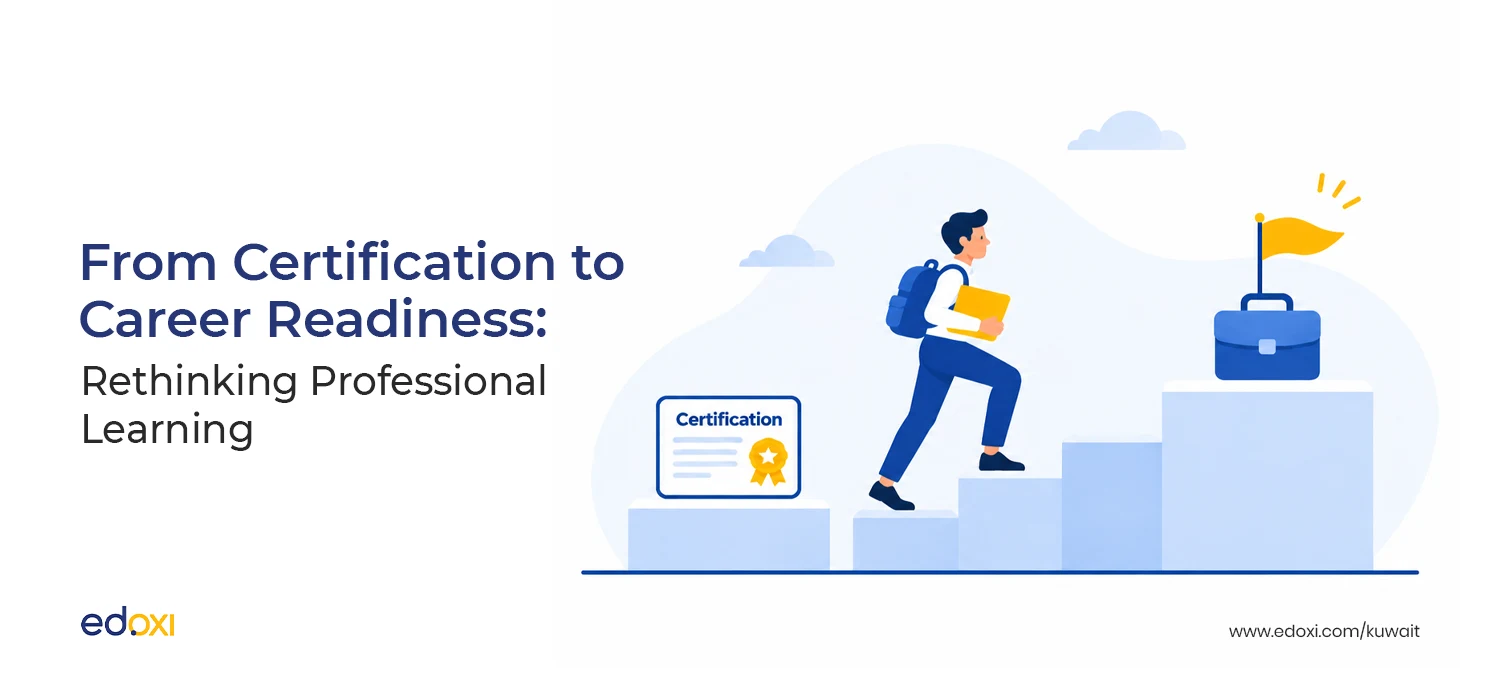
Professional certification validates knowledge against a recognised standard. Career readiness shows you can apply that knowledge through practical tasks, communication, problem-solving, and measurable workplace results.
Employers in Kuwait value both, so professional development in Kuwait works best when the two are paired.Two people sit in the same interview room in Kuwait City. Both hold the same certificate. The manager asks one simple thing: “Tell me about a problem you solved at work.” One person freezes. The other starts talking.
That moment explains this guide.
Professional development in Kuwait means building the knowledge, skills, and habits that help you perform and grow in a Kuwaiti workplace. It covers certificates, training, mentoring, and on-the-job practice. A certificate is the start, not the finish.
In this blog, learn how certification differs from career readiness, which skills matter, and how to choose training that gets results in Kuwait.
| Nos | Contents |
|---|---|
| 1 |
What Is the Difference Between Professional Certification and Career Readiness?
a) What Does a Professional Certification Prove?
b) What Skills Do Professionals Need Beyond Certification?
|
| 2 |
Why Is Certification Alone No Longer Enough for Career Growth?
a) What Is the Gap Between Theoretical Knowledge and Workplace Performance?
b) Why Do Employers Value Practical Skills and Problem-Solving?
|
| 3 |
What Skills Do Professionals Need to Become Job-Ready in Kuwait?
a) Which Technical and Digital Skills Are Changing Job Requirements?
b) Why Do Communication, Critical Thinking and Teamwork Matter?
c) How Do Adaptability, Leadership and Decision-Making Help?
|
| 4 |
How Can Professionals Turn Certifications into Practical Workplace Skills?
a) How Can You Apply Learning Through Real-World Projects?
b) How Do You Build a Portfolio of Practical Work?
c) How Can Feedback and Mentoring Speed Up Your Growth?
|
| 5 |
How Can Organisations in Kuwait Rethink Professional Development?
a) How Do You Align Training with Business Goals and Skills Gaps?
b) How Can Certification Prep Include Hands-On Practice?
c) How Do You Create Continuous Learning and Upskilling Pathways?
|
| 6 |
How Can Companies Measure the Impact of Professional Training?
a) How Do You Measure Skill Improvement Before and After Training?
b) How Can You Track Workplace Application and Employee Performance?
c) How Do You Calculate Training ROI?
|
| 7 |
How Does Career-Ready Learning Support Kuwait Vision 2035?
a) How Does It Build Digital, Technical and Future-Ready Skills?
b) How Does It Strengthen Private-Sector Workforce Readiness?
|
| 8 |
How Can You Choose a Professional Training Programme That Builds Career Readiness?
a) What Should You Check in Practical Projects, Assessments and Trainers?
b) Why Do Industry-Relevant Content and Recognised Certifications Matter?
c) What Post-Training Support and Outcomes Should You Look For?
i) What Questions Should You Ask a Provider Before Enrolling?
|
| 9 | What Are the Key Takeaways? |
| 10 | Frequently Asked Questions About Certification and Career Readiness |
Certification validates what you know. Career readiness shows you can use it on real tasks, with real people, against real deadlines. Employers in Kuwait hire for the second, and the first helps you get noticed.
| Criteria | Certification | Career readiness |
|---|---|---|
| What it shows | You passed an exam | You can do the job |
| How you earn it | Study and a test | Practice, feedback, projects |
| Who judges it | The awarding body | Your manager and your results |
| How long it lasts | Until it expires | Grows with every task |
Professional certification proves you know a defined body of knowledge to a recognised standard.
Many learners begin with professional certification training for this reason
Professionals need problem-solving, clear communication, teamwork, and the habit of finishing tasks well.
No exam fully tests these. Managers only see them in action
Employers hire for results, not paper. PwC’s Kuwait team said in February 2026 that education and training pathways do not yet consistently reflect the applied digital, analytical, and problem-solving skills employers increasingly require.
Khalid AlShatti, PwC Middle East’s Kuwait Country Senior Partner, wrote that Kuwait’s competitiveness depends on “clear and credible pathways from learning to employment.” (PwC Middle East, 25 February 2026)
Exams test what you remember. Jobs test what you can do under pressure.
Picture a newly certified project manager who scores well on scheduling theory. On day three, the client changes the scope. Two suppliers slip. The team needs a new plan by Friday.
The exam never practised that. These industry-relevant skills now shape so many hiring decisions.
Practical people need less supervision and make fewer costly mistakes.
Job-ready professionals combine technical skills (data analytics, AI, cloud, cybersecurity), human skills (communication, teamwork), and mindset skills (adaptability, leadership).
Edoxi’s guide to skills employers in Kuwait names AI and data analytics, cybersecurity, cloud computing, and project management, alongside communication, leadership, and adaptability.
Technical and Workplace Skills Required for Key Professional Roles
| Role | Technical skills | Workplace skills |
|---|---|---|
| Project manager | Scheduling, risk, and budget control | Stakeholder talks, negotiation |
| Data analyst | Excel, SQL, Power BI, data cleaning | Explaining insights simply |
| Cybersecurity professional | Network security, incident response | Calm reporting under pressure |
Data, AI tools, cybersecurity, and cloud lead demand. But owning the tools is not enough.
A March 2026 ILO report on Kuwait’s private sector, based on 2025 enterprise interviews, found that only 26 percent of reported productivity gains met its criteria for verified impact.
The report points to data systems, workforce skills, and governance as the foundations still being built.
Most work happens with other people. How you explain and question ideas matters as much as how you calculate.
Tools change fast, so people who learn fast stay useful.
Use what you learned on a real task within weeks, record the result, and ask for feedback. Good professional courses in Kuwait build this habit into the class itself.
5 steps to turn a certificate into skills
Pick one real work problem linked to your course.
Apply one tool or method to it within 30 days.
Write down what you did and what changed.
Ask a manager or mentor for honest feedback.
Repeat with a harder task.
Choose a small project with a clear start, finish, and owner.
Sample 30-day project (illustrative): A Security+ learner reviews access rights for one team.
A portfolio is a small folder of proof showing what you did and what changed.
For each project, record:
Keep confidential company data out.
Ask someone more experienced to review your work, then act on what they say.
Noura Ayman Boodai, Vice President for Student Affairs and Enrollment at Kuwait Technical College, said that “Field training gives students real experience” and helps employers spot talent early. (Times Kuwait, June 2025)
Ask one specific question: “What one thing should I do differently next time?”
Start with a skills-gap analysis, apply learning on the job, then keep development going all year. Current corporate training trends point the same way.
Start with the gap, not the course.
List the roles critical to your goals.
List the tasks each role must do well.
Test current skill levels on those tasks.
Rank gaps by business cost.
Consultant Abdulilah Annous told Kuwait Times that “Buying AI subscriptions does not make a company an AI-powered business.” Untrained staff and weak processes still limit results. (Kuwait Times, 5 September 2026)
Pair every exam-prep module with a live task.
Give each team a simple ladder: foundation, practice, advanced, mentor.
Access is uneven. In the ILO’s Kuwait study, 65 percent of large companies provided AI training, compared with 29 percent of smaller firms
Globally, PwC’s 2026 Global Workforce Hopes and Fears Survey found only 51 percent of employees have access to learning resources. That second figure is a global finding, not a Kuwait-only one
Record a baseline, then compare at 30, 60, and 90 days against business numbers such as time, errors, and cost. Strong corporate training in Kuwait plans this before day one.
You cannot show improvement without a starting point.
Before training, record the same task, scored the same way, with time taken and error count. Repeat it afterwards.
An illustrative example, not a verified learner outcome, is given below:
90-Day Training Impact Measurement Plan
| Day | Action |
|---|---|
| 1 | Record how long a team member takes to prepare a monthly report |
| 30 | Apply newly learned Excel or data-analysis techniques |
| 60 | Manager checks accuracy, efficiency, and usability |
| 90 | Compare with the Day 1 baseline and document the improvement |
Ask managers one question at each checkpoint: Is this person using the new skill?
Training ROI = (Benefits − Training Cost) ÷ Training Cost × 100.
For example, a team course costs 2,000 KWD and saves 3,000 KWD in rework.
ROI is (3,000 − 2,000) ÷ 2,000 × 100 = 50%.
Count only benefits you can verify, such as hours saved or errors avoided.
Vision 2035 aims for a more diversified, private-sector-led economy. That needs people who can perform in digital and technical roles from the start. Work on Kuwait’s future workforce shows how education and industry can meet in the middle.
Digital transformation depends on people who can use data, AI, and secure systems well.
PwC’s viewpoint links Kuwait’s AI direction to economic growth, workforce empowerment, and faster digital transformation. Career-ready learning turns tool access into daily practice.
Practical skills help more Kuwaitis, and graduates move into private-sector roles with less retraining.
Official Central Statistical Bureau data for Q1 2025 show about 377,000 of roughly 450,000 employed Kuwaitis in government (around 84%, by our calculation), against about 73,000 in the private sector.
Other reports, using different definitions, put the public-sector share near 76 percent. Either way, private-sector readiness matters for diversification (siasat).
Choose the programme that makes you do real work, assesses practical tasks, uses trainers from the field, and supports you after class. A new training centre in Kuwait should pass these checks like any other.
Look for evidence that learners prove competence, not just attendance.
Content should match roles advertised in Kuwait, and the certificate should come from a known awarding body such as PMI, Microsoft, or CompTIA. Check who awards it.
Ask what happens after the last class. Look for mentoring, career guidance, and follow-up assessments.
Ask these five questions.
| If you need… | Choose… | Check for… |
|---|---|---|
| A first job or career switch | Certification plus portfolio projects | Live projects, mock interviews |
| A promotion | Certification plus leadership practice | Case studies, manager feedback |
| Team upskilling | Custom corporate training | Before-and-after tests, business goals |