Request a Callback

+974 66 87 3399
 Nov 12, 2026
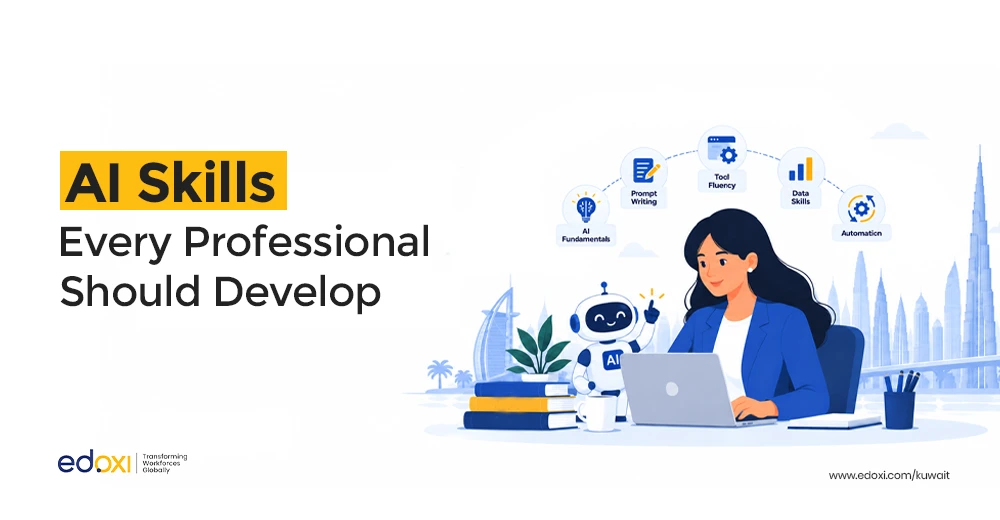
The AI skills every professional should develop in Kuwait are AI fundamentals, prompt writing, tool fluency, data skills, automation, critical thinking, research, and responsible AI use. Start with two or three that match your role. Then practise on real work tasks every week.
Picture two finance managers in Kuwait City. Both get the same monthly variance report. One spends three hours on it. The other finishes in forty minutes and uses the spare time for analysis.
Same data. Same deadline. The gap is skill, not talent.
This blog covers the AI skills every professional should develop in Kuwait, with simple examples from IT, finance, HR, marketing, and project management, and also explainshow AI is helping to identify skills gaps and future jobs.
Table of Contents
| Nos | Contents |
|---|---|
| 1 | What are the AI Skills Every Professional Should Develop in Kuwait? a) What is AI Literacy? b) Which AI Fundamentals Should You Learn First? c) How Do You Write Better Prompts? d) Which AI Tools Should Professionals Learn? e) Why Do Data Skills Matter for AI Use? f) How Can Automation Save Time at Work? g) How Do Critical Thinking and Research Protect You from AI Errors? h) What Does Responsible AI Use Look Like? |
| 2 | How Do AI Skills Work in IT, Finance, HR, Marketing, and Project Management? a) Which AI Skills are in Demand in Kuwait? |
| 3 | Which AI Skill Should You Learn First? a) How to Build AI Skills in 30 Days b) Can Non-Technical Professionals Learn AI? |
| 4 | How Can AI Skills Improve Career Growth in Kuwait? a) Should You Learn AI Skills on Your Own or Take a Course? |
| 5 | Key Takeaways |
| 6 | FAQs: AI Skills Every Professional Should Develop |
Eight skills matter most. They are AI fundamentals, prompt writing, tool fluency, data skills, automation, critical thinking, research, and responsible AI use. Together, they help you work faster without losing accuracy.
Top 8 AI Skills Every Professional Should Develop in Kuwait
| Skill | What it means | Where you use it |
|---|---|---|
| AI fundamentals | Knowing what AI can and cannot do | Judging any AI output |
| Prompt writing | Giving AI clear instructions | Drafts, summaries, analysis |
| Tool fluency | Picking the right tool for the task | Daily office work |
| Data skills | Reading, cleaning, and questioning data | Reports and dashboards |
| Automation | Linking tools to remove manual steps | Reporting, approvals, follow-ups |
| Critical thinking | Checking answers before you trust them | Every AI output |
| Research | Verifying claims with credible sources | Market and policy work |
| Responsible AI | Protecting data, privacy and fairness | Client and staff information |
TheWorld Economic Forum's Future of Jobs Report 2025ranks AI and big data as the fastest-growing skills. It also finds analytical thinking is the top core skill, and seven in ten companies call it essential. Technical and human skills grow together.
AI literacy is the ability to understandwhat artificial intelligence is, use it well at work, and judge its output with care. It needs no coding. It needs curiosity, clear thinking, and good habits.
Joe Atkinson, Global Chief AI Officer, PwC: Firms with the best AI returns use it to "amplify human expertise, accelerate innovation and create entirely new sources of value."
Kuwait is investing in AI at the national level, and employers pay more for people who can use it. Skills now decide who gains from that shift.
Kuwait's draftNational AI Strategy for 2025 to 2028lists workforce upskilling among its priorities. The Kuwait Skills programme, run with Microsoft and the Central Agency for Information Technology, aims to train more than 30,000 employees, 4,000 technical experts and 350 leaders.
The pay signal is strong too.PwC's 2026 Global AI Jobs Barometerfound that jobs needing AI skills grew 69% against 9% for the wider market. It also put the average wage premium for AI skills at 62%.
These are global figures, but Kuwaiti employers compete for the same talent.
Charles Nahas, Regional General Manager, Microsoft Middle East: The Kuwait Skills Programme will "enable over 100,000 users to use Copilot tools."
Kuwaiti employers expect staff to use AI safely, not just experiment with it.
A2026 International Labour Organization studysays AI adoption in Kuwait's private sector is progressing but uneven. Larger firms are more likely to have AI policies and training. Smaller firms face capability gaps.
If you work in a smaller company, learning on your own gives you a clear edge.
Judson Althoff, EVP and Chief Commercial Officer, Microsoft: Copilot across Kuwait's government aims "to empower professionals with AI solutions that drive greater creativity, productivity, and efficiency."
Learn one skill at a time. Practise it on a real task, review the result, and repeat weekly. You can join an artificial intelligence course to build each core AI skill.
Learn how generative AI works, where it makes mistakes, and what data it needs. That is enough to start.
Language models predict likely words. They do not check facts. They can sound sure and still be wrong. Knowing this changes how you read every answer.
State your role, the task, the context, and the format you want. Then refine with follow-up questions.
Weak prompt: "Write a sales report."
Better prompt: "Act as a sales analyst. Summarise Q3 sales for our Kuwait retail branches in five bullets. Flag any branch down more than 10%."
The second prompt gives the AI a job, a scope, and a rule. Expect a first draft, then edit it.
Pick one general assistant, one office-suite tool, and one task-specific tool. Copilot is a practical choice in Kuwait, given the national Microsoft rollout.
AI course for professionals covers the major tools and techniques to master AI efficiently.
AI output is only as good as the data behind it. You need to read, clean, and question data.
Learn to spot missing values, odd outliers, and biased samples. Basic Excel, Power BI, and SQL go a long way. Without them, you cannot tell a good AI insight from a confident guess.
Automation links tools so routine steps run without you. Start with one task you repeat every week.
The WEF report says 73% of employers plan to automate more processes. Tools like Power Automate or Zapier can send reminders, move files, and compile reports. Automate the steps. Keep the judgement.
The ILO found Kuwaiti firms use AI mostly for admin tasks, analysis, and customer service. Small wins add up. This guide onusing AI to increase employee productivityshows how.
They help you catch wrong, biased, or invented answers before they reach a client or your manager.
Follow three habits:
Check names, figures, and dates against a primary source.
Ask the AI for its sources, then open them.
Ask, "What would make this answer wrong?"
Protect confidential data, follow company policy, and keep a human accountable for every decision.
Never paste client files, salary data, or contracts into public tools. Kuwait did not yet have a mature, sector-wide AI law in 2025, so company policy carries much of the weight. The national strategy also stresses privacy, security, and ethical deployment.
These examples show how professionals across different functions can apply AI skills to everyday workplace tasks. From IT and finance to HR, marketing, and project management, each role benefits from specific AI capabilities.
AI Skills by Professional Function in Kuwait
| Function | Everyday AI task | Key skills |
|---|---|---|
| IT | Draft scripts, triage support tickets | Prompt writing, critical thinking |
| Finance | Summarise variances, flag anomalies | Data skills, verification |
| HR | Draft job ads, summarise CVs | Responsible AI, prompt writing |
| Marketing | Draft campaign copy, analyse audiences | Prompt writing, research |
| Project management | Summarise meetings, update risk logs | Automation, tool fluency |
Some sectors feel the change sooner than others. See theindustries most affected by AIto judge how fast your field is moving.
A few simple examples:
Employers want AI tool use paired with judgement, data sense and safe practice.
PwC's 2026 Global AI Jobs Barometer studied more than one billion job ads across 27 countries and territories. It found that jobs needing AI skills are growing 69%, against 9% for all jobs. The average wage premium for AI skills reached 62%.
Kuwait shows a readiness gap. The ILO interviewed firms of different sizes:
AI Policy and Training Adoption by Firm Size in Kuwait
| ILO / KCCI interview sample (2026) | Large firms | Small and medium firms |
|---|---|---|
| Have a formal AI policy | 45% | 14% |
| Run AI training programmes | 65% | 29% |
PwC Middle East adds that training pathways in Kuwait do not yet consistently match the applied digital and analytical skills employers ask for. For a wider view, read howAI will impact the future of work and life.
Start with prompt writing and critical thinking. Every other skill builds on them.
AI Skill Roadmap by Professional Need
| If you... | Start with | Then add |
|---|---|---|
| Are new to AI | Fundamentals and prompt writing | Tool fluency |
| Write reports often | Prompt writing and research | Data skills |
| Handle repetitive admin | Automation | Data skills |
| Manage people or client data | Responsible AI | Critical thinking |
| Lead a team | Fundamentals and responsible AI | Automation |
Follow these steps to build AI skills in 30 days:
Week 1:Learn the basics. Use one AI assistant daily.
Week 2:Practise structured prompts on three real tasks.
Week 3:Automate one repeated task.
Week 4:Write a personal checklist for checking output and protecting data.
Yes. Most workplace AI skills need clear thinking, not coding.
Prompt writing, checking output, and responsible use need no programming. The WEF says human skills such as creative thinking and resilience stay critical alongside technical ones.
Pick a task you repeat every week and use AI on it. Track the time saved. Astep-by-step plan to upskill for AI jobscan help you sequence the rest.
PwC also found that AI-exposed entry-level roles increasingly ask for judgement and leadership.
AI skills raise your value in hiring, pay talks, and promotions. They also move you away from routine tasks that software can now do.
The WEF expects 39% of workers' core skills to change or become outdated between 2025 and 2030. About 80% of employers plan to upskill staff in AI. Waiting is the risky choice.
Some professionals go further and move into technical roles. If that is your goal, this guide on how tobecome a generative AI engineer in Kuwaitlays out the path step by step.
Some jobs carry more risk than others. Here are thejobs most at risk of AI replacement.
Andrew Ng, founder of Google Brain and Stanford professor, told a Bangkok audience that AI may not replace people, but "people that use AI will replace people that don't".
Self-study works for basics. Structured training suits role-specific skills, feedback, and accountability.
| Route | Pros | Cons |
|---|---|---|
| Self-study | Low cost, flexible pace | Easy to stall, no feedback |
| Structured course | Clear plan, expert feedback, peer practice | Costs money, fixed schedule |
The case for acting early is covered inwhy upskilling matters in the age of AI.
Whichever route you take, build proof. A fewAI projects for your portfolioshow employers what you can do.
Kristalina Georgieva, IMF Managing Director, said at Davos 2026: "We must invest in skills and prepare communities".
The AI skills every professional should develop in Kuwait are learnable, practical, and role-friendly. You do not need a technical degree. You need steady practice and sound judgement. Pick one skill from this guide and use it in tomorrow's work.