Request a Callback

+44 7497 303637
 Oct 01, 2026
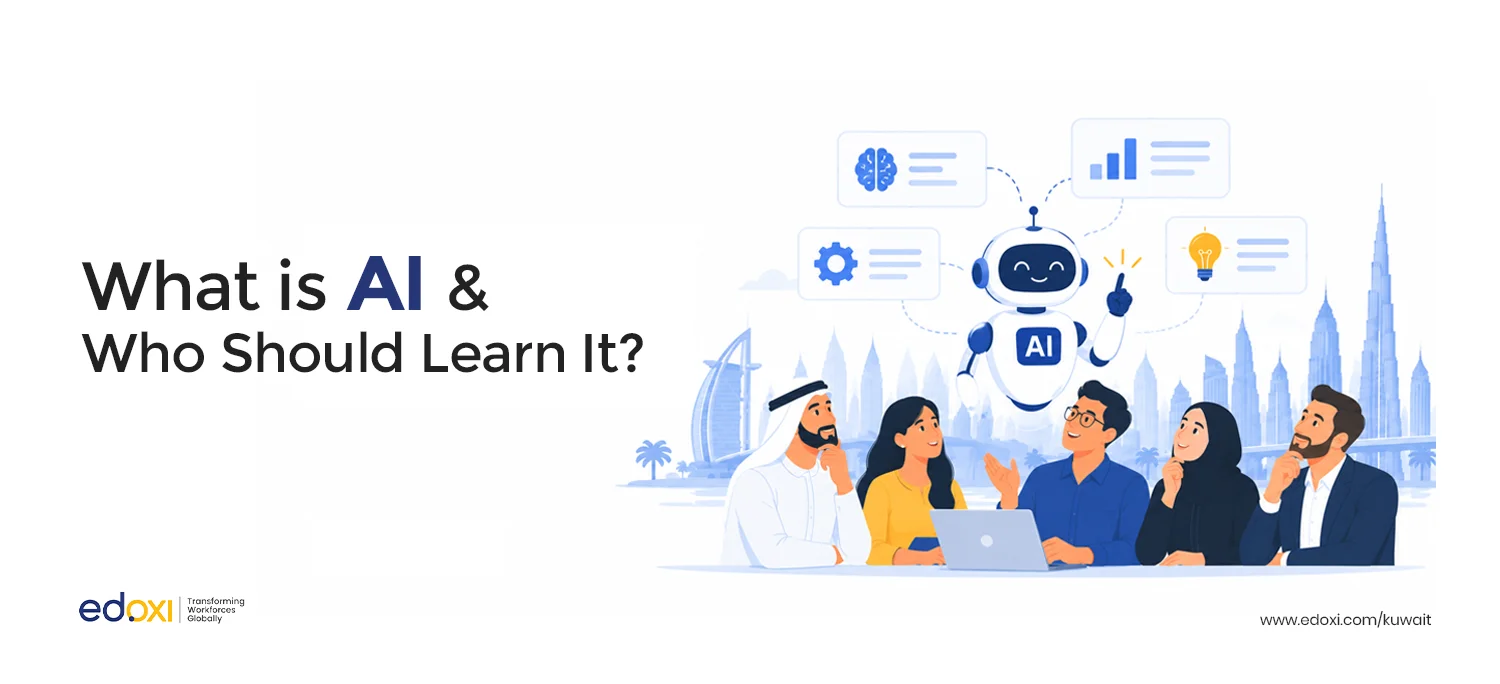
Artificial Intelligence (AI) is technology that lets computers learn from data, recognise patterns, and make decisions with limited human input.
In Kuwait, AI is already used in banking, healthcare, and government services, and demand for AI skills is rising fast across every industry, making it worth learning for almost anyone, technical or not.
Ask ten people in Kuwait what AI means, and you'll get ten different answers. Some picture robots. Others think of ChatGPT. A few assume it's only for coders in Silicon Valley.
None of that is quite right, and none of it is entirely wrong either.
AI is simpler than most explanations make it sound. It's also becoming harder to avoid at work, no matter your job title.
Kuwait's private sector is already using it for document processing, customer service, and forecasting, according to a 2026 International Labour Organization study conducted with the Kuwait Chamber of Commerce and Industry.
The government has a national strategy built around it through 2028.
This guide breaks down what AI actually is, how it works at a basic level, and who in Kuwait stands to gain from learning it, whether you're a fresh graduate, a mid-career professional, or someone running a small business.
Table of Contents
| Nos | Contents |
|---|---|
| 1 | What is Artificial Intelligence AI in Simple Terms? a) What Does AI Mean in Practice? |
| 2 | Why Are AI Skills Important in Kuwait Right Now? a) How is Kuwait Adopting AI Right Now? |
| 3 | Who Should Learn AI in Kuwait? a) Should Students Learn AI? b) Should Fresh Graduates Learn AI? c) Should Working Professionals Learn AI? d) Should Business Owners Learn AI? e) Should Career Changers Learn AI? |
| 4 | Can You Learn AI Without Coding? a) Which AI Skills Can You Learn Without Coding? b) When Do You Need Coding for AI? |
| 5 | What are the Benefits of Learning AI in Kuwait? a) Does AI Skill Pay More in Kuwait? b) How Does AI Skill Improve Job Security in Kuwait? c) What Other Benefits Come With Learning AI in Kuwait? |
| 6 | What AI Skills Should Beginners Focus On? a) What Business and Professional AI Skills Should Beginners Learn First? b) What Technical AI Skills Come Later? |
| 7 | What AI Tools Should Professionals in Kuwait Know? a) Do Professionals Need to Master Every Tool? |
| 8 | What AI Career Opportunities Exist in Kuwait? a) What Qualifications Do Employers Actually Look For? b) Which Industries Are Hiring AI Talent in Kuwait and the Gulf? |
| 9 | How to Start Learning AI in Kuwait? |
| 10 | Key Takeaways |
| 11 | FAQs: What is AI and Who Should Learn It |
AI is a branch of computer science that builds systems capable of tasks normally requiring human thinking, understanding language, spotting patterns, and making predictions.
That's the textbook version. In practice, AI shows up in ordinary moments. It's the reason your email filters spam automatically. It's why a delivery app predicts your arrival time. It's the tool drafting a first version of your report before you touch it.
"The GCC's exceptional AI adoption rates reflect a workforce that has moved decisively beyond experimentation into real integration."
Robert Xu, Managing Director & Partner, BCG X
Kuwait's National AI Strategy (2025–2028)is pushing AI into public and private sectors at pace, and regional hiring data shows AI skills are becoming a standard job requirement, not a specialist add-on.
A few numbers explain the urgency:
The pattern across every one of these reports is the same: AI use is climbing faster in the Gulf than in most of the world, and employers are adjusting hiring criteria to match.
Reports like these are also how employers are spottingskills gaps and future jobsbefore they turn into a hiring crisis.
"Skills, not jobs, are the new currency in the workplace."
-Ravin Jesuthasan, Senior Partner & Global Leader for Transformation Services, Mercer
Students, fresh graduates, working professionals, business owners, and career changers all benefit from AI skills; the specific value differs by group, but the relevance doesn't.
Yes. Employers increasingly expect graduates to arrive with baseline AI literacy, not learn it on the job. Starting early through short courses or electives builds a real head start before entering a competitive market.
"AI literacy is becoming as fundamental as digital literacy was 20 years ago."
Dr. Fei-Fei Li, Co-Director, Stanford Human-Centered AI Institute
Graduates competing for entry-level roles benefit most from practical AI tool skills: using generative AI for drafting and research, understanding data basics, and knowing which tools fit which tasks.
It's a differentiator on a CV that otherwise looks like everyone else's.
It also helps to know how touse AI in your job searchitself, not just once you're hired.
Marketers, HR staff, analysts, project managers, and accountants are all seeing AI features added to the software they already use. Understanding how these tools work and their limits protects your role rather than threatening it.
Small and medium business owners in Kuwait often lag behind larger firms in AI adoption, per the ILO-KCCI findings, mainly due to skills gaps rather than lack of interest.
A working understanding of AI helps owners evaluate which tools are worth the investment and which are hype.
AI and data roles are among the fastest-growing job categories globally. For someone changing fields, structured AI training can offer a credible, faster route in than a full second degree.
AI Learning Path by Career Stage
| Who You Are | What to Focus On First | Common Time Commitment |
|---|---|---|
| Student | AI fundamentals, prompt basics | 4-8 weeks |
| Fresh graduate | Practical AI tools, data literacy | 6-10 weeks |
| Working professional | AI applied to your function (marketing, HR, finance) | 4-12 weeks |
| Business owner | AI strategy, tool evaluation, ROI thinking | Short workshops, ongoing |
| Career changer | Structured, certification-backed learning path | 3-6 months |
Who should learn AI? Students building future-ready CVs, graduates entering a competitive job market, working professionals in any function, business owners making tech decisions, and career changers seeking new roles. AI skills now apply broadly rather than to technical staff alone. |
Yes. Many practical AI skills like prompt writing, tool selection, and data interpretation require no programming at all.
Coding matters if you want to build models or work as a machine learning engineer. It matters far less if your goal is to use AI tools effectively in marketing, HR, operations, or customer service.
A sensible beginner path starts with non-technical tool literacy first, then addsPython skillor data skills later, only if your career direction calls for it.
If you're still weighing whether it's worth the time, this piece onwhy upskilling matters nowmakes the case plainly.
AI skills carry a measurable wage premium, open faster-growing job categories, and protect existing roles from being sidelined as workplaces automate routine tasks.
Yes, and the gap is widening.
PwC's 2026 Global AI Jobs Barometer, drawn from over a billion job advertisements across 27 countries, found workers with demonstrable AI skills earn a 62% wage premium over those without, up from 57% the year before and 25% two years earlier.
Jobs requiring AI skills are also growing about eight times faster than the overall job market.
Theaverage salary of AI professionals in Kuwaitis listed below:
| AI Role | Average Monthly Salary in Kuwait |
|---|---|
| AI Engineer | KWD 1,200-4,000+ |
| Machine Learning Engineer | KWD 1,300-2,000+ |
| Data Scientist | KWD 1,550-2,100+ |
| AI / ML Engineer | KWD 1,800-4,000 |
To present the salary growth trend, the average salary of AI Engineers in Kuwait from 2023 is illustrated in the graph below:

Graph data:
AI Engineer Annual Salary Growth Trend in Kuwait
Source: Naukrigulf:Artificial Intelligence Engineer Salaries in Kuwait
PwC's data points to a "two-track" labour market: roles where AI amplifies human judgement (what the report calls "professionalised" roles) are growing twice as fast and paying better than roles AI mostly automates.
Staying relevant means moving toward the first track, not avoiding AI altogether.
For practical steps beyond the wage data, theseways to protect your jobin an AI-heavy workplace are worth reading.
Most of these gains come down to using AI toincrease employee productivityrather than replace people outright.
Start with AI tool literacy and prompt skills before touching code; these apply immediately, regardless of your role.
Most beginners in Kuwait's job market get more immediate value from the first list. The second list matters once you've decided AI is a specialisation, not just a workplace skill.
Even traditionally creative fields aren't exempt from this shift; see howAI is used in creative jobs, from design work to content production.
A small, practical toolkit covers most professional needs: a generative AI assistant, a research tool, a data tool, and one automation tool.
Which AI Tools Are Worth Learning First?
| Category | Examples | Best For |
|---|---|---|
| Generative AI | ChatGPT, Gemini, Claude, Microsoft Copilot | Drafting, summarising, brainstorming |
| Research | Perplexity, Google's AI Overviews | Fast, sourced fact-finding |
| Productivity | Copilot inMicrosoft 365, Notion AI | Meeting notes, email drafts, planning |
| Data analysis | Power BI, Excel with Copilot | Spreadsheets, dashboards, forecasting |
| Coding assistance | GitHub Copilot | Writing and debugging code faster |
| Automation | Zapier, Make | Connecting apps, automating repetitive steps |
No. One reliable tool per category is enough for most roles. Depth with a small toolkit beats surface familiarity with a dozen apps.
For a longer roundup than the table above, this list oftop AI software for productivitycovers more ground.
Roles range from technical positions like AI engineer and data scientist to hybrid roles like AI consultant and prompt engineer, many of which don't require a computer science degree.
For a step-by-step look at the process, this guide onbuilding a career in AIgoes further than we can here.
| Role | Fundamental Background Needed |
|---|---|
| AI Engineer | Strong technical skills, Python, ML frameworks |
| Data Scientist | Statistics, Python/R, data analysis |
| Prompt Engineer | Strong writing, logical structuring, some technical familiarity |
| AI Consultant | Business background, AI tool fluency |
| AI Product Manager | Product/business background, cross-functional skills |
| AI Governance Specialist | Compliance, ethics, or legal background |
Naukrigulf's 2025 Year-End Reportfound 52% of Gulf employers now treat AI or automation proficiency as a screening factor in hiring, even for roles that aren't technical on paper. That shift is reshaping recruitment across engineering, consulting, and finance, not just IT departments.
If the engineering route appeals, here's how toget started as an AI developer.
Tech leads by a wide margin, followed by banking, audit, and increasingly oil and gas sectors where predictive maintenance and risk modelling deliver clear returns.
Tech's lead makes sense once you see how deeplyAI is transforming the IT industryitself, well beyond a handful of new job titles.
You can also explorewhich industries are most affected by AIright now.
Begin with fundamentals, pick a technical or non-technical track based on your goals, then build practical experience through projects or structured courses.
The 8 key steps to start learning AI are:
Understand core concepts: what AI is, how it differs from automation, and where it adds real value.
Even basic data literacy, like reading trends and spotting outliers, strengthens everything that follows.
Decide early whether you're building a technical career (coding, model-building) or applying AI within an existing role.
Use generative AI tools on actual work tasks. Comfort comes from repetition, not theory alone.
Automate one repetitive task, build a simple chatbot, or analyse a real dataset. A finished project teaches more than a dozen tutorials.
Document what you built, even informally. It matters in interviews.
Self-teaching works, but a recognised, instructor-led path shortens the learning curve and adds credibility on a CV.
Institutes such as Edoxi Kuwait run applied AI Courses and certification-backed programmes designed for exactly this stage: moving from casual tool use to a documented, job-ready skill set.
AI tools update constantly. Treat this as an ongoing habit, not a one-time course.
For a broader roadmap beyond these eight steps, this guide on how toupskill for AI jobsfills in more detail.
Enrol in AI Training