

Request a Callback

+971 4380 1666
 Oct 27, 2026
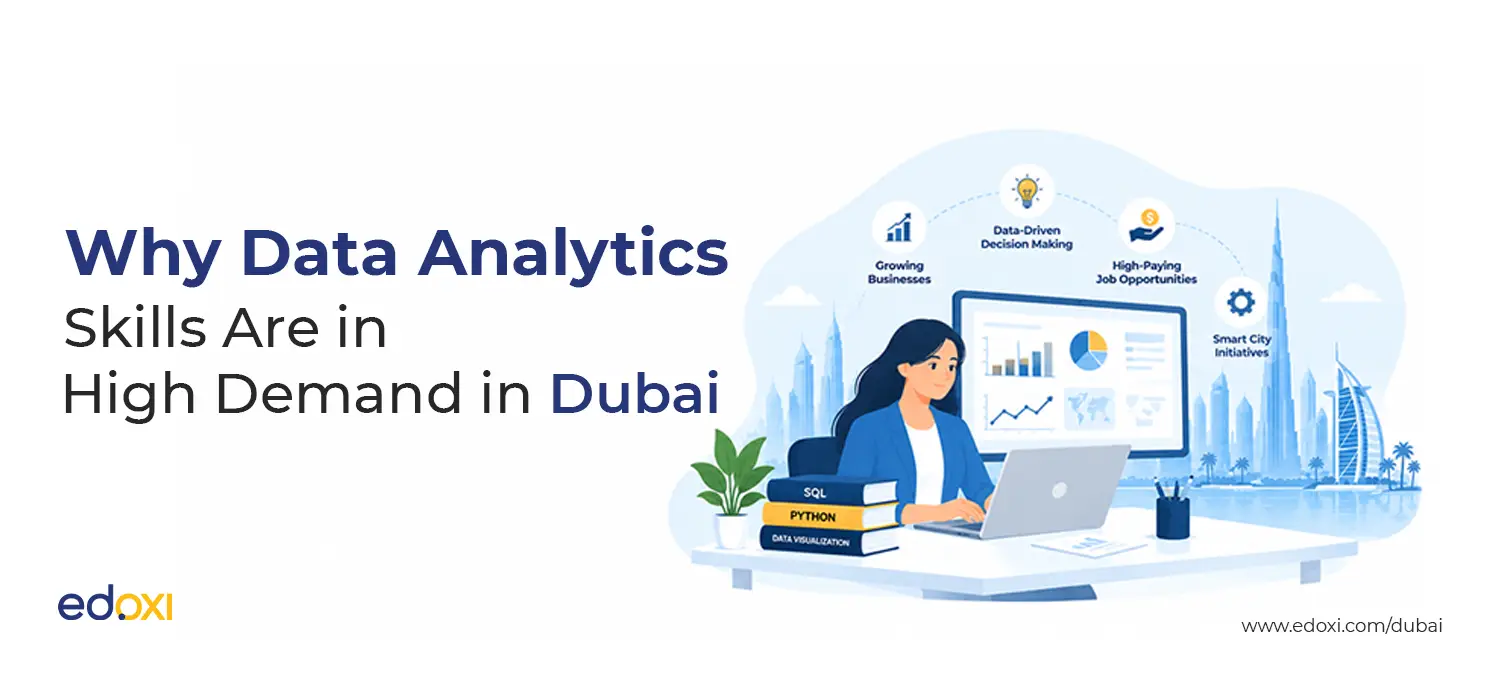
Data Analytics Skills are in high demand in Kuwait because businesses are running on more data than ever, and they need people who can turn that data into decisions. Digital transformation, AI adoption and Kuwait Vision 2035 are pushing sectors like oil and gas, banking, healthcare, retail and logistics to hire for data analytics skills.
This article explains exactly why demand is rising, which industries need analytics talent most, which tools employers actually ask for, and how you can build a job-ready skill set right here in Kuwait.
What's changed is the pace. A few years ago, analytics was treated as a support function something the IT team handled quietly in the background.
Today, it sits at the center of how companies plan, forecast, and compete. A bank in Kuwait isn't just tracking transactions anymore; it's using that data to predict fraud, personalize offers, and manage risk in real time. An oil and gas company isn't just extracting and reporting numbers; it's using predictive models to cut downtime and optimize output.
That shift alone has turned analytics from a "nice-to-have" skill into a baseline expectation for a growing number of roles.
At the same time, the supply side hasn't caught up. Universities and training providers in the region are still building out programs to match this demand, which means companies are often competing for the same small pool of qualified analysts and paying accordingly. If you're weighing whether this is a skill worth investing in, that gap between demand and supply is usually the clearest signal.
The sections ahead break this down practically: where the roles actually are, what tools show up most often in job postings, and what a realistic learning path looks like if you're starting from scratch or upskilling from an adjacent field like finance or IT.
| Table of Contents | |
|---|---|
| 1 | Why Are Data Analytics Skills in High Demand in Kuwait? |
| 2 | What Is Data Analytics, Exactly? |
| 3 | Why Are Data Analytics Skills Suddenly So Important for Kuwaiti Businesses? |
| 4 | Which Kuwait Industries Need Data Analytics Skills the Most? |
| 5 | What Technical Skills Do Kuwait Employers Look for in a Data Analyst? |
| 6 | Why Do Kuwait Employers Also Want Business and Communication Skills? |
| 7 | What Data Analytics Career Opportunities Exist in Kuwait? |
| 8 | How Can You Build Job-Ready Data Analytics Skills in Kuwait? |
| 9 | How Will Demand for Data Analytics Skills Change by 2030? |
| 10 | Frequently Asked Questions |
| 11 | More Questions Kuwait Job Seekers Ask About Data Analytics |
Key Takeaways
Data analytics is the process of collecting, cleaning and examining data to answer a specific business question. Analysts turn raw numbers such as sales figures, customer records, and sensor readings into insights a manager can actually act on. Learn more about what data analytics is.
It isn't quite the same as data science, which leans more heavily on machine learning and predictive modelling, or business analysis, which focuses on business processes rather than the numbers themselves. See the major differences between data analytics and data science, and Business Analytics and Data Analytics. Most analytics jobs in Kuwait focus on data analysis and business intelligence. These roles primarily involve cleaning data and creating dashboards to report trends to decision-makers clearly.
Kuwaiti organisations are digitising fast, and digitisation only pays off once someone can read the data it produces.
Kuwait's Vision 2035 (New Kuwait) programme has pushed government bodies and private companies to invest heavily in digital infrastructure, cloud platforms and artificial intelligence.
The energy sector alone has committed a large share of its long-term strategy to technology and digital transition. The national 5G coverage now reaches the vast majority of the population, the connectivity backbone that real-time analytics depends on. A national workforce programme is also training tens of thousands of Kuwaitis in AI and data science, a clear signal of where employer demand is heading.
As more processes move onto digital systems, Kuwaiti businesses generate far more data than they did even a few years ago. Someone has to clean it, structure it and turn it into a decision, and that is exactly the gap data analytics skills fill. See the scope and future of data analytics.
Six sectors currently generate the bulk of Kuwait's analytics-related hiring: oil and gas, banking and finance, healthcare, retail, logistics, and technology. Each uses analytics differently, but all six need people who can turn operational or customer data into a clear recommendation.
| Kuwait Industry | Where Analytics Is Used | Skills That Matter Most | Example Business Outcome |
|---|---|---|---|
| Oil & Gas | Predictive maintenance, production monitoring, emissions tracking |
SQL, Python, statistics, dashboards |
Fewer unplanned equipment shutdowns |
| Banking & Finance | Fraud detection, credit risk, personalised banking | SQL, Excel, Power BI, statistics | Faster, more accurate risk decisions |
| Healthcare | Patient risk segmentation, resource and capacity planning | Data cleaning, reporting, visualisation | Better-targeted care for high-risk patients |
| Retail & E-commerce | Demand forecasting, customer segmentation | Excel, SQL, Power BI, visualisation | Smarter stock and pricing decisions |
| Logistics | Route optimisation, delivery and fleet tracking | Reporting, dashboard development | Faster deliveries, lower running costs |
| Technology & Telecom | Customer analytics, network performance | Python, SQL, Power BI, Tableau | Improved customer retention |
This spread matters for one reason: it shows analytics is not a niche IT skill in Kuwait. It's becoming a baseline expectation across very different industries, which is exactly why demand keeps climbing. Therefore, data analytics skills are in high demand and are highly paid. Check out the Data Analyst salaries around the world (based on industries, countries, and experience).
|
Start Building These Skills Today: Build practical analytics skills with Edoxi’s Data Analytics Training in Kuwait
|
Job postings across Kuwait's banking, telecom, energy, healthcare and retail sectors repeatedly ask for the same core toolkit: Excel, SQL, Power BI, and increasingly, Python and statistics. See the best data analytics tools. No single tool is universally "the best"; employers usually want a combination, matched to the size and maturity of the data team.
| Skill / Tool | What You Use It For | Why Kuwait Employers Value It |
|---|---|---|
| Excel | Everyday reporting and quick calculations | Almost every Kuwait business already runs on Excel |
| SQL | Pulling and querying data from databases | Core skill for banks, telecoms and government systems |
| Power BI | Building interactive dashboards | Widely requested across Kuwait job postings in every sector |
| Tableau | Advanced, visual data exploration | Preferred by larger enterprises with complex datasets |
| Python | Automating analysis and deeper statistics | Increasingly required for AI-linked analytics roles |
| Statistics | Making sense of patterns and trends | Turns raw numbers into decisions leaders can trust |
If you're starting out, Excel and SQL are the fastest route into a first analytics role in Kuwait. Power BI and Python tend to open doors to more senior or specialised positions. Check out why you should do Data Analytics with Power BI.
Because a dashboard nobody understands is worthless. Kuwait job listings for analyst roles consistently ask for "strong communication," "stakeholder management" or the ability to "present numerical data in a resourceful manner" , alongside the technical requirements. See why Communication Skills are Extremely Important for a Data Analyst?
The World Economic Forum's Future of Jobs research backs this up globally: analytical thinking is rated the single most important core skill by employers worldwide, and its importance is projected to keep growing through 2027. But analytical thinking on its own isn't enough, you also need to explain what the data means, in plain language, to people who don't work with spreadsheets all day. That combination of technical skill and business communication is what actually gets Kuwait-based analysts promoted. Check out these top Analytics skills required to become a Data Analyst.
Live job postings across Kuwait's major platforms show consistent, cross-sector hiring for data analyst, BI analyst, business analyst and fraud/risk analyst roles, spanning banks, telecom operators, oil and gas contractors, universities, hospitality and e-commerce businesses. That spread of employers is itself a useful signal: analytics hiring in Kuwait is not limited to tech companies.
It's worth being clear-eyed here: no training programme can guarantee a job, and we won't pretend otherwise. What the evidence does show is that employers across very different Kuwaiti industries are actively advertising for these skills right now, and that demand tends to track with each sector's own digital transformation timeline.
You may also find these helpful Data Analyst Salaries Around The World (Based On Industries, Countries, And Experience).
Looking to strengthen your data analytics skills? Explore Edoxi's Data Analytics Course in Kuwait.
Start with the tools employers actually ask for, then add real projects. Here's a practical order that works for most beginners in Kuwait:
Learn Excel fundamentals first — formulas, pivot tables, basic charting.
Add SQL next, so you can pull your own data instead of waiting on someone else.
Build 2–3 small dashboards in Power BI using free public datasets.
Learn basic statistics — averages, trends and correlation, not just formulas.
Practise explaining your findings in plain English to someone outside the data team.
Only then consider Python, once the fundamentals feel solid.
Structured, hands-on training and a certification can speed this up considerably by giving you a guided project portfolio, but the fundamentals above are what actually get tested in Kuwait job interviews, certificate or not. Here is a roadmap to becoming a data analyst.
Globally, the data and analytics software market is forecast to nearly double between 2025 and 2030, growing at a compound annual rate of roughly 14–16% a year, according to multiple independent market research firms.
The data given in the chart below is global, not Kuwait-specific, evidence. But it matters here because Kuwait's own AI and digital transformation strategy is explicitly designed to plug the country into that same global growth curve, particularly in energy, banking, healthcare and logistics.
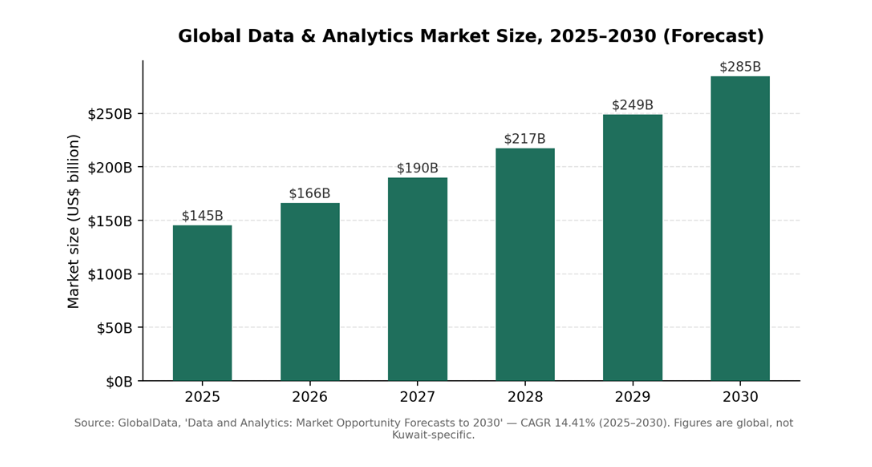
What this means practically for Kuwait: as national digitisation targets move from pilot projects toward full-scale rollout through the early 2030s, the number of roles that require at least foundational analytics skills, even outside dedicated "data" job titles, is likely to keep expanding rather than shrinking. Interested to learn data analytics, see how to learn data analytics.
Ready to develop in-demand data analytics skills? Explore Edoxi's Data Analytics Certification Training in Kuwait.
As Kuwaiti companies adopt AI tools for forecasting, fraud detection and predictive maintenance, they need analysts who can prepare clean data, validate model outputs and explain results, a role that sits alongside, not instead of, AI systems.
Excel and SQL remain the most commonly requested tools across Kuwait job listings, with Power BI close behind for dashboard-building roles in banking, retail and telecom.
Yes, Excel is often the starting point. Adding SQL and a dashboarding tool like Power BI is usually enough to qualify for junior data analyst or reporting analyst roles.
As more Kuwaiti organisations move operations onto digital systems, they generate more data, and need more people who can interpret it. This is a major reason analytics job postings span so many sectors, not just IT.


