Request a Callback

+971 4380 1666
 Sep 24, 2026
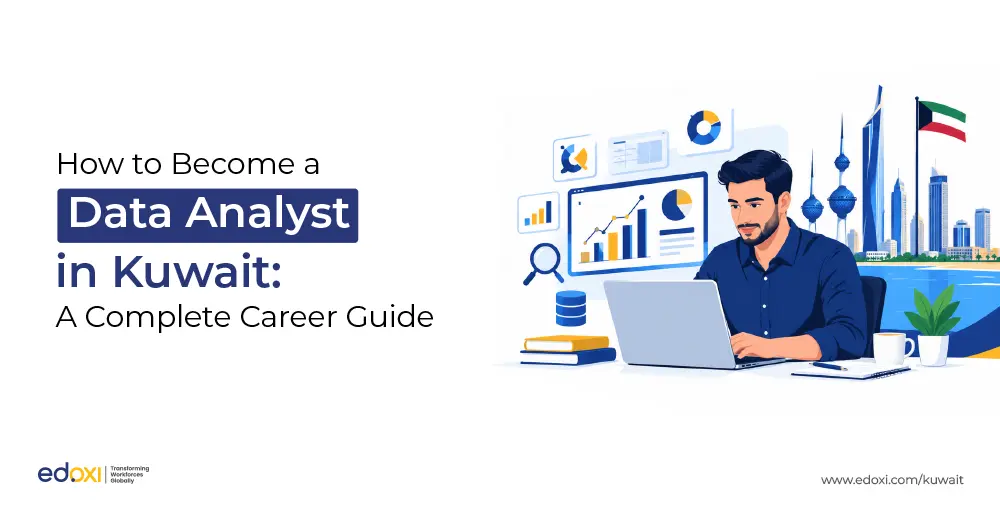
To become a data analyst in Kuwait, learn Excel, SQL, and a visualisation tool such as Power BI, build basic statistics knowledge, complete a project-based data analytics certification, and put together a small portfolio before applying for junior roles.
A few years ago, "data analyst" wasn't a job title most people in Kuwait grew up hearing about.
Now Kuwait's banking, oil and gas, telecom, and retail sectors are actively hiring analysts as the country pushes ahead with its Vision 2035 digital transformation agenda.
Something changed.
What changed is simple: Kuwaiti organisations collect far more data than they used to, and most of it sits unused unless someone knows how to work with it.
Spreadsheets pile up. Dashboards go stale. Reports get built once and are never updated. The gap between "we have the data" and "we understand what it's telling us" is exactly where this career lives.
The good news is you don't need a computer science degree or years of coding experience to close that gap. You need a handful of practical tools, a bit of statistical thinking, and the ability to explain a number in plain language.
This blog walks through exactly how to get there, step by step, with what actually matters for the Kuwaiti job market and what you can safely skip.
| Nos | Contents |
|---|---|
| 1 | Why Become a Data Analyst in Kuwait? |
| 2 | What Does a Data Analyst Do in Kuwait? |
| 3 | How to Become a Data Analyst in Kuwait: Step-by-Step |
| 4 | What Is the Data Analyst Career Path in Kuwait? |
| 5 | What Skills Do Data Analyst Jobs in Kuwait Require? |
| 6 | Data Analyst Qualifications: Degree vs Certification vs Bootcamp |
| 7 | How to Build a Data Analyst Portfolio for Jobs in Kuwait? |
| 8 | Data Analyst Interview Questions in Kuwait |
| 9 | Choosing a Data Analyst Certification in Kuwait |
| 10 | Key Takeaways |
| 11 | FAQs: How to Become a Data Analyst in Kuwait |
Kuwait's push to diversify its economy is creating real demand for people who can work with data.
In January 2023, the Kuwaiti government signed a national alliance agreement with Google Cloud to run a nationwide digital transformation programme, including a national skilling initiative to train government employees in data analytics, machine learning, and AI.
That single agreement is a useful signal: Kuwait's public and private sectors are both investing in data infrastructure, and infrastructure alone doesn't run itself. It needs analysts.
The global picture backs this up too.
The World Economic Forum's Future of Jobs Report 2025 lists big data specialists and AI and machine learning specialists among the fastest-growing job roles worldwide through 2030.
It also stated that projects that demand for AI and big data skills will grow by 87% over that period.
Kuwait is following the same trajectory as the rest of the GCC.
If you're weighing whether this career is worth the effort, the short version is: yes, and the timing is on your side.
Understanding the scope and future of data analytics can help aspiring data analysts in Kuwait assess long-term career opportunities and industry demand.
A data analyst in Kuwait collects data, cleans it, looks for patterns, and presents findings that help a business make a decision. That's the job, stripped of jargon.
On a typical week, you might:
Data analysis and data analytics are used interchangeably, but there's a subtle difference. Data analysis usually means examining existing data to answer a specific question.
Data analytics is the broader discipline of the tools, methods, and mindset behind working with data at scale. Job postings use both terms, so don't overthink the distinction.
This is the core roadmap. Work through it in order, and don't rush past step 7; it's the one most beginners skip.
Pivot tables, VLOOKUP/XLOOKUP, and conditional formatting are still the baseline tests most Kuwaiti employers use to screen candidates early.
Choosing the right tools is an important step in building practical skills, so exploring the best data analytics tools can help beginners decide which technologies to learn first.
SQL lets you pull data directly from a company's database instead of waiting for someone to export a spreadsheet for you. This is the single skill that most reliably separates shortlisted candidates from the rest.
Pick one visualisation tool and go deep. Power BI tends to be the more practical choice in Kuwait, since most organisations already run Microsoft 365 and related tools.
Microsoft has been named a Leader in Gartner's Magic Quadrant for Analytics and Business Intelligence Platforms for 17 consecutive years running as of 2024.
You don't need a maths degree. You need to understand averages, distributions, correlation versus causation, and basic hypothesis testing.
Python is not essential for entry-level roles, but valuable once you're aiming for mid-level or senior analytics positions, automation, or more advanced modelling work.
A structured, project-based data analytics certification in Kuwait compresses months of self-teaching into a guided programme and gives your CV a recognised credential to point to.
This is where most self-taught candidates fall short. A portfolio gives recruiters something concrete to click on instead of taking your word for it. More on this below.
Lead with tools (SQL, Power BI, Excel) and outcomes, not job titles. Link your portfolio directly in your LinkedIn headline or CV summary.
Target Junior Data Analyst, Reporting Analyst, or MIS Executive postings first. These are the realistic entry points, especially for career switchers.
Practise explaining your portfolio projects out loud, not just building them. More detail on what to expect is in the interview section below.
Technical expertise alone is not enough for a successful data analyst career; learning why communication skills are extremely important for a data analyst can help professionals present insights clearly and work effectively with business teams.
Gain practical skills with a Data Analytics Course in Kuwait and prepare for in-demand data roles.
Explore the Data Analytics Course
The data analyst career path in Kuwait mostly progresses from entry-level reporting and data tasks to advanced analytics, business intelligence, and leadership roles as professionals gain experience and technical expertise.
| Career Stage | Common Job Title | Focus |
|---|---|---|
| Entry point | Junior Data Analyst, Reporting Analyst, MIS Executive | Excel, basic SQL, dashboard maintenance |
| 2-4 years | Data Analyst, Business Analyst | SQL, Power BI/Tableau, stakeholder reporting |
| 4-7 years | Senior Data Analyst, Business Intelligence Analyst | Advanced SQL, Python, data modelling |
| 7+ years | Analytics Manager, Data Science Lead | Team leadership, strategy, predictive modelling |
Most people don't start with the title "Data Analyst."
They start somewhere adjacent, often in finance, admin, or operations, and move sideways once they've built the core skill set. Your existing industry knowledge counts for more than most people expect.
The top data analytics skills needed to get into data analyst jobs in Kuwait are:
Microsoft Excel: Pivot tables, lookups, and clean formula work are non-negotiable at the entry level.
SQL: The most consistently requested technical skill across Kuwait's data analytics job postings because it's how analysts access raw company data directly.
Power BI and Tableau: The tools that turn a table of numbers into something a manager can understand in ten seconds.
Python for data analytics: Increasingly valuable as you move into more advanced analytics, automation, and data modelling, though not required to get your first role.
Statistical analysis: Enough to know when a trend is meaningful and when it's noise.
Communication: Employers consistently say the same thing in different words: they want analysts who can explain a chart to someone who's never seen one. Data cleaning and dashboard building are teachable in weeks.
Explaining a finding clearly, under time pressure, to a non-technical stakeholder is what actually gets people promoted.
You don't need a data science degree to become a data analyst.
A relevant bachelor's degree (business, engineering, statistics, economics) combined with a focused data analytics certification course is enough for most entry-level roles in Kuwait.
| Path | Time | Cost Signal | Best For |
|---|---|---|---|
| University degree (Data Science/Statistics) | 3-4 years | High | School leavers, long-term specialists |
| Data analyst certification/bootcamp | 2-4 months | Moderate | Career switchers, working professionals |
| Self-taught (free courses, YouTube) | Unpredictable | Low | Highly disciplined self-starters |
A structured data analytics course in Kuwait sits in the middle path, and for most working adults, it's the most efficient one.
Kuwait-focused job market research has flagged data analysts as consistently sought after for data-driven decision-making in finance, telecom, and retail, alongside related IT systems analyst and financial analyst roles at organisations such as KNPC, Gulf Bank, Zain Kuwait, NBK, Agility, and KIPCO.
You don't need a job to build a portfolio; you need three or four solid projects using public datasets. Generic Kaggle projects work, but Kuwait-specific projects stand out more to local recruiters:
For each project: clean the data, build one dashboard, and write a short summary explaining what you found and why it matters.
Publish it on LinkedIn or GitHub with a clear before-and-after story. Recruiters skim CVs in seconds; a portfolio link gives them something concrete to click on.
Expect a mix of technical and business questions. Common ones include:
Not all certificates carry equal weight. Before enrolling in any professional data analyst certification in Kuwait, check for three things:
Tool coverage: Does it teach Excel, SQL, and at least one visualisation tool together, or just one in isolation?
Project-based learning: Will you finish with a portfolio, or just a certificate and no proof of work?
Local relevance: Does the trainer understand what Kuwaiti and wider GCC employers actually screen for at the interview stage?
Professional Data Analytics Training in Kuwait is built around this exact gap. The programme combines Excel, SQL, Power BI, and Python fundamentals with hands-on projects, so graduates leave with a portfolio, not just a certificate.
It's structured around the tools and case studies employers in banking, retail, and logistics actually ask about.
Learn job-ready analytics skills with Edoxi Training Institute through practical,
industry-focused training.