Request a Callback

+971 4380 1666
 Oct 30, 2026
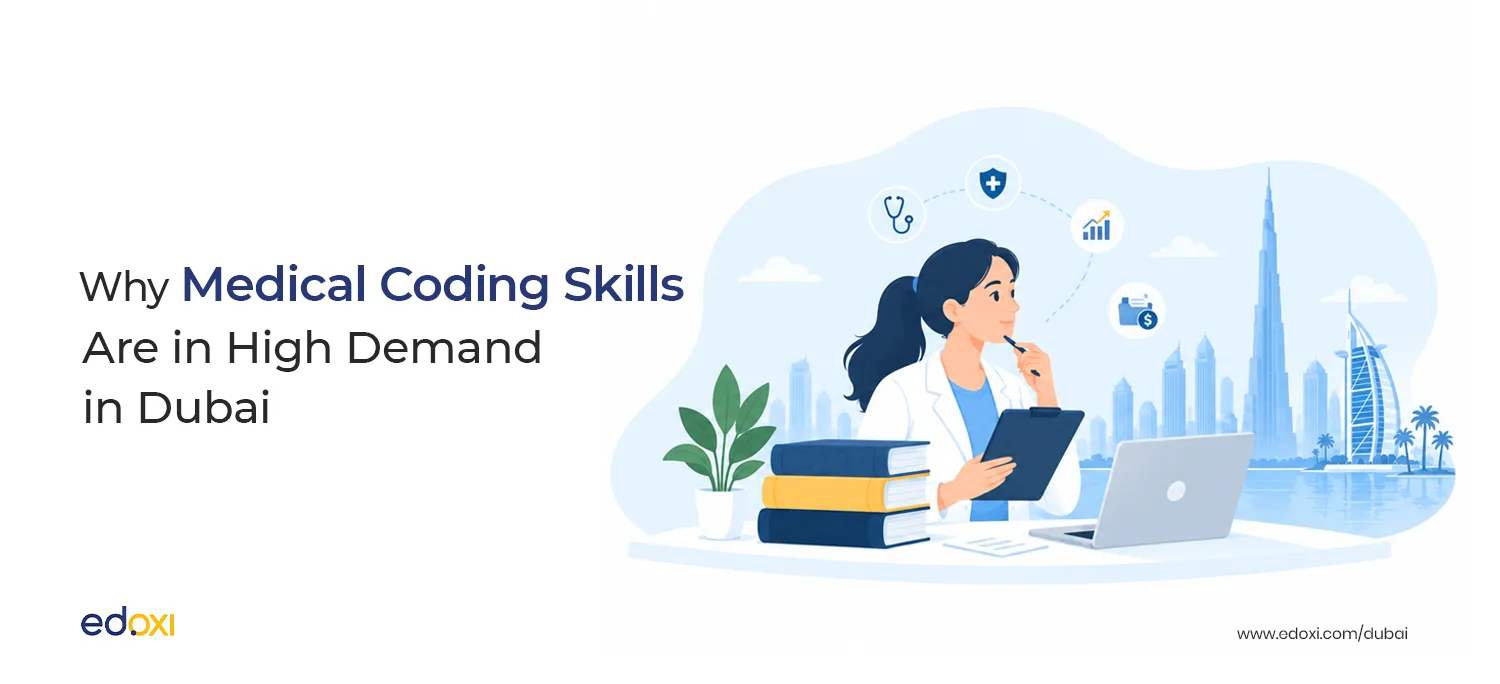
Medical coding skills in Dubai are in high demand because the emirate's healthcare sector is expanding fast, insurance claims now run through digital platforms like eClaimLink, and every claim needs an accurate, compliant code before an insurer will pay it.
Hospitals, clinics, and insurers all need people who can do that reliably.
|
Key Takeaways
|
A patient gets admitted, tested, treated, and discharged, and somewhere in that chain, someone has to turn all of it into codes an insurer will actually accept. In Dubai, that job now has more openings than qualified people to fill them.
|
Table of Contents
|
|
1. What is Medical Coding, and Why Does Healthcare Depend on It?
2. Why are Medical Coding Skills in High Demand in Dubai Right Now? 3. Which Coding Systems Do Dubai Employers Expect You to Know? 4. What Qualifications Do You Need to Become a Medical Coder in Dubai? 5 . What Skills Make a Medical Coder Employable? 5.1. Medical Coding Skill vs Career Value 6. What Career Paths Open Up With Medical Coding Skills? 7. How Much Does a Medical Coder Earn in Dubai? 8. Does Certification Actually Change Your Job Prospects? 9. What Should You Weigh Up Before Choosing a Medical Coding Career in Dubai? 10. FAQs |
Medical coding converts a doctor's diagnosis or procedure into a standard alphanumeric code, so insurers, regulators, and hospitals can process it consistently.
Every hospital visit generates paperwork: a diagnosis, a procedure, a prescription. Someone has to translate that into a code an insurance system recognises. That someone is a medical coder.
Get the code wrong, and a claim bounces back. Multiply that across thousands of daily visits, and coding accuracy becomes a financial and operational issue, not just an administrative one.
Medical coding in Dubai is also the backbone of medical records management: clean codes make patient histories searchable, auditable, and portable between providers.
Coding and billing get used interchangeably, though they're separate roles; this breakdown of medical billing vs. coding is worth a look if you're deciding which one fits you better.
Medical coding skills are in high demand in Dubai because the sector is growing faster than the coder pipeline, and digital claims platforms have made coding accuracy non-negotiable.
Dubai's healthcare footprint has grown steadily.
The Dubai Health Authority reported around 5,800 licensed facilities in 2025, up from 5,340 the year before, an increase of over 8%. The private healthcare workforce crossed 69,400 professionals in 2025, compared to 64,100 in 2024.
|
How many healthcare facilities does Dubai have? Dubai had approximately 5,800 licensed healthcare facilities in 2025, including 55 hospitals and 126 general medical clinics, according to DHA figures reported in February 2026. Source: Gulf News |
His Excellency Dr Alawi Alsheikh-Ali, DHA's Director General, has pointed to the private healthcare sector's expanding infrastructure and digital capability as core to the emirate's healthcare ambitions.
That digital push matters directly to coders: Dubai's NABIDH platform, the unified medical records system, held more than 10.41 million records by mid-2025, with over 53,600 healthcare professionals connected to it.
Dr Mohammed Al Redha, DHA's Director of Health Informatics and Smart Health, has noted that this kind of integration cuts down repeated procedures and smooths transitions between providers, but only when the underlying data, including the codes attached to it, is accurate.
On the insurance side, DHA's own investment guide recorded close to 97.2 million submitted claim activities in a single year through eClaimLink.
Every one of those claims needed a code behind it.
That volume alone explains why medical coder jobs in Dubai keep appearing on job boards, and why healthcare coding jobs in Dubai span far beyond hospitals, insurers, and third-party administrators that hire for the same skill set.
For where this is all heading next, medical coding trends and career opportunities are worth reading.
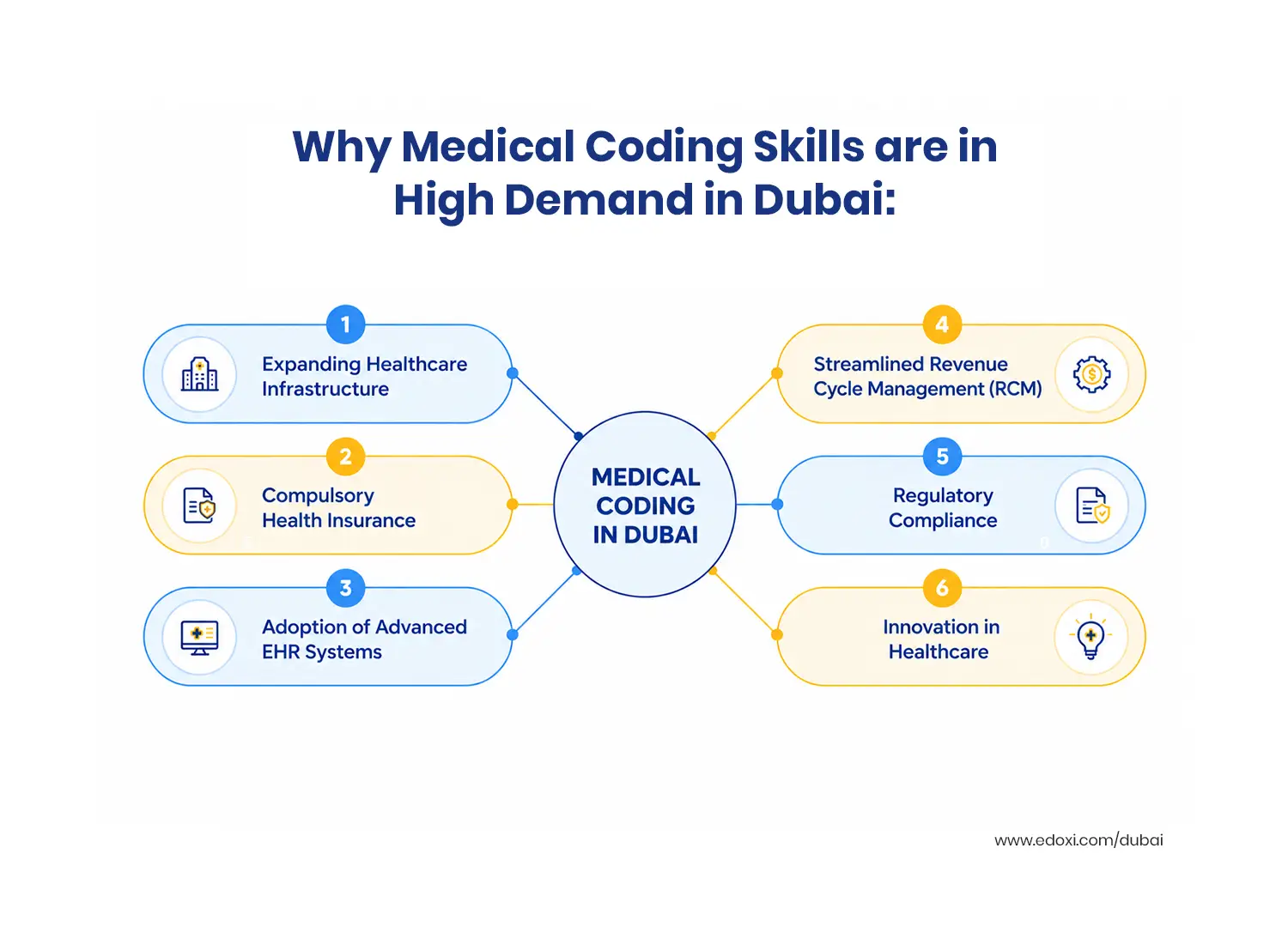
The major reasons for the high demand of medical coding skills in Dubai are illustrated in the infographic below:
Dubai employers expect working knowledge of ICD-10-CM for diagnoses and CPT (alongside HCPCS) for procedures, both applied within DHA, DoH, or MOH guidelines.
ICD-10-CM codes describe diagnoses and what's wrong with the patient. Coders assign these based on physician documentation, matching symptoms and conditions to the correct classification.
CPT codes describe what was done: a procedure, a test, a consultation. Insurers use CPT codes to work out what to reimburse.
Job postings across Dubai and Abu Dhabi consistently list ICD-10-CM, ICD-10-PCS, CPT, and HCPCS Level II as baseline requirements, alongside familiarity with DHA/DoH/MOH-specific rules.
If you're weighing up ICD-10 coding in Dubai against CPT coding in Dubai as a starting focus, most entry-level roles expect working knowledge of both rather than a choice between them.
A recognised medical coding qualification in Dubai combines a relevant educational background, coding-system knowledge, practical case experience, and a professional certification such as CPC or CCS.
The pathway generally looks like this:
1. Relevant educational background: A diploma or bachelor's degree in life sciences, nursing, health information management, or a related field.
2. Medical terminology: The vocabulary clinicians use to describe conditions and treatments.
3. Anatomy and physiology: Enough grounding to understand what a diagnosis or procedure actually involves.
4. ICD, CPT, and HCPCS knowledge: The coding systems covered above.
5. Practical coding experience: Case-based practice, not just theory, is what employers ask about in interviews.
6. Professional certification: A CPC certification (AAPC) or CCS (AHIMA) is the most commonly requested credential for a certified medical coder in Dubai.
7. UAE healthcare and claims knowledge: DHA, DoH, and MOH documentation rules, plus familiarity with claims platforms like eClaimLink.
A structured medical coding course in Dubai mostly bundles steps 2 through 6 into one programme, which is why training providers pair classroom instruction with case-study practice rather than certification exam prep alone.
Not sure which credential to start with? This rundown of the top medical coding certifications breaks down the options.
Employers in Dubai look for coding accuracy, medical terminology knowledge, attention to detail, and familiarity with local compliance rules, not just certification on paper.
The table below shows how key medical coding skills can translate into practical career value in Dubai’s healthcare sector.
Medical Coding Skills and Career Value: Quick Comparison
| Medical Coding Skill | Where It's Used | Career Value |
| ICD-10-CM coding | Diagnosis documentation and claims | Core coding skill |
| CPT/HCPCS coding | Procedure billing and reimbursement |
Supports billing and coding roles
|
| DHA/DoH compliance | Claims audits and regulatory reporting |
Useful for compliance-focused roles
|
| EHR/claims software | Daily coding workflows |
Supports digital healthcare operations
|
| Denial management | Resubmissions and revenue cycle |
Useful in RCM and insurance roles
|
Coders in Dubai mostly move from entry-level hospital or clinic roles into insurance auditing, coding management, or revenue cycle leadership as they gain certifications and experience.
| Role Type | Common Employers | Focus |
| Medical Coder | Hospitals, clinics |
Day-to-day diagnosis and procedure coding
|
| Insurance Coder / Claims Reviewer | Insurers, TPAs |
Claim accuracy, pre-authorisation
|
| Coding Auditor | Hospitals, RCM firms |
Reviewing coding for compliance and error patterns
|
| Revenue Cycle / Coding Manager | Hospital groups, healthcare networks |
Overseeing coding teams and reporting
|
These are common progression patterns, not guaranteed outcomes; actual roles, titles, and pay depend on the employer, your certification, and your experience level.
If you're mapping out your first move, how to start a medical coding career walks through the practical first steps.
Medical coder salaries in Dubai range roughly from AED 3,000 for entry-level freshers to AED 15,000+ for senior consultants and coding managers, with pay shaped more by certification, experience, and employer type than by the job title alone.
The average monthly salary of medical coding professionals in Dubai by experience level is listed in the table below:
Medical Coder Salary by Experience
| Level |
Average Monthly Salary in Dubai
|
| Entry-level (Fresher, CPC/CCA) |
AED 3,000 - 5,000
|
| Experienced Coder (2–5 years) |
AED 4,500 - 7,000
|
| Senior Coder / Auditor (CPMA) |
AED 6,000 - 9,000
|
| Coding Manager / Consultant |
AED 8,000 - 15,000+
|
The average monthly salary of medical coding professionals in Dubai by employer type is listed in the table below:
Medical Coder Salary by Employer Type
| Employer Type |
Average Monthly Salary in Dubai
|
| Insurance firms |
AED 5,000 - 10,000
|
| Hospitals |
AED 4,500 - 9,000
|
| Outsourcing / RCM companies |
AED 3,500 - 7,000
|
| Clinics |
AED 3,000 - 6,000
|
Singaram Annamalai, CFO of Prime Healthcare Group, has described how tighter regulatory controls from Dubai's insurance authorities have shortened the "claim to collection" cycle for hospitals, a shift that puts more weight on getting the coding right the first time, since resubmissions cost providers both time and cash flow.
Certification signals baseline competency to employers, but it works best paired with hands-on practice; job listings across the UAE routinely list a coding certification as a minimum requirement, not a bonus.
Most Dubai and Abu Dhabi job postings for coding roles list a diploma or certificate in medical coding, health information management, or a related field as a baseline requirement.
A medical coding certification in Dubai, CPC being the most commonly requested, tells an employer you've cleared that bar. Structured training from a top medical coding training institute in Dubai covering healthcare documentation,
ICD/CPT application, and DHA-aligned claims workflows is what turns classroom knowledge into something an employer can trust on day one.
Edoxi's medical coding training in Dubai is built around exactly this: practical coding practice, documentation standards, and industry-relevant case work, rather than theory alone.
For those weighing up medical billing and coding in Dubai as a combined skill set, the same foundational training medical billing and coding training covers both sides, since employers often expect coders to understand the billing side of a claim too.
Certification and training build job-relevant skills, but neither one guarantees a placement; hiring still comes down to the employer, the role, and the individual candidate.
Consider your comfort with detail-heavy, compliance-driven work, your willingness to keep pace with coding updates, and whether you're prepared to start in an entry-level role before moving into specialised or auditing positions.
|
Is medical coding a good career in Dubai? Medical coding can be a solid entry point into UAE healthcare administration for people who enjoy detail-oriented, rules-based work, though career growth depends on certification, experience, and the employer, not on the sector alone. |
A few honest questions worth asking yourself:
Medical coding isn't medical billing, though the two overlap in practice; coding assigns the codes; billing uses them to generate and chase the claim.
For a closer look at where these roles are opening up locally, the scope of a medical coding career in Dubai covers it in more depth.