Request a Callback

+971 4380 1666
 Nov 23, 2026

Data skills matter in modern business in Kuwait because they help people choose well, not guess. In Kuwait, oil companies, banks, shops and ministries now collect more data than ever.
Staff who can read it, question it and explain it help their teams act faster, waste less and plan with confidence.
Two managers sit in the same meeting in Kuwait City. Both look at the same sales sheet.
The first says, “Sales feel slow.” The second says, “Sales dropped in one product line, in two branches, right after we changed delivery times.” Only one of them can fix the problem.
The gap is not luck or age. It is data skills, the ability to look at plain numbers and find the story inside them.
Data analytics skills in Kuwait now rank at the centre of modern business. Every year, more data piles up in oil fields, banks, shops and government offices.
This blog shows why those skills matter, where Kuwait’s industries use them, which tools to learn first and how to start.
| Nos | Contents |
|---|---|
| 1 |
Why Are Data Skills Becoming Essential for Businesses in Kuwait?
a) What is the difference between data skills and data-driven decision-making?
|
| 2 |
How Is Kuwait’s Digital Transformation Increasing the Need for Data Skills?
a) What does Kuwaiti research say about data literacy at work?
|
| 3 |
Which Industries in Kuwait Benefit Most from Data Skills?
a) How does data help Kuwait’s oil and gas sector?
b) How does data help banks and financial firms?
c) How does data help retail and e-commerce?
d) How does data help telecom and healthcare?
|
| 4 |
What Data Skills Do Modern Business Professionals Need?
a) Why do Excel and SQL still matter?
b) How does Power BI help with data visualisation?
c) Why is data quality important for business decisions?
d) Which business skills matter as much as software tools?
|
| 5 |
How Do Data Skills Improve Business Decision-Making?
a) How does AI change this work?
|
| 6 |
How Can Professionals in Kuwait Develop Data Skills?
a) What is the best way to build data skills in Kuwait?
|
| 7 | Key Takeaways |
| 8 | Frequently Asked Questions: Why Data Skills Matter in Modern Business in Kuwait |
Data skills are becoming essential for businesses in Kuwait because decisions now move faster than hunches can. Data skills turn raw numbers into clear choices on cost, demand and risk.
Data is just recorded facts. A sales receipt is data. So is a fuel reading or a bank transfer. On its own, it sits in a folder and does nothing.
A person with data skills sorts it, checks it and spots the pattern. That pattern becomes a decision.
This is how data-driven business decisions in Kuwait begin, and many firms now treat data analytics skills as a business advantage, not an IT side topic.
The infographics below show how modern businesses in Kuwait turn raw data into meaningful insights to make smarter decisions.
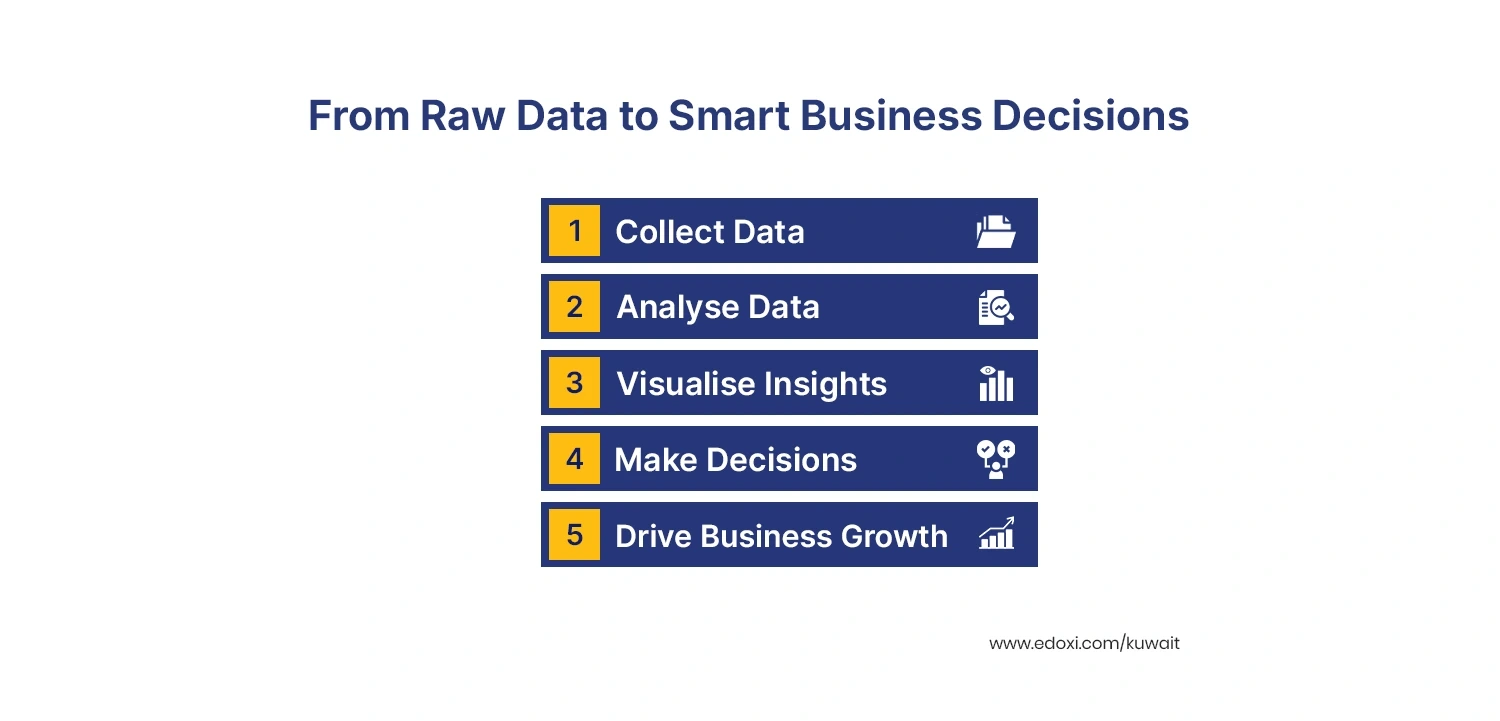
Data skills are what a person can do. Data-driven decision-making is what a team does with the result.
Building a dashboard is a skill. Stocking more of a fast-selling product because the dashboard shows a trend is a decision. You need both.
Kuwait’s digital transformation is increasing the need for data skills as Vision 2035 goals, national programmes, and large company budgets all depend on people who can use data. Technology is arriving fast. Skilled people are the missing link.
Kuwait Vision 2035 aims to diversify the economy, lift productivity and build skilled national talent.
Digital programmes support these priorities by turning goals into numbers that can be tracked, such as productivity, investment returns and waste. Those goals only count if someone measures them.
The money is already moving. Kuwait Petroleum Corporation (KPC) says it has invested more than KD 95 million in its digital portfolio over four years, as Times Kuwait reported on 17 November 2026.
The Central Agency for Information Technology (CAIT) says more than 40,000 Microsoft 365 Copilot licences have been activated under an initiative covering 79 government entities (November 09, 2026, Kuwait Times).
Thirteen of those entities had finished the adoption phase. Activated licences show access, not proven results.
“The real challenge lies not in owning technology,” said CAIT’s acting director general, Najat Ibrahim, at the Kuwait Digital Transformation Conference on 9 November 2026. She added that the real work is turning it into lasting impact.
That push explains the rising demand for data analytics in Kuwait.
A 2026 study of 573 Kuwaiti government employees found positive links between problem-solving skills, data skills and digital performance. Ahmad Alsaber and colleagues published it in Cogent Business & Management.
Staff with stronger problem-solving skills also used business intelligence tools better.
The lesson is that technical data skills work best when paired with analytical thinking. The survey captured one moment in time, so it shows associations, not proof of cause and effect. Tools matter, but thinking matters more.
That is why data literacy for employees in Kuwait is about judgement as well as software. If you wonder what these skills are worth, see this look at the data analyst salary in Kuwait.
Oil and gas, banking, retail, telecom, healthcare, logistics and government all gain. Each uses data for a different daily decision.
These are practical uses, not a claim that every Kuwaiti firm already does them.
| Industry | Decisions data can support |
|---|---|
| Oil and gas | Equipment checks, output tracking, repair timing |
| Banking | Fraud alerts, credit risk, customer groups |
| Retail | KNET payment patterns, stock levels, demand |
| Telecom | Customer churn prediction, network quality |
| Healthcare | Patient flow, staffing, service speed |
| Logistics | Fleet use, delivery times, route costs |
| Government | Service speed, budgets, policy checks |
The same sectors appear in this list of industries hiring data analysts in Kuwait.
Data helps teams monitor equipment, fix faults early and track output in Kuwait’s oil and gas sector.
In January 2026, Kuwait National Petroleum Company (KNPC) announced an executive programme covering 24 digital initiatives. It belongs to the wider digital transformation strategy for Kuwait’s oil sector. These are announced plans, not proven results.
Still, they show why data matters here. Refinery equipment produces constant readings. A planner in Al-Ahmadi who tracks them could spot a pump running hotter each week and book repairs before it fails.
That is data analytics for operational efficiency, and it needs people who combine analysis, digital skills and plant knowledge.
“We are working to transform the way our corporation operates,” said KPC chief executive Sheikh Nawaf Saud Al-Nasser Al-Sabah at the first Kuwait Oil Sector Digital Transformation Forum on 17 November 2026.
He described the ERP One system, which brings finance and HR onto one platform, as Kuwait Times reported.
In the same speech, he described protected and well-used data as a vital national asset.
Banks use data to spot fraud, judge credit risk and forecast demand.
Think of a large bank such as National Bank of Kuwait. Every card payment leaves a record. An analyst who studies those records can spot odd patterns that may signal fraud, and group customers by need.
Data shows what sells, where and when in retail and e-commerce.
Card payments through KNET leave a clear trail. Picture a store manager in Salmiya who sees one product falling for three weeks.
A Microsoft Power BI dashboard splits sales by branch. The fall is in one branch only. She fixes stock there instead of cutting prices everywhere.
Telecom firms use data to keep customers and improve networks. Hospitals use it to cut waiting times and plan staffing.
A telecom company such as Zain Kuwait can study customer usage, complaints and service patterns to see who may cancel and why. That is called churn analysis. A hospital can study patient flow to cut waiting.
The goals differ. The habit is the same: ask, check, act. These applications also create opportunities for people building a career in data analytics.
Business data analysis skills fall into five groups: analysis, spreadsheets and databases, dashboards, forecasting and storytelling. Tools help, but judgement turns results into action.
| Skill or tool | Business use |
|---|---|
| Advanced Excel | Budgets, financial reports, daily operations |
| Power BI | Management dashboards and KPI tracking |
| SQL | Pulling records from company databases |
| Python | Forecasting and automation |
| Tableau | Showing trends and performance |
| Statistics | Finding patterns, risks and openings |
| Data storytelling | Explaining findings to decision-makers |
If you want a guided path, data analytics training in Kuwait can cover these skills in a clear order.
Excel handles everyday budgets and reports. SQL pulls the right records from databases.
A solid Advanced Microsoft Excel course teaches pivot tables, lookups and clean formulas. SQL lets you ask a database a direct question, such as which branch sold the most last month.
Skipping data cleaning is one of the data analytics mistakes beginners make
Power BI turns tables into live dashboards that managers can read at a glance.
Show only the most relevant numbers and present them clearly. Too many charts hide the answer. Business intelligence tools in Kuwait, from Power BI to Tableau, work best when each dashboard answers one clear question
Data quality is important for business decisions because wrong or missing data leads to wrong decisions. Clean, complete and protected data is the base of every reliable report.
A sales forecast built on incomplete records will miss real demand. A finance report with duplicate entries can lead to a poor budget call.
Sensitive data also needs clear rules about who can see it, which matters for banks, oil and gas operations and government bodies. A practical data analytics course in Kuwait should teach cleaning, checking and safe handling, not only charts.
Better data also lifts data analytics for organisational performance, because every team then works from the same facts.
Critical thinking, problem-solving, basic statistics, clear communication, sound judgement and data ethics. Knowing how to build a dashboard is not the same as knowing what to do next.
Software skills only get you started. In the Kuwaiti study above, problem-solving and communication stood out most for data literacy, so these skills deserve equal time:
Analysing data is only one part of the job. Employers also look for professionals who can explain findings and show practical business sense. These are important points when preparing for data analyst roles.
Data skills improve business decision-making by replacing guesses with evidence. Teams spot problems earlier, test ideas cheaply and explain choices clearly.
A data-driven decision follows six steps:
Ask a clear question.
Collect the right data.
Clean out errors.
Look for patterns.
Explain the result simply.
Act, then check the outcome.
For forecasting, a Python programming course shows you how to predict next quarter’s demand from past sales.
AI drafts charts and summaries fast, but people must check the answer.
AI helps, but people decide, which is why will AI replace data analysts has a careful answer.
Sheikh Mohammed Ahmed Al-Sabah, founder and chairman of the Association of Artificial Intelligence of Things, called for a more integrated national digital ecosystem in Kuwait.
He stressed secure data exchange, digital trust and investment in national talent, in the fifth Kuwait Digital Transformation Conference on November 9, 2026.
Start with Excel, add one dashboard tool, learn basic SQL, then try Python. Practise on real work questions.
Start small and stay steady. The roadmap for becoming a data analyst in Kuwait shows a clear order. Practise as you learn, using real data from your own work.
A simple order to follow:
If your goal is prediction and machine learning, a data science course adds the maths and modelling. Start by identifying a measurable business problem in your current role, then answer it with data.