Request a Callback

+971 4380 1666
 Nov 12, 2026
Key Takeaways
Banking, oil and gas, government, healthcare, retail, telecom and logistics all use data analysts, though each sector applies the role in its own way.
A data analyst takes raw numbers and turns them into a report, a dashboard or a clear recommendation that a manager can act on.
Kuwait's push toward a knowledge-based economy under Vision 2035 is expanding the ICT sector, and that expansion is feeding a wider need for people who can read and explain data.
This guide looks at each sector in turn, the real job titles behind the scenes, the tools employers ask for, and a practical route into the field, without inflating demand or promising a job.
| Nos | Contents |
|---|---|
| 1 | Which industries in Kuwait employ data analysts? |
| 2 | How do data analysts contribute to Kuwait's banking and finance sector? |
| 3 | How is Kuwait's oil, gas and energy sector using data analytics? |
| 4 | Why are government and healthcare bodies in Kuwait hiring data-literate talent? |
| 5 | How do retail, telecom and logistics firms in Kuwait use data? |
| 6 | What skills do Kuwaiti employers look for in a data analyst? |
| 7 | What is the career path for a data analyst in Kuwait? |
| 8 | FAQs |
| 9 | Other questions people ask |
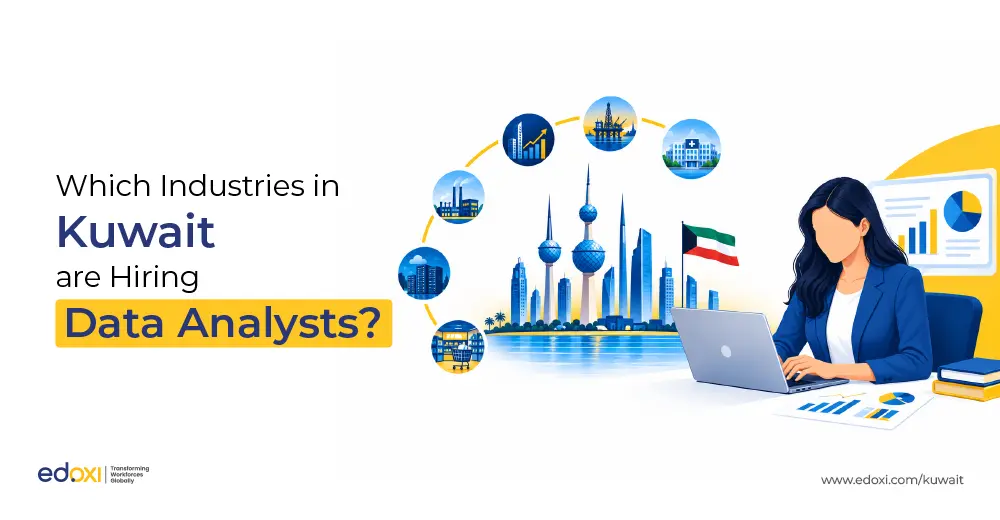
Seven sectors show the clearest evidence of data analyst activity in Kuwait: banking and finance, oil and gas, government, healthcare, retail and e-commerce, telecom, and logistics.
Each sector uses data differently, and not every sector advertises the exact title “Data Analyst”. The table below sets out how each industry sector applies data work today.
| Industry | How data analytics is used |
Kuwait examples
|
|---|---|---|
| Banking & Finance | Fraud detection, credit risk, customer analytics | NBK, Boubyan, fintech start-ups |
| Oil, Gas & Energy | Refining, asset management, predictive maintenance | KPC, KNPC (Al-Zour refinery) |
| Government | E-services, digital ID, policy reporting | CAIT, PACI |
| Healthcare | Patient records, hospital operations, statistics | Private hospital groups |
| Retail & E-commerce | Demand planning, inventory, segmentation | Alghanim Industries |
| Telecom & IT | Network performance, churn analysis | Zain, STC Kuwait |
| Logistics & Supply Chain | Route planning, inventory tracking | Regional logistics and freight firms |
Note: a company using data analytics daily does not always list “Data Analyst” as a job title. Many of these roles sit under Business Intelligence Analyst, Reporting Analyst, Risk Analyst or Operations Analyst instead.
Banking is one of the clearest users of data analysts in Kuwait. Kuwaiti banks and fintech firms hire for fraud detection, credit risk scoring and customer behaviour analysis, and recent Kuwait job listings include fixed-term Fraud Data Analyst and Financial Business Analyst roles working directly with bank data.
National Bank of Kuwait also runs a dedicated NBK Tech Academy, training graduates in data analytics, AI and cybersecurity. Power BI remains a leading reporting tool inside Kuwaiti banks, alongside SQL for pulling transaction data.
See the Best Data Analytics Tools to Learn for the banking and financial sector.
If you enjoy working with numbers and want a stable first industry, banking is a strong place to target.
Kuwait's energy sector uses data analytics to run smarter, safer refineries, rather than to build a separate “Data Analyst” department.
Kuwait Petroleum Corporation and its subsidiary, Kuwait National Petroleum Company, are rolling out a digital refinery programme across sites such as Al-Zour, combining sensors, IoT and real-time analytics for maintenance and quality control. This work is broadening demand for engineers, technologists and data-literate operations staff, more than for entry-level analysts alone.
If you already hold an engineering or operations background, adding SQL and Power BI through a Power BI Training course in Kuwait can open doors inside this sector.
Government and healthcare bodies in Kuwait hire data-literate staff mainly to run e-services, biometric systems and hospital reporting, not classic analyst desks.
Kuwait's Vision 2035 has driven a national digital identity programme and wider e-government services, with the Central Agency for Information Technology pushing public services to become more predictive and data-led. Hospitals and private health groups also advertise roles that blend statistics with clinical operations, and education providers show a similar pattern, with training bodies hiring for reporting-focused work too.
None of this guarantees a fixed number of open roles, but it shows the direction these sectors are moving in.
Retail, telecom and logistics firms in Kuwait use data mainly for demand forecasting, network performance and delivery tracking.
Alghanim Industries, one of Kuwait's largest retail and industrial groups, has advertised data-focused analyst roles tied to customer and operational reporting.
Telecom operators such as Zain and STC Kuwait rely on analytics to monitor network quality and reduce customer churn, supported by the country's National Connectivity Strategy.
Logistics and freight firms increasingly look for supply chain and operations analysts who can query databases and flag bottlenecks before they cause delays.
Across all three sectors, the skill set stays the same even when the job title changes. Check out this guide on How to become a Data analyst in Kuwait
Kuwait employers consistently ask for the same handful of tools, whatever the industry. The table below breaks down what each skill is used for and why it matters locally.
| Skill | Why it matters in Kuwait |
|---|---|
| Excel & Power Query | Cleaning and preparing data quickly — still the most common starting point in job ads |
| SQL | Retrieving data from the databases behind banking, oil and telecom systems |
| Power BI & DAX | Building dashboards — widely used as a leading reporting tool in Kuwaiti corporates |
| Descriptive statistics | Reading trends accurately without overstating what the data shows |
| Data storytelling | Explaining findings to managers who do not work with data day to day |
| Bilingual reporting | Presenting data clearly in Arabic and English, useful across public and energy sector roles |
You can build every skill in this table through Edoxi's Data Analytics Course, designed around real Gulf workplace scenarios
Building a data analytics career in Kuwait starts with tools, not titles.
Begin with Excel and SQL, add Power BI once you are comfortable with basic queries, then build two or three small portfolio projects using public or sample data. Search broadly, because Kuwait job boards list this skill set under many labels, including Business Intelligence Analyst, Reporting Analyst, Risk Analyst and Operations Analyst, alongside “Data Analyst” itself. See this roadmap for becoming a Data Analyst.
Kuwait's ICT (Information and Communication Technology) sector is also on a clear growth path. Industry estimates place it on course to nearly double in size across this decade as government and private investment in digital infrastructure continues.
That scale of investment usually needs more people who can work with data, even if it does not guarantee any single job. See the scope and future of data analytics. The graph below shows the growth of Kuwait’s Information and Communications Technology sector.

A structured, hands-on course, such as Edoxi's Data Analyst Training, gives a faster, guided route through this same toolkit than piecing it together alone. You may also find these best data analytics certifications for career improvement useful.
Data analytics gives you a transferable skill set that works across almost every Kuwaiti industry. That flexibility, rather than any single guaranteed job outcome, is what makes the field worth considering.
A data analyst usually answers one-off business questions in depth. A business intelligence analyst builds recurring dashboards and reports that leadership checks regularly. In Kuwait, the two titles often overlap in practice
Many government and energy sector roles prefer bilingual candidates, though this is not universal. Retail, telecom and banking postings vary by employer, so it is worth checking each listing directly.
Yes, with the right foundation. A recognised course, a small project portfolio and applying under multiple related job titles all help a fresher build a credible first application. Edoxi's Data Analyst Course is built with exactly this starting point in mind.