Request a Callback

+971 4380 1666
 Oct 28, 2026
To get PMP certification in Kuwait, check your eligibility, complete the required project management training, submit your application to PMI, pay the exam fee after approval, and pass the exam.
The total preparation time depends on your experience, training schedule, application review, and exam availability.
Imagine two engineers in Salmiya. Same degree. Same company. Same coffee order. One has "PMP" after her name. She gets the bigger project. Her manager knows she can run it.
That gap is why so many professionals ask how to get PMP certification in Kuwait. The path is clear once you see it.
This blog covers the rules, the steps, the costs, and the real timeline. PMI changed both the exam and some rules in 2026. This blog also shows what PMI confirms and what you should check yourself.
| Nos | Contents |
|---|---|
| 1 | What Is PMP Certification, and Is It Worth It in Kuwait? |
| 2 |
How Do You Get PMP Certification in Kuwait? 5 Steps
a) How Do I Check If I Am Eligible?
b) How Do I Complete the 35 Hours of Training?
c) How Do I Submit the PMI Application?
d) How Do I Pay the Fee and Book the Exam?
e) How Do I Prepare for the Exam and Pass?
|
| 3 | How Much Does PMP Certification Cost in Kuwait? |
| 4 | Where Can You Take the PMP Exam in Kuwait? |
| 5 | How Long Does It Take to Get PMP Certified in Kuwait? |
| 6 |
What Are the Benefits of PMP Certification in Kuwait?
a) How Do You Choose the Best PMP Training Course in Kuwait?
|
| 7 | Key Takeaways |
| 8 | Frequently Asked Questions: How to Get a PMP Certification in Kuwait |
PMP stands for Project Management Professional.
PMI, the Project Management Institute, awards it. It proves you can lead projects. It is worth it if you work in a project-heavy field.
PMP is a global badge. Employers in construction, oil and gas, IT, banking and government projects know it well. Not sure it fits you? This guide on who should pursue PMP can help you decide.
Kuwait is building. A Reuters report (13 December 2025) counted nearly 300 active projects worth about KD35 billion.
In the same report, Electricity Minister Subaih Al-Mukhaizim said Kuwait would add over 14 gigawatts of power capacity by 2031.
Housing Minister Abdulatif Almeshari said the housing authority plans 170,000 homes through public-private partnerships over ten years. Big builds need people who manage time, cost, and risk.
The world needs them too. PMI's Global Project Management Talent Gap report says demand for project professionals could grow 64% from 2025 to 2035. It warns of a shortfall of up to 29.8 million.
For MENA, PMI's construction talent gap report projects demand of up to 330,794 construction project management professionals by 2035. It also warns of a possible gap of 111,737.
Emad Al-Ablani, Group Chief HR Officer, NBK, at the Watheefti careers fair: "We view human capital development as a long-term investment."
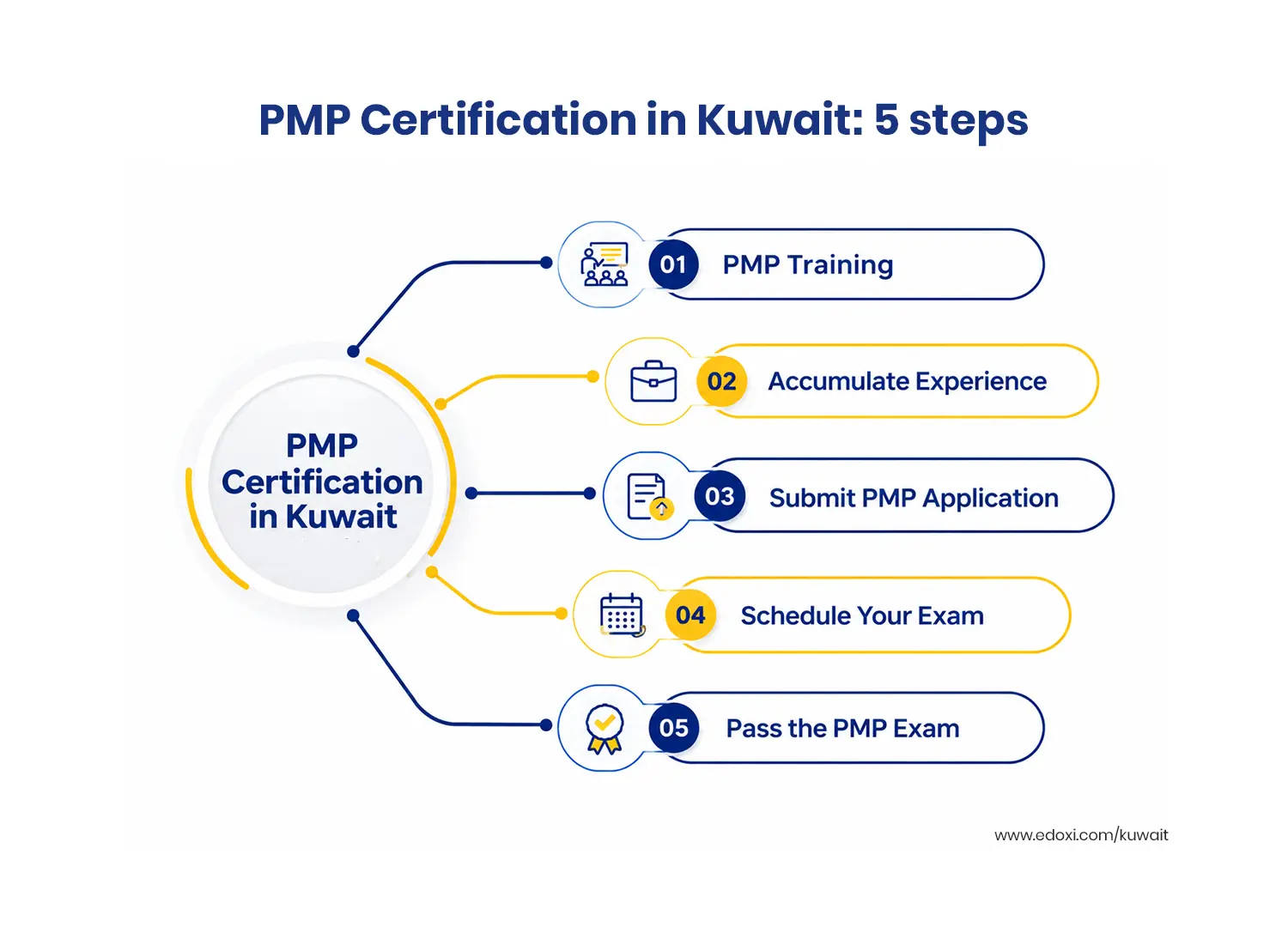
Check your eligibility, finish 35 hours of training, submit your PMI application, pay and book your exam, then study and pass.
Match your education to one of PMI's four paths. Then count your project months from the last 10 years.
PMI's global rules apply in Kuwait. You need to meet one of these paths:
PMP Certification Eligibility Requirements by Education Level
| Your education | Experience managing projects |
|---|---|
| High school diploma (or equivalent) | 5 years |
| Associate degree or vocational diploma | 4 years |
| Bachelor's degree or higher | 3 years |
| Bachelor's or postgraduate degree from a PMI-accredited (GAC) programme | 2 years |
Experience is only half the rule. The 35 hours of training come next
Finish 35 hours of project management training, or hold an active CAPM certification. Then keep your certificate.
PMI accepts three routes, per PMI's PMP page:
A PMI Authorized Training Partner (ATP)
A China Registered Education Provider (REP)
An eligible accredited higher education programme, including PMI GAC programmes
Then follow these steps:
Alaeddine Karim, Country General Manager, Microsoft Kuwait, on a panel about workforce readiness: "We must prepare our people for the future as much as our systems." (Press release on Zawya, event co-hosted by KDIPA and The Business Year)
Submit your education, projects, and training details to PMI. Then wait for PMI's decision.
Gather this important information and documents first:
Then follow these steps:
Once PMI accepts your application, pay the exam fee and book your slot.
Study the 2026 outline, practise with timed mocks, and fix weak spots until your results are steady.
Know the exam:
Eligible is not the same as ready. Eligibility means PMI accepts your application. Readiness means you can answer scenario questions across all three domains in the 2026 Exam Content Outline.
Training hours do not measure readiness. Mock-test results do.
Build your study plan:
The 5 major steps to get a PMP certification in Kuwait is presented in the infographic below:
The PMP exam fee is approximately KWD 126 for PMI members and KWD 203 for non-members, based on published US prices and an estimated exchange rate of 1 USD = 0.31 KWD.
These are estimates, not confirmed Kuwait-specific fees.
PMI may apply different pricing by market, so the amount displayed in your PMI account at checkout is the most reliable figure. The total cost of PMP certification in Kuwait also depends on training fees, PMI membership, and any exam retakes.
| Cost group | Estimated cost (USD) | Approx. cost (KWD) |
|---|---|---|
| PMP exam fee, member | $405 | KWD 126 |
| PMP exam fee, non-member | $655 | KWD 203 |
| PMP training (35 hours) | Varies by provider | Request a KWD quote |
| PMI membership | Varies by market | Check PMI website |
| Exam retake, member | $275 | KWD 85 |
|
Exam retake, non-member
|
$375 | KWD 116 |
PMI allows candidates up to three exam attempts within their one-year eligibility period. Retake fees apply when an additional attempt is required.
Before budgeting, check the official PMI PMP certification page for current fees and eligibility requirements. Contact your training provider for a separate quotation covering the required 35 hours of project management education.
Membership plus the member exam fee often costs less than the non-member fee alone. Do the sum with your own PMI account prices.
When you compare a project management course in Kuwait, ask whether mock exams and application help are included.
You can test at a Pearson VUE test centre or online with a live proctor. PMI recommends the test centre. Use Pearson VUE's PMI page to find centres and open slots.
Start on Pearson VUE's PMI page to search test centres and book appointments. For the online option, read Pearson VUE's OnVUE guidance. PMI advises you to run a system test, pick a private space, and keep a valid photo ID ready. PMI also lists Arabic among the exam languages.
Many learners choose PMP training in Kuwait that also guides them through exam booking. That removes a lot of guesswork.
Timelines vary. Many candidates plan three to four months from first class to result. That is a planning estimate, not a PMI figure.
Worried about difficulty? Read this real experience guide on how hard the PMP exam is. Short daily study beats weekend cramming.
Naqeeb Amin, General Manager, Human Resources, Burgan Bank, at Watheefti: the bank aims to build careers by "investing in continuous learning and professional development." (Kuwait Times, 17 October 2026)
You gain credibility, stronger job options, and a shared language with global teams.
There are limits. PMP needs experience first. It also won't land a job on its own. It makes a strong profile stronger. PMP is also not your only route. See this list of top project management certifications to compare options.
Choose a provider that fits PMI's rules and offers 35 hours, mock exams, expert trainers, and application help.
Key Factors to Check Before Choosing a PMP Training Provider in Kuwait
| Check this | Why it matters |
|---|---|
| PMI authorisation | Live classes must come from an authorised provider from 1 December 2026. Self-paced courses can come from any provider. |
| Trainer experience | Real project stories make ideas stick |
| Mock exams | They show your weak areas early |
| Application support | It saves time and avoids rejection |
| Total fee in KWD | Hidden extras add up |
For a deeper checklist, here is how to choose a PMP training institute in Kuwait with confidence.