Request a Callback

+971 43801666
 Jun 02, 2026

Quick AnswerThe major career opportunities after the Data Analyst course in Dubai are:
|
Completing a data analyst course in Dubai can open the door to one of the most practical and fast-growing career paths in the UAE.
Companies across Dubai are investing in analytics, AI, business intelligence, automation, and digital transformation. That means learners who finish a strong data analyst course are no longer limited to one job title.
According to Grand View Research, the UAE data analytics market is projected to reach USD 5.16 billion by 2030, representing a compound annual growth rate (CAGR) of 17.7%
You can move into roles across banking, fintech, healthcare, retail, logistics, e-commerce, government, and smart city projects.
The biggest advantage is this: in Dubai, data skills are no longer treated as optional technical knowledge. They are now business-critical skills tied to revenue, operations, customer growth, and strategy.
If you are searching for career opportunities after a data analyst course in Dubai, this guide will show you the most in-demand job roles, salary expectations, hiring industries, essential skills employers look for, and the future scope of data analytics careers in Dubai.
| Table of Contents |
| 1. Top career opportunities after a data analyst course in Dubai 2. Which Role Should You Choose After a Data Analyst Course? 3. Which industries in Dubai hire graduates of a data analyst course? 4. What should you do after completing a data analyst course in Dubai? 5. Common mistakes after completing a data analyst course 6. Key Takeaways 7. FAQs |
Below are the most realistic and in-demand roles learners can target after completing a data analyst course in Dubai.
The Junior Data Analyst role is the most direct and accessible starting point for most course graduates. In Dubai, companies across retail, healthcare, banking, logistics, real estate, education, hospitality, and e-commerce regularly hire junior analysts to support reporting, KPI tracking, and basic business analysis.
Recent industry hiring trends show that employers increasingly expect junior analysts to understand not only Excel reporting but also SQL, dashboarding, and business communication.
This role is especially relevant for freshers and career switchers because it gives exposure to real business datasets, reporting workflows, and decision-making processes.
In many Dubai companies, junior analysts support teams that need help organising data, identifying trends, preparing reports, and improving visibility for leadership.
As more organisations in the UAE adopt data-driven operations, junior analysts are no longer expected to only handle Excel sheets.
Employers increasingly prefer candidates who also understand SQL, dashboards, data cleaning, and how to present findings clearly to non-technical teams.
The Junior Data Analyst role is in demand in Dubai as:
The key responsibilities of a Junior Data Analyst in Dubai include:
The average salary of a Junior Data Analyst in Dubai is:
This role can lead to:
The Junior Data Analyst role is best fit for:
A Business Intelligence Analyst focuses on dashboards, reporting systems, performance visibility, and business storytelling. This is one of the most attractive paths for candidates who enjoy transforming raw data into clean, visual, decision-friendly reports.
In Dubai, BI analysts are increasingly valuable because leadership teams want real-time visibility into sales, operations, marketing, customer behaviour, and financial performance.
Companies in banking, aviation, retail, healthcare, logistics, and enterprise services rely heavily on BI professionals to make faster decisions.
A BI analyst usually sits closer to business stakeholders than a purely technical analyst.
The role often requires not only dashboard creation but also the ability to understand what decision-makers want to see, which KPIs matter, and how to design reports that drive action.
The Business Intelligence (BI) Analyst role is in demand in Dubai as:
The key responsibilities of a Business Intelligence (BI) analyst are:
The average salary of a Business Intelligence (BI) analyst in Dubai is:
This role can progress into:
The Business Intelligence (BI) Analyst role is a best fit for:
The Reporting Analyst role remains one of the most stable and accessible career paths in Dubai for early-career analytics professionals.
Many companies hire reporting analysts to support finance, sales, operations, customer support, and executive management with recurring reports and performance summaries.
This role is often a strong stepping stone because it helps candidates build business understanding while developing confidence in reporting logic, KPI ownership, and data validation.
For learners who are not yet ready for highly technical analytics work, reporting roles can be an excellent entry point into the broader BI and analytics ecosystem.
The Reporting Analyst role is in demand in Dubai as;
The key responsibilities of a Reporting Analyst in Dubai are:
The average salary of a Reporting Analyst in Dubai is:
This role can lead to:
The Reporting Analyst job is best fit for:
Operations Analysts are highly relevant in Dubai because the city is one of the region’s strongest hubs for logistics, transportation, retail, hospitality, aviation, and supply chain activity.
Businesses depend on operations analysts to improve efficiency, reduce delays, optimise resources, and support smoother execution.
Unlike roles that focus mainly on dashboards or marketing, operations analytics is closely tied to real-world performance. You may work on warehouse movement, delivery timelines, staffing efficiency, service turnaround time, or process bottlenecks.
The Operations Analyst role is in demand in Dubai as:
The key responsibilities of an Operations Analyst in the UAE are:
The average salary of an Operations Analyst in the UAE ranges from:
This Operations Analyst role can lead to:
The Operations Analyst role is best fit for:
A Marketing Analyst focuses on campaign performance, customer behaviour, lead generation, attribution, acquisition cost, conversion, and return on investment.
The Marketing Analyst role has become increasingly valuable in Dubai as businesses invest more in digital marketing, e-commerce, performance advertising, CRM platforms, and customer retention.
Marketing analysts help organisations understand which channels are working, which campaigns generate qualified leads, where conversions are dropping, and how customer behaviour changes across platforms.
In Dubai, this path is especially attractive because many companies are growing through online channels and need clearer visibility into performance marketing and customer lifecycle metrics.
The Marketing Analyst role is in demand in Dubai as:
The key responsibilities of a Marketing Analyst in the UAE are:
The common tools used by Marketing Analysts in Dubai, 2026 are:
The average salary of a Marketing Analyst in Dubai is:
This Marketing Analyst role can lead to:
The Marketing Analyst role is best fit for:
Dubai’s strong banking, insurance, fintech, and financial services ecosystem creates steady demand for Financial Data Analysts.
These Financial Data Analyst professionals work with revenue, profitability, forecasting, transactions, budgets, risk indicators, and financial performance trends.
This is often one of the better-paying analytics paths because the work directly affects decision-making around money, risk, efficiency, and compliance.
Financial data analysts may work in banks, fintech firms, investment companies, insurers, or large enterprises with strong finance teams.
For course graduates who enjoy structured reporting, business performance analysis, and financial logic, this role offers both stability and long-term growth.
The Financial Data Analyst role is in high demand in Dubai as:
The key responsibilities of a Financial Data Analyst in Dubai are:
The average salary of a Financial Data Analyst in Dubai is:
This Financial Data Analyst role can lead to:
The Financial Data Analyst role is best fit for:
|
Data Analytics in Dubai: Key Statistics & Market Trends for 2026
Source: World Economic Forum |
For learners who want to specialise, Risk Analytics and Fraud Analytics are among the strongest niche paths in Dubai.
As fintech, digital banking, e-wallets, and online transactions continue expanding, financial institutions need professionals who can identify suspicious patterns, monitor risk indicators, and support compliance functions.
This role combines analytics with regulation, investigation, and business protection. It is especially valuable for candidates interested in financial crime prevention, transaction monitoring, compliance reporting, and fraud detection systems.
The Risk Analyst or Fraud Analyst role is in demand in Dubai as:
The key responsibilities of a Risk Analyst or Fraud Analyst in Dubai are:
The average salary of a Risk Analyst or Fraud Analyst in Dubai is:
This role can lead to:
The Risk Analyst or Fraud Analyst role is best fit for:
A Product Analyst helps digital businesses understand how users behave inside an app, website, SaaS product, or platform.
In Dubai, this role is becoming more important because of the city’s expanding startup, fintech, e-commerce, and digital product ecosystem.
Product analysts measure user engagement, conversion funnels, retention, feature adoption, and overall customer experience. Their insights help product teams decide what to improve, what to launch, what to fix, and where users are dropping off.
This is one of the most exciting analytics paths for candidates who enjoy digital products, user behaviour, experimentation, and growth strategy.
The Product Analyst role is in high demand in Dubai:
The key responsibilities of a Product Analyst in Dubai are:
The average salary of a Product Analyst in Dubai is:
This Product Analyst role can progress into:
The Product Analyst role is best fit for:
Healthcare is becoming a strong long-term analytics niche in Dubai as hospitals, clinics, insurers, and health systems invest more in digitisation, reporting, operational optimisation, and patient outcome monitoring.
Healthcare Data Analysts help organisations improve hospital operations, claims reporting, utilisation trends, patient service planning, and performance measurement.
While this role may require more domain understanding over time, it offers a stable and meaningful specialisation path.
For candidates who want to work in a sector with long-term demand and measurable social impact, healthcare analytics can be an excellent choice.
The Healthcare Data Analyst role is in demand in Dubai as:
The key responsibilities of a Healthcare Data Analyst in Dubai are:
The average salary of a Healthcare Data Analyst in Dubai is:
The Healthcare Data Analyst role can lead to:
The Healthcare Data Analyst role is best fit for:
For many freshers, the fastest path into Dubai’s analytics job market is through an internship or trainee role. Many organisations prefer to hire trainees and shape them internally based on business needs, tools, and reporting processes.
Internships are particularly valuable in Dubai because employers often prioritise practical business exposure in addition to technical knowledge. Even short-term internship experience can make a fresher more attractive for junior analyst roles.
This path is ideal for candidates who are still building confidence and want to convert classroom knowledge into real workplace experience.
The Data Analyst Intern or Analyst Trainee role is important in Dubai as:
The key responsibilities of a Data Analyst Intern or Analyst Trainee in Dubai are:
The average salary of a Data Analyst Intern or Analyst Trainee in Dubai is:
Successful trainees often move into:
The Data Analyst Intern or Analyst Trainee job is best fit for:
Sources: Naukrigulf, GulfTalent, Indeed
The major career opportunities after the Data Analyst course in Dubai are summarised in the infographic below:
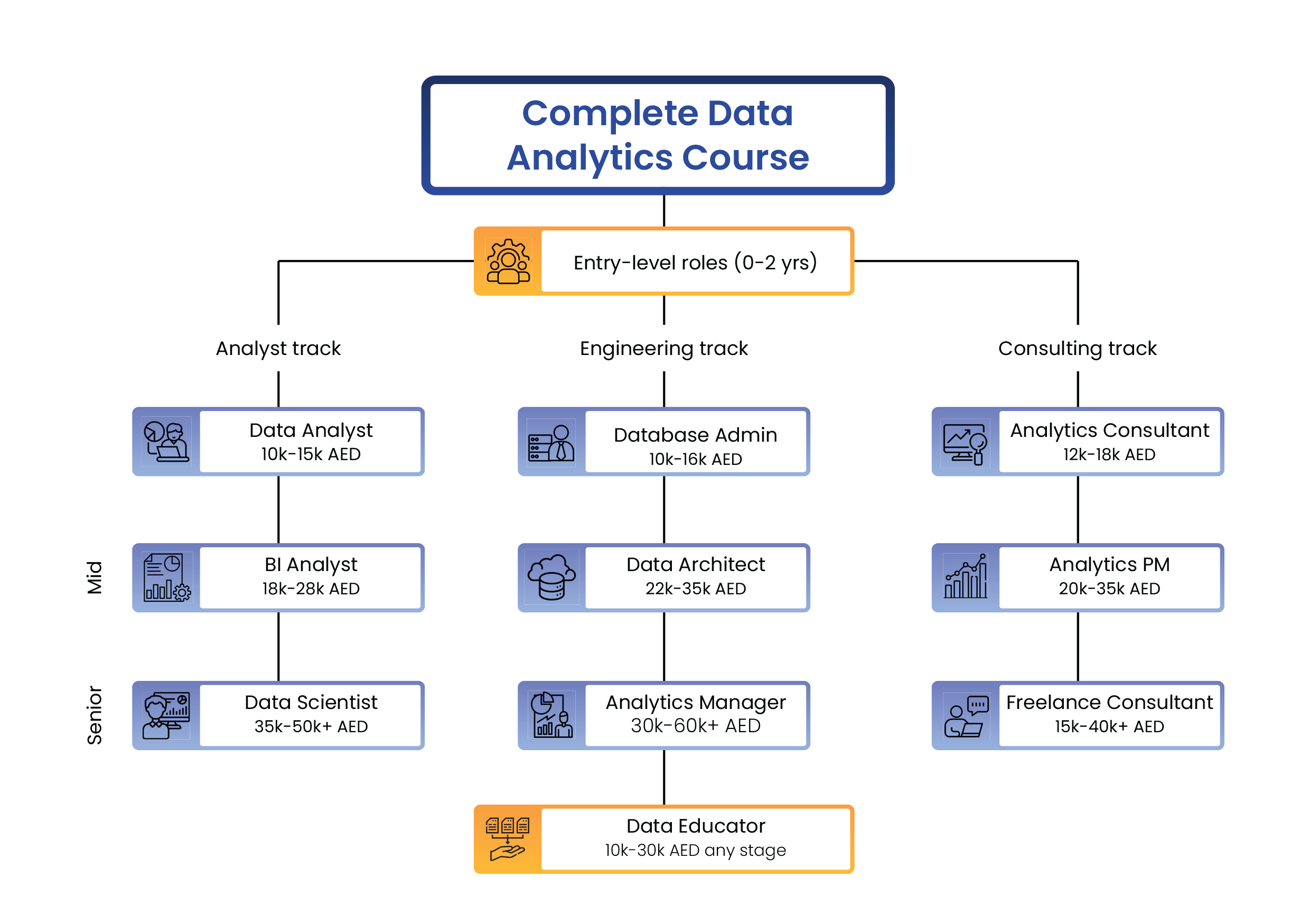
The best role depends on your strengths, tools, and long-term interests.
Comparison of the best job roles after a data analyst course in Dubai
|
Job role |
Entry suitability |
Main tools |
Typical focus |
|
Junior Data Analyst |
Very high |
Excel, SQL, Power BI |
Cleaning, querying, reporting |
|
BI Analyst |
High |
Power BI, Tableau, SQL |
Dashboards, KPI reporting |
|
Reporting Analyst |
High |
Excel, Power BI |
Recurring reports, metric tracking |
|
Operations Analyst |
High |
Excel, SQL, Power BI |
Efficiency, logistics, process improvement |
|
Marketing Analyst |
Medium |
GA4, Excel, SQL, Power BI |
Campaigns, leads, customer behaviour |
|
Financial Data Analyst |
Medium |
Excel, SQL, Power BI, Python |
Finance, transactions, revenue insights |
|
Risk / Fraud Analyst |
Medium |
SQL, Python, BI tools |
Risk scoring, fraud detection |
|
Product Analyst |
Medium |
SQL, BI tools, analytics platforms |
Retention, funnels, and user behaviour |
|
Healthcare Data Analyst |
Medium |
SQL, Excel, BI tools |
Clinical, patient, claims, operations |
|
Analyst Intern / Trainee |
Very high |
Excel, SQL, dashboard basics |
Entry-level learning and support |
A major strength of this career path is industry flexibility. After completing a data analyst course in Dubai, you do not need to rely on one sector alone.
The highest-opportunity sectors after a data analyst course in Dubai
|
Industry |
Why does it hire analysts |
Common entry role |
Higher-growth path |
|
Banking & Fintech |
Risk, fraud, compliance, product insights |
Junior Data Analyst |
Risk Analyst / Financial Analyst |
|
Retail & E-commerce |
Customer behaviour, pricing, and inventory |
Reporting Analyst |
Marketing Analyst / Product Analyst |
|
Logistics & Supply Chain |
Route optimisation, forecasting, operations |
Operations Analyst |
Supply Chain Analyst |
|
Healthcare |
Claims, patient systems, reporting |
Reporting Analyst |
Healthcare Data Analyst |
|
Government & Smart City |
Public service monitoring, planning, and AI operations |
Data Analyst |
Performance / Policy Analytics |
|
Technology / SaaS |
User behaviour, retention, growth |
Junior Analyst |
Product Analyst / Growth Analyst |
If you are a beginner, this practical Roadmap for becoming a Data Analyst will help you understand the right tools and career progression.
Salary depends on four major factors:
Expected salary after a data analyst course in Dubai by Experience Level
|
Level |
Typical monthly salary |
Who does this usually fit |
|
Entry-level / fresher |
AED 8,000-12,000 |
New course graduates, junior analysts, rand eporting support |
|
Early career |
AED 10,000-15,000 |
Candidates with 1–2 years of portfolio, SQL + BI tools |
|
Mid-level analyst |
AED 12,000-20,000 |
Analysts with business experience and a stronger tool depth |
|
Banking/fintech mid-level |
AED 18,000-35,000 |
Analysts with domain knowledge, risk/compliance awareness |
|
Healthcare mid-level |
AED 15,000-28,000 |
Analysts with healthcare systems or reporting specialisation |
|
Retail/e-commerce mid-level |
AED 12,000-25,000 |
Analysts with commercial, CRM, and demand forecasting exposure |
A course alone is useful, but a course plus execution is what gets interviews.
Include 3-5 strong portfolio projects such as:
On your CV and LinkedIn, clearly mention:
Explore the Best Data Analytics Training Institutes in the UAE to choose the right learning path for your analytics career growth.
Do not apply only to “Data Analyst.” Also look for:
Banking, healthcare, logistics, and retail use data differently. Tailor your project examples and CV language to the sector you want.
A data analyst course gets you started. Career growth comes from specialisation.
Why Dubai stands out
Discover the Best Data Analytics Certification Courses for Career Improvement and gain skills that employers actively look for in 2026.
However, Dubai is also competitive. Employers usually prefer candidates who can demonstrate practical work experience, not just course completion. That is why portfolio quality matters so much.
Avoid these if you want faster results:
The best answer to career opportunities after a data analyst course in Dubai is this:
A good course can lead to much more than one job title.
It can open doors to junior analytics, business intelligence, reporting, marketing analytics, finance analytics, operations analytics, healthcare analytics, and product-focused roles.
In Dubai, that opportunity is strengthened by strong digital transformation, tax-free salary structures, and demand across multiple industries.
If you complete your course and then add:
You can turn a course certificate into a serious long-term career path in Dubai.
Understanding the Scope and Future of Data Analytics can help professionals make smarter career decisions in the UAE job market.
The market is not rewarding certificates alone. It is rewarding candidates who can prove they can work with data, explain insight clearly, and support decisions that matter.
After a data analyst course in Dubai, you can apply for roles such as junior data analyst, BI analyst, reporting analyst, operations analyst, marketing analyst, product analyst, financial analyst, support roles, and analyst internships.
A course can help you qualify for interviews, but employers usually expect practical proof of skill. A strong portfolio, SQL, Excel, and Power BI can significantly improve your chances.
Many entry-level roles begin around AED 8,000 to AED 12,000 per month, though some roles may vary by company, tool stack, and industry.
Banking, fintech, retail, e-commerce, logistics, healthcare, and smart city projects are among the strongest sectors for analytics careers in Dubai.
You should focus on SQL, Excel, Power BI, Tableau, and ideally Python. These tools improve both job access and salary growth.
Yes, especially through junior analyst, reporting analyst, and trainee roles. Freshers improve their chances when they have portfolio projects and business-ready dashboards.
After gaining experience, you can grow into a BI analyst, senior data analyst, product analyst, operations analyst, analytics manager, or even data science and analytics engineering paths.