Request a Callback

+971 4380 1666
 Sep 17, 2026
|
Quick Answer: What is Prompt Engineering? Prompt engineering is the process of designing instructions that help AI models generate accurate, relevant, and useful responses. It is one of today's fastest-growing AI skills because it improves productivity across ChatGPT, Gemini, Claude, and Microsoft Copilot. It combines language, logic, and a basic understanding of how Large Language Models (LLMs) process information, and it's fast becoming one of the most in-demand AI career skills for professionals across every industry. |
If you've ever typed something into ChatGPT (OpenAI) and gotten a vague, generic answer, you've already met the problem prompt engineering solves.
The AI didn't misunderstand you. It answered exactly what you asked, and that's the catch. Generative AI is only as good as the instructions it's given.
Ask a vague question, get a vague answer. Ask a clear, well-structured one, and the difference is night and day.
According to Microsoft & LinkedIn, 2024 Work Trend Index, 75% of knowledge workers now use generative AI at work, up from 46% a year earlier.
That's prompt engineering: not a coding skill, just clear communication. It's learning how to "talk" to an AI so it gives you what you need, the first time.
This guide is based on current prompt engineering practices used with ChatGPT, Claude AI (Anthropic), Google Gemini, Microsoft Copilot, and enterprise Large Language Model (LLM) workflows, combined with hiring trends from 2026 AI job market reports.
|
Table of Contents
|
|
1. What is Prompt Engineering? Definition, Meaning, and Examples
2. How Does Prompt Engineering Work? 2.1 Prompt Engineering vs Context Engineering: What's the Difference? 2.2 What is the Prompt Engineering Life Cycle? 2.3 How a Marketing Team Uses Prompt Engineering? 3. What Are the Most Effective Prompt Engineering Techniques? 4. What Skills Do You Need to Become Good at Prompt Engineering? 4.1 How Does Prompt Engineering Work Across Different AI Tools? 5. What Career Opportunities Are Available After Learning Prompt Engineering? 5.1 What Are the Prompt Engineering Career Opportunities in the GCC? 5.2 What is the Average Prompt Engineer Salary Across Countries in 2026? 5.3 Which Industries Are Hiring Prompt Engineers in 2026? 6. How is Prompt Engineering Different from AI Agent Engineering? 7. How Can You Learn Prompt Engineering? 7.1 What Are the Most Common Mistakes When Learning Prompt Engineering? 8. Why Does Prompt Engineering Matter for Professionals? 9. Key Takeaways 10. FAQs: What is Prompt Engineering? A Complete Guide |
Prompt engineering is the process of crafting inputs called prompts that guide an AI model to produce the response you actually want. Think of it as the bridge between human intent and machine output.
Every time you interact with an AI assistant, you're essentially giving it a set of instructions. Prompt engineering is about making those instructions specific enough, structured enough, and contextual enough that the AI has no room to guess.
In simple terms:
This applies whether you're using ChatGPT to draft an email, Google Gemini to summarise a report, Microsoft Copilot to build a spreadsheet formula, or Claude AI to analyse a document. The underlying skill prompt design stays the same across tools.
If you're looking to apply AI in your profession rather than just experiment with it, an industry-focused Generative AI certification can help you develop practical skills for marketing, HR, finance, operations, and other business functions.
|
Example 1: Email Writing Write a professional email to a client regarding the project delay and an update about the timeline. Weak Prompt Write an email. Strong Prompt Act as a project manager. Write a professional email to a client explaining that the project will be delayed by three days due to supplier issues. Apologise briefly, outline the revised timeline, and reassure the client that quality will not be affected. Keep the email under 150 words. Example 2: Learning Give a short explanation about machine learning to a 12-year-old child. Weak Prompt Explain machine learning. Strong Prompt Explain machine learning to a 12-year-old using a football coaching analogy. Keep the explanation under 200 words and include one simple real-world example. Notice the pattern: strong prompts define the role, the format, the audience, and the constraints. That's prompt design in action. |
Prompt engineering can be your entry point into acareer in artificial intelligence, one with strong, growing opportunities across nearly every industry.
"AI is the new electricity. Just as electricity transformed almost everything 100 years ago, today I actually have a hard time thinking of an industry that I don't think AI will transform in the next several years."
- Andrew Ng, Founder of DeepLearning.AI and Co-founder of Coursera
To understand how prompt engineering works, you first need to understand how Large Language Models (LLMs) generate responses.
LLMs are trained on huge amounts of text and learn to predict the most likely next word based on patterns. They don't "understand" language the way humans do; they respond based on probability, context, and how the input is structured.
This is why the way you phrase a prompt changes the output so dramatically. A well-engineered prompt:
Defines the goal: what output you actually want (a list, a summary, a plan, code, etc.).
Adds constraints: tone, length, format, audience, or specific requirements.
Provides examples where useful: so the model has a reference point.
When these elements are missing, the model has to guess your intent, and that's usually where generic or irrelevant answers come from.
This is where context engineering comes in. While prompt engineering focuses on writing a clear instruction, context engineering ensures the AI has the right information, such as documents, conversation history, and previous instructions, to generate better responses.
Together, prompt engineering and context engineering help improve the quality, accuracy, and relevance of AI outputs.
The difference between Prompt Engineering and Context Engineering
| Prompt Engineering |
Context Engineering
|
| Focuses on writing a clear and effective prompt. |
Focuses on providing the AI with the right background information.
|
| Works with a single instruction or query. |
Uses documents, conversation history, examples, and previous instructions.
|
| Improves the quality of an individual response. |
Improves consistency and accuracy across an entire conversation or workflow.
|
| Commonly used by everyday AI users. |
More commonly used in AI applications, agents, and enterprise systems.
|
| Example: "Summarise this report in 100 words." |
Example: Give the AI the report, company guidelines, and previous discussions before asking for the summary.
|
Asartificial intelligence applications become more embedded in daily workflows, understanding both prompt engineering and context engineering is what separates a one-off good result from consistently reliable AI output.
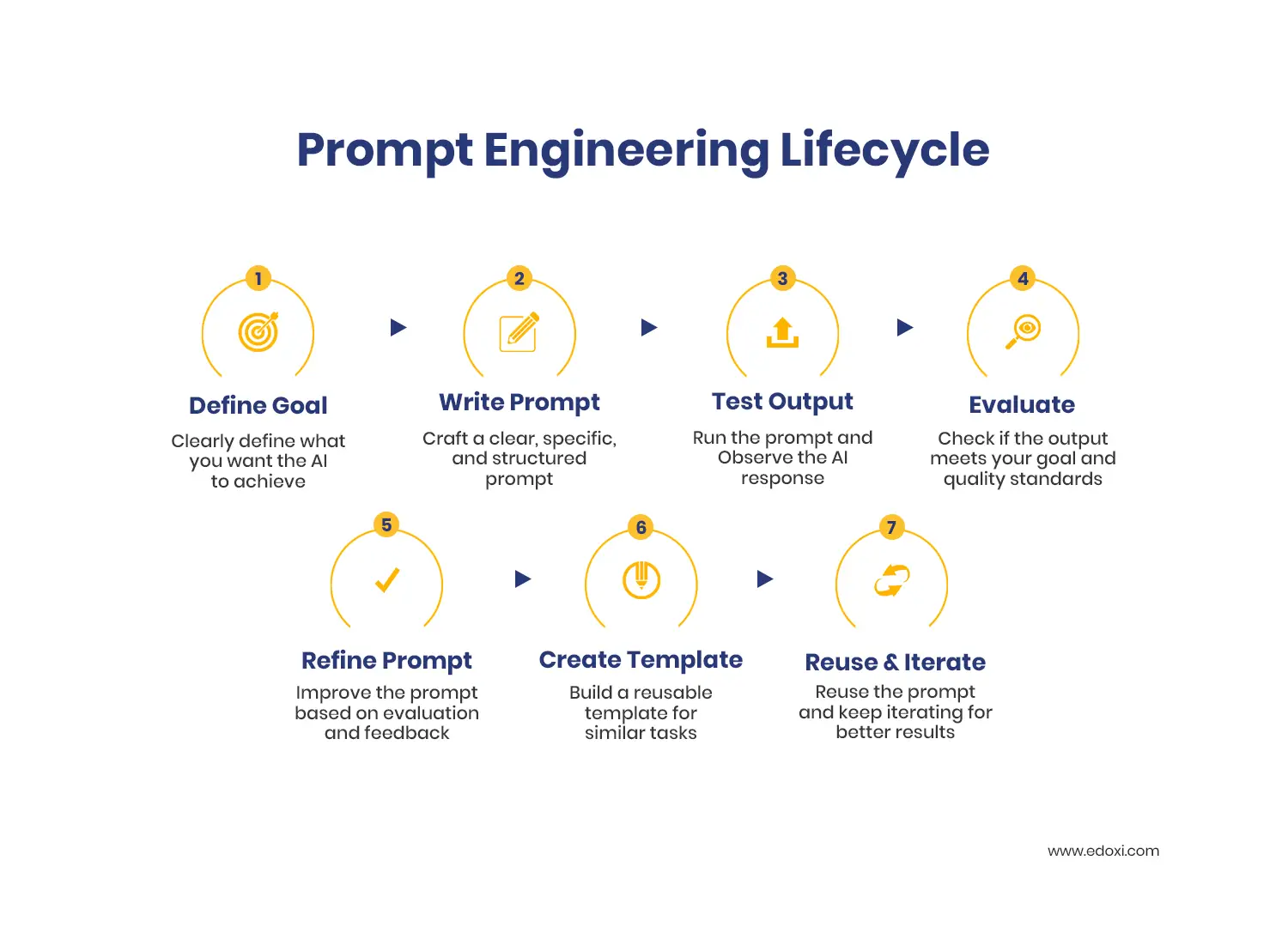
The prompt engineering life cycle includes the following 7 stages:
Define the goal: Know exactly what output you need before writing anything.
Add context: Give the AI role, audience, and background details.
Draft the prompt: Write a clear, structured first version.
Test the response: Run it and see what comes back.
Evaluate the output: Check accuracy, tone, and format against what you wanted.
Refine and iterate: Adjust wording, add examples, or tighten constraints.
Finalise or template it: Save the version that works as a reusable prompt template.
The prompt engineering life cycle is illustrated in the infographics below:
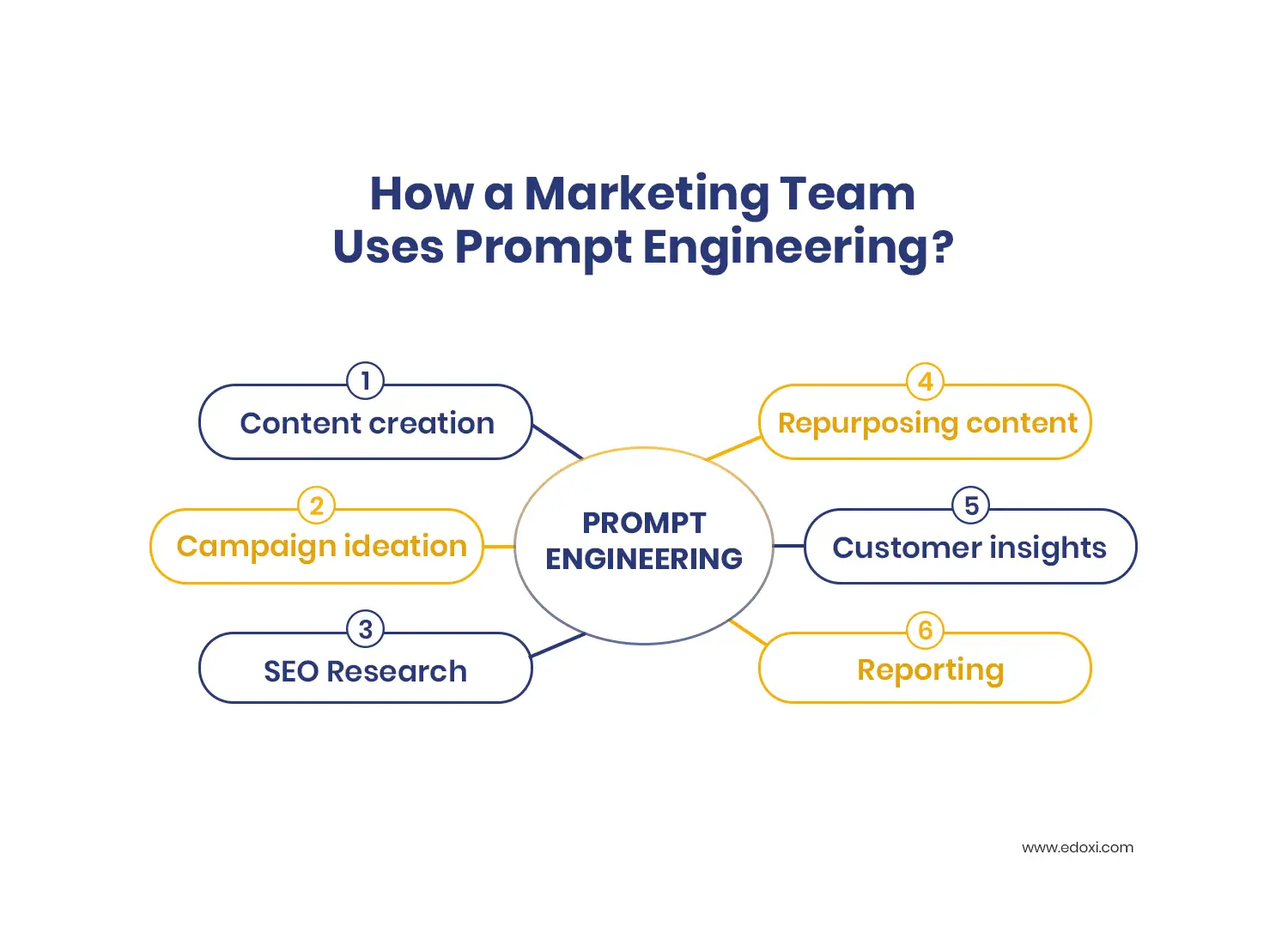
A marketing team uses prompt engineering across almost every stage of their workflow, not just for writing copy. A few real examples of prompt engineering in digital marketing are given below:
Teams get better results by creating reusable prompt templates for recurring tasks instead of writing new prompts every time. This turns prompt engineering into a consistent productivity habit.
As marketing roles evolve, teams that invest in prompt engineering now are also closing the AI skills gaps and future jobs are likely to demand, staying ahead of a shift that's already reshaping how content and campaigns get built
The process of how the marketing team uses prompt engineering is presented in the infographics below:
Once you understand the basics, the next step is learning the actual techniques that separate an average prompt from a great one.
This is the simplest form: you give the AI a task with no examples, relying entirely on its existing training.
Example: "Write a professional email declining a meeting invite."
Zero-shot prompting works well for straightforward, common tasks but can produce inconsistent results for anything nuanced or highly specific.
Here, you provide the AI with one or more examples of the output style or format you want before asking it to complete the task.
Example: "Here are two examples of how we write product descriptions. Using the same tone and structure, write a description for this new item: [details]."
Few-shot prompting is one of the most effective prompt engineering techniques because it removes guesswork; the model has a direct reference to follow.
This technique asks the AI to reason through a problem step by step rather than jumping straight to an answer. It's particularly useful for calculations, logic-based tasks, or multi-step planning.
Example: "Walk through this budget calculation step by step, showing your reasoning before giving the final total."
Chain-of-thought prompting significantly improves AI reasoning accuracy on complex tasks.
As you get more comfortable, you'll start building reusable prompt templates and structured formats you can plug new information into repeatedly. This is especially useful in corporate AI training settings, where teams standardise how they use AI assistants across departments.
|
Prompt Template A simple template structure might look like: "Act as a [role]. Your task is to [goal]. The audience is [audience]. Keep the tone [tone] and the format as [format]. Here is the context: [details]." |
The skills that you need to become good at prompt engineering are the following:
These are transferable skills. Someone good at briefing a colleague or writing a clear project spec usually picks up prompt engineering quickly, because the underlying skill of communicating intent clearly is the same.
Prompt engineering works by tailoring instructions to each AI tool's strengths. Whether you're using ChatGPT, Claude, Gemini, or Midjourney, well-crafted prompts help the AI produce more accurate, relevant, and high-quality results.
An Applied Generative AI Training programme exposes you to real business case studies, helping you understand how organisations use AI to automate tasks, improve decision-making, and enhance productivity.
Learning to adapt your prompt design slightly across these platforms is a practical extension of core AI prompt writing skills.
92% of developers are using AI coding tools both at work and outside work, as stated in the GitHub 2024 Developer Survey.
According to Microsoft & LinkedIn, the 2024 Work Trend Index, 66% of business leaders say they would not hire someone without AI skills, and 71% prefer candidates with AI skills over more experienced candidates without them.
The top 12 career opportunities that you can get after learning Prompt Engineering are listed below:
Some organisations are now hiring dedicated prompt engineers or AI specialists, particularly in tech-heavy industries.
For professionals worried about jobs at risk of AI replacement, prompt engineering offers a practical way to move from being replaced by AI to working alongside it, often the deciding factor in who stays valuable as automation spreads.
"What we have is a new natural user interface that supports text, speech, images, and video as input and output, with new reasoning and planning capabilities that help us understand complex context and complete complex tasks."
- Satya Nadella, Chairman & CEO, Microsoft (Microsoft Build 2024)
For professionals in the region, building these skills early isn't just about career growth; it's increasingly tied to job security in the age of AI, as more roles come to expect at least a working knowledge of generative AI tools.
The average Prompt Engineer salary across countries like the United States, UAE, United Kingdom, Singapore, Canada, Australia, Germany, and India is listed in the table below:
Prompt Engineer Salary Across Countries (2026)
| Country | Average Annual Salary |
Average Monthly Salary
|
| United States | USD 115,000–140,000 |
USD 9,600–11,700
|
| UAE | AED 120,000–180,000 |
AED 10,000–15,000
|
| United Kingdom | GBP 60,000–95,000 |
GBP 5,000–7,900
|
| Singapore | SGD 90,000–130,000 |
SGD 7,500–10,800
|
| Canada | CAD 90,000–120,000 |
CAD 7,500–10,000
|
| Australia | AUD 100,000–130,000 |
AUD 8,300–10,800
|
| Germany | EUR 65,000–85,000 |
EUR 5,400–7,100
|
| India | ₹12–25 LPA | ₹1.0–2.1 lakh |
Key insights from the table:
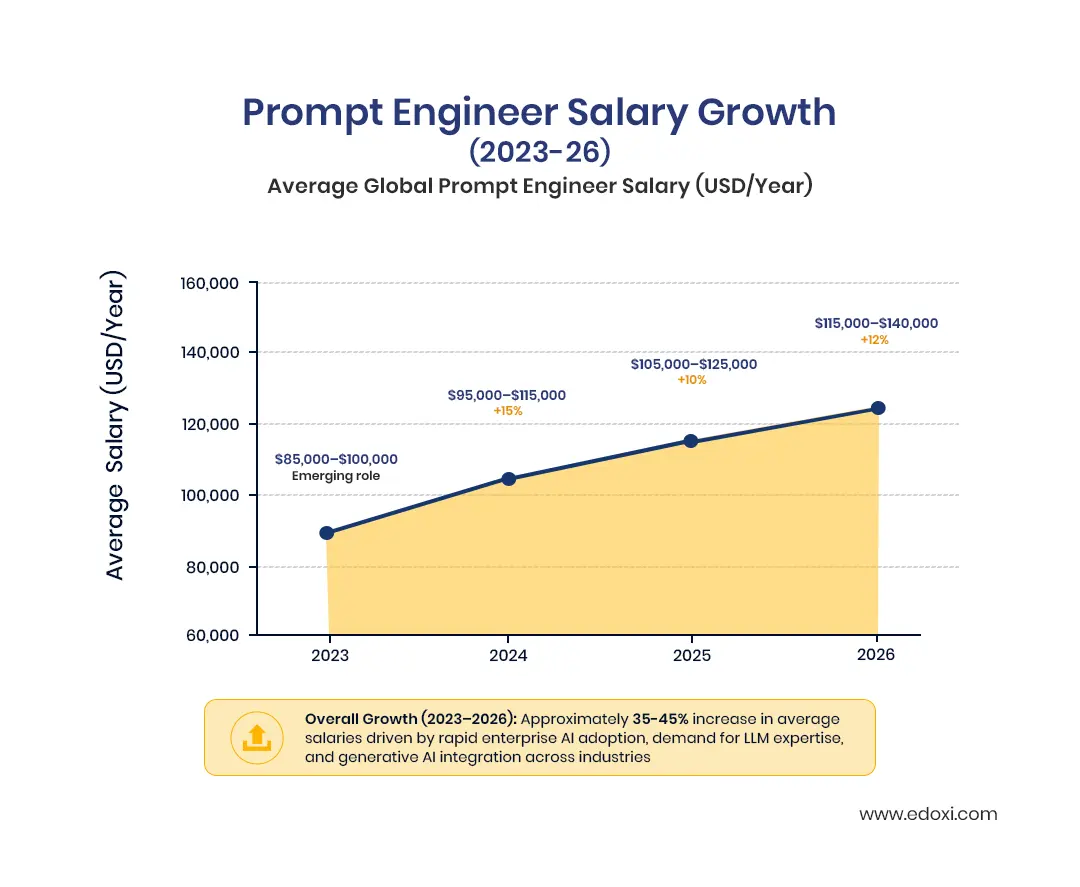
A Prompt Engineer salary growth from 2023 to 2026 is presented in the line graph below:
The top industries hiring prompt engineers in 2026 are listed below:
1. Enterprise SaaS and tech
Enterprise SaaS and tech remains the largest source of prompt engineering roles by volume, as software companies build AI features into their products and need people who can make those features work reliably.
2. Healthcare
AI is increasingly used for diagnostics and patient-facing tools, so accuracy matters more here than almost anywhere else. Prompt engineers in healthcare typically work alongside clinical safety and compliance teams.
3. Financial services
Banks, insurers, and fintech firms use AI for document processing, customer service, and risk analysis, and regulatory requirements mean prompts need to be tightly controlled and auditable.
4. Legal and professional services
Legal tech was slow to adopt AI, but document automation, contract analysis, and legal research have become genuine product categories, driving a wave of hiring in this space.
5. Government and public sector
AI deployment in government settings is growing, though roles here often come with clearance requirements that narrow the candidate pool.
6. Education, retail, and gaming
Education, retail, and gaming sectors are hiring too, using AI for adaptive learning content, personalised shopping experiences, and content generation, though at a smaller scale than the sectors above.
Demand continues to grow. According to SPG Resourcing (reported by TechRadar Pro, 2026), AI Prompt Engineer job postings in the UK increased by 180% year over year, reflecting the rapid expansion of AI-related roles.
Beyond dedicated roles, everyday AI examples and applications, like AI-assisted customer support, automated reporting, and content drafting, show just how deeply prompting has already spread into normal business operations across these industries.
The major difference between prompt engineering and AI agent engineering is stated in the table below:
| Aspect | Prompt Engineering |
AI Agent Engineering
|
| Core focus | Crafting a single, clear instruction |
Designing a full multi-step workflow
|
| Interaction style | One request, one response |
Ongoing planning, tool use, and decisions
|
| Human involvement | Needed at each step |
Minimal once the agent is set up
|
| Skill type | Communication and structure |
Systems thinking, tools/APIs, logic
|
| Output | A specific piece of content or answer |
A completed task or goal, achieved autonomously
|
| Best for beginners | Yes, the foundational skill |
Usually the next step after prompting
|
For beginners, the good news is that prompt engineering doesn't require a technical degree or coding background. A practical learning path looks like this:
Start with free experimentation: Use ChatGPT, Gemini, or Copilot for everyday tasks and notice what works.
Study prompt structures: Learn the role–goal–context–format pattern used throughout this guide.
Practise with real work tasks: Apply prompting to something you already do, like writing reports or planning content.
Take a structured course: A guided prompt engineering course accelerates learning by covering techniques, use cases, and hands-on practice in a fraction of the time self-learning takes.
Professionals in the UAE can gain formal prompt engineering skills through structured AI training in Dubai. These corporate programmes and short courses focus on practical, workplace-ready applications instead of theoretical AI concepts.
The most common mistakes beginners make when learning prompt engineering are:
1. Being too vague
Prompts like "write something about marketing" or "help me with this data" leave the AI guessing. Vague input almost always produces vague, generic output.
2. Skipping context
Jumping straight into a request without telling the AI who it should "be," who the audience is, or what the output is for forces the model to fill in gaps with assumptions, and those assumptions are often wrong.
3. Treating the first response as final
The first output is a draft, not a finished product. Beginners often accept a mediocre answer instead of refining the prompt and asking again.
4. Overloading a single prompt
Cramming five different requirements into one instruction- tone, format, structure, length, and content- often produces a muddled response. Breaking a complex task into smaller steps usually works better.
5. Ignoring format instructions
Not specifying whether you want a list, a table, a short paragraph, or a formal report is one of the most common reasons outputs feel "off," even when the content itself is accurate.
6. Assuming every AI tool behaves identically
A prompt that works well in ChatGPT might need slight adjustments in Gemini or Copilot. Beginners often copy-paste the same prompt everywhere and get inconsistent results.
7. Not fact-checking outputs
AI can sound confident while being wrong. Treating every response as accurate without verification, especially for data, statistics, or anything client-facing, is a habit that catches people out.
8. Giving up too early
Prompt engineering is iterative. A weak first attempt doesn't mean the tool "can't do it"; it usually just means the prompt needs another round of refinement.
Instead of learning through trial and error alone, consider a Professional Prompt Engineering Training program that teaches structured prompting techniques, AI evaluation methods, and practical workflows used across leading AI platforms.
Prompt engineering helps professionals communicate effectively with AI to generate accurate, faster, and higher-quality outputs, improving productivity, decision-making, and problem-solving across a wide range of industries.
AI adoption has moved fast. Tools like ChatGPT, Copilot, and Gemini are now built into everyday workflows: email, spreadsheets, presentations, research, and customer support.
According to McKinsey, The State of AI 2025, 78% of organisations use AI in at least one business function, up from 55% the previous year.
Here's why prompt engineering has become a genuine AI productivity skill rather than a niche technical one:
In short, prompt engineering has quietly become one of the most practical AI skills for professionals, regardless of industry or job title.
Prompt engineering is simply the skill of giving AI clear instructions so it delivers better results. Anyone can learn it, regardless of their role or technical background.
As AI tools like ChatGPT, Copilot, Gemini, and Claude become part of everyday work, prompt engineering helps you get more accurate and useful outputs. It's a simple skill with a big impact and one of the best ways to start building AI literacy.
"Someone coined the pretentious term 'prompt engineering', but it was only ever one thing: the refinement of language to express an idea clearly enough that it can be acted upon."
- Dan Fitzpatrick, AI educator and author, Forbes (2026)