Request a Callback

+971 4380 1666
 Nov 02, 2026
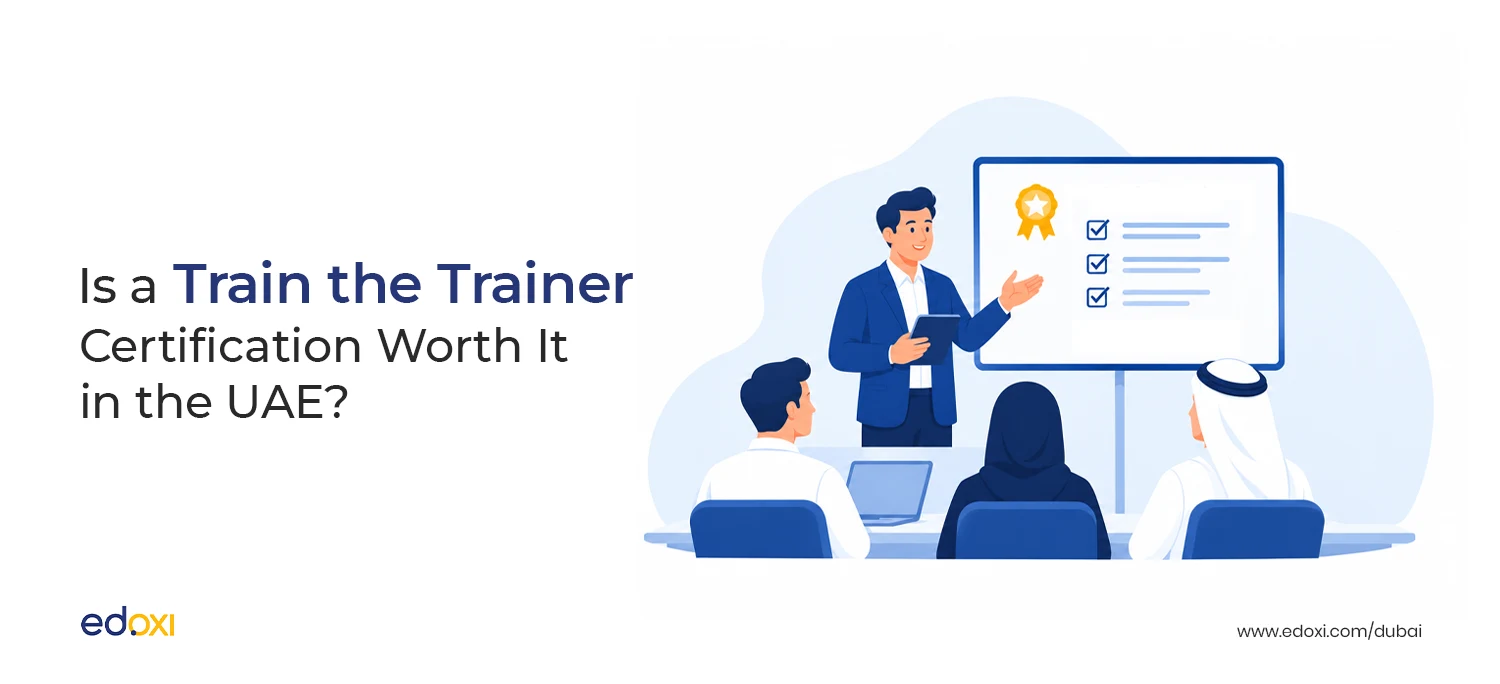
Yes, if training is part of your career. Train the Trainer certification in the UAE is worth it if you regularly train employees, want to move into corporate Learning and Development, or plan to work as a professional trainer.
It builds adult-learning, instructional design, and facilitation skills. It is not worth the cost if you never plan to train others.
Imagine a team lead in Business Bay. She knows her job better than anyone in the office. On Monday, she must teach twelve new joiners how to do it. She opens her slides, looks at the room, and her mind goes blank.
Knowing a job and teaching a job are two different skills. That gap is why so many professionals search for Train the Trainer certification in the UAE.
This guide gives you a straight answer. You will see what the course teaches, who gains most, what to check before you pay, and how to decide in five minutes.
|
Table of Contents
|
|
1. What Is Train the Trainer Certification in the UAE?
1.1 Is TOT the Same as Train the Trainer Certification in UAE? 2. Is Train the Trainer Certification in UAE Worth It? 2.1. How Do You Measure the Return on Trainer Certification? 2.2. What Are the Benefits and Key Considerations of Train the Trainer Certification? 3. What Skills Do You Learn in a Train the Trainer Course? 3.1. How Can Organisations Measure the ROI of Train the Trainer Certification? 4. Who Should Take a Train the Trainer Certification? 4.1. Can I Become a Professional Trainer Without Teaching Experience? 5. What Jobs Can I Get After Train the Trainer Certification? 6. How Much Does a Train the Trainer Course Cost in the UAE? 7. How Do I Become a Certified Trainer in Dubai? 7.1. What Qualifications Do You Need to Become a Trainer in the UAE? 8. Key Takeaways 9. FAQs: Is a Train-the-Trainer Certification Worth It in the UAE? |
Train the Trainer certification in the UAE is a professional development qualification that helps individuals develop adult-learning, instructional design, facilitation, and training evaluation skills.
It is particularly useful for HR professionals, team leaders, subject matter experts, and aspiring corporate trainers.
However, certification alone does not guarantee employment or replace any professional licence required to conduct training activities independently.
Adults learn differently from children. They want to know why a topic matters. They want to use it tomorrow. A trainer who ignores this loses the class in ten minutes.
Edoxi offers a 16-hour CPD-accredited (Continuing Professional Development) Train the Trainer Course in Dubai through its KHDA-permitted (Knowledge and Human Development Authority (Dubai, UAE)) training institute.
The programme has eight modules on adult learning, training needs analysis, instructional design, facilitation and evaluation. Learners practise presenting in small groups of five to eight and get feedback.
Assessment is through practical activities, with no separate written exam. Participants receive a course completion certificate after meeting the programme requirements.
The two labels mean different things. CPD accreditation is a quality mark for the learning. KHDA permission means the institute may operate as a training provider in Dubai. Neither one, on its own, is a personal licence to work as a trainer.
Often, yes. TOT (Training of Trainers) and TTT (Train the Trainer) are commonly used for the same idea: teaching people how to teach others. Course content and level still differ by provider.
Difference Between TOT and Train the Trainer (TTT) Certification
| Comparison | TOT (Training of Trainers) |
TTT (Train the Trainer)
|
| Full form | Training of Trainers | Train the Trainer |
| Purpose | Prepares people to train others |
Develops professional training skills
|
| Focus | Trainer development and knowledge transfer |
Adult learning, delivery and facilitation
|
| Common use | Government and development programmes |
Corporate and professional training
|
| Target audience | Trainers, educators and facilitators |
HR professionals, team leaders and subject experts
|
Compare the outline, not just the name.
Yes, if you will train people several times a year. The course costs time and money, but it can speed up your move into trainer, L&D, and team-lead roles. If you will never train anyone, skip it.
The World Economic Forum’s Future of Jobs Report 2025 says 59 out of every 100 workers will need training by 2030. It also found that 63% of employers see skills gaps as their biggest barrier to change.
Dubai shows this clearly. In April 2026, Digital Dubai launched the AI+ programme to train 50,000 government employees. Someone has to design and deliver sessions at that scale.
Who Should Consider a Train-the-Trainer Certification in the UAE?
| Your Situation |
Recommendation
|
| You regularly train employees | Worth it |
| You want to enter corporate L&D | Worth it |
| You are a subject expert who wants to teach | Worth it |
| You want to become a freelance trainer |
Worth it, with additional licensing considerations
|
| You have no plans to train others | Not essential |
Track results before and after training. The Kirkpatrick model gives four checkpoints: reaction, learning, behaviour, and results (ResearchGate).
For a trainer, results might be faster onboarding, fewer errors, or better test scores. For you, results might be a new role or more training requests. Set one or two measures before you enrol, so you can see whether the cost paid off.
The main gain is skill and credibility. The main costs are fees, time, and uneven quality between providers.
Advantages and Things to Consider of Train-the-Trainer Certification
| Advantages |
Things to Consider
|
| Structured training delivery methods |
Requires an investment of time and course fees
|
| Stronger profile for trainer and L&D roles |
Career opportunities also depend on experience and subject expertise
|
| Improved presentation and facilitation confidence |
Skills develop further through continued practice
|
| Transferable skills across industries |
Course outcomes depend on provider quality and practical training
|
You learn how adults learn, how to plan a session, how to present with confidence, how to handle tough questions, and how to measure results.
Most solid courses cover five areas:
Dubai classrooms are mixed, with many nationalities in one room. Good courses teach you to adapt examples, pace, and words so everyone follows.
Organisations can measure the return on investment (ROI) of Train the Trainer certification by tracking improvements in training efficiency, employee learning, and workplace performance.
Key indicators include:
When these improvements are compared against the course fees and time invested, organisations can better determine whether the certification delivers measurable value.
HR and L&D staff, team leaders, subject experts, teachers moving into corporate work, and freelancers. Anyone who must teach adults at work gains the most.
Is Train-the-Trainer Certification Worth It for Different Professionals?
| Professional Background |
Is Certification Worthwhile?
|
| HR or L&D executive |
Yes, develops training design and delivery skills
|
| Team leader or supervisor |
Yes, improves employee onboarding
|
| Engineer, accountant or IT expert |
Yes, helps transfer technical knowledge
|
| Teacher moving into corporate training |
Yes, builds adult-learning skills
|
| Freelance consultant |
Yes, supports professional credibility
|
| Experienced corporate trainer |
Depends, advanced training may be more useful
|
| Someone who will never train others | Not essential |
Freelancers often add a Professional Trainer Certification in Dubai before they pitch to companies. A clear credential can shorten the trust-building stage.
Vasudha Khandeparkar, VP of Value Based Management at RAKBANK, told Khaleej Times (March 2026): “Reskilling should not begin when your job is at risk.”
Yes. Many beginner courses do not ask for teaching experience, and Edoxi’s course page lists no prerequisites. Subject knowledge matters more.
Check each provider’s entry rules.
You learn by doing: short practice talks, feedback, then a second try. Start small by teaching a process to two colleagues.
Corporate trainer, L&D specialist, training coordinator, instructional designer, and training manager are common routes. The certificate supports your application. It does not guarantee a job.
Banks, hospitals, airlines, hotels, and government bodies in Dubai train staff all year. The Dubai Logistics Academy at Dubai Customs, for example, delivered 601 training programmes in the first half of 2026.
A Train the Trainer certificate can support applications for corporate trainer and L&D positions, but it does not automatically qualify someone for every training role.
Employers may also require industry experience, subject expertise, instructional design skills, or additional qualifications.
Career Paths and Skills Required for Each Role
| Career Path |
Additional Skills Employers May Expect
|
| Corporate trainer |
Industry knowledge and facilitation
|
| L&D specialist |
Training needs analysis and programme design
|
| Training coordinator |
Scheduling and training administration
|
| Instructional designer |
ADDIE, learning design and digital tools
|
| Training manager |
Leadership, budgeting and performance measurement
|
| Freelance trainer |
Subject expertise, client acquisition and applicable licensing
|
Khamis Al Muhairi, Director of Human Resources at Dubai Customs, said: “Talent development is fundamental to strengthening Dubai’s competitiveness and sustaining its economic growth.” (July 2026, WAM)
Fees vary by provider, hours, accreditation, and class size, so no single price fits everyone. Ask for the full cost, then compare what you get for each hour.
Five things move the price: the number of hours, accreditation such as CPD, class size, classroom or online delivery, and any extra exam or certificate fee.
Small groups can cost more per head, but they give you more time on your feet. Ask each provider for the current fee and what it covers, so you can compare like with like.
Train-the-Trainer Course Formats: Benefits and Considerations
| Format | Best for | Watch out for |
| Short public course | Beginners and team leads |
Big groups mean less practice time
|
| Longer certificate programme | Career switchers |
Higher fees, more weeks to commit
|
| In-house corporate programme | HR teams training several staff |
Content must match your industry
|
Use this checklist when you compare providers:
Choose a recognised course, attend and practise, finish the assessment, then start training quickly. Certification opens doors. Practice keeps them open.
Decide your goal: corporate trainer, L&D role, or training your own team.
Shortlist providers: Check KHDA permission, CPD accreditation, and the full outline.
Look for modules on adult learning, design, delivery, and evaluation.
Join a class with live practice and feedback. Small groups help.
Finish the assessment: Some courses use practical tasks instead of a written exam.
Run your first real session within a month and collect feedback.
Add your sessions to your CV and LinkedIn profile.
A course certificate shows what you learned. It is not a work licence. Freelancers also need the right permit or licence to work on their own in Dubai, so check with the relevant authority before you sign your first client.
Most employers do not ask for one fixed qualification. They look for subject knowledge, proof that you can teach, and clear communication.
A degree helps for some roles. A trainer certificate shows the teaching side.