Request a Callback

+97466873399
 Jul 27, 2026
Key Takeaways
|
Selecting the right corporate data science training provider shapes how well your organisation turns raw data into decisions. Before evaluating providers, it's important to understand what data science is and how it works. Data science combines statistical analysis, programming, machine learning, and domain expertise to extract valuable insights from data. It follows a structured process of collecting, cleaning, analysing, modelling, and visualising data to support informed business decisions. With this foundation, organisations can better assess whether a training provider covers the skills and tools needed to solve real-world business challenges.
Dubai now hosts dozens of training providers, from boutique consultancies to large institutes, so a structured evaluation process matters more than ever.
This guide walks through twelve practical steps, backed by UAE market context, to help L&D leaders and department heads make a confident, defensible choice.
Corporate data science training has become a strategic priority in Dubai as the UAE accelerates its transition toward an AI-driven, data-centric economy. Through initiatives like the UAE National Strategy for Artificial Intelligence 2031, the government is investing in AI adoption and workforce development, with a goal of contributing approximately AED 335 billion to the economy by 2031.
This shift is reflected in the job market. According to PwC's 2026 AI Jobs Barometer, AI-related job postings in the UAE have more than tripled as a share of total vacancies between 2021 and 2025, while employers increasingly expect data and top AI skills across functions and not just within IT teams.
For businesses, this means that developing internal data science capabilities is no longer optional. Structured corporate training helps organisations bridge skills gaps, improve decision-making, accelerate Artificial Intelligence adoption, and reduce reliance on external talent in an increasingly competitive market.
Check out: How to Make a Career Switch into Data Science by Upskilling?
Choosing the right corporate data science training provider is now a strategic investment in long-term business growth and competitiveness. The following are 12 steps you should follow before choosing the right training institute;
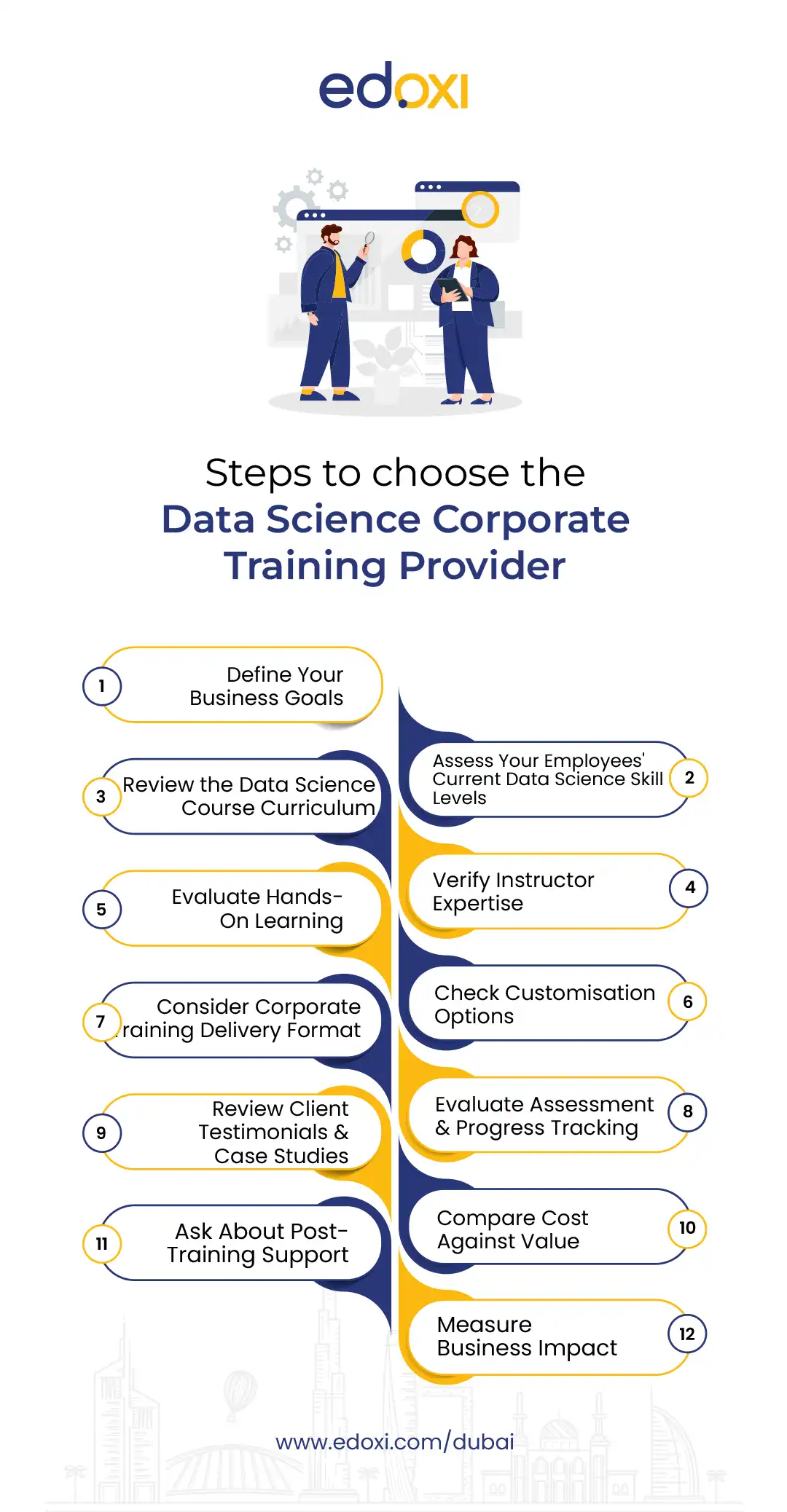
Start by identifying why your organisation needs data science training. Common goals include:
Clear objectives make it easier to shortlist suitable providers and to measure success later.
Segment your workforce before you shop for a course. Most organisations have a mix of:
A quality provider offers customised learning paths for each group. It does not sell a single one-size-fits-all Data Science curriculum to everyone.
Check out: Data Science vs Data Analytics | What's the Difference?
An effective corporate data science programme should cover practical, industry-relevant topics such as:
Make sure the curriculum matches your organisation's goals rather than covering theory for its own sake. Edoxi's Data Science Course in Dubai structures learning around four portfolio-style projects, Python data analysis, database implementation, dashboards, and a machine learning model, so learners leave with applied outputs, not just notes.
Check Out: Data Science vs Machine Learning: What's the Difference?
Experienced trainers make a significant difference to outcomes. Look for instructors who bring:
Trainers who have both taught and worked in industry tend to deliver the most relevant learning experience, especially when they can translate concepts into UAE business scenarios.
Corporate training should emphasise practical application over lecture time. Ask whether the programme includes:
Practical scenario: Consider a Dubai-based retail chain that wants its operations team to forecast stock demand more accurately. A theory-heavy Data Science course might explain regression models in the abstract.
In contrast, a hands-on program, would have the team clean an actual sales dataset, build a demand-forecasting model, and present findings to a manager, mirroring the exact workflow they will use on the job. This applied learning that changes day-to-day decision-making, not just test scores.
Every company has different requirements. Choose a provider that can tailor:
Customised training delivers greater relevance and better business outcomes than a generic public-batch course repurposed for a company audience.
Determine which learning format best suits your organisation's operating rhythm.
| Delivery Format | Best For | Trade-off to Consider |
| On-site corporate training | Teams that learn better together, in-office culture building |
Requires venue and scheduling coordination
|
| Virtual instructor-led training | Distributed or multi-emirate teams |
Needs strong facilitation to keep engagement high
|
| Hybrid learning | Mixed in-office/remote workforces |
Slightly more complex logistics to manage
|
| Weekend or evening sessions | Teams that cannot pause daily operations |
Slower pace, longer overall timeline
|
| Intensive boot camps | Urgent skill gaps, project deadlines |
High time commitment in a short window
|
Flexibility here helps minimise disruption to business operations, particularly for customer-facing or operational teams that cannot be pulled offline for long stretches.
A strong training provider measures learning outcomes through:
Progress tracking helps managers understand the return on investment in training and identify who may need extra support.
Look for evidence of successful corporate training engagements, such as:
Consistent positive feedback across multiple sources is a stronger signal than a handful of standout quotes.
The lowest-priced option is not always the best one. Weigh factors such as:
Focus on long-term business value rather than upfront cost alone. A cheaper course that fails to change behaviour on the job is not actually the cheaper option once you factor in the wasted training hours.
Find out: Highest Paying Data Science Jobs
Learning should continue after the course ends. A good provider may offer:
Ongoing support helps employees retain and actually apply new skills once they return to daily workload pressure.
Before selecting a provider, decide how you will evaluate success. Useful metrics include:
Defining success metrics in advance ensures the training delivers measurable business benefits rather than a one-off event that is hard to justify at renewal time.
The cost of corporate data science training in Dubai varies depending on factors such as the course duration, level of customisation, delivery format, instructor expertise, and the number of employees being trained. While there is no fixed pricing model, organisations can generally expect the following ranges.
| Training Type |
Typical Cost (AED)
|
| Half-day workshop | 2,500–6,000 |
| One-day corporate workshop | 5,000–12,000 |
| 2–5 day instructor-led training | 10,000–35,000 |
| Customised corporate program | 20,000–75,000+ |
| Enterprise-wide training (multiple teams/locations) |
Custom quotation
|
Note: These are indicative market ranges in Dubai and may vary based on the provider, course scope, and delivery requirements.
Read: Top 8 Data Science Certifications To Advance Your Career
Before making your final decision, confirm that the provider offers:
| Criteria | Confirmed? |
| Experienced industry trainers | ☐ |
| Practical, project-based learning | ☐ |
| Customised corporate programmes | ☐ |
| Flexible delivery options (on-site, virtual, hybrid) | ☐ |
| Modern data science and AI curriculum | ☐ |
| Assessment and progress tracking | ☐ |
| Verifiable client testimonials | ☐ |
| Recognised local accreditation (e.g. KHDA in Dubai) | ☐ |
| Post-training support | ☐ |
| Transparent, published pricing structure | ☐ |
| Measurable learning outcomes | ☐ |
Choosing a corporate data science training provider in Dubai requires more than comparing course fees. By clearly defining Data Science Career Path, business goals, assessing current skill levels, verifying instructor expertise, prioritising hands-on learning, and confirming credible local accreditation, organisations can select a partner suited to their needs. This kind of structured evaluation also aligns naturally with the UAE's broader AI Strategy 2031 talent objectives, making the training easier to justify internally and more likely to deliver lasting value.
Edoxi Training Institute supports organisations across the UAE with KHDA-approved, customised Data Science and Data & AI corporate training, covering everything from foundational data analytics to advanced deep learning and big data programmes, helping teams build the practical, job-ready skills that Dubai's digital transformation agenda demands.