Request a Callback

+971 4380 1666
 Oct 22, 2026
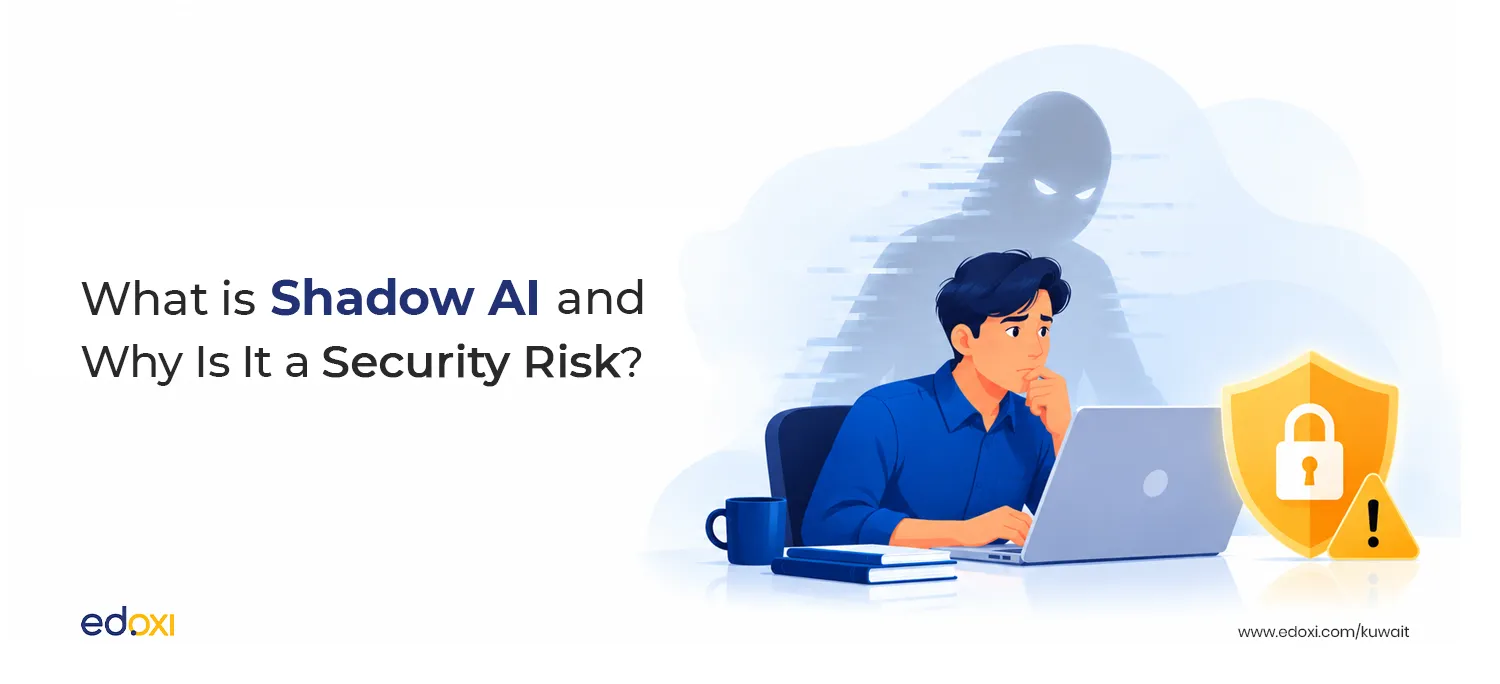
Shadow AI is the use of AI tools by employees without their organisation's approval or oversight. It can expose confidential business information, customer data, and source code when staff enter sensitive information into unapproved tools.
A manager in Kuwait City has a 40-page contract and a noon deadline. She pastes it into a free AI app on her phone and gets a summary in seconds. Her boss is pleased. Security never knew the contract left the building.
That is Shadow AI, and it happens in offices across the Gulf. Most people mean well. The risk lies in what they share and where it goes.
Table of Contents
| Nos | Contents |
|---|---|
| 1 | What Is Shadow AI in Cybersecurity? |
| 2 | Why Do Employees Use Unauthorised AI Tools? |
| 3 |
What Are the Most Common Shadow AI Examples?
a) Is Using ChatGPT at Work Shadow AI?
b) Approved AI vs Shadow AI vs Prohibited AI: Key Differences
c) Why Is Shadow AI a Security Risk?
d) How Does Shadow AI Expose Sensitive Data?
e) How Does Shadow AI Affect Regulatory Compliance?
f) How Can Shadow AI Lead to Data Breaches?
g) What Other Risks Does It Add?
|
| 4 | What Is the Difference Between Shadow AI and Shadow IT? |
| 5 |
How Can Companies Identify Shadow AI Usage?
a) How Can Organisations Prevent Shadow AI Risks?
|
| 6 | What Should Companies Do After Discovering Shadow AI? |
| 7 | How Can Organisations Prevent Shadow AI Risks? |
| 8 | Key Takeaways |
| 9 | FAQs: What Is Shadow AI and Why Is It a Security Risk? |
Shadow AI means employees use AI tools or services without formal approval or oversight from their organisation.
"Shadow" means hidden from the people who protect company data. Picture a finance team using a personal AI account to tidy a supplier price list. The file is now outside every control security has set up.
Security cannot protect what it cannot see. Organisations that build AI-ready teams start by learning which tools staff already use.
People are judged on speed, and AI tools are fast. When the company offers no approved option, the quickest route is often a free tool or a personal account.
The usual reasons are:
This is mostly a gap in provision and guidance, not bad intent. Many employees have never been shown where the safe line sits, so a structured AI Course in Kuwait can teach safe use alongside the productivity skills.
Uploading company documents to public AI tools
Once uploaded, the organisation may lose direct control over how the data is stored, accessed, or retained. That depends on the provider's terms and technical controls.
Using AI to analyse customer data
A sales team pastes a spreadsheet of names and phone numbers into a chatbot for quick insights.
Copying source code into AI assistants
Developers paste code to fix bugs. Samsung temporarily banned generative AI tools in 2023 after engineers reportedly pasted confidential chip designs into ChatGPT.
Using unapproved AI browser extensions
Some request permission to read the pages you open, including email and internal dashboards.
Generating reports with personal AI accounts
The work sits in an account the company cannot audit or close.
Abeer Anwar Al-Awadhi, Head of Kuwait's National Cybersecurity Center, called cybersecurity "a foundational pillar of digital development and national stability." (Kuwait Times, October 2025)
It depends on approval. ChatGPT used under a company-approved account and policy is approved AI. The same tool used on a personal account for work files is Shadow AI.
Approved AI vs Shadow AI vs Prohibited AI: Key Differences
| Classification Criteria | Approved AI | Shadow AI | Prohibited AI |
|---|---|---|---|
| Approval | Yes, with rules | None | Explicitly banned |
| Example | Company-licensed assistant with admin controls | Personal chatbot account used for work files | Uploading restricted data to any public tool |
| Visibility | Logged and managed | Hidden from IT | Blocked or flagged |
| Action | Use as allowed | Review, then approve or replace | Stop and report |
Most Shadow AI is not banned. It is simply unreviewed. That is why a review process matters as much as a ban.
Company data can move into tools nobody has assessed. The organisation may then be unable to track it, delete it, or show who accessed it.
The cost is measurable. IBM's 2025 Cost of a Data Breach research found that 63% of organisations studied had no AI governance policy.
A separate summary of the same report says 20% reported a breach linked to shadow AI, and that high levels of it added about USD 670,000 to breach costs.
These are global figures, not Kuwait-specific, but they show why cybersecurity matters more than ever.
Depending on the tool's design, prompts and uploaded files may be processed or stored by the provider or its infrastructure partners. Some providers offer strict controls. Free consumer versions often offer fewer.
IBM's analysis found that attackers who breached Shadow AI targeted customer personal data first and intellectual property second.
Exposure is not the same as a confirmed leak. But when the organisation has no record of what was shared, it cannot show that nothing was.
Kuwait's National Center for Cyber Security was set up under Decree No. 37 of 2022.
A Legal 500 review says processing sensitive data outside Kuwait needs the Center's prior approval under the applicable classification and cross-border rules.
Which rules apply depends on the data category and sector, so confirm with your legal team. A public chatbot will not check any of this for your employee.
Teams that handle regulated data often build this awareness through a cybersecurity course in Kuwait, so the rules are understood before tools are chosen.
Weak access controls, compromised accounts, and vendor flaws can all expose what staff uploaded. IBM reported that 97% of breached organisations with an AI-related security incident lacked proper AI access controls.
Accidental disclosure by a trusted employee is still an insider incident. Intent changes the response, not the exposure. This sits within the wider picture of growing cyber risks.
Dr Khaled Al-Zamel, CITRA Chairman, said, "AI carries a civilisational responsibility that demands awareness and sound governance."
Risk, example and mitigation at a glance
| Risk | Example | Mitigation |
|---|---|---|
| Data leakage | Client list pasted into a free chatbot | Restrict public tools for sensitive work; use data loss prevention (DLP) |
| Confidential exposure | Board papers summarised in a personal account | Label data; provide an approved AI tool |
| IP loss | Product code shared to fix a bug | Approved coding assistant with contractual data protections |
| Privacy violation | Customer civil IDs sent to an AI sheet tool | Mask personal data; limit access |
| Compliance issue | Sensitive data processed abroad without approval | Map data rules; audit regularly |
| Incorrect information | Wrong figure in a client report | Human review before sharing |
| Vendor risk | Browser add-on reads every page | Vet vendors; allow-list extensions |
Shadow IT is any unapproved software or device. Shadow AI is a subset with its own risks.
Shadow IT vs Shadow AI: Key Differences and Security Risks
| Criteria | Shadow IT | Shadow AI |
|---|---|---|
| Example | Personal file-sharing app | Public chatbot or AI add-on |
| What is shared | Files | Files, prompts and context |
| Extra risks | Data stored in the wrong place | Prompt disclosure, generated misinformation, AI-specific data handling |
Shadow AI adds risks that Shadow IT does not. Which one is more severe depends on the use case. A personal file-sharing app holding payroll data can be worse than a chatbot used for public text.
Companies can identify shadow AI usage by following these steps:
The message: AI use is growing, so governance has to keep pace.
Organisations can prevent shadow AI risks by setting a clear AI policy, providing approved tools, training staff, classifying data, limiting access, monitoring use, and reviewing the policy often.
Keep it to two pages. Say which tools are allowed, what data never goes in, and who to ask. The NIST AI Risk Management Framework is a solid base for governance, and CISA and ENISA publish useful guidance.
People turn to shadow tools when no safe option exists. Offer business-grade AI with data controls and admin settings. Then build the skills to use it well, because AI Training in Kuwait lets teams practise on safe, realistic examples.
Use four labels: public, internal, confidential, and restricted. Make the rule simple: restricted data never goes into an unapproved tool. Give access only to people who need it.
Short, regular cybersecurity training in Kuwait helps staff apply these rules day to day.
DLP (data loss prevention) tools can flag or block confidential files before they leave. Review the policy every six months, because new AI tools appear fast. For staff who run these controls,
Security+ certification is one way to validate core security knowledge.
Stay calm and find the facts before assigning blame.
Identify the tool and the data involved.
Check the provider's terms and request deletion where possible.
Inform security, legal, and data protection teams.
Move the team to an approved tool.
Update the policy and training.
So, what is Shadow AI? It is a visibility problem, and clear rules plus good tools fix it.