Request a Callback

+971 4380 1666
 Aug 10, 2026

Anti Money Laundering AML refers to the laws, regulations, processes, and technologies used to detect, prevent, and report these illegal financial activities. Every year, criminals move an estimated $800 billion to $2 trillion through the global financial system, but only a small portion is identified and stopped.
Money laundering is the process of making illegally obtained money appear legitimate, while AML (Anti-Money Laundering) is the framework used to prevent and detect it. FATF has cited estimates that money laundering and underlying serious crime may represent approximately 2% to 5% of global GDP, highlighting the scale of the financial-crime challenge. This guide covers AML fundamentals, KYC, CDD, EDD, beneficial ownership, risk assessment, transaction monitoring, red flags, and suspicious transaction reporting.
In this guide, you will learn how money laundering works, why AML is important, what AML compliance involves, and how professionals across the UK, US, Europe, the Gulf, Asia, and Africa help protect businesses and financial systems from financial crime.
| Table of Contents | |
|---|---|
| 1 | What Is Money Laundering and Why Does AML Matter? |
| 2 | What Are the Three Stages of Money Laundering? |
| 3 | Which Countries Carry the Highest and Lowest Money Laundering Risk? |
| 4 | What Is the Difference Between KYC, CDD and EDD? |
| 5 | What AML Regulations Should You Know Across the UK, US, EU, UAE and Asia? |
| 6 | How Is AI Reshaping AML Compliance Monitoring? |
| 7 | What Does an AML Compliance Officer Do, and What Career Paths Exist? |
| 8 | Which Industries Need AML Compliance the Most? |
| 9 | How Can You Start a Career in AML Compliance? |
| 10 | Frequently Asked Questions |
Money laundering is the practice of making illegally obtained funds appear to come from a legal source. Money Laundering matters because it fuels drug trafficking, human trafficking, corruption and terrorism. Criminal networks cannot spend dirty money openly, so they push it through banks, property deals, casinos and shell companies until its origin becomes untraceable.
AML exists to stop money laundering before illegal money enters the financial system. It combines laws, customer identity checks, transaction monitoring, and suspicious activity reporting.
Banks, law firms, real estate companies, fintech platforms, and other regulated businesses use these measures to detect and prevent financial crime.
However, global estimates suggest that less than 2% of laundered money is detected, even though organisations spend over $206 billion each year on AML compliance, according to LexisNexis Risk Solutions.
This gap is driving regulators, including FinCEN and the FCA, to focus on making AML programmes more effective, not just compliant with regulations.
Money laundering happens in three stages: placement, layering and integration. Each stage pushes dirty money further from its criminal source. Recognising these stages is the fastest way for a beginner to understand how AML controls are designed.
Table 1: The three-stage money laundering cycle every AML programme is designed to interrupt.
| Stage | What Happens | Typical Exmaple |
|---|---|---|
| Placement | Illicit cash enters the financial system for the first time. | Depositing cash into multiple bank accounts below reporting thresholds. |
| Layering | Funds move through complex transactions to obscure their origin. | Wiring money through several countries or shell companies in quick succession. |
| Integration | Laundered funds re-enter the economy looking legitimate. | Buying property, luxury goods or shares with the now 'clean' money. |
Myanmar, Haiti, the Democratic Republic of the Congo and Chad currently carry the highest money laundering risk scores, while Finland, Iceland and San Marino sit at the bottom of the Basel AML Index. The Index scores 177 jurisdictions from 0 (lowest risk) to 10 (highest risk) across five domains: AML/CFT framework quality, corruption, financial transparency, public accountability, and legal and political risk.
The picture across major regions looks like this:
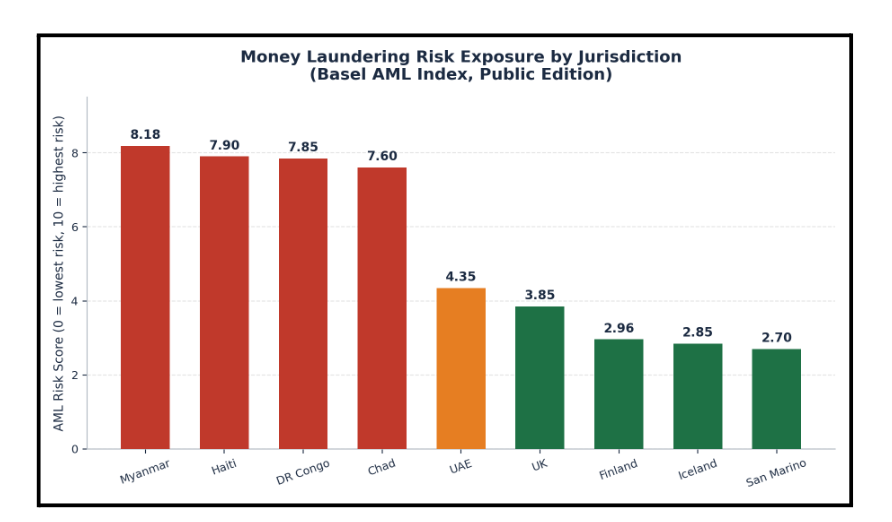
Chart 1: AML risk exposure by jurisdiction, Basel AML Index (Public Edition). Lower scores indicate stronger institutional resilience, not the absence of financial crime.
Comparatively low structural risk, though the EU is rebuilding its architecture around the new Anti-Money Laundering Authority (AMLA), and the UK is consolidating supervision under the FCA.
A falling risk profile following the UAE's exit from the FATF grey list, backed by tighter rules for virtual asset firms and real estate agents.
Wide variance, from tightly regulated hubs such as Singapore to jurisdictions still under FATF monitoring.
The most uneven picture globally: only three of 48 assessed countries (Botswana, Seychelles and Mauritius) sit in the low-risk band, while 25 remain high risk.
More than half of assessed jurisdictions improved their scores this cycle, while 43% saw a decline, leaving the global average largely unchanged.
|
See Where Your Market Sits on the Risk Map: Understanding jurisdictional risk is step one for any compliance career. Edoxi's AML Training breaks down how these risk ratings feed directly into real-world customer due diligence.
|
KYC is the process of verifying who a customer is, CDD assesses the risk that the customer poses, and EDD applies deeper scrutiny to higher-risk customers such as Politically Exposed Persons (PEPs). Together they form the backbone of every onboarding process across banking, fintech and real estate.
Table 2: KYC, CDD and EDD compared - three linked but distinct layers of customer risk management.
| Term | Purpose | When It Applies |
|---|---|---|
| KYC (Know Your Customer) | Confirms identity using official documents and data checks. | At onboarding, for every customer without exception |
| CDD (Customer Due Diligence) | Assesses ongoing risk based on customer behaviour and profile. | Throughout the customer relationship, on a risk-based schedule. |
| EDD (Enhanced Due Diligence) | Applies deeper investigation, source-of-funds checks and senior sign-off. | For PEPs, high-risk jurisdictions or unusual transaction patterns. |
Every major economy is currently tightening its AML rulebook, and the direction of travel everywhere is the same: fewer box-ticking checklists, more proof that controls actually work. Here is what beginners need to track region by region.
FinCEN's AML/CFT Program Rule reform separates programme 'establishment' (design) from 'maintenance' (execution), and expects a US-based compliance officer, independent testing, risk-based policies and ongoing training.
The FCA is consolidating AML supervision under its own remit, and the Economic Crime Plan continues to push firms toward continuous, not periodic, monitoring.
A single AML Regulation and the new AMLA authority are replacing the old patchwork of national rules, with direct supervision of the riskiest cross-border institutions.
Decree-Law No. 10 of 2025 tightened obligations for virtual asset service providers and real estate agents, supporting the UAE's exit from the FATF grey list.
Australia's Tranche 2 reforms extend AML duties to lawyers, accountants and real estate agents, while other markets align more closely with FATF recommendations.
FATF grey-list exits, such as Namibia's and Algeria's, show what a credible reform roadmap looks like, though most jurisdictions remain in the medium or high-risk band.
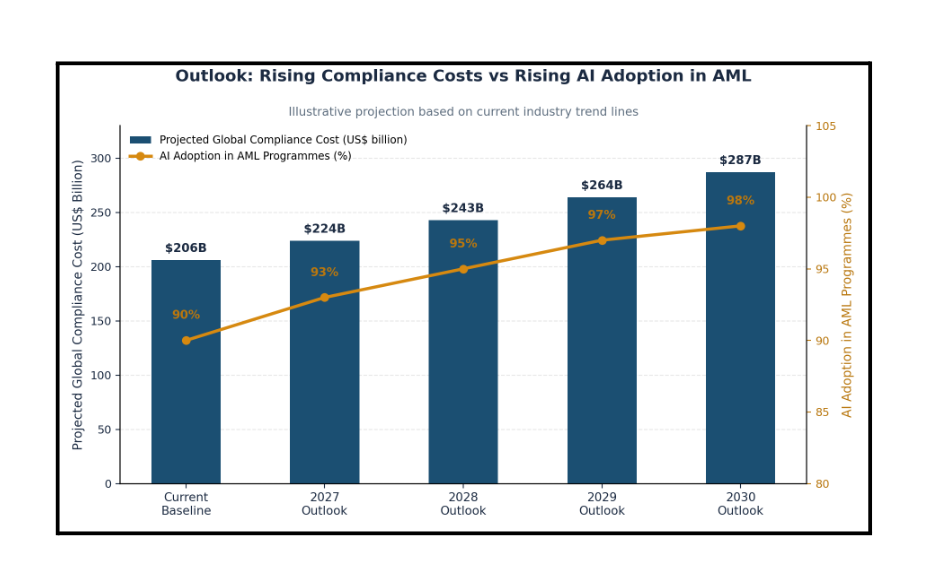
AI has moved from a support tool to the operational core of AML compliance, with adoption already running above 90% among financial institutions. Analytical AI cuts false positives, generative AI drafts suspicious activity reports, and agentic AI now runs entire sanctions-screening workflows with minimal human input, reportedly cutting alert volumes by more than 80% in some deployments.
Chart 2: Illustrative outlook — global compliance cost and AI adoption trend lines, projected forward from current industry baselines.
Banks no longer rely only on their own data. Today, many financial institutions share information through secure consortium networks. These networks connect thousands of organisations and millions of customer profiles. This helps banks detect mule accounts, shell companies, and hidden money-laundering networks that a single institution might miss.
AI supports this process, but it does not replace human expertise. Instead, it handles repetitive checks and routine alerts. This gives AML professionals more time to investigate complex, high-risk, and cross-border cases where human judgement matters most.
|
Ready to Work with AI in AML?: Today's AML professionals need more than regulatory knowledge. Employers also look for skills in RegTech, AI-powered transaction monitoring, and digital compliance tools.
Build both technical and compliance skills with Edoxi's AML Certification Course.
|
An AML Compliance Officer helps protect an organisation from money laundering and financial crime. They monitor financial activities, assess risks, ensure compliance with AML regulations, train employees, investigate suspicious transactions, and report serious cases to regulators.
It is one of the fastest-growing compliance careers across banks, fintech companies, financial institutions, and many other industries.
Table 3: A typical AML career roadmap, from analyst to Money Laundering Reporting Officer (MLRO).
| Career Stage | Typical Experience | Core Focus |
|---|---|---|
| AML Analyst | 0–2 years | Transaction monitoring, alert triage and initial KYC checks. |
| AML Compliance Officer | 2–5 years | Case investigation, CDD/EDD decisions and SAR filing. |
| AML Manager / Head of AML | 5–10 years | Team leadership, audits and regulator liaison. |
| MLRO / Chief Compliance Officer | 10+ years | Enterprise-wide strategy, board reporting and regulatory accountability. |
Banking and fintech carry the heaviest AML obligations, but the same rules increasingly apply well beyond traditional finance. Regulators now expect controls across the following sectors:
The fastest way into an AML career is to pair a recognised certification with practical, scenario-based training in KYC, CDD, sanctions screening and SAR filing. Employers across the UK, US, UAE and wider Gulf increasingly favour candidates who understand both regulation and the AI tools now built into modern compliance software.
Edoxi's AML Training programme covers exactly this ground, combining FATF standards, UAE-specific regulation and hands-on RegTech practice, and is a practical next step for anyone serious about building a compliance career. For a closer look at what the role pays across experience levels, Edoxi's Study Hub also breaks down current AML compliance salary benchmarks in Dubai and gives you a wider look at AML specialist salary trends globally.
|
Start Your AML Career With a Recognised Certification: Edoxi's 40-hour, KHDA-approved Anti-Money Laundering Course prepares you for AML Analyst and Compliance Officer roles with real-world case studies.
|
AML controls help protect the integrity of the financial system.
Without effective controls, criminals may attempt to use legitimate financial institutions and businesses to move or conceal illicit funds. This can expose organizations to financial losses, regulatory action, reputational damage, and other risks.
AML is particularly important for organizations that handle money or provide financial services, including:
For organizations operating in international financial centres such as Dubai, AML knowledge is particularly relevant because businesses may deal with customers, transactions, and counterparties from multiple jurisdictions.
AML red flags are indicators that may require further review.
Examples can include:
A red flag is an indicator, not proof of criminal activity. Compliance professionals must consider the complete customer and transaction context.
When an organization identifies activity that meets the applicable legal threshold for reporting suspicion, it may be required to submit a suspicious transaction or suspicious activity report to the relevant authority.
The terminology and reporting requirements vary by jurisdiction.
Compliance professionals should therefore understand the specific laws, regulatory requirements, reporting channels, and internal procedures applicable to their organization and location.
A beneficial owner is the individual who ultimately owns or controls a legal entity or benefits from the ownership or control of that entity.
Identifying beneficial ownership is important because criminals may attempt to hide behind companies, trusts, nominees, or complicated ownership arrangements.
Understanding the real ownership and control structure helps organizations assess customer risk more accurately.
A risk-based approach means that an organization does not necessarily apply exactly the same level of AML controls to every customer and transaction.
Instead, it considers factors such as:
Higher-risk relationships may require stronger controls, while lower-risk relationships may be subject to proportionate measures in accordance with applicable requirements.
The UAE has developed a comprehensive framework for combating money laundering, terrorist financing, and related financial crime.
Businesses operating in the UAE should understand the AML obligations that apply to their sector and the requirements of the relevant UAE authorities and regulators.
For professionals working in Dubai, knowledge of AML concepts can be valuable across banking, financial services, accounting, auditing, compliance, risk management, and other regulated or compliance-sensitive roles.
Because regulations and regulatory guidance can change, professionals should always refer to current official UAE requirements rather than relying solely on older training material or general online explanations.
AML and KYC are closely connected, but they are not the same thing.
KYC focuses primarily on knowing and verifying the customer.
AML is broader and includes the overall framework for identifying, managing, monitoring, and reporting money-laundering and related financial-crime risks.
In simple terms:
KYC helps answer: Who is the customer?
AML helps answer: What financial-crime risks could this relationship or activity present, and how should the organization manage them?
AML knowledge can be useful for:
Someone pursuing an AML or compliance career can benefit from developing a combination of technical and analytical skills.
Important skills include:
Technology skills are also becoming increasingly useful as compliance teams use data analytics, automated monitoring systems, screening tools, and other technologies to identify potentially unusual activity.
A beginner can start by understanding the basic concepts rather than trying to memorize regulations immediately.
A practical learning path is:
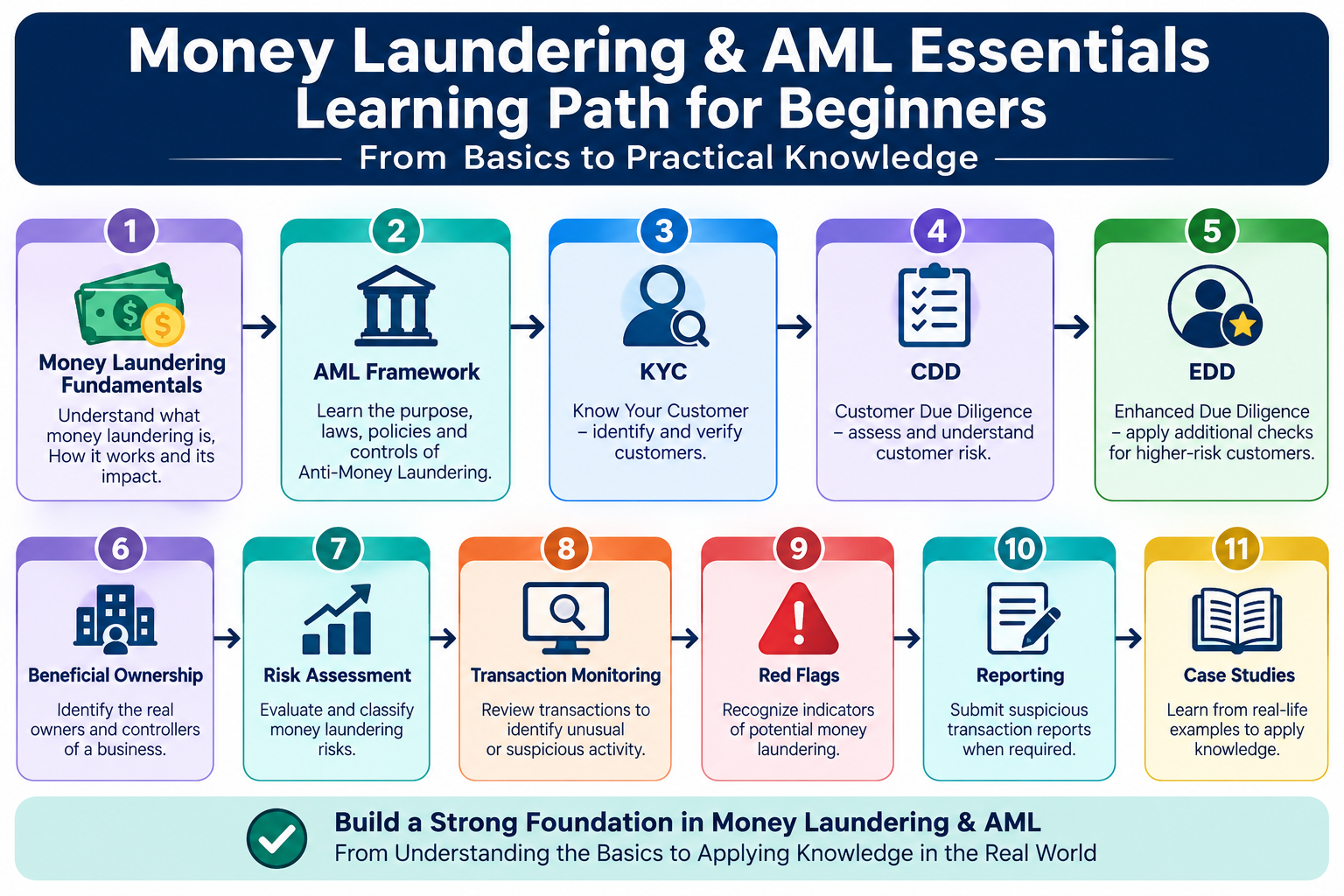
Case studies are particularly useful because they show how AML concepts work in realistic situations.
For example, instead of simply memorizing the definition of transaction monitoring, a learner can examine a hypothetical customer profile, review a series of transactions, identify unusual patterns, determine what additional information may be required, and document the reasoning behind an escalation.
Money laundering is the process of disguising money obtained from illegal activity so that it appears to have a legitimate source.
AML stands for Anti-Money Laundering. It refers to the systems, controls, procedures, and legal requirements designed to prevent and detect money laundering and related financial crime.
The traditional model describes three stages: placement, layering, and integration. Real-world cases may not always follow these stages in a clear or sequential manner.
No. KYC is an important part of customer due diligence and AML compliance, but AML covers a much broader range of controls and activities.
Transaction monitoring helps organizations identify activity that may be unusual or inconsistent with a customer's expected profile and determine whether further investigation or action is necessary.
No. An unusual transaction is an indicator that may require investigation. There may be a legitimate explanation, so context and appropriate review are important.
AML and financial crime compliance can offer career opportunities across banking, financial services, FinTech, accounting, auditing, risk, and compliance functions. The specific career path depends on qualifications, experience, industry, and local regulatory requirements.
For professionals looking to develop practical compliance skills, an AML Course in Dubai can provide a structured way to understand money laundering risks and the controls organizations use to address them. A well-designed AML Course typically covers KYC, Customer Due Diligence (CDD), Enhanced Due Diligence (EDD), beneficial ownership, risk assessment, transaction monitoring, red flags, and suspicious transaction reporting. Choosing an anti money laundering course in Dubai with practical examples and case-based learning can help learners connect regulatory concepts with real workplace situations. An Antimoney Laundering Course can therefore serve as a useful foundation for professionals planning to build or strengthen careers in compliance, banking, finance, auditing, and risk management.
AML is fundamentally about understanding financial-crime risk and putting effective controls in place to manage it. For beginners, the most important concepts to understand first are money laundering, KYC, CDD, EDD, beneficial ownership, risk assessment, transaction monitoring, red flags, and suspicious transaction reporting.
As financial crime becomes more complex and organizations face increasing regulatory expectations, professionals with practical AML knowledge can contribute to stronger compliance and risk-management processes.
The best way to build AML expertise is to combine foundational knowledge with current regulatory guidance, practical examples, case studies, and structured learning. This helps transform AML from a collection of compliance terms into a practical skill that can be applied in real financial and business environments.