Request a Callback

+971 4380 1666
 Oct 20, 2026
To speak confidently in meetings at work, prepare one key point, open with a short sentence, speak slowly, and pause before you answer. Start small by sharing updates or asking questions. Practise aloud each week.
Confidence grows through repeated, low-pressure speaking, not through perfect words or a loud voice.The meeting is nearly over. You had one good point, and you were ready to say it. Then the topic moved on. Your idea stayed in your head.
Most of us have been there. Meetings move fast, senior people talk first, and the clock feels loud. Introverts feel this most, but plenty of outgoing people freeze too.
The good news is that speaking up is a skill. You can learn how to speak confidently in meetings at work with small, steady steps. This guide shows you how, with simple examples for Kuwait workplaces.
Table of Contents
| Nos | Contents |
|---|---|
| 1 | What Is Public Speaking in the Workplace? |
| 2 |
How Can Introverts Speak More Clearly at Work?
a) How Do You Prepare Key Points Before a Meeting?
b) How Do You Speak Slowly and Keep Sentences Simple?
c) How Do You Practise One Idea at a Time?
d) How Do Small Contributions Build Confidence?
|
| 3 |
How Can You Improve Your Public Speaking Skills at Work?
a) How Do You Control Nervousness Before Speaking?
|
| 4 |
What Are the 5 Essential Public Speaking Skills?
a) What Are the 5 P's of Public Speaking?
|
| 5 |
How Can Professionals Speak Confidently in Meetings at Work?
a) What Opening Sentence Can You Use?
b) How Do You Share an Update or Ask a Good Question?
c) How Often Should You Contribute?
|
| 6 | What Public Speaking Skills Do Professionals Need? |
| 7 |
How Can Students Build Public Speaking Skills Before Their First Job?
a) What Quick Tips Should You Remember About Public Speaking Skills?
|
| 8 |
Key Takeaways
|
| 9 |
FAQs: How to Speak Confidently in Meetings at Work
|
Workplace public speaking means sharing ideas out loud with colleagues, managers, or clients in a clear, planned way. It is not limited to stage talks.
It shows up in four everyday places:
So a two-line update on Monday counts. So does a client pitch. The skill is the same. Only the room gets bigger.
Employers notice this skill. In the 2023 Future of Work survey by Bayt.com and YouGov, 92% of Kuwait respondents named communication among the top skills that matter today.
Bayt.com's Ola Haddad said the findings "highlight the importance of both technical and soft skills in the future"
Many Kuwait teams mix Arabic and English Speaking in one meeting, often with colleagues from several countries. Plain, simple speech helps everyone follow.
If you need material to practise on, pick one of these public speaking topics and give a two-minute talk.
Prepare one or two points, use short sentences, and share one idea at a time. Start with small comments. Clear speech comes from preparation, not personality.
Introverts often think deeply before they speak. That is a strength. The problem is timing. Your thought is ready, but the meeting has moved on.
Many professionals in Kuwait also work in a second language. A few simple habits help, and this guide shows you how to speak English confidently.
Read the agenda, choose one or two points, and write each as one sentence.
Say the agenda lists a delivery delay. Your note could read: "The supplier needs two more days. I suggest we move the review to Thursday." Done. Do this the evening before, or ten minutes before the meeting starts.
Keep the note short enough to fit on a sticky note or the corner of your notebook.
If the agenda is not shared, ask the organiser for the main topics a day early. Then glance at your note once, before you speak.
Use one idea per sentence and pause after it. Short sentences are easier to hear and easier to trust.
Fast speech often comes from nerves. Slow down by a small amount. People will not notice, but they will understand you better. Try counting "one" in your head at the end of each sentence.
Cut long sentences in two, and swap big words for plain ones. This matters even more in Kuwait meetings where colleagues may follow in a second language. When your pace is steady, your voice sounds calmer, and you feel calmer too.
Say your point in one sentence, add one reason, then stop.
Record yourself on your phone. Listen once. You will spot extra words quickly. Cut anything that does not help the main point. Then record it again and compare the two versions.
Practise in the car, in the lift, or while walking, so it never feels like extra work. Stopping on time is the hardest part. Most people keep talking because silence feels uncomfortable, so practise ending cleanly.
Each short comment shows you that speaking is safe. Confidence follows proof.
Begin with "I agree with that, and I would add one point." Next week, share a short update. The week after, ask a question. Each time, nothing bad happens, and your brain starts to notice that.
Keep a simple tally of how many times you spoke each week. Seeing the number rise is a quiet, real reward. After a month, longer comments will feel much less scary.
Organise your ideas, practise aloud, use open body language, pause when nervous, and ask for feedback. Do a little each week.
Organise your ideas: Use three parts: point, reason, example.
Practise aloud: Reading silently hides mistakes. Say your update twice before the meeting.
Fix eye contact and posture: Sit upright, keep your hands visible, and look at one person at a time.
Use pauses: A pause feels long to you. To listeners, it sounds calm.
Ask for feedback: Ask one trusted colleague: "Was my main point clear?"
Some people add public speaking classes to this routine, because a trainer can correct habits you cannot see yourself. Kuwait employees seem to value learning too.
In another Bayt.com and YouGov survey, 83% of Kuwait employees said they would leave their company for better training opportunities.
|
Workplace Communication Statistics in Kuwait: Key Insights for Professionals:
|
Slow your breathing, pause, and focus on your message instead of how you look.
Breathe in for four counts and out for six, twice, before you speak. Fear of public speaking shrinks with practice. Every short comment you make counts as practice.
The five core skills are clear communication, confidence and voice control, body language, audience engagement, and organisation and preparation.
| Skill | What it means | Meeting example |
|---|---|---|
| Clear communication | Simple words, one idea at a time | "The report is late by two days." |
| Confidence and voice control | Steady pace, steady volume | Speak at the speed you would use with a friend |
| Body language | Open posture, eye contact | Face the person you are answering |
| Audience engagement | Keep listeners involved | Ask "Does this timeline work for everyone?" |
| Organisation and preparation | A plan before you talk | Write three bullet points first |
Learners often practise all five together in public speaking training in Kuwait, where a trainer gives live feedback.
The 5 P's are Planning, Preparation, Practice, Performance, and Passion. Sources vary, and some swap in words like "purpose" or "pace."
Treat it as a simple checklist before any meeting, not a strict rule.
Prepare a short opening line, share an update or question, use a clear structure, and speak regularly. Confidence comes from repetition.
Use a short, ready line.
Write two of these on a sticky note. Having words ready lowers the fear of the first sentence.
Give the update in one sentence. Ask a question that moves the topic forward.
Updates are safe. They are facts, not opinions. A question like "What do we need from the client by Friday?" shows you are thinking ahead.
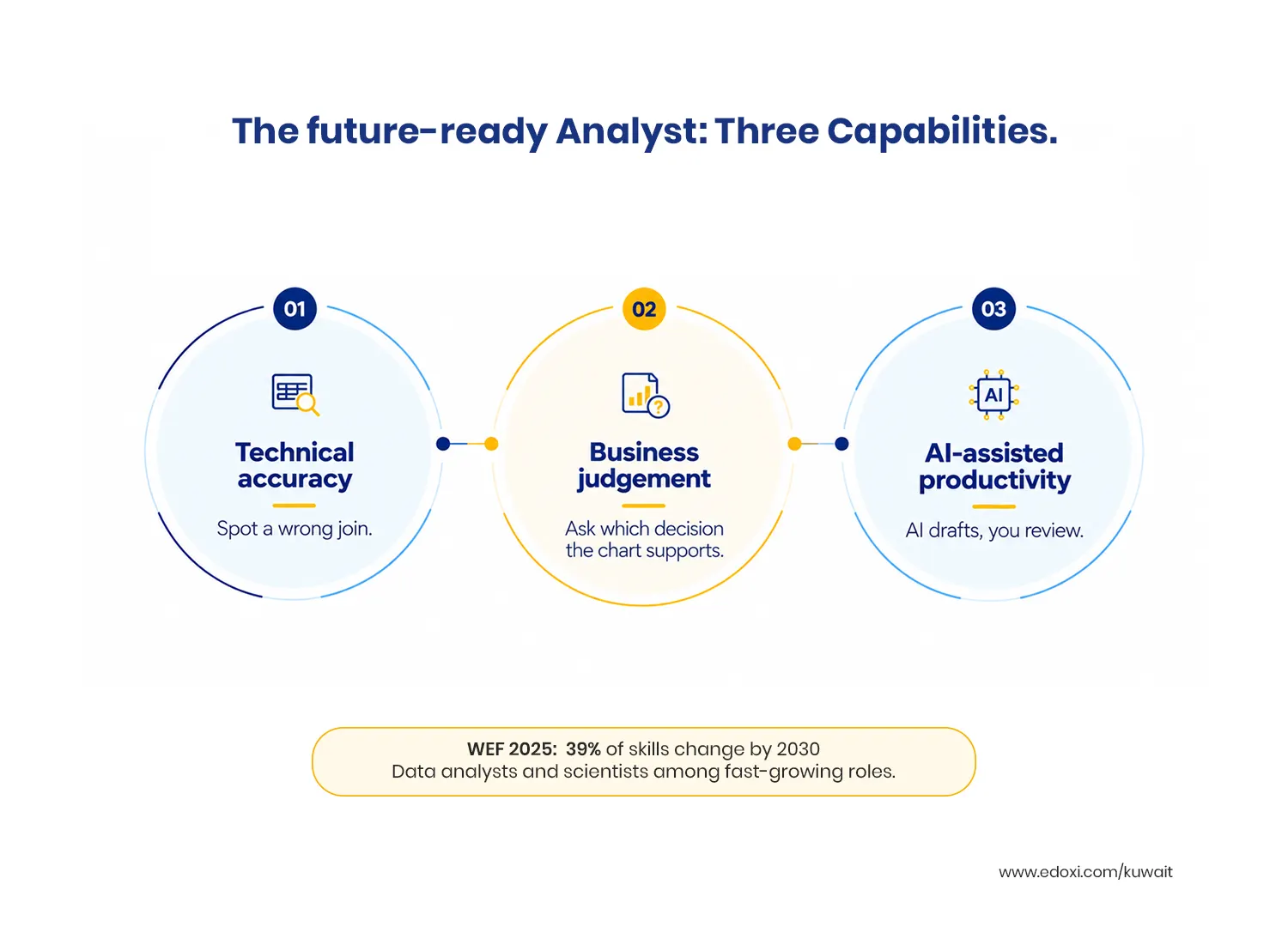
Use Point, Reason, Example, Ask.
"We should test the new form first (point). It will catch errors early (reason). Last month it saved us a day (example). Can we try it this week? (ask)"
Not sure how to order your thoughts? This four-step visual shows the flow at a glance.
Aim for one useful comment per meeting. Raise it as your comfort grows.
Practical Ways to Handle Difficult Situations in Workplace Meetings
| Situation | Best move | Sample line |
|---|---|---|
| You are nervous | Share a fact | "The numbers are up by five per cent." |
| You disagree | Ask first | "Can you help me understand the risk?" |
| You were interrupted | Calmly return | "I would like to finish my point." |
| You do not know the answer | Be honest and offer a next step | "I will check and reply by noon." |
Clear speech also depends on language comfort. This piece on English language skills explains why it matters for your career.
Suhail Masri, General Manager, Tenderd, said the skills gap in the Middle East is "not one of technical skills, but of soft skills."
Zafar Shah, Head of Research & Commercial Growth, RFI Global, said: "Employees in the MENA region are eager to develop their careers."
Professionals need to present to managers, talk to clients, lead discussions, handle objections, and explain complex ideas simply.
Lead with the result, then the reason. Managers are short on time and want the point first. Say, "I recommend option B. It saves two days." Give details only if asked.
Use plain words, avoid jargon, and confirm what you heard. Clients relax when they feel understood. End with, "Let me repeat that to be sure we agree." People trust those who check.
State the goal, invite each person, and summarise at the end. This keeps the meeting on track and stops one voice from taking over. Call on quieter members by name, because many good ideas sit with them.
Listen fully, pause, then answer one point at a time. A calm reply builds more trust than a fast one. Try, "That is a fair concern.
Here is how we plan to handle it." For formal credentials, see these business communication certifications
Use a comparison from daily life and keep numbers few. Explaining a delay? Say, "Think of a road with one lane closed. Cars still move, but slower." Listeners remember pictures better than figures.
Practise through class projects, mock interviews and group talks. Start small and ask for feedback each time.
Share the problem, your solution, and one result in about three minutes. Keep slides light and talk to the people in the room, not the screen. Practise with a friend and ask what stayed in their mind.
Prepare short answers about yourself, your strengths, and one real example. Use the same simple structure each time: point, reason, example. Say your answers aloud before the interview, because thinking them is not the same as speaking them.
Listen first, then add a point that builds on someone else's. Say, "I agree with that, and I would add one point." This shows you listen, which employers value as much as speaking.
Speak in a small setting every week, such as a club, a class, or a study group. Ask for one piece of feedback after each talk. Fresh graduates in Kuwait can also join a short public speaking course in Kuwait to practise with a trainer before the first job.
Know your message, keep it short, stay calm, and listen. Aim for clear communication, not a perfect performance.
Key Takeaways
Public speaking is the act of delivering a planned spoken message to a live audience, in person or online, to inform, persuade, motivate, or entertain. It includes speeches, presentations, pitches, training sessions, and team meeting updates.
Public speaking means speaking formally or purposefully to a group of people to share ideas, information, or opinions. The audience can be small or large, and the setting can be a conference room, classroom, event stage, or video call.
Public speaking is also called oratory, speechmaking, or rhetoric. In everyday and professional settings, it is often described as presenting or giving a talk. The fear of it is called glossophobia.
Seven useful speaking skills are clarity, organisation, vocal control, body language, active listening, storytelling, and handling questions.
Start with small, low-pressure speaking opportunities such as sharing a team update, asking a question in a meeting, or practising a short talk with a friend. Build up gradually to longer talks. Record yourself, note what to improve, and practise regularly rather than waiting to feel ready.
The most effective way to practise at home is to rehearse your talk aloud while recording yourself, then review the recording. Practise in front of a mirror or a trusted friend, time your speech, and repeat it several times. Focus on one improvement each session, such as pace or filler words.
Prepare your main message, know your audience, practise aloud, speak slowly, and pause between key points.
Keep it short, prepare a clear structure, and rehearse until the opening and closing feel natural. Arrive early to check the room or technology, focus on helping the audience rather than being judged, and accept that some nervousness is normal. A short, well-practised talk beats a long, rushed one.
Prepare thoroughly, practise aloud, and use slow breathing before you speak to calm your body’s stress response. Focus on your message instead of how you appear, and start with smaller audiences to build comfort. If anxiety is severe or interferes with daily life, speaking with a qualified health or mental health professional can help.
Common public speaking challenges include nervousness, fear of judgement, forgetting your points, speaking too fast, using filler words, and keeping the audience engaged. Technical problems, unfamiliar audiences, and language confidence can add pressure. Most of these improve with preparation and regular practice.
Examples of public speaking include a business presentation, a conference talk, a wedding toast, a classroom lecture, a sales pitch, a team meeting update, a webinar, and a graduation speech. Each has a different purpose, but all involve delivering a clear message to a live audience.
The best course depends on your goal, budget, and learning style, so compare options using clear criteria. Look for:
Common routes include communication programmes from universities and online learning platforms, professional training providers, and club-based practice such as Toastmasters. Check each provider’s current syllabus, fees, and reviews before you enrol.