Request a Callback

+971 4380 1666
 Aug 13, 2026
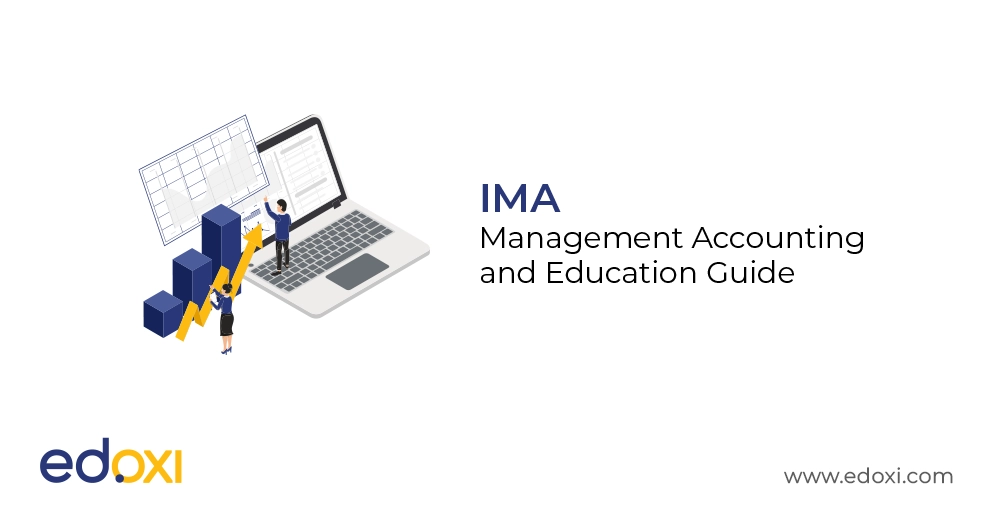
The Institute of Management Accountants (IMA) is a global professional body for management accountants. It is best known for offering the Certified Management Accountant CMA certification, which validates expertise in financial planning, performance management, strategic decision-making, and business finance.
An IMA membership also provides access to professional development, networking opportunities, and career resources.
If you have ever typed "how do I become a management accountant" into Google, chances are you have seen the IMA on the first page.
The Institute of Management Accountants (IMA) is one of the most recognised names in global finance education.
Its flagship IMA Certification, the Certified Management Accountant (CMA), is a globally respected credential.
It helps accountants move beyond traditional bookkeeping and into strategic decision-making and business leadership roles.
This guide walks through what IMA Management Accounting actually covers, how the IMA Education Guide works, and why so many finance professionals in the UAE and beyond are choosing this path in 2026.
The Institute of Management Accountants (IMA) is the worldwide association for accountants and financial professionals working inside businesses, rather than in public practice.
Unlike traditional accounting bodies that focus mainly on audit and compliance, IMA focuses on advancing the management accounting profession and supports professionals through certification, continuing education, research, networking, and advocacy of ethical business practices.
In practical terms, this means the IMA is less about ticking regulatory boxes.
It is more about building the skills a modern Management Accountant actually uses day to day.
These include budgeting, forecasting, cost control, risk management, and strategic finance.
If your job involves helping a business decide where to spend money, not just record how it was spent, this is the professional home built for you.
Management Accounting is fundamentally about using financial data to guide business decisions, rather than simply reporting historical numbers. IMA structures this around a few core pillars that show up throughout its Learning Path and exam content:
These aren't abstract theory topics.
They map directly onto the exam blueprint for IMA's flagship certification.
In Part 1, planning, budgeting, and forecasting account for 20% of the exam.
Performance management accounts for another 20%.
Cost management makes up 15%, while internal controls account for 15%.
Part 2 is weighted heavily toward financial statement analysis, corporate finance, and business decision analysis.
This is where the IMA Education Guide becomes genuinely useful, because IMA doesn't offer just one credential; it offers a structured path depending on where you are in your career.
The Institute of Management Accountants (IMA) offers three main professional certifications: the CMA, the CSCA, and the FMAA.
You don't have to start at the top. Enter the IMA Education Guide wherever it matches your experience. Then move up as your career grows.
Yes. IMA offers a foundational credential for professionals in business who want to understand the basics of financial and managerial accounting, as well as for four-year college and university students who want an edge when starting their careers.
It's designed as a stepping stone, allowing newer professionals to build the fundamentals before committing to the full CMA Certification.
The Certified Management Accountant credential is IMA's flagship qualification, and the one most people mean when they say "IMA Certification."
It's aimed at early and mid-level accounting and finance professionals who want to advance into management roles.
This includes CPAs moving from audit into industry and career changers.
The common career progression includes roles such as Senior Accountant, Controller, Director, Vice President (VP), and ultimately Chief Financial Officer (CFO).
Globally, this credential carries real weight.
The CMA is respected in over 150 countries.
More than 100,000 CMA certification have been earned worldwide.
Certified Management Accountants are recognised for explaining the "why" behind the numbers, not just the "what."
Yes, for finance professionals who already hold a certification and want to specialise further, IMA offers an advanced credential in strategy and competitive analysis, aimed at certified accounting and finance professionals seeking a specialised skillset in strategy.
This sits above the CMA in IMA's Learning Path, for those pushing into pure Finance Leadership territory.
This is one of the most searched questions among candidates, and the honest answer is: it's rigorous, but predictable if you prepare properly.
Recently published data puts the global CMA pass rate at roughly 45% per part, with coached candidates who follow structured review courses performing noticeably better than those studying alone.
One notable update for 2026 is worth knowing about: IMA is replacing the traditional essay section with Case-Based Questions starting in the May or June 2026 testing window, a change expected to make the exam more scenario-driven and, for many candidates, more intuitive to prepare for.
The honest answer is money and mobility. Employer data consistently shows a pay gap between certified and non-certified professionals, with CMA-certified professionals typically earning 20–25% more than their non-certified peers.
That's not a rounding error; over a 10 years career, that gap compounds significantly.
There's also a demand story here that goes beyond salary. Regional hiring data backs this up strongly for professionals based in the Gulf.
If you're weighing up an Accounting Certification anywhere in the world right now, the timing genuinely works in your favour.
Industry research shows that 61% of finance and accounting leaders say finding skilled talent is harder than it was a year ago, even as 56% plan to increase permanent hiring and 54% are turning to contract professionals to fill critical gaps.
Employers report a 27% skills gap overall, and only around a quarter of professionals are currently building the capabilities companies need most.
The knock-on effect of that shortage is significant. Skills shortages have caused project delays for 75% of finance and accounting leaders, the highest rate of any professional field surveyed, and 62% report projects being cancelled outright.
Unsurprisingly, employers are responding with their wallets: 87% of finance and accounting leaders say they're now offering higher compensation specifically to candidates with specialised expertise.
That's exactly the gap a strong Management Accounting Certification is built to close. Employers aren't short of applicants; they're short of people who can turn numbers into decisions.
Yes. The IMA isn't a regional player; it's the worldwide association for accountants and financial professionals working inside businesses, with members and chapters spanning North America, Europe, Asia, and the Middle East.
This global reach matters in practical terms.
Skills like corporate tax expertise, IFRS knowledge, and ERP proficiency are increasingly included in finance job descriptions worldwide.
They are no longer limited to a single market.
IMA's international footprint means candidates anywhere can join a global professional community.
They also follow a learning path built around the same globally recognised standard.
An IMA Membership isn't just a badge for your LinkedIn profile.
It typically includes access to research publications, discounted exam fees, continuing education credits, career planning tools, and a genuine professional network of finance-focused peers.
For anyone serious about accounting career growth, membership is usually the first practical step.
It often comes well before sitting any exam.
A certificate opens the door, but the Management Accounting Skills that keep you in the room are things like:
If you're mapping out where to begin, a sensible sequence looks like this:
For finance professionals working in the Middle East, professional development is increasingly connected to the ability to understand both financial performance and wider business strategy. Companies operating across the UAE, Saudi Arabia, Qatar, Bahrain, Kuwait, and other regional markets work with diverse business models, international teams, changing regulations, and increasingly digital finance functions.
This makes management accounting skills relevant beyond traditional accounting departments. Professionals may be expected to contribute to budgeting discussions, evaluate business performance, analyse costs, interpret financial information, and communicate recommendations to decision-makers.
IMA's international professional community gives Middle East-based accounting and finance professionals a way to stay connected with developments in management accounting while building knowledge that can be applied across different business environments.
The role of finance is no longer limited to preparing reports at the end of a reporting period. Modern finance teams are increasingly involved in planning, forecasting, performance measurement, business analysis, risk evaluation, and strategic discussions.
For professionals in the Middle East, developing these capabilities can be particularly useful when moving from transactional accounting positions toward roles involving financial analysis, management reporting, FP&A, controllership, or broader finance leadership.
The value of an IMA pathway therefore extends beyond earning a credential. It can form part of a longer professional development journey in which accounting knowledge is combined with analytical ability, commercial awareness, communication, and decision-making skills.
An accounting qualification can help demonstrate technical knowledge, but career progression also depends on how effectively a professional applies that knowledge in a business setting. Understanding the financial impact of operational decisions, explaining results to non-finance stakeholders, and identifying opportunities for better performance are increasingly important capabilities.
For this reason, professionals considering the IMA pathway should look beyond the examination itself. The stronger objective is to develop a practical understanding of how financial information supports planning, performance, and business decisions throughout a company's growth.
For professionals looking to build a career in management accounting, a CMA course in Dubai provides a structured way to develop knowledge in financial planning, performance management, cost management, financial analysis, and strategic decision-making.
A good CMA training programme should go beyond exam preparation by helping learners understand how these concepts apply to real business situations. Choosing a suitable CMA course can be particularly useful for accountants, finance executives, FP&A professionals, and other candidates who want to strengthen their management accounting skills and prepare for the CMA certification while working in Dubai's diverse business environment.
IMA Middle East is the regional community of the Institute of Management Accountants for accounting and finance professionals. It provides access to professional learning, networking, career resources, and management accounting development.
Yes, the CMA is an internationally recognised professional certification offered by IMA. It is relevant to accounting and finance professionals seeking skills in management accounting, financial analysis, planning, and business decision-making.
A IMA CMA training in Dubai helps candidates prepare for the CMA examination while developing practical knowledge of management accounting and financial management. Training commonly covers the concepts, techniques, and skills assessed in the CMA syllabus.
CMA training can suit accountants, financial analysts, FP&A professionals, finance executives, and other professionals looking to strengthen their management accounting and financial decision-making skills.
Candidates need to meet IMA's education and professional experience requirements, become an IMA member, and pass both parts of the CMA examination. They must also satisfy IMA's certification and ethical requirements.
CMA preparation covers areas such as financial planning, budgeting, performance management, cost management, financial analysis, corporate finance, decision analysis, risk management, and technology and analytics.
Yes, many working professionals prepare for the CMA alongside their careers. A structured CMA training programme can help candidates organise their preparation around their professional schedule.
CMA candidates can take the examination at designated testing locations, subject to availability and current scheduling arrangements. Candidates should check the latest information from IMA before booking their examination.
CMA knowledge can support careers in financial planning and analysis, management accounting, financial analysis, budgeting, performance management, corporate finance, and finance leadership.
IMA membership provides access to a professional community, learning resources, networking, and career development opportunities. CMA certification is a professional credential that requires candidates to meet specific examination, education, experience, and ethical requirements.
Yes, IMA Middle east has a professional presence in the Middle East, including Dubai, supporting accounting and finance professionals through its regional activities and professional community.
The IMA CMA can help accountants develop skills beyond traditional financial reporting, including planning, analysis, performance management, cost management, and strategic financial decision-making.