Request a Callback

+971 4380 1666
 Aug 13, 2026
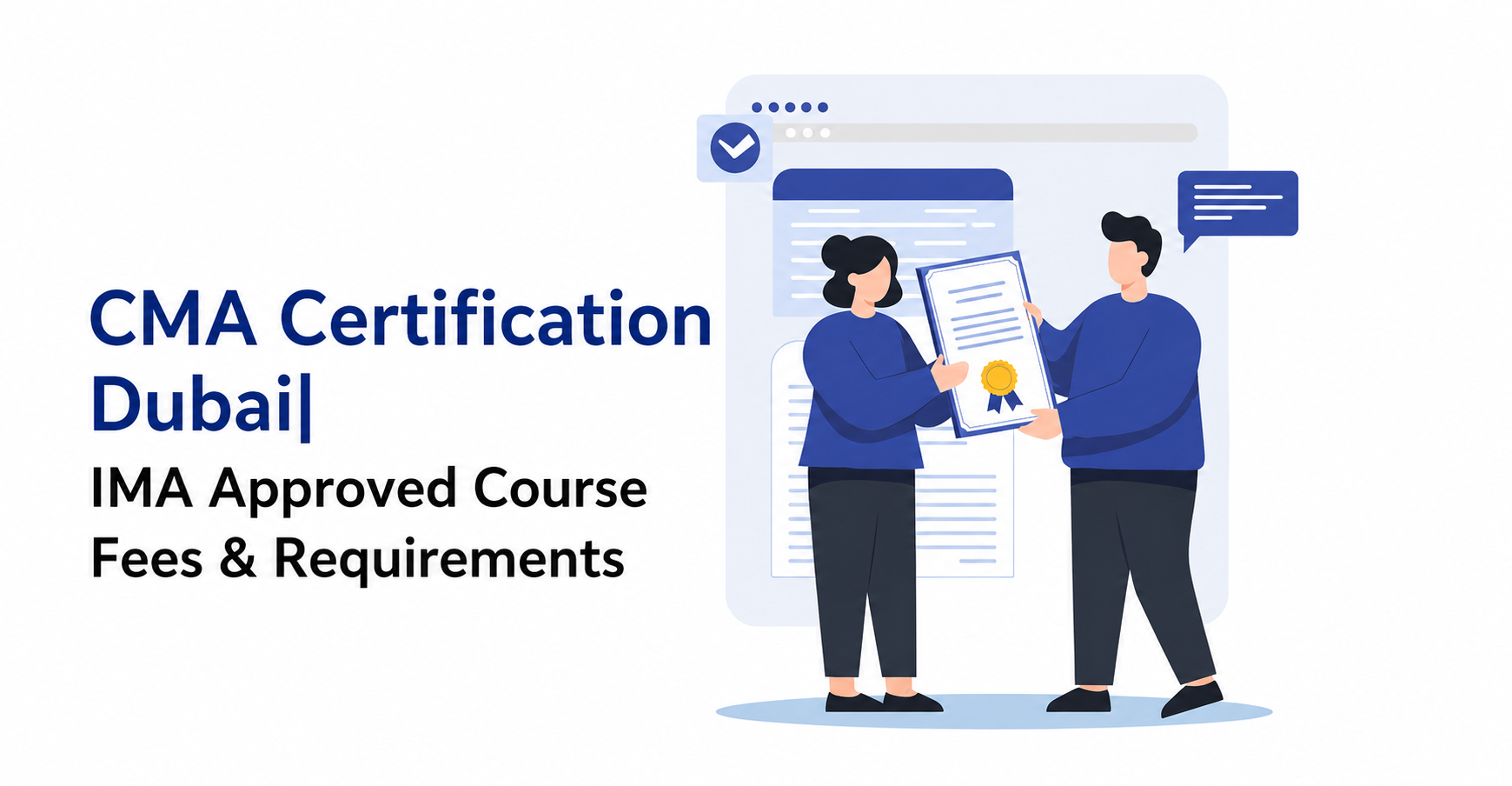
Certified Management Accountant (CMA) is the global benchmark credential for management accounting, awarded by the Institute of Management Accountants (IMA) since 1972. In the UAE, CMA holders work as Finance Managers, Financial Controllers, and CFOs across banking, real estate, logistics, and multinational corporates.
IMA Middle East connects students and professionals across the UAE with verified, IMA-approved CMA training providers in Dubai, Abu Dhabi, and Sharjah so you get quality instruction and a clear path to exam success, without vetting institutes yourself.
The CMA is a two-part professional exam covering 12 core competency areas, including financial planning and analysis, cost management, internal controls, technology and analytics, and professional ethics. Unlike the CPA, which focuses on public accounting and compliance, the CMA is built for corporate finance and strategic decision-making — which is why it's especially valued by UAE employers moving away from traditional bookkeeping toward data-driven finance functions.
Yes, for three concrete reasons:
To sit for the CMA exam, you generally need:
Costs have two components: what you pay your training provider, and what you pay the IMA directly.
Edoxi Training Institute, Dubai (120-hour programme, Part 1 + Part 2)
Many providers offer interest-free instalment plans (e.g., four payments via Tabby), and periodic discounts on IMA registration fees.
Training fees vary by provider and package the table above reflects one Dubai institute's published 2026 pricing as a concrete reference point. IMA membership, entrance, and exam fees are set by the IMA directly and may change; confirm current amounts at imanet.org before budgeting.
CMA exams run in three testing windows each year: May–June, September–October, and January–February.
Test centers in the UAE include:
Dubai's finance industry is changing rapidly. Companies are no longer looking only for professionals who can prepare financial statements or manage daily accounting tasks. Today's employers want finance experts who can analyze business performance, reduce costs, support strategic decisions, and help organizations grow in an increasingly competitive market.
This shift has significantly increased the demand for professionals with management accounting skills, making the CMA Course one of the fastest-growing finance qualifications among accountants, auditors, finance executives, and business professionals across the UAE.
If you're exploring a CMA course in Dubai, understanding why the qualification is gaining popularity can help you decide whether it's the right investment for your career.
Digital transformation, artificial intelligence, automation, and data-driven decision-making are reshaping finance departments across industries. While software can automate many routine accounting tasks, organizations still need professionals who can interpret financial information, identify business opportunities, manage risks, and advise leadership teams.
A CMA Certification focuses on these practical management accounting skills, preparing professionals to contribute beyond traditional bookkeeping and financial reporting.
Dubai is home to multinational corporations, government organizations, logistics companies, healthcare providers, banks, retail groups, hospitality businesses, and manufacturing firms. These organizations require finance professionals who understand budgeting, forecasting, cost management, performance analysis, and strategic planning.
Professionals who complete CMA Training often find opportunities in roles such as:
As businesses continue investing in expansion and digital transformation, demand for management accounting expertise is expected to remain strong.
Unlike many accounting qualifications that focus mainly on compliance and financial reporting, the CMA Course emphasizes how financial information supports business decisions.
During the program, learners develop practical knowledge in areas such as:
The qualification is suitable for a wide range of professionals, including:
Many professionals pursue CMA Certification because it develops both technical and strategic finance skills.
Instead of focusing only on accounting processes, the program helps learners understand how financial information influences business performance. This combination is increasingly important as finance teams become key partners in organizational decision-making.
Professionals with management accounting expertise are often involved in:
Selecting the right training provider can make a significant difference in your preparation. When comparing options, look beyond fees and class schedules.
These factors contribute to a stronger learning experience and greater confidence before the examination.
The finance profession continues to evolve alongside technology and changing business requirements. Professionals who regularly update their knowledge are often better positioned to adapt to new tools, regulatory changes, and business challenges.
Pursuing a CMA Course demonstrates a commitment to professional development while building expertise that remains relevant across industries.
For professionals who want to strengthen their management accounting knowledge, improve analytical skills, and prepare for greater responsibilities in finance, a CMA Course in Dubai offers a practical learning pathway. As organizations increasingly seek finance professionals who can contribute to strategic planning and business performance, CMA Training continues to be a valuable option for career development.
If you're evaluating your next professional qualification, understanding the course structure, career opportunities, and learning outcomes can help you make an informed decision. Exploring a well-structured CMA Certification in Dubai program is an excellent place to start.
If you've been searching for "CMA course in Dubai," you've probably already landed on half a dozen pages that all say the same thing in the same order - what CMA stands for, a list of job titles, then a form to fill out. This isn't that page. Let's actually talk through what the CMA is, why it matters if you're building a finance career in the UAE, what it costs in 2026, and how the exam itself has changed this year.
The Certified Management Accountant (CMA) is a credential handed out by the US-based Institute of Management Accountants (IMA). Unlike a CPA, which leans heavily into audit and compliance, the CMA is built for people who want to sit closer to the business decisions - budgeting, forecasting, cost strategy, performance analysis, and increasingly, data-driven decision-making.
It's a two-part exam, and each part maps to a distinct skill set:
Between the two parts, the IMA tests twelve competency areas, and passing both is what actually earns you the letters after your name- there's no partial credential for clearing just one.
The UAE's finance sector has quietly become one of the busiest CMA markets outside the US, and there's a practical reason for that: multinational companies headquartered or regionally based in Dubai want finance staff who can speak a "global" accounting language, not just a locally licensed one. A CMA signals that you can walk into a finance team in Dubai, Singapore, or Houston and understand the same frameworks.
That said, the certification itself isn't location-specific, you register with the IMA directly, and your certificate is identical whether you sat the exam in Dubai, Mumbai, or Chicago. What Dubai gives you is proximity to Prometric testing centers, a dense cluster of training providers, and a job market that actively rewards the credential.
This is the part most older blog posts miss, because it's new: the CMA exam is undergoing major changes in 2026, with the introduction of Case-Based Questions (CBQs). Rather than testing you purely on isolated multiple-choice scenarios, CBQs are designed to mirror the kind of decisions you'd actually make at work - think scenario-driven judgment calls rather than plug-and-chug calculations. If you're prepping now, factor this into your study plan; it rewards applied reasoning over memorization.
The cma exam still tests what the IMA calls "Level C" cognitive skills ,analysis, synthesis, and evaluation bso you're expected to go beyond calculating a number and argue why a decision makes sense, including against non-financial factors like ESG. There's also a heavier lean toward data analytics and digital transformation than in past syllabus versions, reflecting how much finance teams now rely on forecasting tools rather than static spreadsheets.
You don't need a finance degree to start, but the IMA does have baseline requirements:
Fee breakdowns are where a lot of pages get vague, so here's the real range based on current IMA pricing structures. Costs vary depending on whether you register as a student or a working professional:
None of this includes coaching or study materials, which is a separate line item and varies a lot by provider. If a program's total quote seems dramatically higher or lower than these ranges, ask exactly what's bundled in some providers fold in test banks and mentoring, others don't.
The CMA exam runs in three windows a year:
You get a three-year window from registration to pass both parts, but most focused candidates finish in 6–12 months - noticeably faster than the multi-year timelines typical of a CPA or CFA track.
The value of the CMA shows up less in the certificate itself and more in what doors it opens inside a finance function. Common next steps for CMA holders include:
The common thread across all of these is that they sit closer to decision-making than to bookkeeping, which is exactly the gap the CMA syllabus is built to close.
Plenty of candidates self-study successfully, especially if they already work in finance and just need structured practice materials. But if you're newer to the concepts, or you're balancing a full-time job with prep, a structured course can shorten the runway, mainly by keeping you accountable to a study schedule and giving you exam-style practice questions rather than just reading theory.
If you do go the training-provider route, a few questions are worth asking before you sign up: Is the fee quote inclusive of IMA registration, or on top of it? Do they provide a test bank, or just live classes? What's their actual first-attempt pass rate, not just their marketing pass rate?
Dubai has become one of the go-to destinations in the region for anyone serious about finance courses and accounting courses, and it's easy to see why. The city's mix of multinational corporations, free zones, and a genuinely competitive job market means employers actively look for candidates who've backed up their degree with a recognized professional qualification. Whether you're a fresh graduate trying to stand out or a working professional aiming for a finance leadership role, Dubai gives you access to well-established training providers, convenient exam centers, and a peer group of ambitious professionals all working toward the same goal. It's less about ticking a box and more about genuinely widening your career options across the UAE's finance sector.
Finance courses and accounting courses in Qatar have been gaining real momentum, largely driven by Doha's growing banking, energy, and consulting industries. Candidates no longer need to travel abroad to access globally respected certifications training institutes here now offer the same structured classes, study support, and CMA exam scheduling that used to require studying overseas. For professionals building a career in this market, that local accessibility matters: it means you can pursue a serious qualification while still working full-time and staying close to the industry connections that actually help your career move forward.
Certified Management Accountant (CMA) is one of the world's most respected professional credentials for finance and management accounting professionals. Awarded by the Institute of Management Accountants (IMA), USA, the CMA certification is recognized by multinational companies, government organizations, and leading employers across the UAE and more than 150 countries.
Unlike traditional accounting qualifications that focus mainly on financial reporting, the CMA develops practical skills that today's employers value most. The program covers financial planning, budgeting, performance management, business analytics, cost management, strategic financial management, internal controls, risk management, technology, ethics, and decision-making. These competencies prepare professionals to support business growth, improve profitability, and contribute to strategic decisions.
For professionals working in Dubai's competitive finance sector, earning a CMA certification demonstrates advanced expertise and leadership potential. It can strengthen your credibility, improve career prospects, and open opportunities for roles such as Management Accountant, Financial Analyst, Finance Manager, Cost Accountant, FP&A Analyst, Controller, and CFO.
Preparing for the CMA exam through a structured training program also provides expert guidance, practical case studies, mock examinations, and exam-focused coaching. Whether you are a recent graduate, an accountant, an auditor, or an experienced finance professional looking to move into strategic finance, CMA training helps you build the knowledge and confidence needed to pass the exams and succeed in your career.
With Dubai continuing to grow as a global financial and business hub, CMA-certified professionals remain in high demand across industries including banking, consulting, manufacturing, healthcare, retail, logistics, energy, and technology. Earning this globally recognized qualification is a valuable investment for anyone aiming to accelerate their career, increase earning potential, and gain international recognition in the finance profession.
According to IMA's 2023 Global Salary Survey, professionals who hold the CMA credential report a 21% higher median total compensation than non-certified finance professionals worldwide. The survey also found that 83% of CMA holders believe the certification increased their professional confidence, reflecting its value in career development and professional growth.
At Edoxi Training Institute, we combine expert-led instruction, practical case studies, structured revision, mock examinations, and flexible learning options to help you prepare confidently for both CMA exam parts. Whether you're starting your finance career or aiming for a leadership role, our training is designed to help you build job-ready skills and achieve your certification goals.
If you want to build a successful career in finance, accounting, or business management, the Certified Management Accountant (CMA) certification is a valuable step toward achieving your goals. Whether you are a student preparing to enter the workforce or a finance professional looking to advance your career, the CMA equips you with the practical skills employers seek in today's competitive business environment.
Modern organizations expect finance professionals to do more than prepare financial statements. They rely on them to analyze business performance, manage costs, support strategic planning, identify risks, and make data-driven decisions. The CMA certification is designed to develop these in-demand competencies, helping you become a trusted business partner who contributes to organizational growth and profitability.
As businesses continue to embrace digital transformation and global expansion, the demand for professionals with strong management accounting and financial decision-making skills continues to grow. A CMA credential demonstrates your expertise, commitment to professional excellence, and ability to handle strategic financial responsibilities across industries.
Whether your goal is to secure a better job, earn a higher salary, move into leadership roles, or gain international career opportunities, the CMA certification provides a globally recognized qualification that can strengthen your professional profile and support long-term career growth.
The Certified Management Accountant (CMA) certification prepares professionals for strategic finance and management accounting roles across the UAE. Employers value CMA-certified professionals for their expertise in financial planning, budgeting, cost management, business analysis, risk management, and decision-making.
Companies value CMA professionals because they can:
The CMA course is ideal for professionals and students who want to build a successful career in finance and management accounting. It is especially valuable for those who want to:
The Institute of Management Accountants (IMA) is a globally recognized professional association dedicated to advancing the fields of management accounting and financial management. Established in 1919, IMA supports finance professionals worldwide through internationally respected certifications, professional education, research, ethical standards, and a strong global member network.
As the awarding body of the Certified Management Accountant (CMA) credential, IMA is committed to helping finance professionals build the knowledge, skills, and leadership capabilities needed to succeed in today's evolving business environment.
The CMA certification is ideal for graduates, accounting professionals, finance executives, auditors, analysts, and anyone looking to build a career in management accounting and corporate finance.
For years, Edoxi Training Institute has helped finance professionals and aspiring management accountants prepare confidently for the CMA certification. Our training combines expert instruction, practical learning, and exam-focused preparation to help you understand key concepts and perform well in both CMA exam parts.
Our experienced trainers simplify complex topics through real-world examples, interactive sessions, practice questions, mock exams, and dedicated revision classes. Whether you're balancing work or studies, our flexible learning options make it easier to stay on track.
Attend classroom training at our UAE centers or join live online classes from anywhere, allowing you to prepare for the CMA exam in a way that fits your schedule.
Edoxi combines experienced trainers, practical learning, and flexible study options to help professionals prepare confidently for the CMA examination and advance their finance careers.
Since 2017, Edoxi has helped 75,000+ professionals across 20+ countries build industry-ready skills through career-focused professional training and globally recognized certifications. Our commitment to practical learning has made us a trusted training provider for individuals and corporate teams alike.
Choose between classroom training in Bur Dubai, Burjuman,Business Bay, DIFC, DMCC,Downtown Jumeirah, Dubai or live online classes, allowing you to study at your own pace without interrupting your work schedule.
Train with certified instructors who bring extensive industry and teaching experience, helping you understand CMA concepts through practical examples and real business scenarios.
Our structured learning approach includes comprehensive study materials, mock examinations, revision sessions, and continuous mentor support to help you prepare confidently for both CMA exam parts.
Edoxi is trusted by finance professionals across the UAE and the Middle East for delivering practical, career-focused training. Our positive learner reviews reflect the quality of our instructors, learning experience, and student support.
Yes. The CMA is a globally recognized certification awarded by the Institute of Management Accountants (IMA), USA. It is highly regarded by employers in the UAE and can help professionals qualify for senior finance and management accounting positions while improving long-term career growth and earning potential.
the CMA is a genuinely useful credential if your career goal is to move from reporting numbers to shaping the decisions behind them and Dubai's finance market rewards that shift more visibly than most. Just go in with accurate numbers on cost and timeline, and factor the 2026 case-based question format into how you prepare.