Request a Callback

+97466873399
 Jul 27, 2026
|
Quick Answer: Should Beginners Learn Python or R for Data Science in the UAE? For most beginners in the UAE, Python is the better first language for data science. It has broader job demand across Dubai and Abu Dhabi's finance, government, and technology sectors. Python also integrates directly with AI and machine learning tools. Its gentle learning curve makes it a good choice for learners without a statistics background. R is a stronger option if you plan to pursue academic research, biostatistics, or specialised statistical analysis roles. |
Choosing between Python and R for data science in the UAE can shape a beginner’s career path. Python offers versatility, job-market demand, and beginner-friendly learning, while R excels in statistics and academic research.
This blog compares both languages to help UAE learners pick the right starting point for their goals.
Table of Contents |
|
1. Why Does the Python vs R Question Matter So Much for UAE Beginners?
2. Python vs R: Which Language Should Data Science Beginners Learn in the UAE? 3. Key Takeaways 4. FAQs: Python vs R for Data Science: Which Should Beginners Learn in the UAE |
Choosing a first programming language shapes how quickly you land your first data role, and the UAE's job market has its own particular shape.
The country's data science hiring grew sharply between 2024 and 2025, driven by government AI investment, fintech expansion in Dubai International Financial Centre and Abu Dhabi Global Market, and smart-city projects tied to Dubai's long-term vision.
Recruiters in this market are not comparing Python and R in the abstract; they are hiring against very specific, currently open roles, and the overwhelming majority of those roles list Python as a required or preferred skill.
That doesn't make R irrelevant. It means the decision should be based on where you want to work, not on which language "wins" a popularity contest.
Looking for the best place to learn data science? Read our guide to the Best Data Science Training Institutes in the UAE.
|
Expert Quote "The future belongs to those who can imagine it, design it, and execute it. It isn't something you await, but rather create." - Omar Sultan Al Olama, Minister of State for Artificial Intelligence, Digital Economy, and Remote Work Applications, United Arab Emirates. As Dubai accelerates AI adoption, professionals with programming skills in Python and data science are better positioned to contribute to AI-driven innovation across government and industry. |
Python's syntax is a great option for data science beginners as it was designed to read close to plain English, which is one reason it's taught as the default introductory language in computer science programmes worldwide, including at universities and training institutes across the UAE.
Beginners with no prior coding background typically find Python's logic, variables, loops, and functions more approachable than R's functional programming style, which was built by statisticians for statistical work first and general programming second.
That said, R's tidyverse packages (dplyr, ggplot2) are specifically designed to make data manipulation and visualisation intuitive even for people with zero programming experience, provided their goal is purely statistical analysis rather than building applications or deploying models.
|
Factor |
Python |
R |
|
Learning curve for non-programmers |
Gentler, natural-language-like syntax |
Steeper if coming from outside statistics |
|
Best for beginners aiming at |
AI, ML, general data roles, career flexibility |
Pure statistics, academic research |
|
Visualisation quality |
Strong (Matplotlib, Seaborn, Plotly) |
Best-in-class (ggplot2) |
|
Deployment and production use |
Seamless integration with APIs, cloud, backend systems |
Limited outside statistical/reporting contexts |
|
Transferable skills |
Applies to web development, automation, AI engineering |
Mostly confined to data analysis |
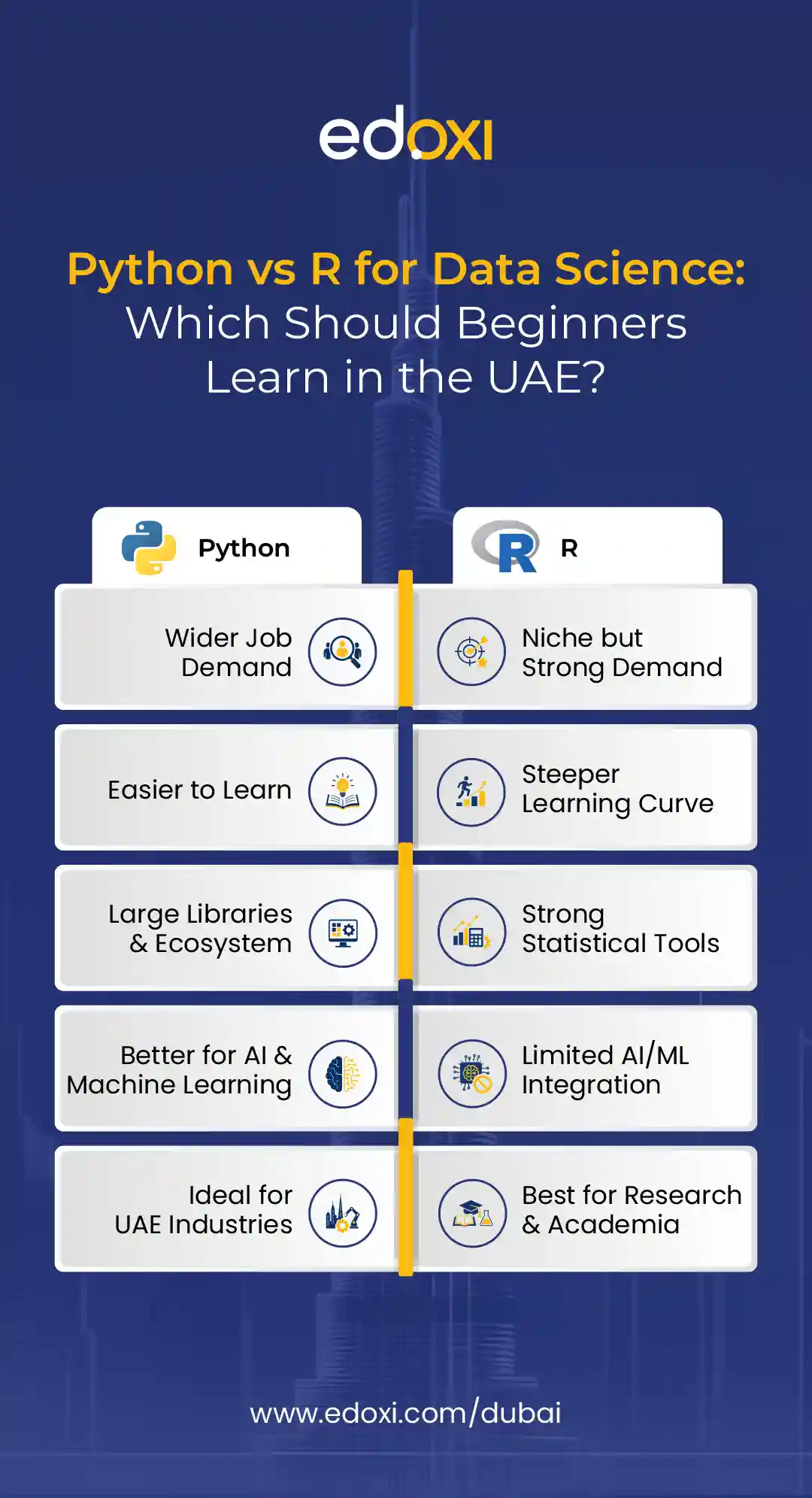
The major differences between Python and R, especially in data science is illustrated in the infographics below:
Most experienced practitioners don't choose one language religiously; they build a primary skill in Python for three to six months to become productive and employable, then add R selectively if their specialism (academic research, biostatistics, epidemiology, or a specific employer's existing R-based workflow) genuinely calls for it.
Learning Python first tends to make picking up R later easier than the reverse, because Python's broader programming concepts transfer well, while R's statistics-first design doesn't always translate as smoothly into general software skills.
For a UAE-based beginner, this pragmatic sequencing Python first, R as a specialism maximises both learning efficiency and the breadth of roles you can realistically apply for across Dubai, Abu Dhabi, and the wider GCC market.
Job postings across Dubai and Abu Dhabi for data analyst, data scientist and machine learning roles consistently name Python, SQL, and cloud platforms (AWS, Azure, GCP) as core requirements.
R appears as a secondary or "nice to have" skill in most listings, except in a narrower set of academic, healthcare research, and pharmaceutical roles, where it's often a genuine requirement rather than a bonus.
|
Skill area |
How often it appears in UAE data roles |
Typical sectors |
|
Python |
Core requirement in most listings |
Fintech, e-commerce, government AI units, tech, telecoms |
|
Core requirement, paired with Python |
Almost all data roles |
|
|
R |
Secondary skill, sometimes core |
Healthcare research, academia, government statistics units |
|
Cloud platforms (AWS/Azure/GCP) |
Increasingly expected at mid-to-senior level |
Enterprise, banking, government |
|
Machine learning frameworks (TensorFlow, PyTorch) |
Python-only ecosystem |
AI-focused roles across sectors |
Want to know why Python is the top choice for data science? Read our guide on the 7 Benefits of Using Python for Data Science.
The global data backs up what UAE job boards show locally. Kaggle's State of Data Science Survey found Python used by more than 90% of respondents, compared with under 30% for R, with the gap widening since 2018. Thus, Python has more global momentum in 2026.
TIOBE's language index has tracked a similar long-run pattern: Python has held the top or near-top spot for several years running, while R sits well down the rankings, even though it has recently climbed a few places as statistical computing regains some attention in specialised fields.
The clearest signal comes from the AI boom itself. Every major foundation-model provider like OpenAI, Anthropic, Google DeepMind, Mistral, Cohere and xAI ships an official Python SDK; none offer a first-party R client.
If your career plan includes any exposure to generative AI, agentic tools, or machine learning pipelines, Python is effectively the default interface to that entire ecosystem.
|
Metric |
Python |
R |
|
Kaggle DS/ML practitioner usage |
90%+ |
Under 30% |
|
Stack Overflow developer survey ranking |
Top 5 |
Around 20th |
|
Official SDKs from major AI labs |
Yes, across the board |
None first-party |
|
Global job posting volume (data roles) |
3-5x higher |
Lower, but less competition per role |
|
TIOBE trend (2022–2026) |
Consistently top-ranked |
Declining, slight recent recovery |
It's more accurate to say R has become a specialist's tool rather than a general-purpose one. Once you filter job postings down to genuine data science and statistics titles (rather than the full universe of "Python jobs" that includes web and backend development), the gap between the two languages narrows considerably.
R remains excellent, arguably unmatched for classical statistical modelling, hypothesis testing, and publication-quality graphics through the ggplot2 package.
Academic research, epidemiology, biostatistics and pharmaceutical programming are the domains where R specialists are still actively sought, and because fewer people learn R, those specialists face less competition per role.
For a UAE beginner without a strong pull toward academic research or clinical biostatistics, though, this specialism doesn't outweigh Python's broader applicability across finance, government analytics, retail and AI-driven product roles that dominate the local market.
New to data science? Read our beginner-friendly guide to understand What Data Science Is and How It Works.
|
Expert Insight The introduction of AI and digital economy plans by Dubai means that there will be a growing need for individuals with expertise in programming and data science. Python should be used by most people who seek jobs in Dubai’s financial, technological, healthcare, logistics, and governmental institutions since R will be more useful in professions dealing with statistical modelling, research, and biostatistics. |
Salary data for UAE data science roles varies by source and city, but the overall pattern is consistent: pay depends far more on seniority, sector and certifications than on which single language you know.
Python is typically the baseline expectation, with R, SQL, and cloud certifications in Dubai adding incremental value on top.
|
Experience level |
Typical monthly salary (AED) |
Notes |
|
Entry-level/junior |
8,000 – 12,000 |
Python, SQL and basic Machine Learning (ML) expected |
|
Mid-level (2–5 years) |
12,000 – 25,000 |
Python plus one cloud platform boosts pay |
|
Senior data scientist / ML engineer |
35,000 – 50,000+ |
LLM and MLOps skills command a premium |
|
Government/Abu Dhabi AI entities |
20% – 30% above market median |
National AI Strategy 2031-linked roles |
Cloud certifications (AWS, Azure, GCP) and demonstrated generative AI or MLOps experience tend to add the largest premiums on top of a Python foundation, more than R proficiency alone does at any experience level.
Planning your next career move? Explore the Top 8 Data Science Certifications to Advance Your Career.