Request a Callback

+971 4380 1666
 Jul 25, 2026
Procurement has become a strategic function that keeps businesses lean, compliant, and competitive. And in the UAE, where trade, construction, and government spending drive so much of the economy, skilled procurement professionals are in genuine demand.
Procurement professionals across Dubai and Abu Dhabi are looking to upskill without pausing their careers. That's exactly why online procurement courses have become so popular. This guide walks you through what's worth studying in 2026, why it matters, and how to pick a course that actually moves your career forward.
The UAE's procurement landscape is changing fast. Businesses are digitising sourcing, tightening compliance, and demanding more from category managers than ever before.
The UAE demands more from category managers due to the digitisation of sourcing and tightening compliance. In the UAE the procurement software market growth is expected at a CAGR of around 9.8% between 2026 and 2035, according to Presidence Research. The adoption of AI-driven spend analytics and predictive supplier risk tools is the chief driving factor that accelerates the hiring of certified procurement professionals who know how to use this platform
As companies invest in digital procurement solutions, they need professionals who understand both procurement strategy and modern technology. Developing these skills today can help you stay relevant and advance your career tomorrow.
CIPS qualifications aren't just a line on your CV they translate directly into higher earning potential and better job prospects. Procurement professionals who hold a CIPS certification often command noticeably higher salaries than their non-certified peers, simply because the qualification signals proven expertise in sourcing, negotiation, and supply chain management. Employers know that hiring someone with CIPS credentials reduces risk: you're bringing tested skills to the table from day one, not learning on the job. Add to that the fact that many organizations now list CIPS as a preferred or even required qualification for procurement roles, and it becomes clear why investing the time and money into certification pays off. In an industry where cost savings and supplier relationships can make or break a company's bottom line, having someone qualified to navigate that complexity is worth every penny and the market compensates accordingly.
According to the CIPS Procurement & Supply Salary Guide 2025, procurement professionals with MCIPS status in the Middle East and North Africa earn significantly more than their non-MCIPS peers. The report found average salaries of about $116,998 for MCIPS professionals compared with $62,253 for those without MCIPS, highlighting the strong career and salary advantage that CIPS membership can provide.
In the UAE, experienced procurement and supply chain managers, particularly those working in sectors such as oil & gas, government, construction, and large multinational companies can earn anywhere from around AED 30,000 to AED 60,000+ per month, depending on experience, industry, and responsibility level.
Government and semi-government organizations are among the UAE's largest employers of procurement professionals, creating strong demand for skilled buyers, sourcing specialists, contract managers, and supply chain professionals. As public sector procurement is governed by regulations such as the UAE Federal Government Procurement Law No. 6 of 2018 and Dubai Executive Council Resolution No. 3 of 2016, employers increasingly seek professionals who understand compliance, transparent tendering, supplier evaluation, contract administration, and ethical purchasing practices. Developing these skills can improve your employability and open doors to rewarding procurement careers across government entities and government owned organizations.
According to Fortune Business Insights, cloud-based deployment will make up approximately 74% of the procurement software market share by 2026.
Every business depends on procurement to keep operations running smoothly. From buying raw materials to selecting reliable service providers, good procurement helps control costs, avoid supply disruptions, and ensure the right products are available when they're needed.
AI is making procurement faster by reducing manual work such as reviewing invoices, comparing supplier quotes, and tracking spending. Instead of spending hours on routine tasks, procurement professionals can focus more on supplier strategy, negotiations, and managing business risks.
Procurement is used in almost every industry. Manufacturing companies purchase raw materials for production, hospitals source medical supplies, retailers manage inventory from multiple suppliers, and construction firms buy equipment and building materials to keep projects on schedule.
Every organization in the UAE, whether it's a government department, oil and gas company, airline, hospital, construction firm, or retail business, depends on procurement to purchase goods and services efficiently. As the country continues to invest in infrastructure, renewable energy, logistics, smart cities, and digital transformation, the demand for skilled procurement professionals continues to grow. According to the UAE Ministry of Finance, the 2025 Federal Budget allocated AED 71.5 billion to support national development and public services, creating ongoing procurement opportunities across government entities and strategic industries. In this guide, you'll learn how procurement works in the UAE, from everyday purchasing and procurement documents to RFQs, tender evaluation, VAT, procurement laws, and the procurement practices followed by organizations such as DEWA, ADNOC, DP World, Dubai Municipality, Etisalat, and Emirates.
Here's what we recommend looking at, based on what employers across the UAE are actually asking for.
This is the global benchmark in procurement and supply chain management, and it's the qualification UAE government entities and multinationals ask for most often. CIPS training generally runs around 35 hours and covers strategic sourcing, contract management, supplier relationship management, and ethical procurement, taught with real case studies rather than dry theory.
This designation is aimed at people with three or more years of procurement or supply chain experience who want to move into senior buying roles. It focuses heavily on spend optimisation and strategic sourcing, which matters because procurement managers are increasingly judged on cost savings they deliver, not just contracts signed.
SAP MM is one of the most requested skills in Dubai's job market right now, particularly in retail, manufacturing, and oil and gas. Learners configure real purchase requisition, vendor selection, and invoice verification workflows, which means you leave the course able to actually run procurement inside an ERP system, not just describe how it works.
Procurement doesn't exist in isolation. This course covers freight forwarding, customs clearance, warehousing, and transportation planning, giving you the wider supply chain context that strategic buyers need when they're negotiating with suppliers or planning inventory.
A shorter, more focused course covering inventory control, demand forecasting, and warehouse automation. It's particularly useful if your procurement role touches stock replenishment or you want to understand the operational side of what happens after a purchase order is placed
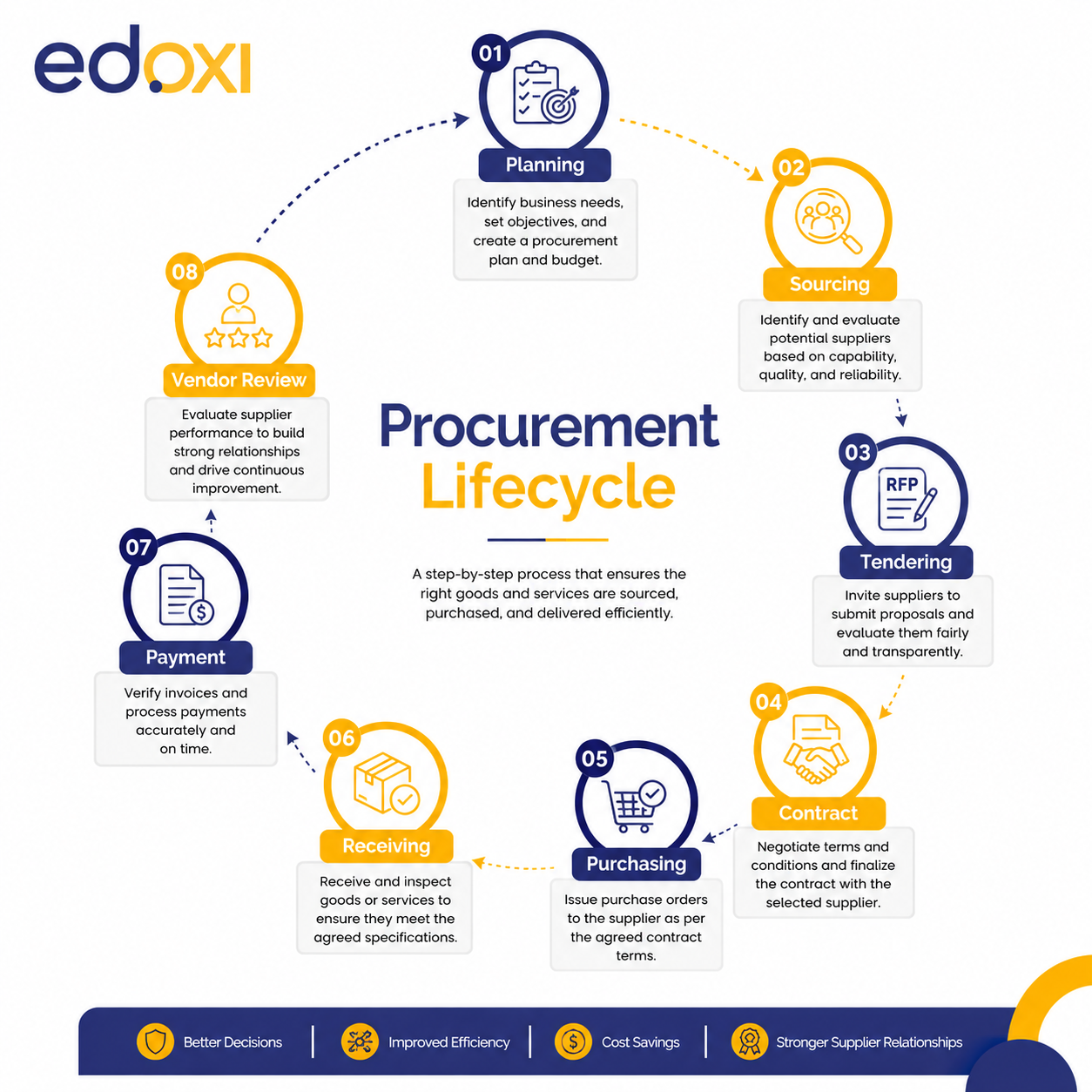
The procurement process is the series of steps an organization follows to purchase goods or services in a controlled and cost-effective way. It usually starts when a department raises a purchase request and ends after the supplier delivers the order and payment is completed. Following a clear procurement process helps businesses reduce purchasing risks, control spending, and maintain reliable supplier relationships.
| Recognition / Trust Signal | Why It Matters |
|---|---|
| KHDA-Licensed Training Institute (Dubai) | Edoxi is a KHDA-licensed professional training institute, meeting Dubai's regulatory requirements for training providers |
| ISO 9001:2015 Certified | Operates under an internationally recognised Quality Management System to ensure consistent training quality and learner satisfaction |
| CPD Registered Provider (Provider No. 20122) | Delivers recognised Continuing Professional Development (CPD) programmes that support professional learning and certification renewal |
| American Purchasing Society (APS) Partner | Partnered with the American Purchasing Society, strengthening Edoxi's presence in procurement and purchasing education |
| 400+ Career-Focused Courses | Offers more than 400 professional training programmes across 22 specialised domains, including Procurement and Supply Chain Management |
| 10,000+ Training Programmes Delivered | Successfully delivered thousands of corporate and professional training programmes since its establishment in Dubai. |
| Learners from 20+ Countries | Professionals and organisations from over 20 countries have chosen Edoxi for career-focused training. |
| International Accreditation Network | Collaborates with globally recognised organisations including Autodesk, EC-Council, CompTIA, PECB, Microsoft, Qualifi, British Council, CPD UK and APS. |
| Outstanding Organisation Award | Recognised at the Education 2.0 Conference for innovation and excellence in professional education |
| EC-Council ATC Circle of Excellence Award (2023 & 2024) | Awarded for excellence in training delivery and learner outcomes as an EC-Council Accredited Training Center. |
| Global Training Presence | Operates training centres in Dubai, Doha, London and Sydney, serving both individuals and corporate clients. |
| Industry-Experienced Trainers | Courses are developed and delivered by certified trainers and industry professionals with practical workplace expertise |
Procurement skills are valuable across many industries and job roles. Whether you're starting your career or looking to move into procurement, this course provides practical knowledge that can benefit professionals at different experience levels.
| Profession / Learner | How the Course Helps |
|---|---|
| Procurement Executives |
Improve sourcing, supplier management, and procurement planning skills.
|
| Purchasing Officers |
Learn best practices for purchasing, RFQs, purchase orders, and vendor selection.
|
| Buyers |
Make informed purchasing decisions while controlling costs and quality.
|
| Supply Chain Professionals |
Understand how procurement supports efficient supply chain operations.
|
| Logistics Coordinators |
Strengthen procurement knowledge to improve inventory and supplier coordination.
|
| Contract Administrators |
Gain practical knowledge of tendering, contracts, and procurement documentation.
|
| Warehouse Managers |
Learn procurement planning to maintain optimal inventory levels.
|
| Project Managers |
Manage procurement activities, supplier performance, and project purchasing effectively.
|
| Finance & Accounts Professionals |
Understand procurement controls, budgeting, and purchase-to-pay processes.
|
| Operations Managers |
Improve procurement efficiency to support business operations.
|
| Government Procurement Professionals |
Build knowledge of public procurement procedures and compliance requirements.
|
| Manufacturing Professionals |
Learn strategic sourcing of raw materials, equipment, and production supplies.
|
| Construction Professionals |
Understand procurement processes for contractors, materials, and project procurement.
|
| Fresh Graduates |
Build job-ready procurement skills for entry-level purchasing and supply chain roles.
|
| Career Changers |
Start a career in procurement, purchasing, or supply chain management with practical knowledge.
|
Understanding procurement theory is only the first step. In many organisations, procurement professionals are expected to analyse supplier performance, compare quotations, negotiate contracts, manage procurement risks, and support cost-saving initiatives.
These responsibilities require more than conceptual knowledge. Employers often value candidates who understand practical procurement workflows, documentation, supplier evaluation methods, and procurement software used in day-to-day operations.
Learning these practical applications through structured case studies or instructor-led training can help bridge the gap between theory and workplace expectations.
Many of these practical skills are covered in a structured Procurement Course, alongside real-world sourcing and supplier management scenarios.
Not every online course delivers the same value. Here's what separates a course worth your time from one that isn't.
Look for courses tied to bodies like CIPS, CPD Registered Provider the American Institute of Business and Management, or KHDA approval, since these are the credentials UAE employers actually check during hiring. A course without recognised backing might teach useful skills, but it won't carry the same weight on your CV.
Procurement is a hands-on discipline, so a course built around real supplier negotiations, tender processes, and contract disputes will prepare you far better than one built entirely on slides. Ask providers for sample modules or case studies before enrolling.
A trainer who has worked procurement roles in construction, oil and gas, or government understands the UAE-specific challenges, like Emiratisation quotas and free zone regulations, that generic global courses often miss. This regional grounding is genuinely hard to find outside the UAE.
Working professionals need weekend classes, evening sessions, or fully online options that fit around a job. If a course only runs during weekday office hours, it's simply not built for people already working in procurement.
A good course should tell you exactly what roles it prepares you for, whether those are procurement manager, category manager, or strategic buyer. If a provider can't explain the career path clearly, that's a red flag worth taking seriously.
Procurement courses are suitable for professionals at various career stages.
Procurement skills are transferable across almost every industry.
Common career opportunities include:
Supply chain and procurement continue to be some of the business functions with consistent hiring demand, LinkedIn’s Global Talent Insights reports, as supply chain transformation and digital procurement initiatives carry on. (Source: LinkedIn Talent Insights)
The numbers back up why this investment makes sense. Here is a tabulated view of salary and career opportunities after procurement course.
|
Career Aspect
|
Key Information
|
|---|---|
| Entry-Level Salary |
AED 7,000–16,000/month for Procurement Officers.
|
| Mid-Level Salary |
AED 16,000–56,000/month for Procurement Managers.
|
| Senior-Level Salary |
AED 62,000–90,000/month for Chief Procurement Officers.
|
| High-Paying Industries |
Oil & gas and construction offer higher salaries.
|
| 2026 Salary Outlook |
Expected salary growth of 5–10%.
|
| Emiratisation Opportunities |
Strong demand for qualified UAE nationals
|
| If you are... | Best Certification |
|---|---|
| Fresh graduate | Entry-level procurement program |
| Buyer | CPP |
| Procurement Executive | CIPS Level 3 |
| Procurement Manager | CIPS Level 5 |
| Supply Chain Manager | CIPS Level 6 |
| Government Procurement | Public Procurement Certification |
| Software | Used For |
|---|---|
| SAP MM | Procurement & inventory |
| SAP Ariba | Supplier collaboration |
| Oracle Procurement | Enterprise purchasing |
| Coupa | Spend management |
| Microsoft Dynamics 365 | ERP procurement |
| Odoo | SME procurement |
Procurement professionals are in demand across the UAE as businesses continue to expand in sectors such as construction, oil and gas, logistics, healthcare, retail, manufacturing, and government services. Whether you plan to work in Dubai, Abu Dhabi, Sharjah, or other Emirates, developing practical procurement skills can open up opportunities across a wide range of industries.
Training providers such as Edoxi offer instructor-led procurement programmes that combine theoretical concepts with practical applications, helping learners develop workplace-ready procurement skills.
|
Location
|
Procurement Opportunities
|
|---|---|
| Dubai |
Home to multinational companies, free zones, logistics hubs, aviation, retail, and government organizations, making it one of the UAE's largest procurement job markets.
|
| Abu Dhabi |
Offers strong career opportunities in oil and gas, energy, infrastructure, manufacturing, healthcare, and public sector procurement.
|
| Sharjah |
Growing industrial, manufacturing, and logistics sectors create demand for procurement and purchasing professionals.
|
| Ajman |
Procurement roles are available in manufacturing, trading, construction, and small and medium-sized enterprises (SMEs)
|
| Ras Al Khaimah |
Industrial manufacturing, cement, ceramics, and construction projects require procurement professionals to manage sourcing and supplier relationships
|
| Fujairah |
Procurement opportunities are supported by the port, shipping, logistics, oil storage, and marine services industries
|
| Umm Al Quwain |
Procurement professionals support businesses involved in manufacturing, trade, food production, and local industries
|
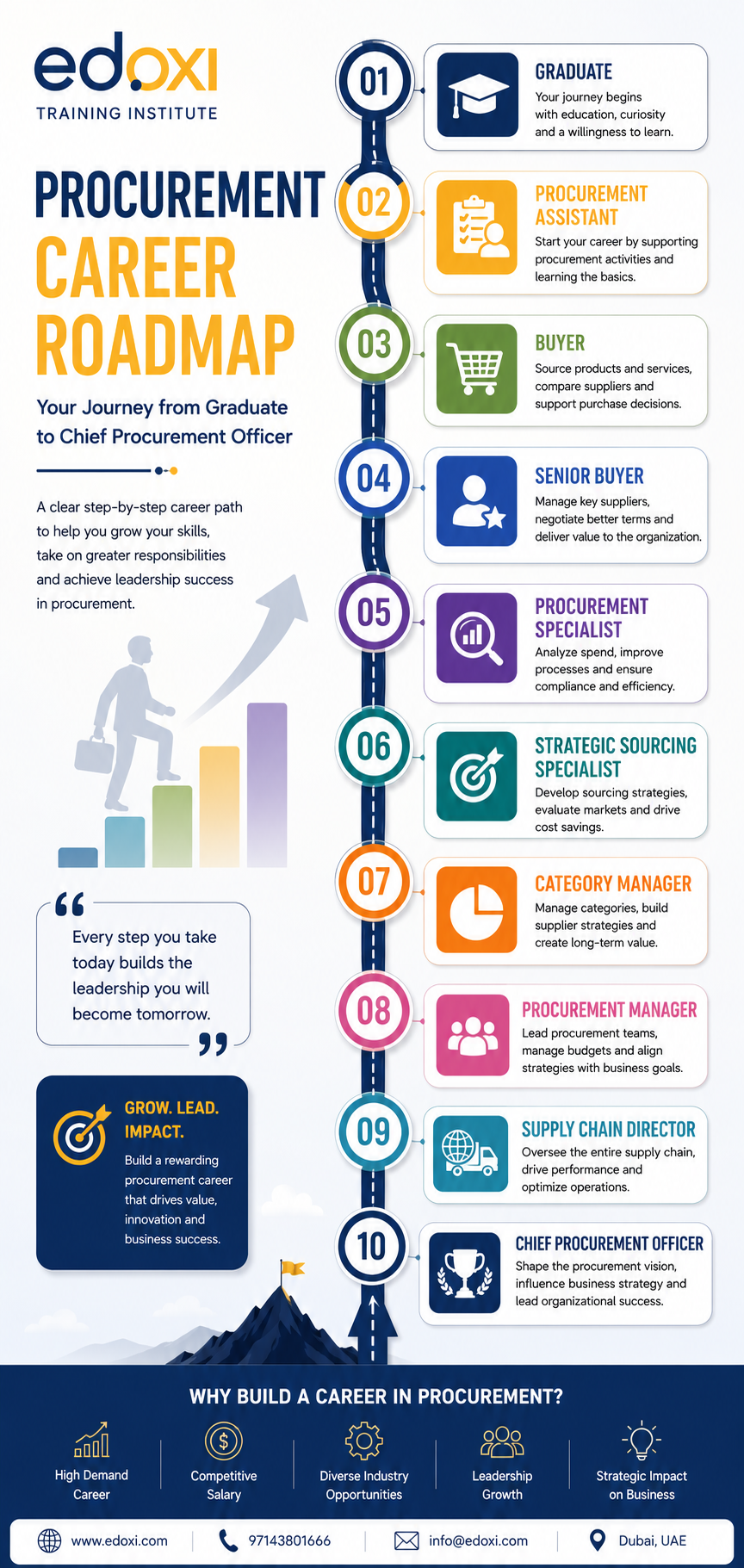
procurement career offers opportunities across industries, from entry-level purchasing roles to senior leadership positions. As you gain experience and develop expertise in sourcing, supplier management, contracts, and strategic procurement, you can progress into higher-paying roles with greater responsibilities.
| Career Level | Common Job Roles | Typical Focus |
|---|---|---|
| Entry Level | Procurement Assistant, Purchasing Assistant, Junior Buyer |
Purchase requests, vendor communication, procurement documentation, purchase orders
|
| Early Career |
Procurement Executive, Purchasing Officer, Buyer
|
Supplier sourcing, RFQs, quotation analysis, vendor coordination
|
| Mid-Level |
Senior Buyer, Procurement Specialist, Category Buyer
|
Contract negotiation, supplier performance, spend analysis, strategic sourcing
|
| Experienced |
Procurement Manager, Strategic Sourcing Manager, Category Manager
|
Procurement strategy, budgeting, contract management, team leadership
|
| Senior Leadership |
Head of Procurement, Supply Chain Manager, Procurement Director
|
Procurement planning, policy development, risk management, business strategy
|
| Executive Level |
Chief Procurement Officer (CPO), Supply Chain Director
|
Enterprise procurement strategy, digital transformation, supplier partnerships, organizational leadership
|
Whether you're new to procurement or looking to build specialized skills, Edoxi offers a range of procurement training course designed for different experience levels. Explore our procurement and supply chain courses to find the programme that best matches your career goals.
| Course Name | Who It's For | Key Learning Areas |
|---|---|---|
|
Procurement & Purchasing Course
|
Beginners and working professionals
|
Procurement process, sourcing, supplier management, RFQs, purchase orders
|
|
Supply Chain Management Course
|
Supply chain and logistics professionals
|
Inventory management, logistics, procurement planning, demand forecasting
|
|
Certified Professional Purchasing Manager (CPPM)
|
Purchasing and procurement professionals
|
Strategic sourcing, contract management, supplier negotiations
|
|
Certified Professional Purchasing Consultant (CPPC)
|
Experienced procurement professionals
|
Procurement strategy, purchasing leadership, supplier performance
|
| Logistics & Supply Chain Course | Logistics coordinators and warehouse professionals | Transportation, warehousing, procurement coordination, inventory control |
| Inventory & Warehouse Management Course | Inventory controllers and warehouse staff | Stock management, warehouse operations, procurement support |
| Contract Management Training | Procurement and contract professionals | Contract preparation, negotiation, compliance, risk management |
Procurement plays a vital role in almost every industry, helping organizations purchase the goods and services they need to operate efficiently. While the procurement process follows similar principles, the products, suppliers, and purchasing requirements vary depending on the industry's operations and business objectives.
| Industry | How Procurement Is Used |
|---|---|
| Construction | Purchasing building materials, equipment, and contractor services |
| Oil & Gas | Sourcing drilling equipment, industrial supplies, and engineering services. |
| Healthcare | Procuring medical equipment, pharmaceuticals, and hospital supplies. |
| Manufacturing | Buying raw materials, machinery, and production components. |
| Retail & E-commerce | Managing supplier relationships and inventory replenishment. |
| Logistics & Supply Chain | Procuring transportation, warehousing, and distribution services |
| Government | Managing public tenders, contracts, and compliant purchasing processes |
| Aviation | Purchasing aircraft parts, maintenance services, and operational supplies. |
|
Hospitality
|
Sourcing food, beverages, furniture, and guest amenities. |
|
Information Technology
|
Procuring software, hardware, cloud services, and cybersecurity solutions. |
Edoxi offers flexible learning options to suit different schedules and learning preferences. Whether you prefer face-to-face training, live online sessions, or customized corporate programmes, you can choose the format that best meets your learning goals
| Training Mode | Who It's Best For | What You Can Expect |
|---|---|---|
| Classroom Training | Learners who prefer in-person interaction | Instructor-led sessions, practical discussions, and hands-on learning at the training centre. |
| Live Online Training | Working professionals and remote learners | Attend live classes from anywhere with real-time interaction and trainer support. |
| Corporate Training | Companies and business teams | Customized procurement training designed around your organization's goals and industry requirements. |
| One-to-One Training | Learners seeking personalized guidance | Individual sessions tailored to your learning pace and specific career objectives. |
Dubai has become a regional hub for logistics, construction, aviation, retail, manufacturing, healthcare, and government projects, creating strong demand for skilled procurement professionals. A procurement course helps you develop practical skills in sourcing, supplier management, contract administration, and cost control that employers value across industries. Whether you're starting your career or looking to move into a senior procurement role, professional training can improve your job opportunities and prepare you for real-world procurement challenges.
| Learning Method | Best For | Limitations |
|---|---|---|
| Reading blogs | Understanding procurement basics | Limited practical application |
| Watching online videos | Learning specific topics | No structured learning path |
| Self-study | Flexible learning | Requires strong discipline |
| Professional procurement training | Building practical skills, certification, and career readiness | Requires time and financial investment |
For professionals seeking structured learning, comparing different Procurement Course options based on curriculum, trainer expertise, certification, and practical learning activities can make the selection process easier.
Before enrolling in any procurement programme, it is worth asking:
Answering these questions helps ensure that the training aligns with your professional goals and learning expectations.
Reading about procurement provides valuable knowledge, but applying procurement principles effectively often requires practical learning and continuous skill development.
If you are evaluating procurement as a career or planning to strengthen your professional skills, reviewing a detailed Procurement Course in Dubai syllabus can help you understand the topics covered, expected learning outcomes, certification options, and whether the programme matches your career aspirations.
When reviewing supplier quotations, experienced procurement professionals typically evaluate more than just price. Factors such as supplier reliability, delivery timelines, contract terms, quality standards, and long-term business relationships often influence procurement decisions.
A procurement executive sourcing office equipment may receive quotations from three vendors offering similar prices. Rather than selecting the lowest bid immediately, they may also assess delivery schedules, warranty coverage, supplier performance history, and payment terms before making a purchasing decision.
Many beginners focus only on procurement terminology while overlooking practical areas such as supplier negotiations, contract management, risk assessment, and procurement analytics.
Developing these practical competencies can improve confidence during interviews and workplace decision-making.
The best procurement certification depends on your career goals, experience level, and industry. Professionals interested in procurement operations, strategic sourcing, contract management, purchasing, supply chain, logistics, or inventory management should choose a certification that matches their career path. If you're unsure, Edoxi's course advisors can help you select the most suitable program.
Yes. A procurement certification demonstrates professional competence and helps you build practical procurement skills. Certified professionals are often better positioned for promotions, leadership opportunities, salary growth, and roles involving strategic sourcing, supplier management, contracts, and supply chain operations.
Depending on your experience and specialization, you may qualify for roles such as Procurement Executive, Purchasing Officer, Procurement Specialist, Buyer, Strategic Buyer, Category Manager, Sourcing Specialist, Procurement Analyst, Contract Administrator, Vendor Manager, Supply Chain Executive, Logistics Coordinator, Inventory Controller, Warehouse Manager, Procurement Manager, Supply Chain Manager, and Procurement Consultant.
Procurement is the complete process of identifying business requirements, sourcing suppliers, negotiating contracts, purchasing goods or services, managing supplier relationships, and evaluating supplier performance. Purchasing is only one part of procurement and focuses primarily on buying products or services after suppliers have been selected.
The procurement process generally includes identifying requirements, preparing purchase requests, sourcing suppliers, evaluating quotations, negotiating contracts, issuing purchase orders, receiving goods or services, verifying invoices, making payments, and reviewing supplier performance. Modern organizations often use Procure-to-Pay (P2P) systems and e-Procurement platforms to automate these activities, improve efficiency, reduce costs, and maintain compliance.
The seven commonly accepted stages of procurement are:
Procurement professionals commonly face supplier risks, delivery delays, cost fluctuations, quality issues, contract disputes, compliance requirements, geopolitical disruptions, cyber security threats, and supply chain interruptions. Effective procurement training helps professionals identify, manage, and minimize these risks.
Procurement course is ideal for Procurement Officers, Buyers, Purchasing Executives, Supply Chain Professionals, Contract Managers, Logistics Coordinators, Inventory Controllers, Warehouse Professionals, Project Managers, Engineers, Finance Professionals, ERP Users, Business Owners, Government Employees, and graduates interested in procurement careers.
Topics typically include procurement planning, strategic sourcing, supplier evaluation, negotiation techniques, contract management, purchasing procedures, inventory control, warehouse operations, procurement analytics, procurement technology, compliance, supplier relationship management, risk management, and procurement best practices using real business case studies.
The procurement course in dubai duration depends on the course. Short professional programs may be completed within a few days, while comprehensive procurement certifications may take several weeks or months. Edoxi offers flexible schedules to suit both working professionals and full-time learners.
Assessment methods vary depending on the course. Some programs include examinations, while others assess learners through practical assignments, projects, or continuous evaluation. The difficulty level depends on the certification, but most courses are designed to accommodate both beginners and experienced professionals.
Procurement professionals are in high demand across industries such as construction, oil and gas, manufacturing, healthcare, aviation, retail, logistics, hospitality, government, utilities, telecommunications, and technology. Ongoing infrastructure development and digital transformation across the GCC continue to create strong demand for skilled procurement professionals.
Course fees vary based on the certification, course duration, training format, and learning objectives. Contact Edoxi for the latest course fees, upcoming batch schedules, corporate pricing, and available payment options.
Picking the right procurement course comes down to matching the qualification to your career stage. If you're early in your career, a CPP or a foundational logistics course builds the groundwork. If you're aiming for senior sourcing or category management roles, CIPS is close to non-negotiable given how often UAE employers specify it. And if you work with ERP systems day to day, SAP MM training will make you noticeably more valuable to your employer. If 2026 is the year you want to move your procurement career forward, now's a sensible time to start looking seriously at your options. Whatever you choose, prioritise accreditation, practical teaching, and trainers who actually understand the UAE market.
Many professionals spend months reading articles, watching videos, and following procurement trends, yet still feel unsure about applying procurement concepts in real workplace situations. Learning independently is valuable for building awareness, but structured training becomes useful when you need practical knowledge, recognised certification, or career advancement.
You may benefit from formal procurement training if you:
Books, online articles, and free resources are excellent for understanding procurement fundamentals. However, professionals preparing for interviews, promotions, or career transitions often look for more structured learning that includes guided instruction, practical exercises, and recognised certification.
When comparing learning options, consider factors such as:
Evaluating these aspects helps you choose a learning path that supports your long-term career goals rather than focusing only on course duration or fees.
Successful procurement professionals continuously update their knowledge because procurement practices evolve with technology, sustainability requirements, digital procurement platforms, and changing supply chain risks. Combining theoretical understanding with practical application helps professionals make informed purchasing decisions and contribute greater value to their organisations.