Request a Callback

+971 4380 1666
 Sep 01, 2026
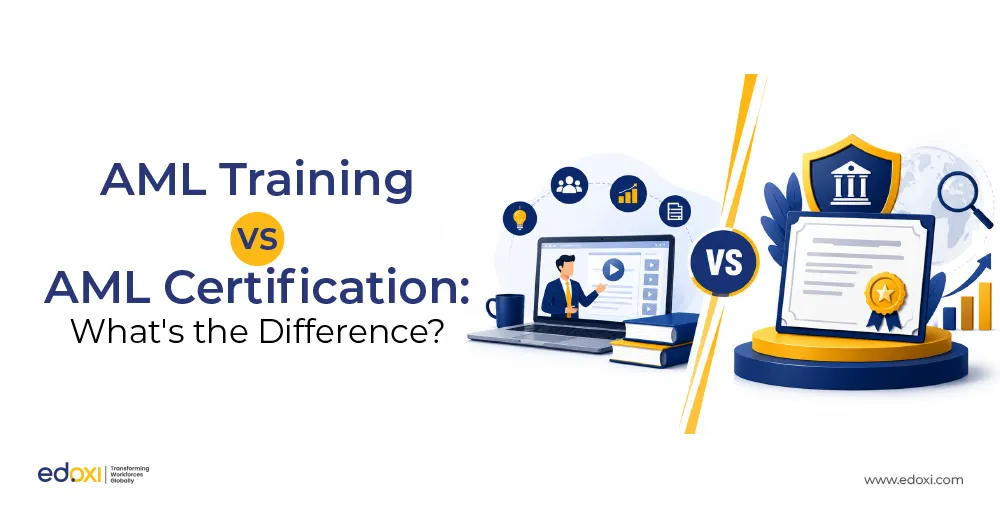
AML training builds your knowledge of anti-money laundering. AML certification tests and proves it through a formal exam. If you work in compliance, finance, or banking in Dubai, this distinction shapes your next career move. Leading institutions such as Emirates NBD and First Abu Dhabi Bank run dedicated financial crime compliance programmes, staffed by people who hold both.
This blog breaks down six key differences, so you can choose the right path for where you stand in your AML career.Purpose
Structure and Format
Issuing Authority and Recognition
Target Audience
Outcome
Validity
Let us understand these in more detail.
Purpose comes down to what each one is designed to achieve.
AML Training: AML training is designed to build your understanding. It explains how money laundering works, how criminals exploit financial systems, and how compliance teams are expected to respond when they spot suspicious activity. There is no formal assessment involved
AML Certification: AML certification tests what you already know. You study and then sit for the exam set by the certifying body. If you pass, the result proves that you understand AML well enough to apply it on the job
Training builds the knowledge. Certification proves you actually learned it.
Structure and format refer to how each one is delivered, from start to finish.
AML Training: AML training is flexible. You can work through course material at your own pace. This could be a few days or weeks. Many training providers may not even require a formal test at the end. Others include a short quiz at the end, but you rarely need to pass it to get your certificate of completion
AML Certification: AML Certification follows a fixed process set by the issuing body. This includes:
Issuing authority and recognition determine who offers the certification and how widely it is recognised.
AML Training: An AML training provider can issue its own certificate of completion. That certificate is a genuine record of what you studied, but its value depends on the provider's reputation. No external body is formally validating your competence
AML Certification: Recognised AML certification comes from a small number of established professional bodies. Association of Certified Anti-Money Laundering Specialists (ACAMS) is one of them, and its Certified Anti-Money Laundering Specialist (CAMS) credential is widely regarded as an industry benchmark. Earning it requires membership, a minimum level of professional experience or education, and a supervised exam.
A Quick Note: Not every AML course results in a certification. So, ask these three questions before you sign up.
If the answer to all three is no, you are most likely looking at a training program rather than a professional certification.
AML Training: AML Training is for someone new to AML, or for professionals who want to refresh their knowledge in a specific area, such as KYC or transaction monitoring. This includes:
AML Certification: AML Certification is better suited to professionals who already have some AML exposure and want a credential that carries weight with future employers. This includes:
Outcome is what you are left with once training or certification is complete.
AML Training: AML Training provides practical knowledge of KYC, CDD, AML risk assessment, and how transaction monitoring identifies suspicious activity. You can apply this knowledge immediately, even though no external body has formally assessed it.
AML Certification: AML Certification offers you a reputable credential. A compliance director at a different company, in a different country, will recognise it without needing your full CV to explain it.
In short, training builds capability. Certification proves that capability to people who never saw you acquire it.
Validity refers to how long the certification remains recognised.
AML Training: AML Training does not expire. Once you understand how a particular laundering method works, or how a red flag surfaces in a transaction, that knowledge stays with you, regardless of what any certificate states.
AML Certification: AML Certification does expire, or at least requires active renewal. CAMS, for example, requires annual recertification along with ongoing education to remain valid. AML regulations and laundering methods change quickly, so a certification that never needed renewal would eventually say very little about your current knowledge.
The table below highlights the key differences between AML training and AML certification
| Criteria | AML Training | AML Certification |
|---|---|---|
| Purpose | Builds foundational knowledge | Formally verifies your competence |
| Structure and Format | Flexible and self-paced, often with no formal test | Follows a fixed syllabus and includes a timed, supervised exam |
| Issuing Authority and Recognition | Issued by the training provider | Issued by a recognised professional body, such as ACAMS or ICA |
| Target Audience | Beginners, career changers, and professionals seeking a refresher | Professionals looking to earn a recognised credential |
| Outcome | Practical knowledge that can be applied immediately | A portable professional credential recognised by employers |
| Validity | Typically does not expire | Usually requires periodic renewal |
Money laundering does not stop for anyone, and neither should your preparation to fight it. Whether you are just starting out or already deep into a compliance career, the right course, training, or certification moves you from understanding the problem to actually being equipped to catch it. Do not wait for the next audit to make that decision for you. Enrol in an AML course today, and turn what you already know into a credential the industry trusts.
Yes. Graduates, career changers, and anyone stepping into financial crime compliance for the first time tend to start exactly here.