Request a Callback

+971 43801666
 Aug 11, 2026

Data analysts in London earn salaries around y £42,000–£48,000 a year on average as per data reports of mid-2026. Though the exact figure depends heavily on which salary platform you check, your seniority, and your industry. Data analysts remain among the better-paid digital professionals in London. Ongoing digital transformation across finance, healthcare, e-commerce, and the public sector keeps demand, and pay is well above the UK average.
Because no single salary source tells the whole story, this guide benchmarks London data analyst pay across five independent platforms. From there, it breaks the numbers down by region, industry, experience level, and in-demand technical skill, so you can see where you sit and where the growth is.
Most sources put it at £42,000–£48,000 a year. Here's how five major salary platforms compare:
| Source | Average London Salary | Typical Range | Last Updated |
| Glassdoor | £42,280/yr | £33,019 – £54,864 | June 2026 |
| Indeed | £47,603/yr | — | May 2026 |
| Michael Page (UK-wide) | £44,730/yr | — | 2026 Salary Guide |
| Reed | £40,000 – £50,000/yr | — | 2026 |
| PayScale | £35,000 – £42,000/yr (by experience band) | £25,000 – £54,000+ | 2026 |
The spread between platforms is normal: Glassdoor and PayScale skew toward self-reported base pay across all seniority levels, while Indeed and Reed weigh more heavily toward current live job postings, which tend to sit higher for London specifically. Reading across sources rather than relying on one number is the safest way to benchmark your own offer or job ad.
For reference, Glassdoor puts the UK-wide average at £37,581/yr and Indeed's UK-wide figure sits at £38,689/yr, confirming London's roughly 10–25% premium over the national average, depending on the source used.
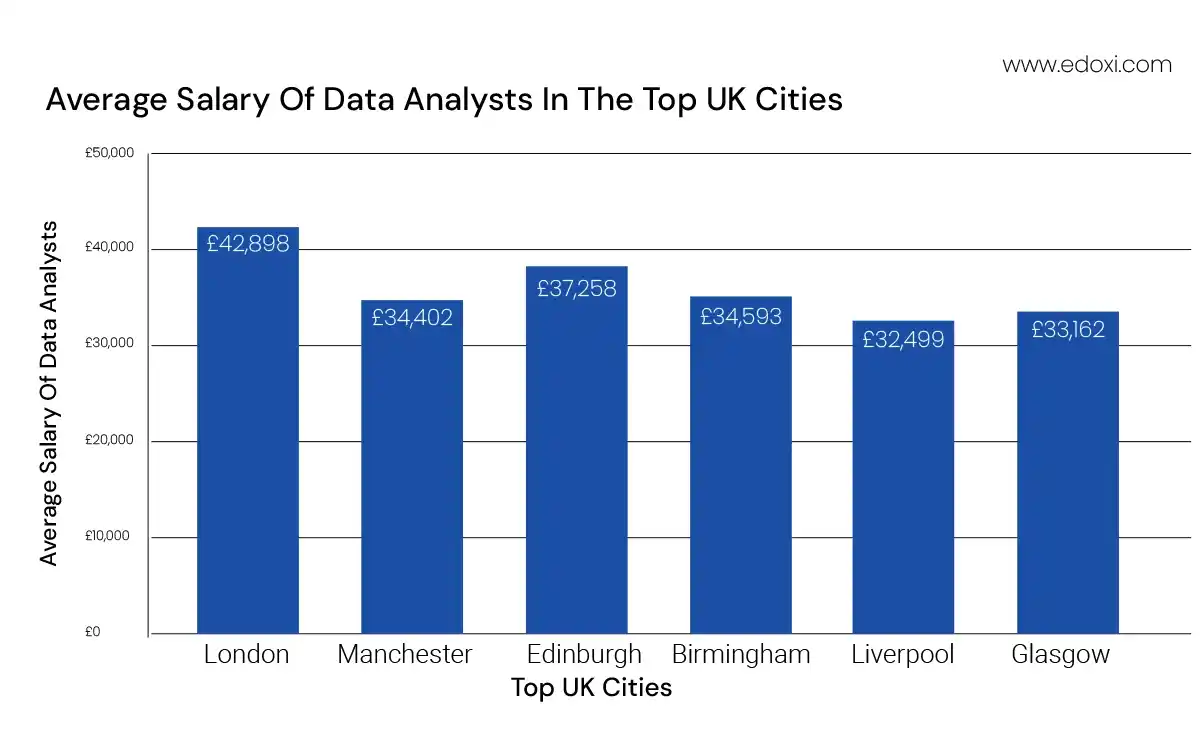
London pays the most: £42,280 a year on Glassdoor's June 2026 data, well above the UK average and every other major city.
| City | Average Salary | Source |
| London | £42,280 | Glassdoor |
| UK average | £37,581 | Glassdoor |
| Edinburgh | £36,724 | Glassdoor |
| Bristol | £34,407 | Glassdoor |
| Manchester | £34,202 | Glassdoor |
| Birmingham | £34,019 | Glassdoor |
This guide breaks salary down by:
The table below shows how pay varies by area within London. West London, the City, and North London pay the most, reflecting the concentration of finance, professional services, and corporate HQs in those areas.
| London Region | Average Salary |
| West London | £46,683 |
| City of London | £43,453 |
| North London | £41,054 |
| Croydon | £40,449 |
| Bromley | £40,160 |
| Kingston | £37,000 |
| East London | £35,678 |
| Hounslow | £34,691 |
The table below shows average data analyst pay in London in each industry.
| IndustryIndustry | Average SalaryAverage Salary |
| Finance | £58,300 |
| Healthcare | £57,500 |
| IT | £49,000 |
| Entertainment | £48,900 |
| Consumer Goods & Services | £47,600 |
| Media & Communications | £46,305 |
| Digital Marketing | £45,783 |
| Education | £44,991 |
| Legal | £44,762 |
| Public Administration | £43,200 |
| Real Estate | £42,000 |
| Tourism | £41,820 |
| Transport & Logistics | £40,543 |
| Construction | £38,700 |
| Non-Profit | £34,640 |
Finance and healthcare pay the most, reflecting London's position as Europe's largest financial centre. Major platforms like Glassdoor and Indeed report by job title and location rather than industry, so treat these figures as directional.
Company-level pay varies more than industry averages suggest, and it's worth checking multiple sources since employer-reported and employee-reported figures can differ by £5,000–£10,000. Here's what independently verifiable platforms show as of mid-2026:
| Company | Glassdoor Average (London) | Source |
| Bloomberg L.P. | £56,000/yr median total pay | Glassdoor |
| HSBC | £35,100 – £51,000/yr | Glassdoor |
| Barclays | £37,500 – £45,000/yr | Glassdoor |
| NHS | £30,000 – £50,000/yr | Glassdoor |
| £48,000 – £100,000/yr | Glassdoor | |
| Octopus Energy | £35,000 – £55,000/yr | Glassdoor |
Other employers frequently cited in earlier salary surveys, including Natwest Group, Experian, Lloyds Banking Group, PwC, KPMG, Thomson Reuters, Amazon, and JP Morgan Chase, continue to advertise London data analyst roles broadly in the £34,000–£45,000 range, though we could not independently re-verify each figure this cycle. Always check a live salary comparison tool (Glassdoor, Levels. fyi, or Indeed's company pages) before negotiating an offer, since these estimates shift quarterly.
| Level | Years of Experience | Typical Range |
| Entry-Level | 0–2 years | £29,000 – £46,000 |
| Intermediate | 3–7 years | £45,000 – £59,000 |
| Senior | 8+ years | £58,000 – £75,000 |
| Lead / Staff | 10+ years | £69,000 – £116,000 |
These bands reconcile figures from Glassdoor's entry-level, senior-level, and lead-level London data, alongside PayScale's early-career figures, which tend to run lower because they include analysts with under a year of experience. Progression from entry-level to senior typically brings a 60–90% pay increase over a data analyst's first 8–10 years in London, driven more by skill acquisition (SQL, Python, cloud platforms) and stakeholder-facing experience than by tenure alone.
The clearest gap in most salary guides is what happens once a data analyst adds AI, machine learning, or advanced engineering skills. Recruiters, including Michael Page, report strong demand for professionals who can combine AI literacy with data engineering and cybersecurity skills, and this shows up clearly in pay for adjacent, more senior titles:
Core technical skills tied to higher pay include SQL, Python, Power BI, and Tableau, plus growing demand for cloud data platforms (AWS, Azure, Snowflake, Databricks) and dbt/Airflow-based pipelines.
Analysts who can speak to model governance, MLOps, or agentic AI workflows are increasingly commanding lead-analyst or analytics-engineer level pay rather than traditional analyst salaries. This is the fastest-growing pocket of the market, even as overall hiring volumes have cooled.
It's worth being upfront about a mixed picture here, because a purely upbeat “demand keeps rising” narrative doesn't match everything the data shows in 2026.
The growth case:
The reality check:
Net effect for London data analysts: pay for skilled, in-demand profiles (AI-adjacent, cloud-fluent, stakeholder-facing) is holding firm or rising, while entry-level hiring has become more competitive and slower-moving than the market commentary of 2023–2024 suggested it would stay.
A few practical pointers for using this data rather than just reading it:
Use a range, not a single number: Quote the £42,000–£48,000 London band rather than one platform's average when discussing pay with a recruiter or setting a job ad budget.
Check the job title carefully: "Data Analyst," "Business Intelligence Analyst," "Insight Analyst," and "Business Analyst" are often used interchangeably by employers, but can carry meaningfully different pay bands. Reed's guide, for instance, puts UK business analyst salaries at £55,000–£75,000, notably above the standard data analyst range.
Weight recency: Salary guides published even 12–18 months ago can undercount current London rates, given the pace of AI-driven role changes; always check the "last updated" date on any source you cite.
Factor in total compensation: Not just base salary, especially at banks and larger tech employers, where bonus and benefits can add 15–30% on top of base pay.
London data analysts already out-earn the UK average, but the numbers in this guide point to one clear pattern: pay rises fastest for those who add the right skills, not just years on the job. SQL, Python, and solid statistical fundamentals remain the baseline; Power BI, Tableau, and cloud platforms (AWS, Azure, Snowflake) are what push salaries into the senior and lead-analyst bands covered above.
Recognised certifications from Microsoft, Google, AWS, IBM, and CompTIA, plus growing demand for applied AI/ML skills, help analysts stand out for the higher-paying roles this guide highlights. Just as important are the softer skills: critical thinking, stakeholder management, and the ability to turn technical findings into commercial value, which are what actually separate mid-career analysts from those who reach senior or lead positions.
Demand for data roles is more resilient than the wider UK job market, which has cooled overall in 2025–2026. London remains the largest single hub for data-role vacancies in the UK, though entry-level hiring has become more selective.