Request a Callback

+971 4380 1666
 Oct 08, 2026
Key Takeaways
|
Prompt engineering still matters in five years, but the job looks different by then. The narrow task of finding the 'magic words' for a chatbot fades. In its place, a broader skill grows: directing AI systems, feeding them the right context, checking their output and building that into everyday workflows.
This guide answers the central question directly, then walks through the evidence: what changes, what stays, and what to learn next, whether you are based in Dubai, London, New York, or anywhere in between.
Table of Contents |
|
1. What Is Prompt Engineering, and Why Does It Matter Today?
2. Will Prompt Engineering Still Matter in Five Years? 3. What Could Make Basic Prompting Less Important? 4. Why Does Prompt Engineering Not Simply Disappear? 5. What Is Context Engineering, and How Is It Different From Prompt Engineering? 6. How Are AI Agents Changing the Way People Prompt? 7. Which Prompt Engineering Skills Are Likely to Remain Valuable? 8. Is Prompt Engineering Still Worth Learning in 2026? 9. How Can Professionals Future-Proof Their AI Careers? 10. What Does the Prompt Engineering Outlook Look Like in the UAE, UK and US? 11. How Does Prompt Engineering Fit Into Broader AI and Business Skills? 12. Frequently Asked Questions 13. More Questions People Ask About the Future of AI Prompting |
Prompt engineering is the practice of writing and refining instructions so an AI model gives a reliable, useful answer. It matters today because large language models respond very differently depending on how a request is framed, structured and constrained.
A good prompt indicates the desired role, format, constraints, and examples for the AI. On the other hand, poorly phrased prompts can lead to unclear or inconsistent results. This is why structured techniques like few-shot examples and step-by-step reasoning are essential when working with generative AI.
As more professionals began using tools like ChatGPT, Claude, and Gemini, the difference in output quality between casual users and skilled prompt engineers became clear.
Yes. Prompt engineering is likely to remain useful, but the skill is changing. Instead of being a stand-alone job, prompting is becoming part of broader AI skills such as context management, AI evaluation and AI-agent oversight.
PwC’s 2026 Global AI Jobs Barometer analysed more than one billion job advertisements across 27 countries and territories. It found that roles where AI augments expert skills grew faster and recorded stronger salary growth than roles where AI mainly makes routine work easier for non-experts.
This shift is important for prompt engineering. Basic prompting is becoming easier as AI models improve. More people can get useful results without advanced prompting skills.
However, complex AI work still needs human judgement. Professionals who can provide the right context, guide multi-step AI workflows, evaluate outputs and oversee AI agents can offer greater value.
So, prompt engineering is not simply disappearing. It is evolving. Over the next five years, prompting is likely to become one part of a broader AI skill set built around context, evaluation, critical thinking and human-AI collaboration. See why prompt engineering skills are in high-demand in Dubai.
Better models are the main driver. As large language models improve at understanding natural, everyday language, they need less careful phrasing to produce a good result. Here are the reasons that makes bsic prompt engineering less important:
Stronger instruction-following: Newer models interpret loosely worded requests more accurately than earlier versions.
Built-in prompt help: Many AI tools now suggest or auto-improve a prompt before it is even submitted.
Longer context windows: Models can absorb more background information, reducing the need for tightly engineered single prompts.
Automated optimisation: Some platforms test and refine prompts automatically, based on measured output quality.
None of this removes the need for human judgement. It simply lowers the barrier for the most basic prompting tasks, the same way spellcheck reduced the need for manual proofreading, without ending writing as a skill.
Prompt engineering survives because four things a model cannot supply on its own remain firmly human such as: context, constraints, evaluation and domain knowledge. These are better explained here.
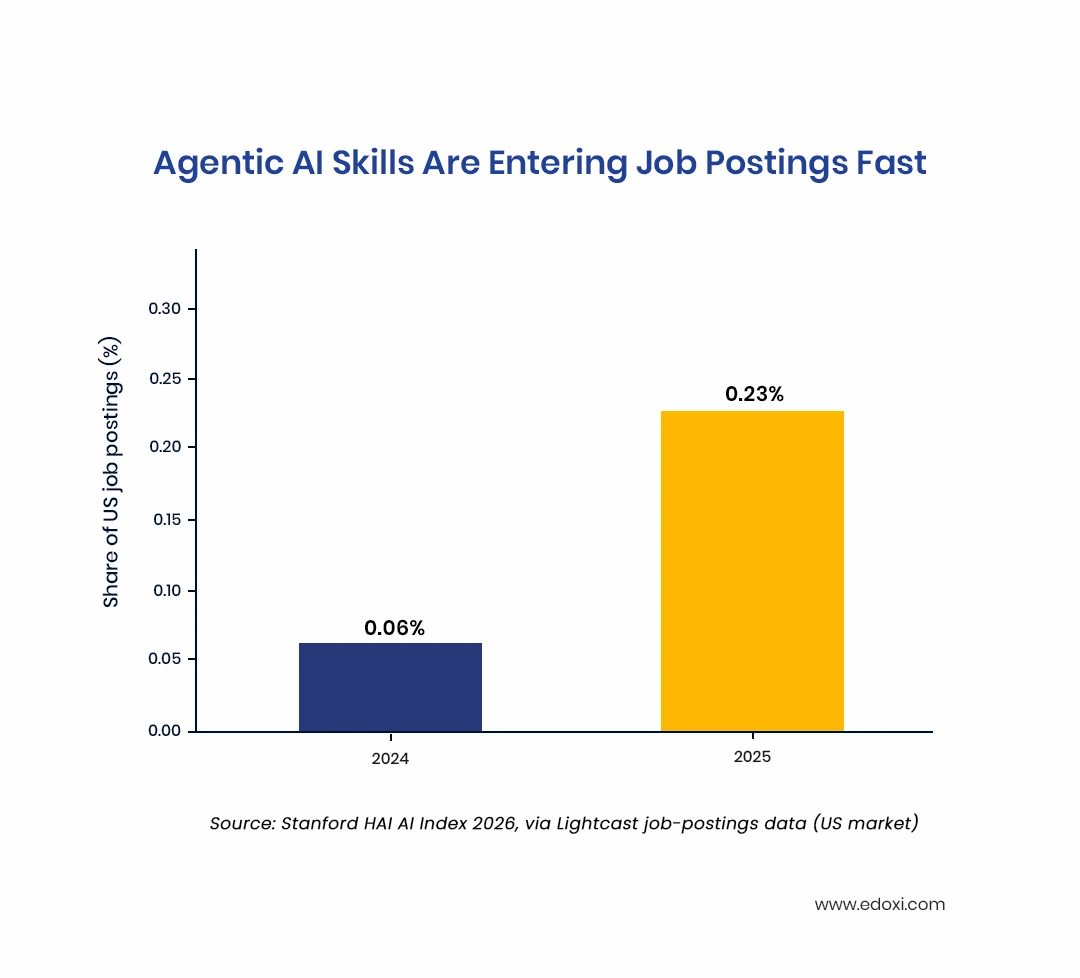
Research from Stanford's HAI 2026 AI Index, compiled with labour-market data firm Lightcast, shows this shift happening in real time. Skills linked to agentic AI systems grew from 0.06% to 0.23% of all US job postings between 2024 and 2025, a jump of more than 280% in a single year. Employers are not asking for fewer AI-interaction skills; they are asking for more advanced ones.
Context engineering is the discipline of feeding an AI system the right information, memory, tools and instructions, not just a well-phrased question. The term became widely used in mid-2025, after Shopify CEO Tobi Lütke and AI researcher Andrej Karpathy both described it as a better label for what strong AI practitioners actually do.
Prompt engineering does not vanish under this framing. It becomes one layer inside a bigger discipline. A prompt is the instruction. Context is everything else the model needs to act on that instruction well: retrieved documents, conversation history, tool outputs and system rules.
Prompt Engineering vs Context Engineering
| Aspect | Prompt Engineering | Context Engineering |
| Main focus | Wording a single instruction well |
Assembling all relevant information around a task
|
| Typical use | One-off questions, simple content generation |
Multi-step AI agents and production AI systems
|
| Skill emphasis | Clarity, structure, examples |
Data retrieval, memory, tool integration, sequencing
|
| Where it sits | A core building block |
The wider system prompt engineering fits inside
|
For learners, the practical message is reassuring rather than alarming: prompt engineering fundamentals are still the foundation. Context engineering simply builds on top of them.
AI agents shift prompting from a single instruction to an ongoing conversation between a person, a model and a set of tools. Instead of asking one question and reading one answer, an agent plans steps, calls tools, checks its own work and adjusts.
This is a genuine shift in emphasis, not a rejection of prompting. Every one of those four steps still relies on someone writing clear instructions. These are the instructions simply now govern a system, rather than a single reply.
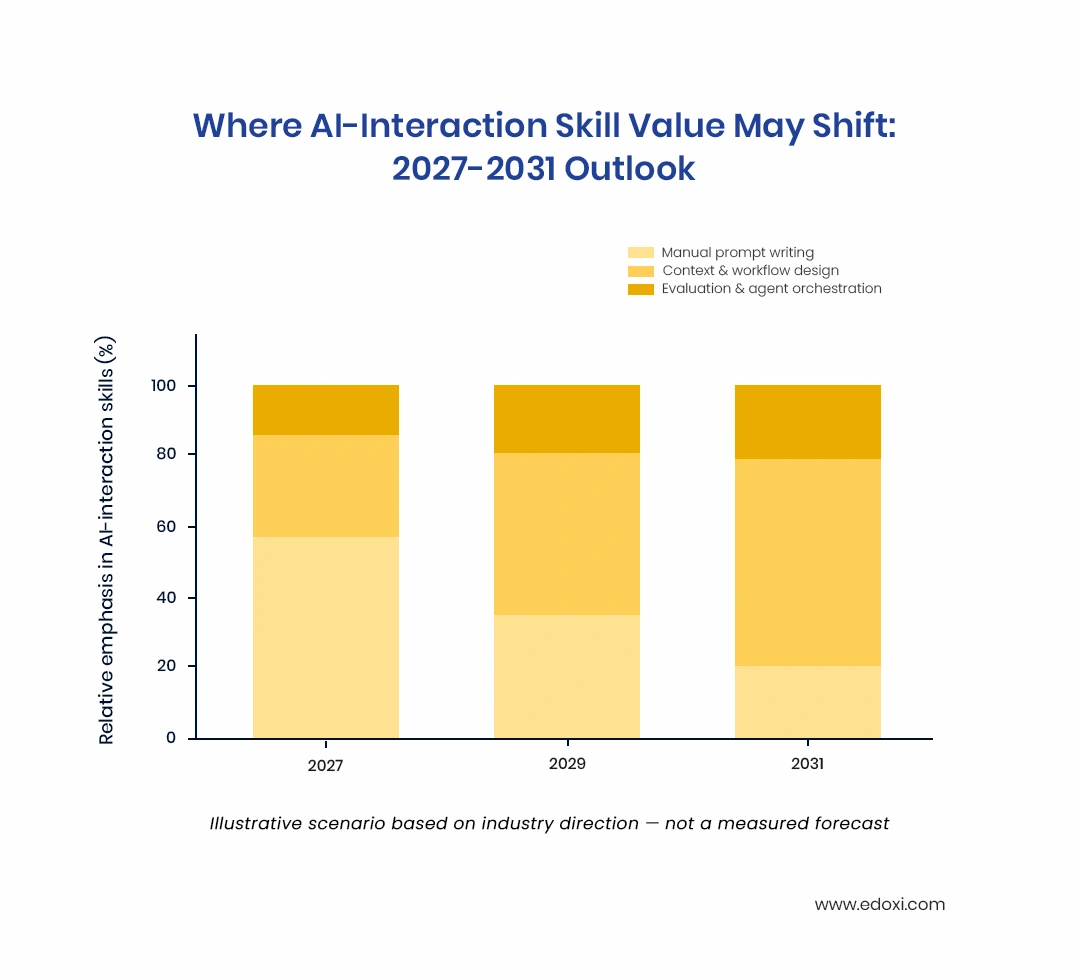
Skills tied to judgement, structure and verification hold their value. Skills tied purely to memorising clever wording lose value fastest, because models increasingly handle that part automatically.
A Comparison of 2027 and 2031 Prompt Engineering Skills Value
| Today's Emphasis (2027) |
Future Emphasis (2031)
|
| Writing single prompts |
Designing context and multi-step workflows
|
| Trial-and-error phrasing |
Structured testing and evaluation of AI output
|
| Text-only interaction |
Multimodal and tool-connected interaction
|
| Individual AI tasks |
AI-powered, repeatable business workflows
|
| Manual output checking |
Built-in evaluation sets and quality metrics
|
Notice the pattern: nothing here says prompting stops mattering. It says the useful unit of work grows from 'one good prompt' to 'one reliable, evaluated AI workflow'.
Yes, for almost every professional profile, as a foundation, prompt engineering is not a finish line. Prompt engineering teaches the underlying logic of working with AI: how models interpret instructions, why structure improves accuracy, and how to judge a good answer from a weak one. Let’s see how it is beneficial for different type of learners:
Where learning stops matters more than whether to start. Treating a prompt engineering course as the entire skill set is short-sighted. Treating it as the entry point to a wider generative AI skill set is a sound, evidence-backed decision.
Future-proofing means layering skills on top of prompt engineering, rather than relying on it alone. A practical roadmap moves from prompting to understanding how models work, to context and evaluation, to AI-agent oversight, to domain expertise.
Not every professional needs every layer at expert depth. A marketer benefits most from strong prompting and evaluation habits; a developer benefits from pushing further into agent orchestration and tool integration. The combination that matters is the one relevant to your own role. See how long it take to learn prompt engineering.
Regional demand for AI-interaction skills is strong across all three markets, though each moves at its own pace and for its own reasons. Let’s see what role does prompt engineering plays in different markets of major regions in the world.
| Region |
What the Evidence Shows
|
| UAE |
Dubai's free 'One Million AI Prompt Engineers' initiative aims to train a million residents in practical AI and prompting skills, part of the wider UAE National Strategy for Artificial Intelligence 2031 and its target to train one million people in AI by 2027.
|
| UAE infrastructure |
Abu Dhabi's Stargate UAE project (a 1-gigawatt AI compute cluster inside a 5-gigawatt US-UAE AI campus spanning 19.2 square kilometres) signals long-term national investment in the AI capacity that agentic, prompt-driven applications depend on.
|
| UK |
Stanford's Lightcast-backed AI Index data places the UK among the more established Western markets for AI-related job postings, with continued year-on-year growth in AI skills demand across sectors beyond IT.
|
| US |
The US remains the largest single market for AI job postings globally, and the home of the agentic AI hiring surge. Stanford HAI's 2026 AI Index found agentic-related postings nearly quadrupled their share of the market in a single year.
|
The regional detail differs, but the direction agrees everywhere: employers reward people who can direct AI systems with judgement, not just write a decent one-off prompt. See what is thePrompt Engineer Salary in Dubai & UAE: What to Expect in 2027.
Prompt engineering increasingly sits inside other roles, rather than standing apart from them. A software developer uses it to direct coding assistants. A marketer uses it to brief content and research agents. A business analyst uses it to query data through natural language.
This embedding is a sign of maturity, not decline. Skills that matter enough to spread across every discipline, such as spreadsheets, presentation software, basic data literacy, usually stop being separate job titles precisely because they become universally expected.
Prompt engineering does not fade quietly by 2031. It grows up into context design, workflow thinking and AI oversight. Learners who build on that foundation now, rather than waiting for the market to fully settle, put themselves ahead of it.
No. Context engineering is broader, it covers the data, memory and tools around a task, while prompt engineering covers the instruction itself. One sits inside the other.
Many professionals move towards AI workflow design, agent orchestration, or AI evaluation and observability, all natural extensions of core prompting skills.
Standalone job titles are less common than in 2023–2024, but the underlying skill is now expected inside developer, marketing, analyst and operations roles across all three markets.
Employers increasingly list AI literacy, prompting and evaluation skills as baseline requirements across marketing, data, operations and technical job postings, rather than as a separate specialism.