Request a Callback

+971 4380 1666
 Aug 20, 2026
The CMA (Certified Management Accountant) exam is a two-part, IMA-administered professional certification exam for finance and accounting professionals, covering financial planning, performance, analytics, and strategic financial management. Each part has 100 MCQs and 2 case-based essay questions, runs 4 hours, and requires a scaled score of 360/500 to pass.
The CMA exam is the certification examination for the Certified Management Accountant credential offered by the Institute of Management Accountants (IMA).
Certified Management Accountant (CMA) exam is a globally recognized professional certification exam designed for accountants and finance professionals. It measures knowledge in financial planning, budgeting, performance management, internal controls, cost management, corporate finance, investment decisions, risk management, and strategic financial management. The certification is widely valued by multinational companies because it focuses on practical financial decision-making and business strategy. Passing both exam parts, along with meeting education and experience requirements, qualifies candidates to earn the internationally respected CMA designation.
| Fact | Detail |
|---|---|
| Administered by | Institute of Management Accountants (IMA), USA |
| Number of parts | 2 (Part 1 and Part 2, can be taken in any order) |
| Questions per part | 100 MCQs + 2 case-based/essay questions |
| Duration per part | 4 hours (3 hrs MCQ + 1 hr essay) |
| Passing score | 360 out of 500 |
| Global pass rate | ~45% per part (IMA average) |
| Exam windows | Jan–Feb, May–Jun, Sep–Oct |
| Test centers in UAE | Prometric centers, Amideast Dubai & Abu Dhabi |
| Typical completion time | 6–12 months for both parts |
| Retake limit | None, but both parts must be passed within 3 years of enrollment |
| Recognized in | 100+ countries |
The CMA exam has two parts, and each is a self-contained 4-hour exam, there is no single combined test. Candidates can take either part first
If you're based in the UAE and weighing up classroom versus online prep, it's worth checking whether a CMA course in Dubai actually runs both formats side by side, that flexibility matters more than people expect once work schedules get in the way.
| CMA Part 1 | CMA Part 2 | |
|---|---|---|
| Full name | Financial Planning, Performance & Analytics | Strategic Financial Management |
| Core topics | Cost management, internal controls, budgeting, data analytics, external financial reporting | Financial statement analysis, corporate finance, risk management, investment decisions, decision analysis |
| MCQs | 100 (75% of score) | 100 (75% of score) |
| Essays | 2 case-based scenarios (25% of score) | 2 case-based scenarios (25% of score) |
| Duration | 4 hours (3 hrs MCQ, 1 hr essay) | 4 hours (3 hrs MCQ, 1 hr essay) |
| Best suited for (by role) | FP&A, budgeting, cost accounting professionals | Treasury, corporate finance, investment analysis professionals |
There's a real eligibility bar here, and it's worth knowing before you invest time in studying.
You'll need a bachelor's degree (or a recognized equivalent, a CA or ACCA background typically satisfies this), active IMA membership, and two years of relevant experience in management accounting or financial management. Here's the part people miss: that experience doesn't have to come before the exam. You can pass both parts first and complete the two years afterward, as long as you finish within seven years of passing. That flexibility matters if you're early in your career and eager to start now.
No exemptions exist for CA, ACCA, or CPA holders, everyone sits the same two parts, no matter their background. What those qualifications do buy you is a head start on the underlying concepts and, often, credit toward the work-experience requirement.
Hard enough that you shouldn't wing it, not so hard that it's out of reach with a real plan.
A ~45% global pass rate per part tells you two things: it's a legitimate professional bar, and roughly half the people sitting it aren't following a structured plan. The exam isn't testing memorization, it's testing whether you can apply a concept to a messy, realistic business scenario, which is exactly what the essay section is built to catch. Most candidates who struggle aren't failing because they didn't know the material; they're failing because they never practiced writing a case-based answer under time pressure until exam day.
If there's one piece of advice that separates first-attempt passes from people who need a second run: do full-length, timed mock exams well before the real thing not as a last-week cram, but as a regular part of your study rhythm from month two onward. Reading and re-reading notes feels productive. It isn't, on its own.
CMA certification consists of two exam parts: CMA Part 1 – Financial Planning, Performance and Analytics, and CMA Part 2 – Strategic Financial Management. Candidates can take the exams in any order, with each part containing 100 multiple-choice questions and two essay or case-based questions.
To earn the CMA designation, candidates must pass both exam parts, hold a bachelor's degree or approved professional qualification, maintain active IMA membership, and complete two years of relevant professional experience in management accounting or financial management.most candidates complete the CMA journey within 6–12 months, making it one of the fastest pathways to a globally recognized finance qualification.
US CMA focuses on financial planning, analytics, and corporate decision-making making it ideal for finance professionals working in Dubai, UAE, Saudi Arabia, Qatar, and the broader GCC
Structure: Consists of two CMA exam parts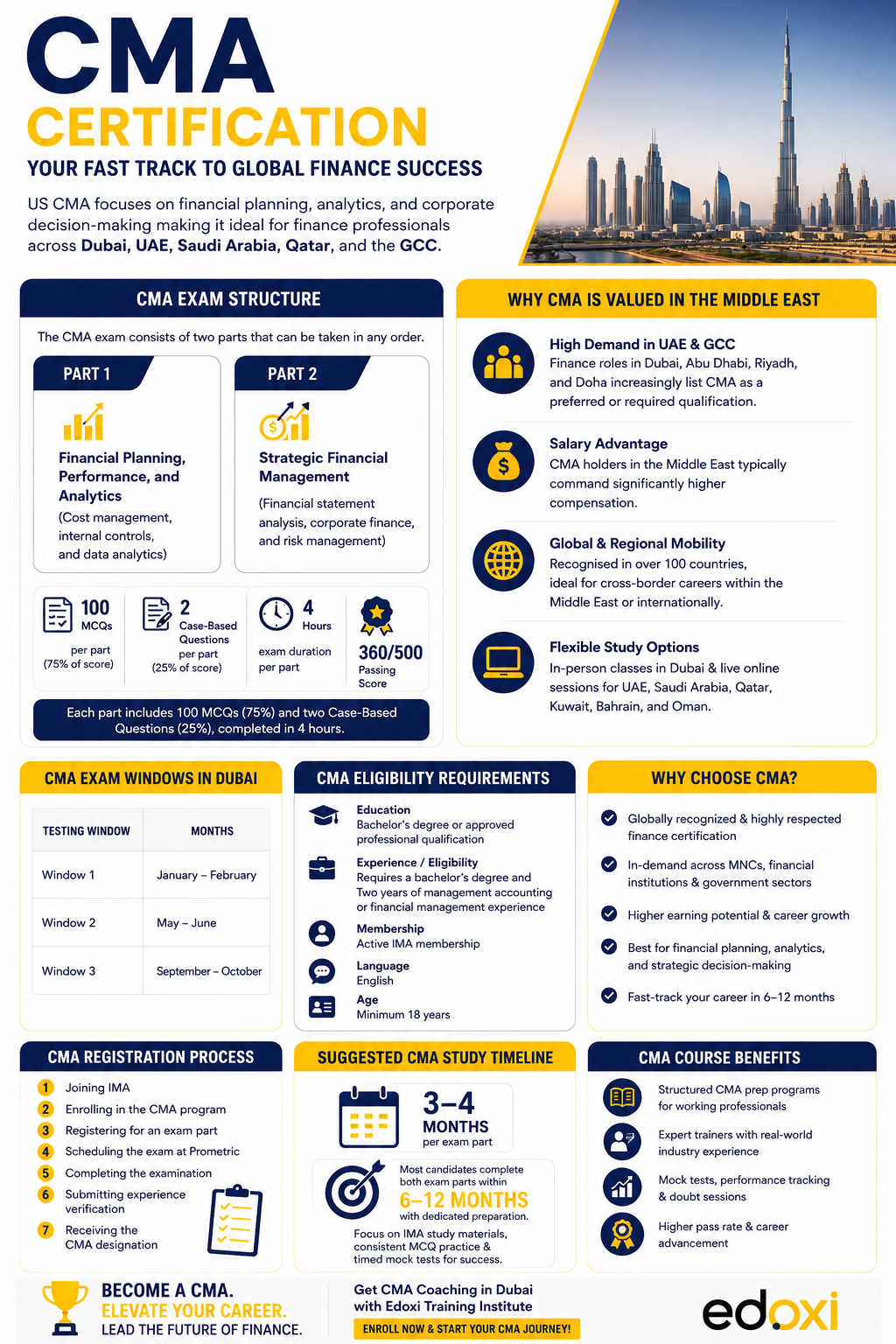
The CMA is globally recognised and particularly in demand across the GCC, where multinational corporations, financial institutions, and government-linked enterprises actively seek CMA-certified professionals.
A lot of candidates ask us whether it's worth doing in a classroom or just online, honestly, if you can find a CMA course in Dubai that runs both formats side by side, take that option. It gives you flexibility when work travel or long shifts get in the way of a fixed schedule.
Experts recommend dedicating 3 to 4 months of preparation per exam part. Prioritising official IMA study materials, consistent MCQ practice, and timed mock tests is the most effective way to pass on your first attempt. Edoxi Training Institute, Dubai provides structured CMA prep programs designed for working professionals in the Middle East.
We get this question a lot from working professionals: is it worth doing structured CMA training instead of just self-studying from PDFs? Almost always yes , having someone check your mock exam scores catches gaps you'd otherwise only find out about on exam day.
One thing we tell candidates in Doha specifically: the exam requirements don't change based on where you sit it, but finding a CMA course in Qatar with live instructor access, not just recorded videos - makes a real difference once you hit the essay section.
The CMA exam consists of two parts that can be taken in any order.
| Component | Details |
|---|---|
| Multiple Choice Questions | 100 |
| Essay/Case-Based Questions | 2 |
| Exam Duration | 4 Hours |
| Passing Score | 360/500 |
The CMA examination is conducted three times annually.
| Testing Window | Months |
|---|---|
| Window 1 | January – February |
| Window 2 | May – June |
| Window 3 | September – October |
The registration process involves:
Most candidates complete both exam parts within 6–12 months, depending on study commitment and preparation schedule.
The candidates who pass on their first attempt usually aren't the ones who studied the most hours, they're the ones whose CMA certification program pushed them into timed mock exams early instead of leaving that for the final two weeks.
The total cost of the CMA USA certification depends on your IMA membership category. Candidates can register as a Professional Member, Student Member, or Academic Member, with each category having different entrance, exam, and membership fees.
Professional Members:
Student / Academic Members:
Note: The AED values are approximate and may vary based on the current exchange rate and any applicable taxes or payment processing charges.
Looking for CMA certification training near you? Edoxi provides expert led CMA courses in major cities across the Middle East and Africa. Choose your location and explore dedicated CMA training programs tailored to your region.
| CMA | CPA | ACCA | CIMA | |
|---|---|---|---|---|
| What it's really for | Steering business decisions from the inside — FP&A, strategy, controllership | Auditing, tax, and signing off on financial statements | A broad, globally portable accounting qualification | Management accounting with a UK/Commonwealth lean |
| Exam load | 2 parts | 4 sections | 13 papers (exemptions possible) | 3 levels, several papers |
| Typical time to finish | 6–12 months | 12–18 months | 2–3 years | 3–4 years |
| Pick this if... | You want to end up in FP&A, budgeting, or eventually the CFO's chair | You want to work in audit at a firm like a Big 4 | You want maximum flexibility across financial and management accounting | You want a strategy-heavy, UK-recognized management accounting path |
If your five-year plan involves making financial decisions rather than certifying someone else's, CMA is usually the faster, more direct route.
Numbers move around depending on who's reporting them, but the pattern is consistent across every serious survey: CMA holders in the Middle East earn noticeably more than uncertified peers doing similar work, and the gap widens the higher you climb ,the certification tends to matter most at the Finance Manager and Controller level, where it becomes a genuine differentiator between candidates with otherwise similar experience.
It also opens doors that aren't purely about salary , multinational finance teams, government-linked enterprises, and companies in oil & gas, banking, and manufacturing across the UAE increasingly list CMA as a preferred qualification in job postings, not just a nice-to-have.
The process trips people up not because it's complicated, but because it's spread across a few different systems. In order:
There's no universal answer, but there is an honest range. Candidates studying intensely - think 20+ hours a week - can realistically clear one part in two to three months. Most working professionals, putting in a more sustainable 10–15 hours weekly, are looking at three to four months per part. If your week is genuinely tight, stretching to four to six months per part with 5–8 hours a week is completely workable - it just needs consistency more than intensity.
The one mistake that shows up again and again: compressing four months of study into six weeks right before a testing window opens. It rarely ends well on the essay section specifically, because that's the part that rewards practiced fluency, not last-minute cramming.
No. As things stand for 2025–2026, IMA requires you to sit the exam physically at an authorized Prometric center -there's no remote-proctored option here.
No, you genuinely can take them in any order. Choose based on which content feels closer to what you already know.
You can sit and pass both exam parts first, then complete your experience afterward - you just need to wrap it up within seven years of your exam pass date.
No exam exemptions exist for anyone, regardless of prior qualification- though your existing credential can often satisfy the education requirement and your professional experience typically counts toward the two-year rule.
As many times as you need, with no cap, but you must clear both parts within three years of enrolling, and each attempt requires paying the exam fee again.
They sit in a similar difficulty range, with comparable pass rates, the real difference is what they test. CPA leans into financial reporting, audit, and tax; CMA leans into applying financial data to business strategy and decisions.
Yes, staying certified means keeping your IMA membership active and completing your continuing professional education hours each year.
Yes, at Prometric centers in Dubai and Abu Dhabi, within IMA's official testing windows , you'll pick your exact date once your ATT letter comes through.
Looking for structured CMA training, updated fee breakdowns, and a study plan built around your schedule? Our team at Edoxi works with candidates across Dubai and the wider GCC: explore the current CMA course details here.
Each CMA exam part lasts 4 hours. Candidates complete 100 multiple-choice questions (MCQs) followed by 2 essay scenarios.
Certified Management Accountant (CMA) exam consists of two separate exam parts, and each part is four hours long. During the first three hours, candidates answer 100 multiple-choice questions. Those who achieve the required minimum score in the MCQ section proceed to the final one-hour essay section, which includes two scenario-based questions. The exam is computer-based and administered at Prometric testing centers during three annual testing windows. Because the exam is time-limited, effective time management and regular practice with mock exams are essential for success.
The CMA certification requires passing two exams: Part 1 and Part 2. Both exams must be passed to earn the CMA credential.
CMA certification consists of two comprehensive exam parts covering management accounting and strategic financial management. Part 1 focuses on Financial Planning, Performance, and Analytics, while Part 2 covers Strategic Financial Management, including financial statement analysis, corporate finance, decision analysis, risk management, investment decisions, and ethics. Candidates can take the exams in any order and are not required to complete them in the same testing window. After passing both parts and meeting the education and professional experience requirements, candidates become eligible for the CMA designation.
The CMA exam cost depends on your IMA membership category. Candidates pay membership fees, entrance fees, and an exam fee for each exam part.
The total cost of becoming a CMA includes three components: the IMA membership fee, the CMA entrance fee, and the exam fee for each of the two exam parts. The exact amount varies depending on whether you are a professional, student, or academic member. Professional members typically pay higher fees than students. Candidates should also consider additional costs such as exam preparation courses, study materials, practice exams, and exam rescheduling fees if applicable. Always check the latest fee structure before registering because fees may change periodically.
Prepare for the CMA exam with a structured study plan, official syllabus, practice questions, and regular mock exams.
Successful CMA preparation usually requires a disciplined study schedule over several months. Start by reviewing the official exam content specification and dividing the syllabus into manageable topics. Use reliable study materials, video lectures, practice questions, and full-length mock exams to strengthen your understanding. Focus on areas where you score lower and regularly review formulas, calculations, and concepts. Many candidates also enroll in instructor-led CMA training programs for expert guidance and accountability. Consistent practice and revision are key factors in achieving a passing score.
Study consistently using the CMA syllabus, practice MCQs daily, review weak areas, and complete mock exams before your test date.
An effective CMA study strategy combines conceptual learning with extensive question practice. Begin by understanding each topic rather than memorizing answers. Create a weekly study schedule, dedicate time to solving practice questions, and regularly review incorrect answers to identify knowledge gaps. Simulate actual exam conditions by taking timed mock exams to improve speed and confidence. Short daily study sessions are generally more effective than irregular intensive study. Revision during the final weeks before the exam should focus on high-weight topics and previously challenging concepts.
To take the CMA exam, join IMA, register for the CMA program, pay the required fees, and schedule your exam with Prometric.
Candidates begin the CMA exam process by becoming members of the Institute of Management Accountants (IMA). After joining, they enroll in the CMA certification program and pay the applicable entrance and exam fees. Once registered, candidates receive an authorization number that allows them to schedule their exam through Prometric during one of the available testing windows. On exam day, candidates must bring valid identification and arrive early at the testing center. The computer-based exam includes both multiple-choice and essay sections.
Failing the CMA exam three times does not permanently disqualify you. You may continue retaking the exam as long as you remain within the program completion period.
There is no rule stating that candidates are permanently barred after failing the CMA exam three times. Candidates may retake an exam part during future testing windows after paying the required exam fee again. However, all CMA program requirements, including passing both exam parts, must be completed within the eligibility period established by the Institute of Management Accountants (IMA). After multiple unsuccessful attempts, candidates should reassess their preparation strategy, strengthen weaker topics, and consider additional coaching or structured training before retaking the exam.
The highest possible CMA exam score is 500, and a score of 360 or above is required to pass each exam part.
Each CMA exam part is scored on a scale ranging from 0 to 500. Candidates must achieve a minimum scaled score of 360 to pass. The score is not based simply on the number of correct answers but is determined using a scaled scoring methodology that accounts for exam difficulty across different testing windows. Scores reflect overall performance in both the multiple-choice and essay sections. Receiving a score close to 500 indicates exceptional performance across the entire exam.
CMA exam results are available through your IMA candidate account. Candidates receive an email notification when scores are released.
Once CMA exam results are published, candidates receive an email from the Institute of Management Accountants (IMA) informing them that their scores are available. To view the results, candidates log in to their IMA account and access the certification portal. The portal displays whether the candidate passed or failed and provides the official scaled score. Candidates who do not pass may also receive performance feedback to help identify areas requiring additional study before retaking the exam.
Register by joining IMA, enrolling in the CMA program, paying the applicable fees, and obtaining your exam authorization.
CMA registration process begins with creating an account with the Institute of Management Accountants (IMA). Candidates then purchase an IMA membership, enroll in the CMA certification program, and pay the entrance fee. After completing these steps, candidates register for the desired exam part by paying the exam fee. Once registration is confirmed, an authorization number is issued, allowing candidates to schedule their exam appointment with Prometric during an available testing window.
After registering for the CMA exam, schedule your exam through Prometric using your authorization number.
After successfully registering for a CMA exam part, candidates receive an authorization number from IMA. This authorization is used to book an appointment with Prometric, the official testing provider. Candidates can choose their preferred testing center, date, and available time within one of the annual testing windows. Early scheduling is recommended because popular testing centers may fill quickly, particularly near the end of each testing window. Candidates should review Prometric's rescheduling policies before making changes to their appointment.
Start with the official CMA syllabus, follow a structured study plan, and practice mock exams regularly. Choose a training provider that offers experienced instructors, updated study materials, question banks, and exam-focused revision sessions.
If you're planning to take CMA Part 1 at the end of 2026, start preparing at least three to six months in advance. Focus on understanding concepts, solving practice questions, and taking mock exams regularly.
The CMA is manageable with proper preparation, but it is not an easy certification. Candidates who follow a structured study plan, understand the concepts, and practice consistently have a much higher chance of passing.
CMA exam results are generally released about six weeks after the end of the month in which you took the exam.
nstitute of Management Accountants (IMA) typically releases CMA exam results approximately six weeks after the end of the month in which the candidate completed the exam. Because exams are offered during specific testing windows, candidates should expect a waiting period before official scores become available. Results are published in the candidate's IMA account, and email notifications are sent when scores are ready. Exact release dates may vary slightly depending on exam administration and scoring timelines.
| Category | Details |
|---|---|
| Certification | Certified Management Accountant (CMA) USA |
| Exam Parts | 2 |
| Exam Duration | 4 Hours (Each Part) |
| MCQs | 100 |
| Essay Questions | 2 |
| Total Testing Windows | 3 Per Year |
| Exam Format | Computer-Based Test (CBT) |
| Testing Provider | Prometric |
| Passing Score | 360 / 500 |
| Maximum Score | 500 |
| Administered By | Institute of Management Accountants (IMA) |
| Result Release | Approximately 6 Weeks After Exam Month |
| Order of Exams | Either Part 1 or Part 2 First |
| Certification Requirement | Pass Both Parts + Meet Education & Experience Requirements |
Passing the CMA exam requires more than memorizing concepts, it demands consistent preparation, strategic time management, and regular practice under exam conditions. Start your preparation early, follow the official CMA syllabus, complete full-length mock exams, and focus on understanding the practical application of management accounting concepts. Before scheduling your exam, verify the latest eligibility requirements, exam fees, and testing windows through the Institute of Management Accountants (IMA). With the right study plan and commitment, earning the CMA certification can open opportunities in financial management, corporate finance, FP&A, cost accounting, and leadership roles across global organizations.
The CMA is not necessarily harder than the CPA; the two qualifications test different areas of accounting and finance. The CMA focuses on management accounting, financial planning, performance analysis, cost management, and strategic financial management. The CPA covers a broader professional accounting framework, including auditing, financial accounting, taxation, and related areas. For finance professionals pursuing corporate finance, FP&A, or management accounting careers, the CMA provides a more specialized pathway.
The CMA exam cost in the Philippines depends on the candidate's IMA membership category and the applicable examination fees. The overall cost generally includes IMA membership, the CMA entrance fee, and an examination fee for each part. Student, academic, and professional members may have different fee structures. Because IMA can revise its fees, candidates should verify the current charges before registering for the examination.
CMA and CA differ significantly in structure, scope, and examination requirements, so neither can be universally described as harder. The US CMA is a two-part professional certification focused on management accounting, financial planning, performance management, analytics, and strategic financial management. CA programs typically cover a wider range of disciplines, including financial reporting, auditing, taxation, and accounting. The more suitable qualification depends on your career objectives and professional background.
The CMA exam cost consists of several components rather than a single examination fee. Candidates generally need to account for IMA membership, the CMA entrance fee, and the examination fee for each of the two parts. The applicable amount varies according to membership category. Preparation courses, study materials, and other training expenses are separate from the official examination fees.
The CMA exam is conducted during three testing windows each year: January–February, May–June, and September–October. Candidates must complete the required registration process and schedule an appointment within an available testing window. The exact appointment date depends on testing-center availability.
The CMA exam schedule consists of three testing windows annually: January–February, May–June, and September–October. Candidates can select an examination date within the relevant window based on available appointments. Planning ahead is recommended, particularly for candidates who need a specific testing location or date.
CMA exam booking begins after the candidate completes the required IMA registration and examination-entry process. Once eligible to schedule, the candidate receives the necessary authorization and can select an available examination appointment through the designated testing system. Candidates should check appointment availability before finalizing their preparation timeline because preferred dates and testing locations may fill up.
CMA exam centers in the UAE are available through authorized computer-based testing locations. Candidates can view the current testing locations and appointment availability when scheduling their examination. Locations can include testing facilities in major UAE cities such as Dubai and Abu Dhabi, subject to availability. Because testing-center availability changes, candidates should rely on the official scheduling system for the current list.
The CMA exam is challenging but manageable with disciplined preparation and sufficient practice. It tests both conceptual understanding and the ability to apply financial and management accounting principles to business situations. Candidates generally benefit from following a structured study plan, completing substantial question practice, taking timed mock examinations, and reviewing incorrect answers rather than relying solely on memorization.
Passing the CMA exam in three months is possible with a focused study plan, consistent practice, and effective revision. Start by covering the complete syllabus systematically, then move progressively toward question practice and mock examinations. Your final weeks should focus on identifying weak areas, improving time management, and revising high-weight topics.
The CMA exam cost in Dubai is primarily determined by IMA's applicable fees. Candidates should budget for IMA membership, the CMA entrance fee, and examination fees for both parts. Training and study-material costs are separate.
The US CMA is a globally recognized certification offered by the Institute of Management Accountants (IMA). It has two exam parts covering financial planning, performance management, and strategic financial management. Indian students need an active IMA membership, pass both exams, complete a bachelor's degree, and gain two years of relevant work experience for certification.
The CMA course focuses on management accounting, financial planning, budgeting, cost management, performance analysis, and strategic decision-making. It is designed for finance professionals who want to advance into leadership and management roles.
CMA USA is an internationally recognized management accounting certification valued by employers across manufacturing, banking, consulting, healthcare, and multinational companies. It helps professionals develop expertise in financial management and business strategy.
If you're new to the CMA course, begin by understanding the exam structure, eligibility requirements, and syllabus. Create a realistic study schedule, use reliable learning materials, and practice consistently to build confidence.
Yes, it is realistic. Many professionals start later in their careers while working full-time. Success depends on consistent study, time management, and building accounting fundamentals before moving to advanced topics.
The Certified Management Accountant (CMA) credential validates expertise in financial planning, cost management, budgeting, business analysis, and strategic decision-making. It is recognized by employers worldwide.
CMA certification is one of the most respected credentials for management accountants and finance professionals worldwide. Whether you're preparing for your first exam or planning a retake, understanding the exam format, registration process, scoring system, and preparation strategy will help you study with confidence. Stay updated with the latest IMA guidelines, maintain a disciplined study routine, and use quality learning resources to maximize your chances of success. The sooner you begin preparing, the closer you'll be to achieving your CMA certification and advancing your career in finance and accounting.
Continuous learning through recognized finance courses and accounting courses helps professionals stay updated with evolving industry standards, strengthen analytical skills, and remain competitive in global finance careers.
CMA exam is considered challenging because it evaluates analytical thinking, financial management, and practical decision-making skills rather than memorization.
Candidates who follow a structured study plan, practice mock exams, and receive expert guidance generally have a higher chance of success. The global pass rate for each exam part typically ranges between 45% and 50%, highlighting the importance of consistent preparation.
CMA USA exam is offered 3 times each year during the January–February, May–June, and September–October testing windows. You can choose the exam window that best fits your study schedule and book your preferred test center in advance.
If you're planning to take the exam in the UAE, you can select from the following authorized testing locations:
Booking your exam early gives you a better chance of securing your preferred date, time, and location, allowing you to prepare with confidence.