Request a Callback

+971 43801666
 Aug 24, 2026

Generative search systems need to identify entities, attributes, relationships, and context before using information in generated answers. Schema markup provides a machine-readable layer that can make these relationships more explicit. In GEO, the objective is not simply to rank a webpage but to make information easier for AI systems to understand, retrieve, evaluate, and potentially cite.
Schema does not guarantee visibility in Google AI Overviews, Gemini, ChatGPT, or other generative systems. Its value comes from strengthening the structured representation of information alongside useful content, entity consistency, evidence, authority, and other signals.
Generative systems need to understand more than keywords. They need to determine what an entity represents, which attributes belong to it, how entities relate, and whether information from different sources refers to the same entity.
Schema provides a standardized way to represent this information.
GEO depends heavily on entity understanding. A generative system may encounter the same person, organization, product, or service across multiple sources. Clear entity definitions can reduce ambiguity and provide additional context.
For example, a Person entity can identify Neeraj and connect him with Photowant as an organization:
Neeraj → worksFor → Photowant
The relationship is more explicit than simply mentioning both names in the same paragraph.
Schema does not create entity authority by itself. It provides structured context that works alongside visible content, external references, and other signals.
AI systems need to understand relationships, not just isolated facts. Schema can represent relationships such as:
Person → authorOf → Article
Organization → offers → Service
Article → about → Topic
These relationships give machines additional semantic context and help represent how different pieces of information connect.
HTML communicates information through visible content and page structure. JSON-LD provides another representation that machines can process using standardized types and properties.
A simple GEO entity graph might contain:
Organization → offers → Service
Organization → location → Place
Article → author → Person
The objective is not to add maximum schema. It is to create accurate and meaningful representations of entities and relationships supported by the website.
Schema becomes more useful when it works with the broader information architecture of a website. Visible content, structured data, internal links, author information, organization information, and external references should communicate consistent information about the same entities.
Structured data should represent information users can actually find on the page.
If an article identifies an author, the schema should identify the same author. If a page describes a service, the corresponding Service entity should accurately represent that offering.
This creates alignment between the human-readable and machine-readable layers.
Schema should reinforce the meaning of the content, not introduce unsupported claims.
The @id property provides a stable identifier for an entity within a structured data graph. It allows different schema objects and pages to reference the same entity instead of repeatedly defining it as a separate entity.
For example:
{
"@type": "Person",
"@id": "https://example.com/#person",
"name": "Person Name"
}
Another page can reference the same entity:
{
"author": {
"@id": "https://example.com/#person"
}
}
This creates continuity between the entity and its content across the website.
The sameAs property can associate an entity with external URLs that represent the same entity.
This can connect a website’s representation of a person or organization with established profiles and authoritative references elsewhere on the web.
The critical principle is identity accuracy. sameAs should reference genuine representations of the same entity, not unrelated URLs added to increase the number of references.
Entity names, identifiers, relationships, and important properties should remain consistent across relevant pages.
If the same organization receives different identifiers or conflicting descriptions, its structured representation can become fragmented.
A stronger implementation maintains a consistent graph where entities can be connected to their content, services, locations, authors, and related entities.
Schema types should follow the website’s entity model. They should not be added simply because they are available in Schema.org.
Organization and Person help establish the entities behind a website and its content.
They can describe names, URLs, roles, affiliations, and external references. They are particularly useful for representing publisher identity, authorship, business identity, and relationships between people and organizations.
Article and WebPage provide context about content.
Properties such as author, publisher, about, and mainEntity can connect a page to the entities it describes.
For GEO, these relationships are more valuable than simply declaring that a page is an article. They establish who created the content, what it discusses, and which entities are associated with it.
Service and Product can describe commercial entities and their attributes.
A service can connect to its provider, while a product can connect to its brand, manufacturer, category, and other relevant properties.
This can help represent what an organization offers and distinguish related commercial entities.
LocalBusiness and Place can add geographic context.
Properties related to location, address, area served, and geographic relationships can connect an organization or service to a specific place.
For GEO, this can make geographic relationships more explicit when location is relevant to the query.
Instead of asking:
“Which schema can I add to this page?”
Ask:
“Which entities and relationships need to be represented clearly?”
This changes schema implementation from a checklist into an entity-driven GEO strategy.
A GEO-focused website should not treat every webpage as an isolated object. A stronger implementation connects pages, people, organizations, services, products, locations, and topics into a coherent entity graph.
Identify the entities central to the website’s knowledge.
These may include:
Prioritize entities that are important to the website’s subject matter instead of attempting to describe every possible detail.
An entity becomes more meaningful when its attributes and relationships are clearly defined.
For example:
Organization → offers → Service
Person → authorOf → Article
Article → about → Topic
Organization → location → Place
These relationships provide semantic context that individual properties cannot provide alone.
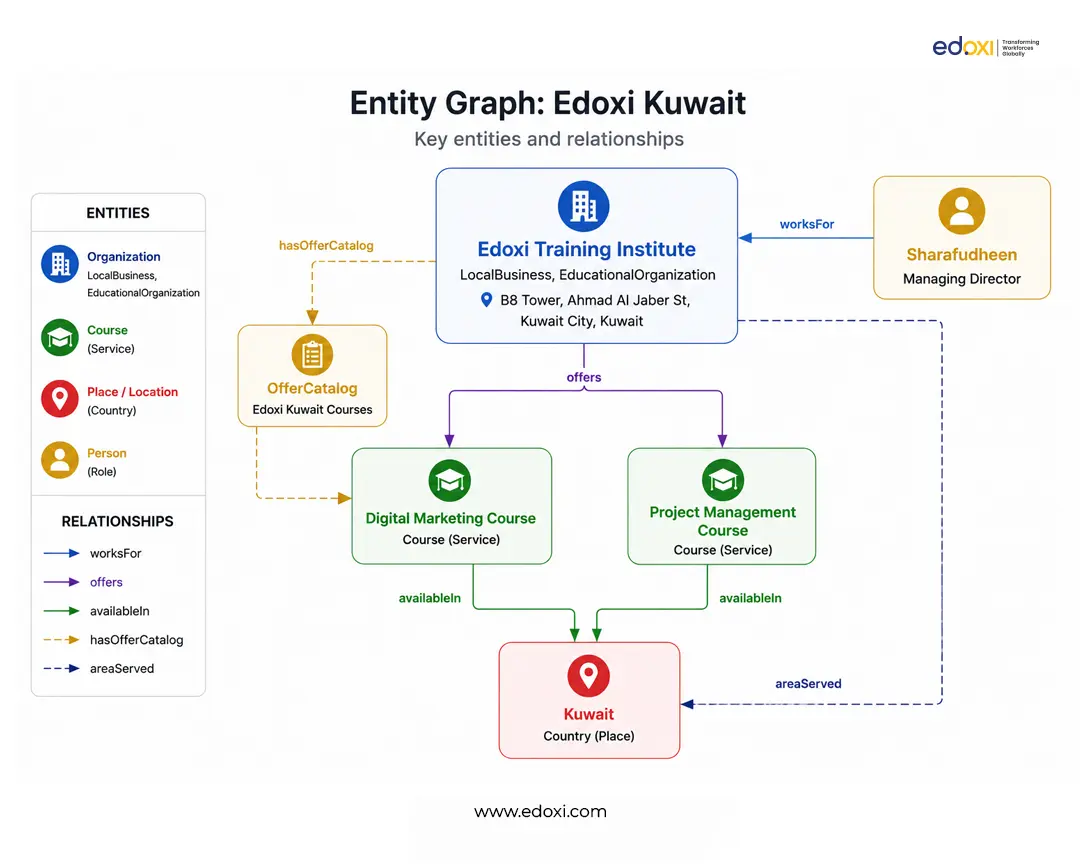
Related pages should reinforce the same entity graph where relevant.
A service page can connect the service to its organization, while an author page can connect the person to the same organization. Supporting articles can then reference those same entities.
For example:
Edoxi → offers → Digital Marketing Course
Edoxi → offers → Project Management Course
Sharafudheen → worksFor → Edoxi
Digital Marketing Course → availableIn → Kuwait
Project Management Course → availableIn → Kuwait
Using consistent @id values across these pages helps maintain the identity of each entity and connects the website's information into a single semantic graph.
This gives AI systems clearer context about who the organization is, what it offers, who is associated with it, and where those offerings are available.
Entity identifiers should remain stable across the website.
A person, organization, or service should not receive a different @id simply because it appears on another URL.
The result should be a connected, consistent entity graph rather than a collection of isolated schema blocks.
Schema can contribute to the machine-readable context around a webpage, but citation depends on more than structured data.
Generative systems can evaluate relevance, clarity, source authority, evidence, and consistency before selecting information for an answer.
AI systems can process information from multiple sources before generating an answer.
They may evaluate:
Schema can provide structured context for entities and relationships, but it does not control which source an AI system retrieves or cites.
A GEO-focused page should make its subject, claims, entities, and relationships clear.
Schema can reinforce this by representing relationships such as:
Article → about → Entity
Article → author → Person
Article → publisher → Organization
Organization → offers → Service
This adds machine-readable context around information already present on the page.
Schema can identify authors, publishers, organizations, and relationships between content and its creators.
Properties such as author, publisher, citation, and sameAs can help represent these relationships when used correctly.
However, structured data does not establish expertise or authority by itself. Those claims require supporting evidence.
A technically valid schema implementation can still provide little value if the underlying content is vague, unsupported, outdated, or irrelevant.
A stronger GEO system combines:
Useful content + clear entities + structured relationships + evidence + authority + consistency
Schema strengthens the structured layer. It does not replace the other signals required for useful and potentially citable information.
A GEO-focused implementation should treat structured data as part of the website’s information architecture.
JSON-LD allows entities and relationships to be represented independently from visible HTML while maintaining a structured graph.
A basic article structure could connect content with its author and publisher:
{
"@context": "https://schema.org",
"@type": "Article",
"@id": "https://example.com/article/#article",
"headline": "Example Article",
"author": {
"@id": "https://example.com/#author"
},
"publisher": {
"@id": "https://example.com/#organization"
}
}
The important element is not simply declaring @type. Stable @id values allow different schema objects to reference the same entities.
Technical validity does not guarantee semantic accuracy.
A validator can identify syntax errors, missing properties, and other implementation issues. GEO implementation also requires checking whether the markup accurately represents the visible content.
The validation process should therefore include:
Technical validation → Is the structured data valid?
Semantic validation → Does it accurately represent the page?
Complex pages can contain multiple related entities. JSON-LD can represent these through nested objects and references.
For Example:
Article → author → Person
Article → publisher → Organization
Organization → offers → Service
Where the same entity appears across multiple pages, referencing a stable @id is generally preferable to creating disconnected definitions.
Schema should be treated as an ongoing technical asset.
Changes to authors, services, organization details, URLs, or content templates can make structured data inaccurate.
Regular checks should identify:
For GEO, monitoring should focus on entity consistency and relationship accuracy, not simply whether a validation tool reports valid markup.
Technical schema can be valid while still being semantically weak.
Schema should represent the primary subject and information available on the page.
Marking a general informational article as a Product simply because the website sells products creates an inaccurate semantic representation.
The key question is:
Does this markup accurately describe what the page represents?
The same organization, person, or service may receive different identifiers, names, or properties across pages.
Consistent @id values help maintain entity identity.
Conflicting descriptions should also be avoided because they can fragment the structured representation.
Adding more schema types or properties does not automatically increase AI visibility.
Schema should strengthen machine understanding rather than attempt to manipulate generative systems.
Every property should have a semantic reason to exist.
Prioritize properties that clarify:
For GEO, semantic accuracy is more valuable than schema volume.
Search optimization is moving from keyword matching toward understanding entities, relationships, context, and information retrieval.
For SEO students, schema should therefore be understood as part of machine-readable information architecture, not simply as markup used to trigger search features.
Consider a query about digital marketing courses in Kuwait.
The entity model could include:
Edoxi → offers → Digital Marketing Course
Digital Marketing Course → availableIn → Kuwait
Edoxi → serves → Kuwait
The first relationship would need correction because Kuwait is a country, not part of the UAE. A technically minded SEO student should recognize this kind of semantic error before implementing the schema.
The correct model would be:
Kuwait → country
Edoxi → offers → Digital Marketing Course
Digital Marketing Course → availableIn → Kuwait
Edoxi → serves → Kuwait
The exercise demonstrates why GEO requires entity understanding rather than simply inserting keywords into structured data.
Students should understand how @type, @id, sameAs, properties, and relationships work together.
The goal is to understand how information can be represented as connected entities rather than isolated keyword strings.
GEO aims to make useful information easier for generative systems to discover, understand, evaluate, and potentially use in answers.
Schema is one layer of this process.
A strong GEO practitioner combines:
Entity understanding + structured data + useful content + evidence + authority + consistency
Learning schema from this perspective helps SEO students move beyond markup implementation and toward building machine-understandable information systems for AI search.
Schema for GEO is not about adding more markup. It is about creating an accurate and connected machine-readable representation of the entities and relationships already supported by the website.
An SEO student should learn to:
The future of GEO will require SEO professionals who understand not only how webpages are crawled, but also how machines interpret interconnected information.