
Leave your message to get our quick response
edoxi automated message icon

Machine Learning with Python Course

Machine Learning with Python Training Course
Master Machine Learning with Python Course. Our comprehensive Python training equips you with the programming skills required to build intelligent applications using industry-standard libraries such as NumPy, Pandas, Scikit-learn, and TensorFlow. Through hands-on projects and practical exercises, you'll be prepared for careers in software development, data science, and AI engineering.
Course Duration
40 Hours
Corporate Days
5 Days
Learners Enrolled
7
Modules
8
star-rating-icon1
star-rating-icon2
star-rating-icon3
Course Rating
4.8
star-rating-4.8
Mode of Delivery
Online
Classroom
Certification by

Upcoming Batches

Start Date Duration Batch Type Time Mode Register
20th September 2026 5 Days Weekdays 09:00 - 17:00 Live Online
Live Online
25th October 2026 5 Days Weekdays 09:00 - 17:00 Classroom
UK Branch Edoxi
1st November 2026 5 Days Weekdays 09:00 - 17:00 Classroom
Abu Dhabi
13th December 2026 5 Days Weekdays 09:00 - 17:00 Classroom
Qatar

Customise Machine Learning with Python Course

Select your preferred location and schedule — customised training tailored to your goals.

What Do You Learn from Edoxi's Machine Learning with Python Training

Python Foundations for AI
Write, structure, and run Python programmes using correct syntax, control flow, functions, and modules for AI development.
Data Manipulation with NumPy and Pandas
Use NumPy, Pandas, and Matplotlib to load, clean, analyse, and visualise real-world datasets for machine learning workflows.
Supervised Learning Algorithms
Build and evaluate regression and classification models including linear, polynomial, logistic regression, k-NN, and random forest.
Unsupervised Clustering Techniques
Apply k-Means and hierarchical clustering methods to identify patterns and segments in unlabelled data using Python tools.
Natural Language Processing
Implement a complete NLP pipeline in Python for text preprocessing, tokenisation, vectorisation, and classification using NLTK or spaCy.
Deep Learning and Neural Networks
Build and train artificial neural networks and convolutional neural networks using TensorFlow or Keras for real-world AI applications.

About Our Machine Learning with Python Course

Python has become the dominant programming language for artificial intelligence, machine learning, and deep learning. Its simplicity, readability, and vast ecosystem of libraries, including NumPy, Pandas, Scikit-learn, and TensorFlow, make it the language of choice for data scientists and AI engineers building intelligent systems across every industry.

This programme takes participants from Python essentials through to building and evaluating machine learning and deep learning models in a single, structured 40-hour curriculum. The programme is practical from the first session. Participants write Python code, manipulate data, train machine learning models, and implement neural networks in a live classroom environment, applying every concept through guided exercises and hands-on labs.

The eight modules progress logically: Python foundations feed directly into data handling, which leads into machine learning algorithms, culminating in deep learning and natural language processing techniques used in real-world AI systems today. By the end of the programme, participants have built regression models, classification models, clustering algorithms, neural networks, and an NLP pipeline, all in Python.

The programme is delivered by Edoxi Training Institute in a live in-person classroom. All sessions include instructor demonstration, guided coding exercises, and independent lab work conducted in Jupyter Notebooks or a configured Python IDE. Participants leave with working code, a clear conceptual understanding of AI, and the practical skills to continue building intelligent systems independently in their roles.

Enrol now to accelerate your career in AI and machine learning with Python.

Key Features of Edoxi's Machine Learning with Python Training

Hands-On Lab Sessions

Every module includes practical workshops where participants write and run real Python code in Jupyter Notebooks or a configured IDE.

Structured 40-Hour Curriculum

A logically sequenced 40-hour programme that takes learners from Python basics through to deep learning and convolutional neural networks.

Expert Instructor-Led Delivery

All sessions are delivered by certified AI and data science trainers with industry experience in machine learning and Python development.

Real-World Datasets and Projects

Participants work with real-world datasets throughout, applying machine learning models to housing, customer, and medical classification problems.

Capstone Project Included

The programme concludes with a capstone project where learners build a complete end-to-end Python AI pipeline and present their findings.

Post-Training Support and Resources

Learners receive access to post-training resources, code samples, and ongoing support through Edoxi's training management platform.

Who Can Join Our Machine Learning with Python Course?

Software Developers and Programmers

Developers transitioning into AI and data science roles who want to apply Python skills to machine learning model development.

Data Analysts

Analysts looking to extend their capabilities by building supervised and unsupervised machine learning models using Python libraries.

IT Professionals

IT professionals developing AI-powered applications and systems who require a structured foundation in Python and machine learning frameworks.

Engineers and Technical Professionals

Engineers working with data who need practical Python and AI skills to automate analysis, modelling, and intelligent system development.

Business Intelligence Professionals

BI and analytics professionals seeking to move beyond dashboards into predictive modelling and machine learning using Python tools.

Recent Graduates and Enthusiasts

Computer science graduates and AI enthusiasts with basic programming knowledge who wish to build job-ready machine learning skills.

Machine Learning with Python Course Modules

Module 1: Python Essentials
  • Chapter 1.1: Python Foundations and Control Flow

    • Lesson 1.1.1: Overview of Python and its role in AI and data science
    • Lesson 1.1.2: Setting up Anaconda, Jupyter Notebooks, and IDE configuration
    • Lesson 1.1.3: Python syntax, variables, data types, and type conversion
    • Lesson 1.1.4: Arithmetic, comparison, and logical operators
    • Lesson 1.1.5: Conditional statements, looping structures, and loop control keywords
Module 2: Functions, Data Structures & OOP
  • Chapter 2.1: Functions, Collections, and Object-Oriented Programming

    • Lesson 2.1.1: Creating and invoking functions with parameters, default values, and return values
    • Lesson 2.1.2: Working with lists, tuples, dictionaries, sets, and frozensets
    • Lesson 2.1.3: Introduction to OOP — classes, objects, encapsulation, and inheritance
    • Lesson 2.1.4: File handling, serialisation, and working with JSON and CSV formats
    • Lesson 2.1.5: Practical Workshop — build a class-based contact manager stored as a JSON file
Module 3: Python for Data Science — NumPy, Pandas & Matplotlib
  • Chapter 3.1: Data Handling and Visualisation Libraries

    • Lesson 3.1.1: NumPy arrays — creation, indexing, slicing, reshaping, and vectorised operations
    • Lesson 3.1.2: Introduction to Pandas — Series, DataFrames, loading CSV and JSON data
    • Lesson 3.1.3: DataFrame operations — filtering, sorting, grouping, merging, and handling missing values
    • Lesson 3.1.4: Data visualisation with Matplotlib — line charts, bar charts, scatter plots, and histograms
    • Lesson 3.1.5: Exploratory data analysis — understanding a dataset before modelling begins
Module 4: Artificial Intelligence & Machine Learning Foundations
  • Chapter 4.1: AI Concepts and Data Preparation

    • Lesson 4.1.1: Definition, history, and types of AI — narrow AI versus general AI
    • Lesson 4.1.2: The machine learning workflow — data collection, preparation, training, evaluation, and deployment
    • Lesson 4.1.3: Supervised and unsupervised learning — labelled versus unlabelled data approaches
    • Lesson 4.1.4: Data cleaning, normalisation, standardisation, and train-test splitting
    • Lesson 4.1.5: Practical Workshop — prepare a raw real-world dataset for machine learning
Module 5: Supervised Learning — Regression
  • Chapter 5.1: Regression Algorithms and Model Evaluation

    • Lesson 5.1.1: Simple linear regression, multiple linear regression, and polynomial regression
    • Lesson 5.1.2: Decision tree regression and random forest regression with feature importance
    • Lesson 5.1.3: Regression evaluation metrics — R-squared, MAE, MSE, and RMSE
    • Lesson 5.1.4: Regularisation techniques — L1 Lasso and L2 Ridge regression to reduce overfitting
    • Lesson 5.1.5: Cross-validation, model selection, and Scikit-learn fit-predict-score workflow
Module 6: Supervised Learning — Classification & Unsupervised Clustering
  • Chapter 6.1: Classification Algorithms

    • Lesson 6.1.1: Logistic regression — sigmoid function, decision boundaries, and probability outputs
    • Lesson 6.1.2: K-Nearest Neighbour, Decision Tree, and Support Vector Machine classification
    • Lesson 6.1.3: Classification metrics — accuracy, precision, recall, F1-score, confusion matrix, and ROC-AUC
  • Chapter 6.2: Unsupervised Clustering

    • Lesson 6.2.1: k-Means clustering — algorithm mechanics, elbow method, and centroid initialisation
    • Lesson 6.2.2: Hierarchical clustering — agglomerative approach, dendrogram, and linkage methods
    • Lesson 6.2.3: Evaluating clustering quality — silhouette score, inertia, and dimensionality reduction with PCA
Module 7: Natural Language Processing (NLP)
  • Chapter 7.1: NLP Pipeline and Text Representation

    • Lesson 7.1.1: Introduction to NLP — text classification, sentiment analysis, NER, and summarisation
    • Lesson 7.1.2: Text preprocessing — tokenisation, stopword removal, stemming, and lemmatisation
    • Lesson 7.1.3: Part-of-speech tagging and named entity recognition using NLTK or spaCy
    • Lesson 7.1.4: Bag of Words model and TF-IDF vectorisation for text classification
    • Lesson 7.1.5: Practical Workshop — build a complete NLP preprocessing pipeline and text classifier
Module 8: Deep Learning — Neural Networks & Convolutional Neural Networks
  • Chapter 8.1: Artificial Neural Networks

    • Lesson 8.1.1: ANN architecture — input layer, hidden layers, activation functions, and output layer
    • Lesson 8.1.2: Forward propagation, loss functions, backpropagation, and gradient-based optimisers
    • Lesson 8.1.3: Overfitting in neural networks — dropout, early stopping, and batch normalisation
  • Chapter 8.2: Convolutional Neural Networks and Capstone

    • Lesson 8.2.1: CNN architecture — convolution, pooling, flattening, and fully connected layers
    • Lesson 8.2.2: Transfer learning — fine-tuning pre-trained models such as VGG, ResNet, and MobileNet
    • Lesson 8.2.3: Capstone Project — build a complete end-to-end Python AI pipeline from raw data to trained model

Download Python with Machine Learning with Python Course Syllabus

Machine Learning with Python Course Outcome and Career Opportunities

Completing this programme equips participants with the Python and AI skills required to build intelligent systems and pursue data-driven roles across the technology, finance, healthcare, and analytics industries.

Course Outcome Image
Write, structure, and run Python programmes using correct syntax, control flow, functions, and reusable modules.
Use NumPy, Pandas, and Matplotlib to analyse, manipulate, and visualise real-world datasets for machine learning.
Build and evaluate supervised learning models including linear regression, logistic regression, k-NN, and random forest.
Apply unsupervised clustering techniques including k-Means and hierarchical clustering to identify data patterns.
Implement a natural language processing pipeline in Python for text preprocessing, vectorisation, and classification tasks.
Build and train artificial neural networks and convolutional neural networks using TensorFlow or Keras frameworks.

Job Roles After Completing the Machine Learning with Python Training

  • Machine Learning Engineer
  • Data Scientist
  • AI Engineer
  • Data Analyst
  • NLP Engineer
  • Deep Learning Engineer

Machine Learning with Python Training Options

Online Training

  • Live instructor-led sessions delivered via virtual classroom platform

  • Access to recorded session replays for post-class revision

  • Hands-on coding labs conducted in Jupyter Notebooks online

  • Interactive Q&A and guided exercises with the instructor

  • Digital course materials, code files, and resources provided

Classroom Training

  • Face-to-face instructor-led sessions at Edoxi's training centres

  • Hands-on lab work in a fully configured Python development environment

  • Peer collaboration and group coding exercises throughout the programme

  • Direct access to the trainer for real-time feedback and support

  • Printed and digital course materials, code notebooks, and resources included

Corporate Training

  • Customised training programme aligned to your organisation's AI and data objectives

  • Delivered on-site at your premises or at an Edoxi training facility

  • Flexible scheduling to minimise disruption to business operations

  • Pre-training needs assessment and post-training evaluation included

  • Group pricing available for teams with dedicated trainer assignment

How to Get a Machine Learning with Python Certification?

Complete Edoxi's Machine Learning with Python programme and demonstrate your skills to earn a recognised certificate of completion.
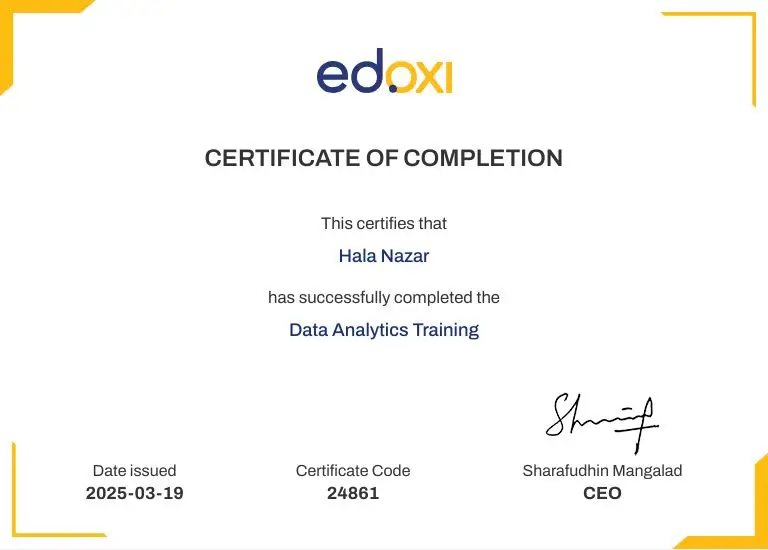
Get Machine Learning with Python Course Certified

Enrol now and earn your Machine Learning with Python certificate

Why Choose Edoxi for Machine Learning with Python Course?

Edoxi Training Institute delivers industry-aligned, hands-on Python and AI training with certified instructors, real-world datasets, and a structured curriculum designed to produce job-ready machine learning practitioners.

KHDA-Approved Training Institute

Edoxi is approved by KHDA and accredited by Microsoft, CompTIA, EC-Council, and PMI, ensuring your certificate is recognised by leading employers.

Certified and Experienced Trainers

All sessions are delivered by certified AI and data science professionals with hands-on industry experience in Python, machine learning, and deep learning.

Fully Hands-On Learning Approach

Every module includes guided coding exercises, practical workshops, and lab sessions so participants build real Python and AI skills from day one.

Real-World Datasets and Capstone Project

Participants work with genuine datasets and complete a capstone project, building a full end-to-end AI pipeline to demonstrate applied competence.

Flexible Training Modes Available

Choose from classroom, live online, or customised corporate training to fit your schedule, location, and organisational learning requirements.

Post-Training Support Included

Learners benefit from ongoing post-training support, access to course materials, and Edoxi's training management platform for continued learning.

students-image

Edoxi is Recommended by 95% of our Students

FAQ

What is the duration of the Machine Learning with Python Course?

The course runs for 40 hours, delivered across 5 days in a structured instructor-led format. Sessions include theory, guided coding exercises, and hands-on lab workshops conducted in Jupyter Notebooks or a configured Python IDE.

Do I need prior Python experience to join this course?

No prior Python experience is required. The programme begins with Python essentials — syntax, control flow, functions, and data structures — before progressing into machine learning and deep learning. Basic familiarity with computers and any programming logic is beneficial but not mandatory.

What tools and software will be used during the training?

Participants will work with Python 3, Anaconda, Jupyter Notebooks, NumPy, Pandas, Matplotlib, Scikit-learn, NLTK or spaCy, and TensorFlow or Keras. The first session includes full environment setup guidance so all participants are ready to code from the start.

Is this course available online as well as in the classroom?

Yes. The course is available in three delivery modes: face-to-face classroom sessions at Edoxi's training centres, live online instructor-led sessions via virtual classroom, and customised corporate training delivered on-site or at an Edoxi facility.

What certificate will I receive after completing the course?

Upon successfully completing the programme and post-training assessment, participants receive an Edoxi Certificate of Completion in Python with Machine Learning & Artificial Intelligence. Edoxi is a KHDA-approved training institute, and its certificates are recognised by employers across the technology, AI, and data science sectors.

What is the average salary after completing the Machine Learning with Python Course?
Salaries vary by role, experience, and location. The following figures represent typical average annual salaries for professionals in these fields.

Job RoleAverage Annual Salary (USD)
Machine Learning Engineer$112,000
Data Scientist$105,000
AI Engineer$118,000
Data Analyst$72,000
NLP Engineer$110,000
Deep Learning Engineer$120,000