Request a Callback

+971 43801666
 Jul 30, 2026
|
Quick Answer: Should You Learn Primavera P6 or Oracle Primavera Cloud? Primavera P6 is Oracle's established, on-premises or server-based scheduling engine built for large, complex programmes with deep enterprise project structures. Oracle Primavera Cloud (OPC) is Oracle's newer, cloud-native platform that delivers the same scheduling core plus modular apps for lean scheduling, risk, and portfolio management, priced on subscription and accessible from any browser. For most organisations moving toward distributed teams and predictable subscription costs, OPC is the forward path, but P6 Professional or EPPM still holds ground where legacy integrations, offline scheduling, or highly customised Gantt configurations are non-negotiable. |
If you've spent any time planning infrastructure, oil and gas, or mega-construction projects across the UAE and wider GCC, you've almost certainly worked in Primavera P6.
It has been the industry's scheduling backbone for over two decades. But Oracle has been quietly and now not so quietly pushing customers toward Oracle Primavera Cloud (OPC), its cloud-first successor.
So the question planners, PMOs, and construction professionals keep asking is simple: should you stick with P6, or is it time to move to OPC?
This article breaks down the real differences: structure, cost, features, collaboration, and where each tool fits, backed with strong recent market data.
| Table of Contents |
|
1. What Is Primavera P6?
2. What Is Oracle Primavera Cloud (OPC)? 3. Primavera P6 vs Oracle Primavera Cloud: Which Project Management Software Should You Learn in 2026? 3.1 Which Is More Cost-Effective: Primavera P6 or Oracle Primavera Cloud? 3.2 Why Is Cloud-Based Project Management Becoming the Industry Standard? 3.2.1 When Should You Choose Primavera P6? 3.2.2 When Should You Choose Oracle Primavera Cloud? 4. Career Implications: Why Primavera Skills Still Matter 5. Key Takeaways 6. FAQs: Primavera P6 vs Oracle Primavera Cloud (OPC) |
Primavera P6 (Professional and EPPM) is Oracle's long-standing enterprise project and portfolio management (PPM) software, purpose-built for scheduling large, resource-heavy, multi-project programmes.
It organises work through the Enterprise Project Structure (EPS), supports multiple root nodes for organising by division, geography, or project size, and stores resources and roles globally so they're available across the enterprise.
P6 Professional is typically installed per machine, while P6 EPPM runs on a server with a web client, both usually requiring dedicated infrastructure, database administration, and scheduled upgrade cycles.
Oracle Primavera Cloud is Oracle's cloud-native PPM platform, and it is genuinely a different animal from a UI and architecture standpoint, even though the underlying scheduling logic feels familiar to P6 users.
It's a Software-as-a-Service (SaaS) solution hosted entirely by Oracle, accessible from any device with a browser, with automatic updates and no local IT overhead.
Instead of the EPS, OPC organises projects through a Workspace hierarchy: a single Root Workspace with unlimited child and grandchild workspaces, which tightens data ownership and access control at each level.
OPC also folds in Primavera Schedule, Primavera Lean, Primavera Portfolio Management, and Primavera Progress as integrated apps rather than separate tools.
“Oracle Primavera Cloud is built from the same pedigree as Primavera P6, the most trusted and widely used contract planning and scheduling solution ever made."
- Oracle Construction and Engineering
When choosing whether to use either Primavera P6 or Oracle Primavera Cloud (OPC), one has to think about their career path, industry, and the kinds of projects one would be working with.
Even though Primavera P6 is still widely used, Oracle Primavera Cloud is more modern with collaboration and project controls features.
Primavera P6 vs OPC: Feature-by-Feature Comparison
| Factor | Primavera P6 | Oracle Primavera Cloud (OPC) |
| Deployment model | On-premises (P6 Professional) or server-hosted (P6 EPPM) | 100% cloud-based SaaS, browser-accessible |
| Organisational structure | Enterprise Project Structure (EPS); supports multiple root nodes | Workspace hierarchy; single Root Workspace with child/grandchild levels |
| Resource & role data | Defined globally, available to all projects | Defined at workspace/project level, manually shared downward |
| Pricing model | Perpetual licence, higher upfront cost, support billed separately | Modular subscription (Progress, Task, full user), support included |
| Budgeting | Top-down at EPS, project, and WBS level | Top-down from portfolio to programme to project, via CBS codes |
| Interface | Mature desktop client, powerful but steeper learning curve | Modern, app-based navigation with guided onboarding and embedded help |
| Built-in modules | Core scheduling, resource, and cost control; EV and portfolio management in EPPM | Schedule, Lean, Risk, Portfolio Management, and Progress apps in one platform |
| Accessibility | Desktop/server-bound; limited mobile support | Any device, anywhere, real-time sync |
| IT overhead | Requires servers, database admin, manual upgrades | Zero infrastructure; automatic updates |
| Best suited for | Legacy enterprise programmes needing deep customisation | Distributed teams, multi-project portfolios, organisations scaling cloud adoption |
Sources: Oracle Customer Hub, CMC Project Solutions, Hyde Park Solutions, Taradigm.
Cost is often the deciding factor for PMOs weighing a platform switch.
Industry analysis from Primavera implementation partners shows that Oracle Primavera Cloud (OPC) is significantly more cost-effective than Primavera P6. OPC's subscription pricing is typically around one-third the cost of a comparable Primavera P6 licence.
OPC licences start at a few hundred dollars per user per year, depending on the licence type, such as Progress, Task, or Full User. In addition, OPC subscriptions generally include technical support, whereas Primavera P6 often requires a separate support contract, increasing the overall cost of ownership.
P6, by contrast, requires larger minimum commitments, perpetual licence fees, and additional infrastructure investment for servers and database administration costs that add up quickly for organisations managing hundreds of users across GCC operations.
Curious about your next career move? Read Primavera Job Roles: A Comprehensive Guide for insights into today's most in-demand roles.
Cost Comparison Between Primavera P6 and Oracle Primavera Cloud
| Cost Factor | Primavera P6 | Oracle Primavera Cloud |
| Licence type | Perpetual | Subscription (annual/monthly) |
| Typical entry cost | Higher upfront investment | Lower entry cost, scalable licence tiers |
| Support | Additional cost | Included in subscription |
| Infrastructure | Servers, IT staff, upgrades required | None fully hosted by Oracle |
| Scalability | Manual, hardware-dependent | On-demand, no hardware limitations |
Cost and Licensing Statistics
Statistics comparing Oracle Primavera Cloud (OPC) to traditional P6 licensing show a notable shift in total cost of ownership:
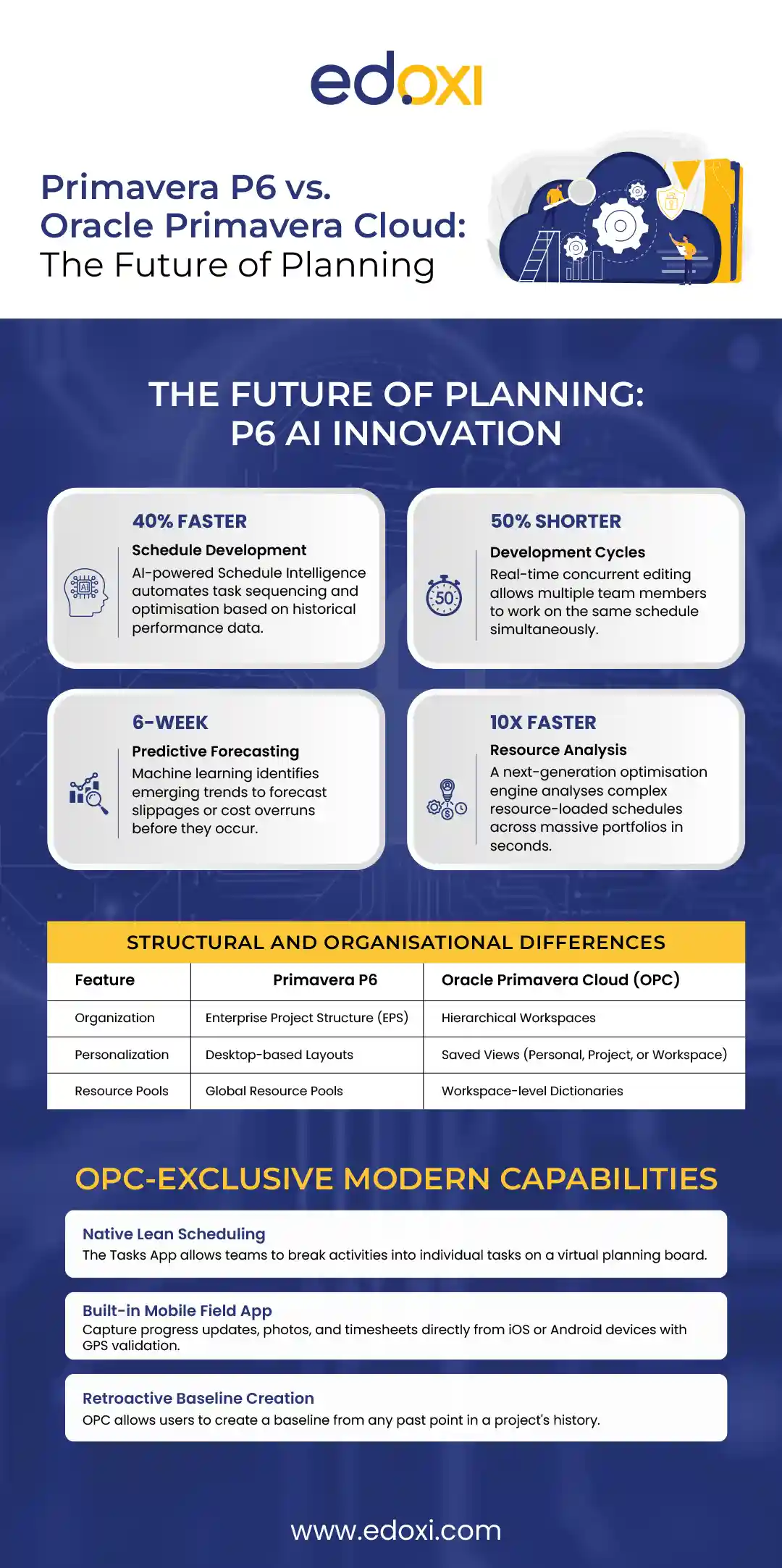
Construction companies operating in Dubai, Abu Dhabi, Riyadh, Doha, London, Singapore, Australia, and North America have been shifting to cloud-based project management software solutions to enhance collaboration and to ensure real-time monitoring and effective distribution of team management.
This is caused by the increased complexity of infrastructure, commercial, and industrial projects all around the world.
Want to see how these tools are actually used on-site? Explore the top 5 benefits of getting Primavera P6 certified for a practical look at how planners apply P6 day to day.
|
AI-Powered Efficiency and Performance Early adopters of Primavera P6 2026 report substantial time savings and faster analytical capabilities:
|
You should choose Primavera P6 in the following situations stated below:
Oracle Primavera Cloud is chosen for the following career requirements and situations:
Not sure which path fits your career or your organisation's roadmap? Read why Primavera P6 training matters for long-term career growth before making the call.
Here's the reassuring part for planners and schedulers: whichever platform your employer runs, the underlying scheduling logic critical path method, WBS, resource loading, EV transfers directly between P6 and OPC.
Oracle itself has structured OPC as a natural extension of P6 knowledge, not a replacement skill set. That means professionals who are P6-certified are well positioned to pick up OPC quickly, and organisations transitioning to the cloud are actively looking for planners who understand both.
With Oracle actively expanding OPC's capabilities, demand for professionals fluent in both environments is only growing across UAE mega-projects, PPP infrastructure, and PMO functions.
"The future of project management is cloud-enabled, connected, and data-driven."
- Mike Sicilia, Chief Executive Officer, Oracle
The key takeaways from the article Primavera P6 vs Oracle Primavera Cloud (OPC) are:
Oracle continues to support and develop P6, but its product investment and roadmap are increasingly centred on OPC, particularly for cloud-native features like digital twins and portfolio-level risk management.
Yes. Oracle provides a P6 EPPM to Primavera Cloud migration path, and most enterprise data resources, roles, and WBS can be brought across, though some P6-specific features (like resource shifts) don't have a direct OPC equivalent.
Generally, yes. OPC's modular subscription pricing, which includes support, tends to work out to roughly a third of the cost of a comparable perpetual P6 licence, especially for organisations that would otherwise carry separate infrastructure and support costs.
Not immediately, but it's a smart long-term investment. Core scheduling concepts carry over, and as more UAE and GCC employers adopt OPC, dual proficiency strengthens your position for PMO and senior planning roles.
Both are used extensively across UAE infrastructure and construction projects. P6 remains dominant on legacy and government programmes with established workflows, while OPC is gaining ground with organisations prioritising cloud accessibility and multi-project portfolio visibility.