Request a Callback

+971 4380 1666
 Jun 27, 2026
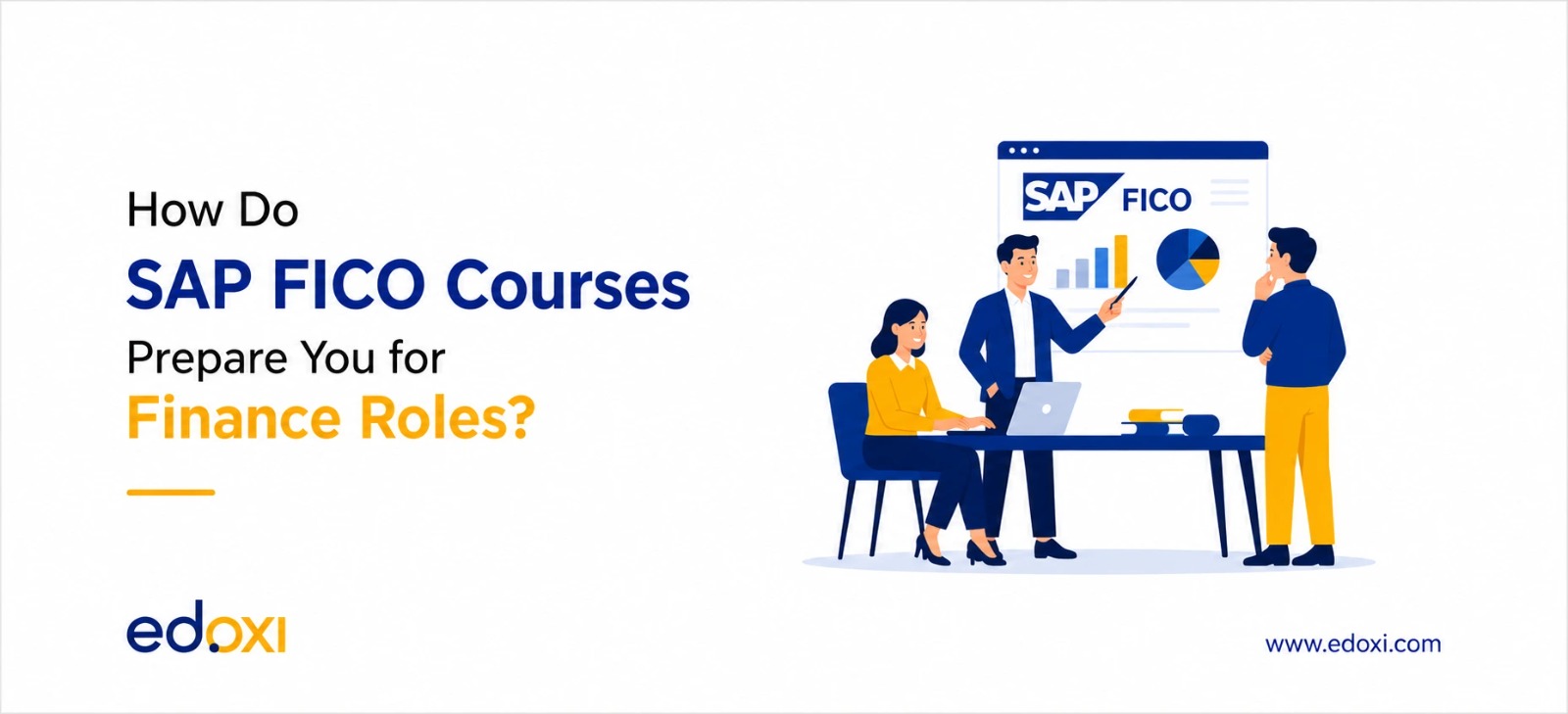
SAP FICO courses prepare you for finance roles by building real system skills alongside financial knowledge. According to the SAP Integrated Report 2025, over 400,000 organisations worldwide run SAP systems across finance, manufacturing, retail, and healthcare.
Companies like Deloitte, Accenture, and IBM actively hire SAP FICO-certified professionals across finance, controlling, and ERP consulting. With S/4HANA migrations accelerating globally in 2025 and 2026, demand for certified SAP finance talent has never been stronger. Whether you are starting or upskilling, SAP FICO connects your financial knowledge to the systems employers actually use. This blog breaks down exactly how.
What Does an SAP FICO Course Teach?An SAP FICO course teaches you how businesses manage financial accounting, cost control, budgeting, reporting, and compliance using SAP ERP software. It combines accounting principles with hands-on SAP system training, preparing learners for finance, accounting, auditing, and ERP consulting roles. |
Let us understand these in more detail.
SAP FICO covers two core disciplines: Financial Accounting (FI) and Controlling (CO). Together, these two core disciplines manage an organisation's complete financial picture.
While most finance courses teach you the theory, SAP FICO shows you how that theory operates within a live enterprise system used by some of the world's largest organisations.
Topics covered under the Financial Accounting module are:
Topics covered under the Controlling module are:
The shift from principle to practice is what most finance qualifications skip over. And it is where SAP FICO training delivers the most immediate value.
SAP FICO training allows you to work inside real business workflows, the actual processes that companies run every day.
You learn how to:
Such hands-on exposure is what separates SAP-trained candidates from those with only theoretical financial knowledge. Leading firms like Deloitte, Accenture, and Capgemini want people who can use the system confidently from day one
According to the 2025 ITJobsWatch UK salary data, SAP FICO frequently ranks among the higher-paying skill sets in finance and ERP roles. This is a direct reflection of how much that hands-on system experience is worth.
SAP FICO Certification sharpens how you think about financial data, not just how you record it.
Working inside SAP's reporting environment teaches you to think about data structure; how cost centres are configured, how transactions flow through the system, and how those decisions affect every report you generate downstream.
The following table outlines the core financial reporting skills you develop through SAP FICO training, along with their real-life applications.
|
Skill |
Practical Application |
|---|---|
| Variance analysis | Identifying and explaining budget vs. actual gaps |
| Cost centre reporting | Tracking departmental spend against targets |
| Profitability analysis | Measuring margins across products or regions |
| Audit trail management | Producing traceable, defensible transaction records |
| Period-end reporting | Executing clean financial closes on time |
SAP FICO integrates directly with other SAP modules. This gives you a clear view of how finance connects with the rest of the business.
The following table shows how SAP FICO connects with other SAP modules across the business and what each integration means for finance professionals.
|
SAP Module |
How It Connects to FICO |
|
SAP MM (Procurement) |
Purchase orders trigger accounting entries in SAP FI |
|
SAP SD (Sales) |
Sales invoices flow into revenue recognition in FICO |
|
SAP PP (Production) |
Production runs generate cost postings into CO |
|
SAP HR (Payroll) |
Payroll costs are posted directly into the cost centre accounting |
Understanding these integrations makes you more effective in cross-functional roles. Because the job is not just managing numbers, it is understanding what drives them across the whole organisation. Finance Business Analysts, Financial Controllers, and ERP Project Managers all rely on this end-to-end visibility.
Why Do Employers Prefer SAP FICO Professionals?Employers prefer SAP FICO Course for professionals because they understand both finance and SAP systems. They can process financial transactions, generate reports, manage costs, support audits, and work across departments, allowing them to contribute with minimal training from day one. |
SAP FICO builds the exact combination of skills that employers consistently ask for - financial knowledge plus the system proficiency to apply it.
Most finance graduates understand the theory. What they often lack is the ability to work confidently inside the platforms that large organisations actually run on. SAP FICO closes that gap directly.
The table below lists the top SAP FICO skills that employees look for in professionals.
Table 3: Skills SAP FICO adds to your profile:
| Skill | Why Employers Value It |
|---|---|
| SAP system proficiency | Productive from day one, no system ramp-up needed |
| Financial data accuracy | Builds traceable, audit-ready transaction habits |
| Cross-module awareness | Understand business impact beyond your department |
| Period-end close experience | Directly applicable in controller and analyst roles |
| Compliance knowledge | Critical in pharma, banking, and public sector roles |
SAP FICO keeps you relevant in a finance job market that increasingly expects system proficiency alongside technical knowledge.
Organisations running SAP S/4HANA need finance professionals who understand both the accounting and the platform. That combination is still relatively rare, and the professionals who hold both are the ones employers call first.
The following table outlines the key finance and ERP roles that SAP FICO training prepares you for and how the skills apply directly in each position.
| Role | How SAP FICO Applies |
|---|---|
| SAP FICO Consultant | Full-cycle implementation and configuration |
| Finance Business Analyst | Translating business needs into SAP processes |
| Financial Controller | Month-end close and cost reporting in SAP |
| Management Accountant | Cost centre and profit centre analysis via CO |
| Accounts Payable Specialist | Day-to-day transaction processing in SAP FI |
| ERP Project Manager | Overseeing SAP finance implementations |
SAP FICO is not something you pick up overnight, but it is one of those skills that genuinely changes what roles you can go for and what you can earn. The demand is real, the job market reflects it, and the gap between finance professionals who know SAP and those who do not is only getting wider. If you already have a finance background, you are closer than you think the system knowledge is the missing piece, and this course is where you get it. Do not put it off until the right moment. Start now, build on what you already know, and put yourself in the room where the better opportunities are.
SAP FICO teaches you how to manage financial accounting and controlling inside SAP systems covering general ledger, accounts payable, accounts receivable, cost centre accounting, and financial reporting.