Request a Callback

+971 4380 1666
 Jun 15, 2026
The global demand for finance professionals has entered a new chapter. According to IMA’s Global Salary Survey, CMA holders earn a median total compensation premium of around 58% over non-CMA peers in similar roles, with strong global demand in corporate finance and FP&A.
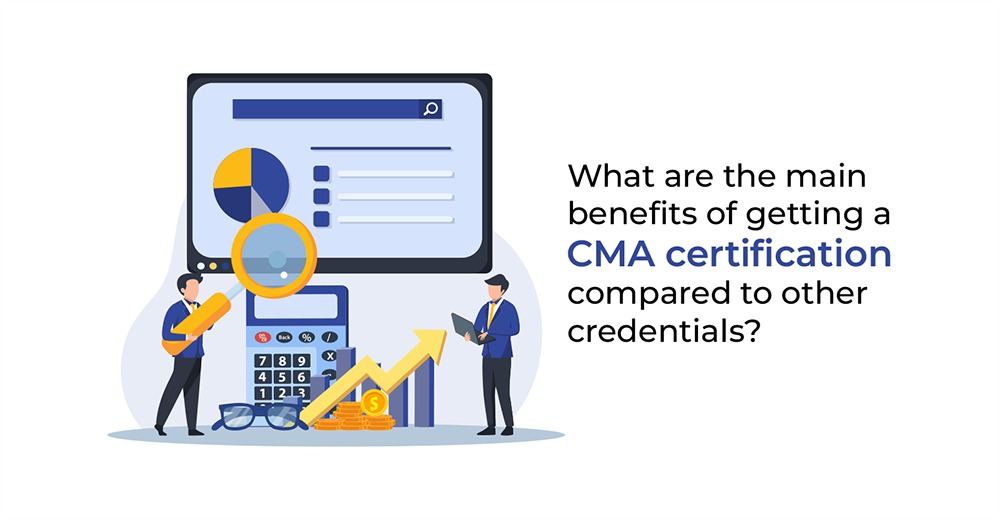
Meaning, the choice of certification is more consequential than ever. This guide provides the main benefits of CMA compared to other credentials. Read now and find out why CMA has become the credential of choice for aspiring finance leaders worldwide.
CMA (Certified Management Accountant) certification, offered by the Institute of Management Accountants (IMA), emphasises strategic finance, management accounting, decision-making, and leadership. It equips professionals for roles in FP&A, corporate finance, and management rather than purely compliance or investment-focused paths.
The CMA certification is often preferred because it combines management accounting, financial planning, strategic decision-making, and leadership skills in a shorter and more cost-effective pathway than many alternative finance credentials.
The CMA certification provides a faster, more affordable route to developing expertise in management accounting, financial planning, strategic decision-making, and leadership. The following are the key benefits of CMA Certification;
The CMA is built around the financial decisions that drive business performance from the inside. Every module connects to how finance can be used to improve operations, reduce costs, increase profitability, and support executive decision-making.
According to research from McKinsey and Gartner, the most in-demand finance competencies in 2025 are not technical accounting skills; they are analytical thinking, business partnering, and the ability to communicate financial insights to non-finance stakeholders. CMA delivers exactly these competencies.
The CMA curriculum's integration of budgeting, cost management, performance analysis, data analytics, risk management, and strategic decision-making means a CMA holder can confidently walk into a finance leadership role, immediately add value, and challenge the strategy.
The CMA Course takes 6–12 months and costs $1,500–$2,500, roughly half the cost and time of the CPA, and a fraction of the CFA. The return is immediate: 88% of CMA holders recover their full investment within 3 years. That is a payback period most professional credentials cannot match.
CMA vs Other Credentials: Cost & Time Comparison
| Qualification | Approximate Cost | Typical Completion Time |
|---|---|---|
| CMA | $1,500–$2,500 | 6–12 months |
| CPA | $3,000–$5,500 | 12–18 months |
| CFA | $3,000+ | 2–4 years |
| MBA (Finance) | $20,000+ | 1–2 years |
88% of CMA Certification holders recover their full certification investment within 3 years. The average global compensation gap between CMAs and non-CMAs stands at $23,000 per year. At a certification cost of $2,500, the payback period is typically under 2 months of incremental salary.
FP&A (Financial Planning & Analysis) is the fastest-growing segment of corporate finance, and the CMA curriculum maps onto it almost perfectly. Budgeting, forecasting, scenario analysis, performance management, and variance reporting are all core CMA competencies and all core FP&A responsibilities. In 2026, demand is surging across technology, renewables, manufacturing, and healthcare, all industries where CMAs are being specifically recruited for strategic finance roles that CPA and CFA holders are not trained for.
No credential builds the CFO pathway more directly. CMA Part 2 covers corporate finance, investment decisions, risk governance, and strategic leadership, the exact competencies that separate a Finance Director from a Finance Manager. Data from the UAE market shows that 70% of CMAs hold senior management roles, with a median salary of $111,000. In India, CMAs at the CFO level earn INR 20–80 lakhs. The typical CMA holder reaches Finance Manager within 5–7 years and can progress to CFO within 12–15 years, consistently faster than non-certified peers.
The CMA outperforms every major alternative in the corporate finance space. At $1,500-$2,500 in total costs, it is roughly half the cost of the CPA and a fraction of the cost of an MBA Finance program. Yet the salary premium it delivers 58% above non-certified peers globally, according to IMA data, rivals or exceeds credentials that take twice as long and cost five times as much.
In the Middle East, CMAs earn 76% more than non CMAs, the highest regional premium of any finance credential in that market. The global compensation gap between CMAs and their non-certified counterparts stands at $23,000 per year. For a $2,500 certification, that is a payback period of approximately six weeks of incremental earnings.
|
Region |
Typical CMA Earnings | Premium vs. Non-Certified |
|---|---|---|
| Middle East (UAE) | Median $111,000/year | 76% higher |
| United States | Median $120,000/year |
21% higher |
| Global average | $23,000 annual gap | 58% salary premium |
| India (mid-career) | INR 14–24 lakhs/year | ~40–50% higher |
| India (CFO level) | INR 20–80 lakhs/year | Significantly higher |
While AI is automating 32–39% of routine finance tasks, such as data entry, basic reporting, and standard reconciliations. The skills that CMAs are trained in are precisely the ones AI cannot replicate: strategic judgment, business partnering, stakeholder communication, and contextual decision-making. The IMA recognised this shift early.
The 2024 CMA curriculum update added dedicated modules on AI tools in finance, data analytics, and machine learning applications. CMAs are not racing against automation, but they are being trained to direct it. 63% of CFOs say AI has already made cash flow forecasting easier; CMA trained FP&A professionals are the ones interpreting those forecasts and turning them into strategy.
CMA Certification is recognised in 100+ countries and valued across manufacturing, banking, technology, healthcare, consulting, and energy, not just in financial services firms. This industry-agnostic value is a significant advantage over the CFA (primarily financial services) and CPA (primarily accounting firms).
Whether you are targeting a role at an Indian tech unicorn, a Gulf conglomerate, a US manufacturer, or a European MNC, CMA travels with you. Amazon, KPMG, Deloitte, and major manufacturing groups across Asia and the Middle East actively recruit CMAs for strategic finance roles.
CMA is not the right choice if you want to work in public audit (choose CPA), investment banking (choose CFA), or need broad international accounting recognition (choose ACCA). But for corporate finance leadership, it is the strongest credential available.
The main benefit of the CMA certification over every alternative is its unique combination of strategic finance expertise, management accounting depth, leadership development, and business decision-making capability, all packaged into a globally recognised, cost-effective, and time-efficient credential.
While the CPA excels in auditing, the CFA dominates investment management, and the ACCA covers international reporting, only the CMA is purpose-built for professionals who want to lead finance functions, drive business strategy, and reach the senior finance leadership roles, Finance Manager, Finance Director, and CFO, which represent the pinnacle of the corporate finance career.
For any finance professional who wants to move beyond compliance, build genuine strategic influence, and build a career that AI cannot automate, the CMA is the most powerful credential available.
Neither certification is universally 'better', they serve different career goals. For strategic finance, FP&A, and the CFO track, CMA is the superior choice. For public accounting, audit, and tax, a CPA has legal authority and industry expectations that a CMA cannot replace. Many senior finance professionals eventually hold both credentials, using CMA to build strategic skills and CPA to establish accounting credibility. If your goal is corporate finance leadership, choose CMA first.