Leave your message to get our quick response
edoxi automated message icon

Digital Forensic Essentials Course in Qatar

Professional using digital forensic technology on a laptop.
Edoxi’s 20-hour Digital Forensic Essentials (D|FE) Course in Qatar equips professionals with practical skills in digital evidence collection, forensic imaging, data recovery, and investigation techniques. Training is delivered online and offline through Edoxi’s EC-Council-authorised training centre in Qatar. Participants strengthen cybersecurity expertise, and organisations upskill their teams for overall security readiness. Enrol now to build essential digital forensics skills. 
Course Duration
20 Hours
Corporate Days
3 Days
Learners Enrolled
50+
Modules
12
star-rating-icon1
star-rating-icon2
star-rating-icon3
Course Rating
4.9
star-rating-4.9
Mode of Delivery
Online
Classroom
Certification by
edoxi-accreditation-logo

What Do You Learn from Edoxi's Digital Forensic Essentials Training

Digital Evidence Collection
Learn how to identify, collect, preserve, and document digital evidence from computers, mobile devices, and other storage media while maintaining evidence integrity.
Chain of Custody
Understand how to establish and maintain a proper chain of custody in digital forensic investigations. Learn to document evidence handling, transfer, storage, and access to support its admissibility.
Forensic Imaging
Gain practical knowledge of creating forensic disk images using industry-standard tools and techniques. Learn to verify image integrity with hashing methods and preserve original evidence.
Data Recovery Techniques
Develop foundational skills in recovering deleted, damaged, or inaccessible files from different storage devices. Explore basic file recovery and file-carving techniques used in digital investigations.
File System Analysis
Examine file systems, metadata, timestamps, deleted files, and hidden data to uncover information relevant to cybercrime and security investigations.
Digital Forensic Reporting
Learn how to prepare clear and structured digital forensic reports and present these technical findings effectively for legal, corporate, and cybersecurity investigations.

About Edoxi’s Digital Forensic Essentials Training in Qatar

Digital Forensic Essentials Course in Qatar helps participants build practical digital forensics skills that can support careers in cybersecurity, cybercrime investigation, incident response, and digital evidence analysis. Edoxi’s 20-hour EC-Council-authorised Digital Forensic Essentials course helps learners develop key skills in digital evidence collection, forensic imaging, and data recovery.

The training is available in online/classroom and Corporate Training formats and is ideal for IT professionals, security enthusiasts, and career changers. Participants learn the foundations of Digital Forensics, including Digital evidence Handling, forensic imaging and recovery, file and system analysis, forensic tools training and incident response and investigation skills through guided, tool-based learning.
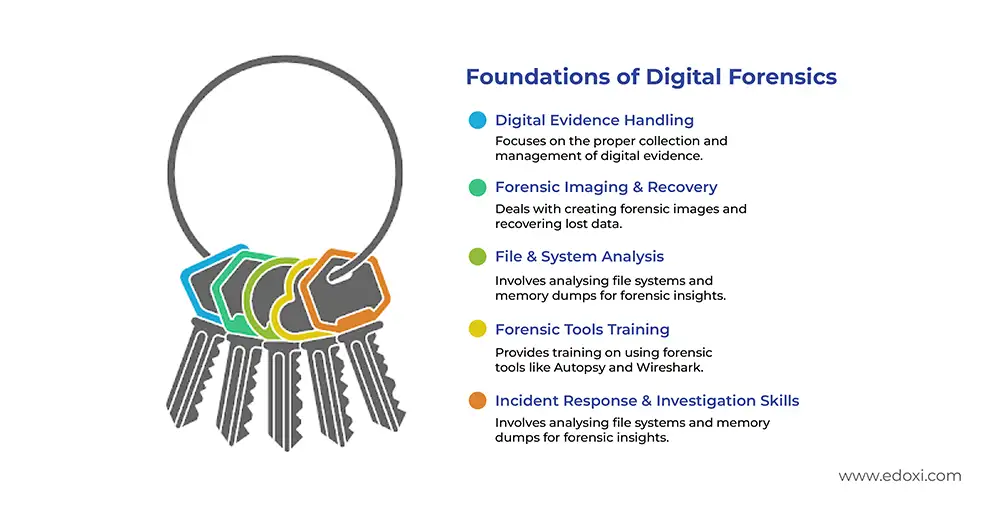
foundation-of-digital-forensic

The training includes dedicated hands-on sessions using professional forensic tools like Autopsy and Wireshark. These tools help participants gain real-world experience in digital forensics. Students perform exercises such as disk cloning, file system analysis, and email header examination. These tasks help develop key investigative capabilities.

The course also emphasises maintaining a proper chain of custody, ensuring evidence is handled correctly throughout the investigation. Enrol now in Edoxi’s Digital Forensic Training to build practical knowledge needed for real-world cybersecurity investigations. 

Digital Forensics Essentials Exam Details

Our Digital Forensics Essentials Course curriculum aligns with EC-Council's certification exam objectives, preparing students to successfully pass the 112-57 Digital Forensics Essentials (D|FE) certification exam. Key exam details include

Exam Criteria Details
Exam Code 112-57
Exam Name EC-Council Digital Forensics Essentials
Duration 2 hours
Number of Questions 75, Multiple Choice
Passing Score 70%
Certification Validity 3-years
Exam Administration Authority EC-Council

Why Is Digital Forensic Essentials Training Important in Qatar?

Digital Forensic Essentials training in Qatar is increasingly important as the country continues to expand its digital economy and cybersecurity capabilities. Qatar’s National Cyber Security Strategy 2024–2030 focuses on strengthening national cyber resilience, protecting critical infrastructure, and developing cybersecurity capabilities. This creates growing demand for professionals with practical skills in digital evidence collection, forensic analysis, data recovery, and incident response. D|FE training helps Qatar-based IT and cybersecurity professionals build these skills and supports organisations in strengthening their cybersecurity readiness.

Key Features of Edoxi's Digital Forensic Essentials Training

Professional Forensic Lab Environment

Practice in a specialised lab setup with forensic workstations and professional-grade tools like Autopsy and Wireshark.

Real-World Investigation Scenarios

Work through authentic case studies involving compromised systems, deleted evidence recovery, and network attack analysis.

EC-Council Exam Preparation

Receive targeted preparation for the 112-57 Digital Forensics Essential (D|FE) certification exam with practice questions and scenario-based assessments.

Hands-On File System Analysis

Examine file systems practically to understand metadata, timestamps, and deleted file recovery using forensic techniques.

Network Traffic Investigation

Analyse network communications with Wireshark to identify suspicious activities and trace digital evidence across networks.

Forensic Documentation Templates

Utilise industry-standard templates for maintaining chain of custody and producing court-admissible investigation reports.

Who Can Join Our Digital Forensic Essentials Classes in Qatar?

IT Support Professionals

Technical specialists seeking to expand into cybersecurity incident investigation roles.

Cybersecurity Career Starters

Students and graduates pursuing careers in digital forensics and security.

Law Enforcement Personnel

Officers needing digital evidence collection skills for modern investigations.

System Administrators

IT admins adding forensic capabilities to enhance security incident management.

Corporate Security Teams

Organisations building in-house capabilities for preliminary digital investigations.

Career Changers

Professionals transitioning to cybersecurity roles starting with forensic fundamentals.

Digital Forensic Essentials Course Modules

Module 1: Computer Forensics Fundamentals
  • Chapter 1.1: Fundamentals of Computer Forensics

    • Lesson 1.1.1: Definition and Importance of Computer Forensics
    • Lesson 1.1.2: Evolution and Applications of Digital Forensics
  • Chapter 1.2: Digital Evidence

    • Lesson 1.2.1: Types of Digital Evidence
    • Lesson 1.2.2: Collection and Preservation Techniques
  • Chapter 1.3: Forensic Readiness

    • Lesson 1.3.1: Importance of Forensic Readiness
    • Lesson 1.3.2: Strategies to Achieve Forensic Readiness
  • Chapter 1.4: Roles and Responsibilities of a Forensic Investigator

    • Lesson 1.4.1: Key Responsibilities
    • Lesson 1.4.2: Ethical and Professional Conduct
  • Chapter 1.5: Legal Compliance in Computer Forensics

    • Lesson 1.5.1: Legal Frameworks and Standards
    • Lesson 1.5.2: Chain of Custody and Admissibility in Court
Module 2: Computer Forensics Investigation Process
  • Chapter 2.1: Forensic Investigation Process and Its Importance

    • Lesson 2.1.1: Overview of the Investigation Process
    • Lesson 2.1.2: Importance of Cybercrime Response
  • Chapter 2.2: Pre-Investigation Phase

    • Lesson 2.2.1: Planning and Preparation
    • Lesson 2.2.2: Legal Considerations and Warrants
  • Chapter 2.3: Investigation Phase

    • Lesson 2.3.1: Evidence Collection and Preservation
    • Lesson 2.3.2: Analysis and Interpretation
  • Chapter 2.4: Post-Investigation Phase

    • Lesson 2.4.1: Reporting and Documentation
    • Lesson 2.4.2: Testifying and Legal Proceedings
Module 3: Understanding Hard Disks and File Systems
  • Chapter 3.1: Disk Drives and Their Characteristics

    • Lesson 3.1.1: Types of Drives – HDD, SSD, Hybrid
    • Lesson 3.1.2: Drive Interfaces and Performance
  • Chapter 3.2: Logical Structure of a Disk

    • Lesson 3.2.1: Sectors, Clusters, and Partitions
    • Lesson 3.2.2: Master Boot Record and Partition Table
  • Chapter 3.3: Booting Process

    • Lesson 3.3.1: Windows Booting Process
    • Lesson 3.3.2: Linux Booting Process
    • Lesson 3.3.3: Mac Booting Process
  • Chapter 3.4: File Systems Overview

    • Lesson 3.4.1: NTFS, FAT32 (Windows)
    • Lesson 3.4.2: EXT3, EXT4 (Linux)
    • Lesson 3.4.3: HFS+, APFS (Mac)
  • Chapter 3.5: File System Examination

    • Lesson 3.5.1: Techniques for File System Analysis
    • Lesson 3.5.2: Recovering Deleted Files and Metadata
Module 4: Data Acquisition and Duplication
  • Chapter 4.1: Data Acquisition Fundamentals

    • Lesson 4.1.1: Importance of Data Acquisition
    • Lesson 4.1.2: Legal and Technical Considerations
  • Chapter 4.2: Types of Data Acquisition

    • Lesson 4.2.1: Static and Live Acquisition
    • Lesson 4.2.2: Local and Remote Acquisition
  • Chapter 4.3: Data Acquisition Format

    • Lesson 4.3.1: Raw, E01, AFF Formats
    • Lesson 4.3.2: Pros and Cons of Each Format
  • Chapter 4.4: Data Acquisition Methodology

    • Lesson 4.4.1: Tools and Techniques
    • Lesson 4.4.2: Validation and Integrity Checks
Module 5: Defeating Anti-Forensics Techniques
  • Chapter 5.1: Anti-Forensics and Its Techniques

    • Lesson 5.1.1: Data Hiding and Obfuscation
    • Lesson 5.1.2: Artefact Wiping and Encryption
  • Chapter 5.2: Anti-Forensics Countermeasures

    • Lesson 5.2.1: Detection Strategies
    • Lesson 5.2.2: Recovering Altered or Hidden Data
Module 6: Windows Forensics
  • Chapter 6.1: Volatile and Non-Volatile Information

    • Lesson 6.1.1: Capturing Volatile Data
    • Lesson 6.1.2: Analysis of Non-Volatile Data
  • Chapter 6.2: Windows Memory and Registry Analysis

    • Lesson 6.2.1: Memory Dump Analysis
    • Lesson 6.2.2: Registry Artifacts
  • Chapter 6.3: Web Browser Artefacts

    • Lesson 6.3.1: Cache, Cookies, and History
    • Lesson 6.3.2: User Activity Tracking
  • Chapter 6.4: Windows Files and Metadata

    • Lesson 6.4.1: NTFS Artifacts
    • Lesson 6.4.2: Timestamps and Metadata Analysis
Module 7: Linux and Mac Forensics
  • Chapter 7.1: Linux Data Analysis

    • Lesson 7.1.1: Volatile and Non-Volatile Data
    • Lesson 7.1.2: Important Linux Artefacts
  • Chapter 7.2: Filesystem Image Analysis

    • Lesson 7.2.1: Using The Sleuth Kit
    • Lesson 7.2.2: Mounting and Investigating Images
  • Chapter 7.3: Memory Forensics

    • Lesson 7.3.1: Linux Memory Acquisition
    • Lesson 7.3.2: Mac Memory Acquisition
  • Chapter 7.4: Mac Forensics

    • Lesson 7.4.1: Mac System Artefact
    • Lesson 7.4.2: Analysing Mac File Systems
Module 8: Network Forensics
  • Chapter 8.1: Network Forensics Fundamentals

    • Lesson 8.1.1: Network Evidence Collection
    • Lesson 8.1.2: Protocol Analysis
  • Chapter 8.2: Event Correlation

    • Lesson 8.2.1: Concepts and Methods
    • Lesson 8.2.2: Correlation Tools and Techniques
  • Chapter 8.3: Indicators of Compromise (IoCs)

    • Lesson 8.3.1: Identifying IoCs in Network Logs
    • Lesson 8.3.2: Network Artefacts of Malicious Activity
  • Chapter 8.4: Network Traffic Investigation

    • Lesson 8.4.1: Packet Capturing and Analysis
    • Lesson 8.4.2: Log Analysis for Intrusions
Module 9: Investigating Web Attacks
  • Chapter 9.1: Web Application Forensics

    • Lesson 9.1.1: Types of Web Attacks
    • Lesson 9.1.2: Identifying Exploits in Logs
  • Chapter 9.2: Web Server Logs

    • Lesson 9.2.1: IIS Logs Analysis
    • Lesson 9.2.2: Apache Logs Analysis
  • Chapter 9.3: Investigating Windows-Based Web Attacks

    • Lesson 9.3.1: Common Vulnerabilities and Exploits
    • Lesson 9.3.2: Tracing Attack Vectors
  • Chapter 9.4: Investigating Web Application Attacks

    • Lesson 9.4.1: SQL Injection, XSS, and Other Attacks
    • Lesson 9.4.2: Capturing and Preserving Evidence
Module 10: Dark Web Forensics
  • Chapter 10.1: Introduction to the Dark Web

    • Lesson 10.1.1: Surface Web vs Deep Web vs Dark Web
    • Lesson 10.1.2: Dark Web Marketplaces and Forums
  • Chapter 10.2: Dark Web Forensics

    • Lesson 10.2.1: Techniques for Investigating Dark Web Activity
    • Lesson 10.2.2: Tools Used for Dark Web Analysis
  • Chapter 10.3: Tor Browser Forensics

    • Lesson 10.3.1: Understanding Tor Architecture
    • Lesson 10.3.2: Analyzing Tor Browser Artifacts
Module 11: Investigating Email Crimes
  • Chapter 11.1: Email Basics

    • Lesson 11.1.1: Email Protocols and Headers
    • Lesson 11.1.2: Anatomy of an Email Message
  • Chapter 11.2: Email Crime Investigation

    • Lesson 11.2.1: Identifying Spoofing and Phishing
    • Lesson 11.2.2: Investigating Email Headers and Logs
Module 12: Malware Forensics
  • Chapter 12.1: Malware Fundamentals

    • Lesson 12.1.1: Components of Malware
    • Lesson 12.1.2: Distribution Methods and Vectors
  • Chapter 12.2: Malware Forensics and Analysis Types

    • Lesson 12.2.1: Static vs Dynamic Analysis
    • Lesson 12.2.2: Choosing the Right Analysis Method
  • Chapter 12.3: Static Malware Analysis

    • Lesson 12.3.1: Identifying Embedded Code
    • Lesson 12.3.2: Analysing Suspicious Word Documents
  • Chapter 12.4: Dynamic Malware Analysis

    • Lesson 12.4.1: Setting Up a Safe Lab Environment
    • Lesson 12.4.2: Behavioural Analysis Techniques
  • Chapter 12.5: System and Network Behaviour Analysis

    • Lesson 12.5.1: Monitoring System Behaviour
    • Lesson 12.5.2: Detecting Network Indicators of Malware

Download Digital Forensic Essentials (DFE) Course Brochure

Real-World Exercises in Digital Forensic Essentials Course

This Digital Forensic Essentials course offers extensive hands-on labs focusing on digital evidence collection and forensic analysis techniques. Classroom activities include simulated investigations using professional tools like Autopsy and Wireshark. Key exercises include

Recovering Deleted Files from Hard Disks

Retrieve intentionally deleted evidence using file carving techniques while maintaining proper chain of custody documentation.

Creating a dd Image of a System Drive

Create forensically sound disk images using the dd command and verify integrity through multiple hash functions.

Performing Hash or HMAC Calculations

Use cryptographic functions to verify evidence integrity and establish non-repudiation for collected digital artefacts.

SSD File Carving on a Windows File System

Extract data fragments from solid-state drives despite TRIM commands that complicate traditional recovery methods.

Identifying Network Attacks using Wireshark

Analyse network traffic to identify suspicious patterns, malicious connections, and evidence of intrusion attempts.

Investigating a Suspicious Email

Examine email headers, attachment metadata, and embedded links to trace origins and identify phishing attempts.

Performing Static Analysis on a Suspicious File

Analyse potentially malicious files without execution to identify indicators of compromise and malware characteristics.

Detecting TOR Browser on a Machine

Identify artefacts indicating TOR usage and recover browsing evidence despite anonymisation attempts.

Digital Forensic Essentials Course Outcomes and Career Opportunities in Qatar

The Digital Forensic Essentials course opens doors to numerous job roles in Qatar’s digital investigation field. Graduates find opportunities across cybersecurity, legal, and corporate compliance sectors where these specialised skills command increasing demand and competitive salaries. Key outcomes include

Course Outcome Image
Enables teams to investigate and respond to cybersecurity incidents more quickly and effectively.
Strengthens the collection, preservation, and analysis of digital evidence during investigations.
Improves the detection of suspicious activities, compromised systems, and potential cyber threats.
Supports accurate documentation and stronger cybersecurity compliance processes.
Helps organisations investigate data breaches, insider threats, and other security incidents efficiently.
Builds stronger in-house digital forensics and incident response capabilities for long-term security readiness.

Job Roles After Digital Forensic Essentials Course

  • Cybersecurity Technician
  • Forensic Investigator
  • Cybersecurity Analyst
  • Incident Response Specialist
  • Forensics Consultant

Companies Hiring Digital Forensics Professionals in Qatar

  • QatarEnergy
  • QatarEnergy LNG
  • Ooredoo Qatar
  • MEEZA
  • Malomatia
  • Mannai Corporation
  • Vodafone Qatar
  • Qatar National Bank
  • Commercial Bank
  • Doha Bank

Digital Forensic Essentials Training Options

Classroom Training

  • 20-hour Digital Forensic Essentials Training in Qatar

  • Professional Forensic Workstations

  • Hands-on Evidence Collection Exercises

  • Collaborative Investigation Scenarios

  • Direct Access to Expert Instructors

Live Online Training

  • 20-hour Online Digital Forensic Essentials Training

  • Remote Access to Forensic Tools

  • Interactive Virtual Lab Environment

  • Flexible Schedule for Professionals

Corporate Training

  • Customised for Company Security Needs

  • Flexible Delivery Options (On-Site / Edoxi Office / Hotel)

  • Fly-Me-a-Trainer Option

  • Team-Based Investigation Exercises

Do You Want a Customised Training for Digital Forensic Essentials (DFE)?

Get expert assistance in getting you Digital Forensic Essentials (DFE) Course Customised!

How to Get a Digital Forensic Essentials Certification?

Here’s a four-step guide to becoming a certified Digital Forensic Essentials Professional.
Do You Want to be a Certified Professional in Digital Forensic Essentials (DFE)?

Join Edoxi’s Digital Forensic Essentials (DFE) Course

Why Choose Edoxi for Digital Forensics Training in Qatar?

Edoxi Training Center is a professional training provider in Qatar offering cybersecurity, IT, and certification-focused programmes for individuals and organisations. Here are some reasons why you should choose us for your training needs

EC-Council-Accredited Cybersecurity Training

Train through an Edoxi centre that offers EC-Council-aligned cybersecurity programmes and certification preparation.

Industry-Relevant Cybersecurity Tools

Develop practical familiarity with tools and technologies used across cybersecurity and forensic investigations, including network analysis and forensic environments.

Expert-Led Learning

Learn from cybersecurity trainers with industry experience across areas including digital forensics, incident response, security operations, governance, and cloud security.

Flexible Training in Qatar

Choose classroom, live online, or corporate training based on your schedule and learning requirements. Edoxi also offers customised corporate programmes for organisations.

Dedicated Cybersecurity Learning Resources

Access courseware, hands-on lab guides, security reference materials, and digital practice environments designed to reinforce technical learning.

Corporate Cybersecurity Upskilling

Organisations in Qatar can customise training to address their teams’ cybersecurity requirements, helping build internal capabilities in digital forensics, incident response, and security investigation.

students-image

Edoxi is Recommended by 95% of our Students

Meet Our Mentor

Our mentors are leaders and experts in their fields. They can challenge and guide you on your road to success!

mentor-image

Inzamam Nizam

Inzamam Nizam is a Cyber Security & Security Engineer with over six years of experience in offensive cybersecurity, vulnerability research, and application security. His expertise includes mobile (iOS/Android), web, and network penetration testing, secure code review, red teaming, exploit development, and secure architecture assessments. Recognised in the SynAck Hall of Fame for discovering critical security vulnerabilities, he is passionate about helping organisations strengthen their security posture through practical, research-driven approaches.

Throughout his career, Inzamam has led security assessments, adversary emulation exercises, and secure development initiatives across diverse industries, including banking and enterprise environments. He has contributed to innovative cybersecurity projects such as SPELL-BOUND, an open-source adversary emulation framework, GHOSTWARE AI, an AI-powered security assessment platform, and KAEDAE, a behaviour-based keylogger detection solution. Through his writing, he shares practical insights, emerging attack techniques, and defensive strategies to help security professionals stay ahead of the evolving threat landscape.

Locations Where Edoxi Offers Digital Forensic Essentials Course

Here are the major international locations where Edoxi offers Digital Forensic Essentials Course

FAQ

What is the Digital Forensic Essentials Course in Qatar?

The Digital Forensic Essentials (D|FE) Course in Qatar is a foundational cybersecurity training programme that teaches participants how to collect, preserve, examine, and report digital evidence. It covers essential digital forensic concepts, evidence handling, forensic imaging, file-system analysis, and investigation techniques.

Who can enrol in the Digital Forensic Essentials Course in Qatar?
The course is suitable for IT professionals, cybersecurity professionals, network administrators, security analysts, digital investigators, law-enforcement personnel, and students who want to develop foundational digital forensics skills.
What are the prerequisites for the Digital Forensic Essentials Course?

The course is designed as an entry-level digital forensics programme, so extensive prior forensic experience is not required. Basic knowledge of IT, networking, operating systems, and cybersecurity can help participants understand the training more effectively.

How long is the Digital Forensic Essentials Course in Qatar?

Edoxi’s Digital Forensic Essentials Course in Qatar is a 20-hour training programme. The training focuses on essential concepts and practical techniques used in digital forensic investigations.

What topics are covered in the Digital Forensic Essentials Course?

The course covers digital evidence collection, chain of custody, forensic imaging, data recovery, file-system analysis, network traffic investigation, and forensic reporting. Participants also gain practical exposure to digital forensic investigation techniques and tools.

What is the EC-Council D|FE certification exam?

The Digital Forensics Essentials (D|FE) certification is an EC-Council credential that validates foundational knowledge of digital forensics and investigation. It demonstrates an understanding of essential processes used to identify, preserve, analyse, and report digital evidence.

What is the D|FE exam format, duration, and passing requirement?

The D|FE exam is identified by exam code 112-57. Candidates should check the latest EC-Council examination guidelines for the current number of questions, exam duration, and passing score, as these details can be updated.

How much does the Digital Forensic Essentials Course cost in Qatar?

The D|FE course fee in Qatar can vary depending on the training format, schedule, and course package. For the latest course fee, candidates should check the current pricing offered by the training provider.

What is the average salary for digital forensics professionals in Qatar?

Digital forensics professionals in Qatar can earn around QAR 12,000–25,000 per month, depending on experience, job role, qualifications, and employer. For comparison, current salary data places Forensic Analyst roles at around QAR 5,500 per month, while Cyber Security Analyst roles average approximately QAR 10,030 per month in Qatar.

What career opportunities are available after completing D|FE in Qatar?

D|FE can help build foundational knowledge for roles such as Digital Forensics Analyst, Cybersecurity Analyst, Incident Response Analyst, SOC Analyst, Cybercrime Investigator, and IT Security Specialist. Additional experience and advanced certifications may be required for specialised or senior positions.

Is the Digital Forensic Essentials Course available online and offline in Qatar?

Yes. Edoxi offers the Digital Forensic Essentials Course in Qatar through online and offline training options, allowing professionals and organisations to choose a learning format that suits their requirements.

What tools and practical skills are covered in the Digital Forensic Essentials training?

Participants develop practical skills in forensic imaging, file-system analysis, data recovery, evidence handling, network investigation, and forensic reporting. Training also includes exposure to commonly used forensic and network-analysis tools such as Autopsy and Wireshark.