Request a Callback

+965 222 37100
 Nov 12, 2026
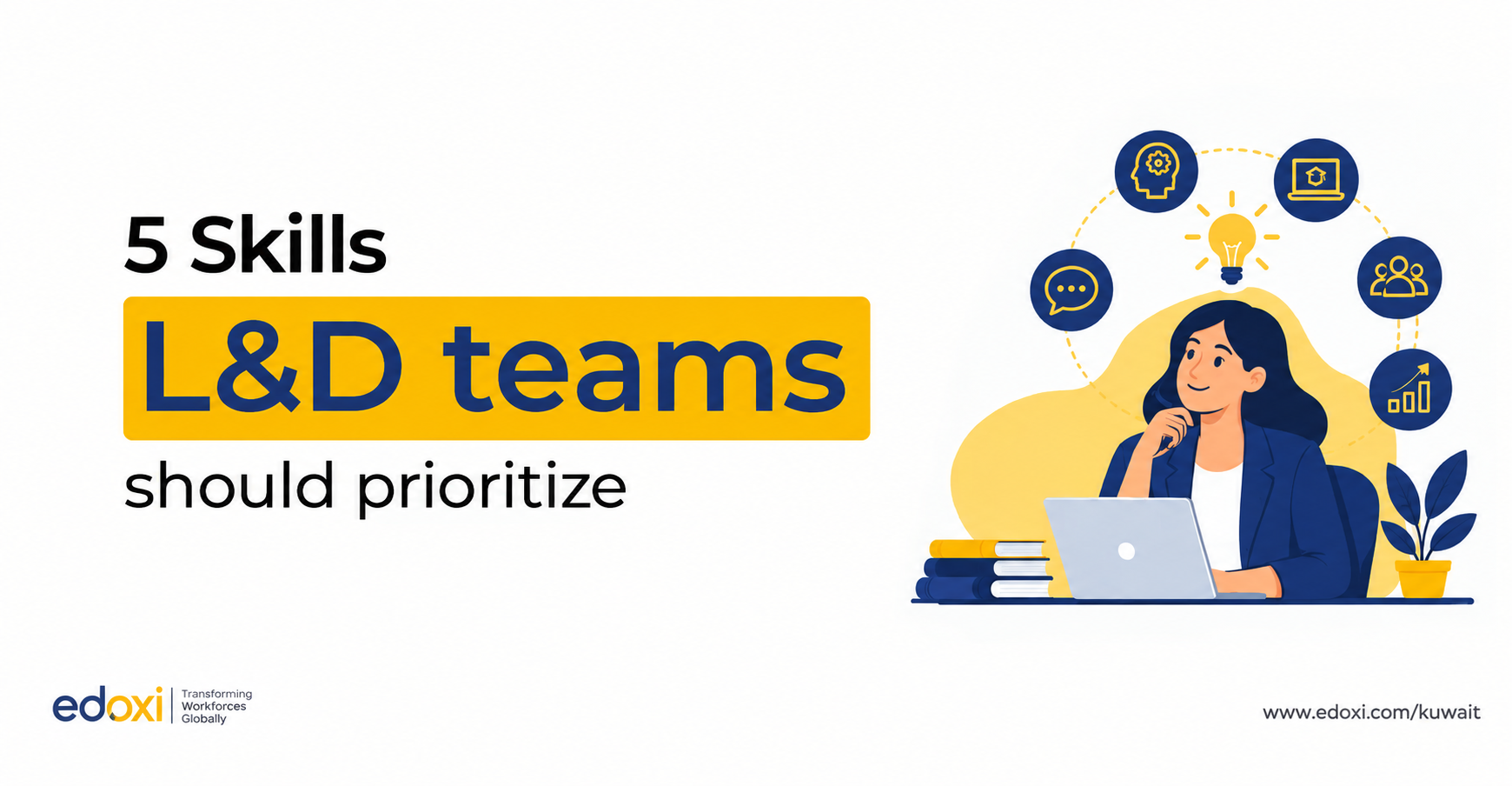
The top L&D skills for 2026 are AI and generative AI, data analytics, cybersecurity, leadership and management, and a human-skills group: communication, critical thinking, and adaptability.
Together, they help Kuwait's L&D teams train faster, prove results, protect data, and guide people through change.Picture a training room in Kuwait City. Thirty people. One slide deck. And at least three learners who asked an AI chatbot about your topic before the session began.
That is the job now. L&D teams no longer compete with the clock. They compete with a search bar that answers in seconds.
So what should your own team learn next? This blog covers the L&D skills for 2026 that matter most, using fresh reports and voices from Kuwait. The language is simple on purpose.
Table of Contents
| Nos | Contents |
|---|---|
| 1 | Why Are L&D Skills for 2026 Changing So Fast? |
| 2 | Which 5 Skills Should L&D Teams Prioritise? a) Why Does AI and Generative AI Come First? i) What Should L&D Teams Learn First? ii) How Are Kuwaiti Employers Training for AI? |
b) How Does Data Analytics Help L&D Teams? i) Which Numbers Should L&D Teams Track? | |
c) Why is Cybersecurity Now an L&D Skill? i) What Can L&D Teams Do About It? | |
d) What Leadership and Management Skills Should L&D Build? i) What is Reverse Mentoring? | |
e) Are Communication, Critical Thinking, and Adaptability Still Worth Teaching? i) How Do You Teach Critical Thinking? | |
| 3 | Which Skill Should Your L&D Team Start With? |
| 4 | How Can an L&D Team Start This Quarter in Kuwait? |
| 5 | Key Takeaways |
| 6 | FAQs: 5 Skills L&D Teams Should Prioritise in 2026 |
Technology is rewriting jobs faster than most training plans can follow. TheWorld Economic Forum's Future of Jobs Report 2025says employers expect 39% of key skills to change by 2030.
Kuwait feels this shift too.PwC's Middle East Workforce Hopes and Fears Survey 2025found that 75% of workers in the region used AI at work in the past year, against 69% worldwide.
Kuwait's National AI Strategy (2025-2028)pushes in the same direction.
Here is what sits behind it:
There is a gap, though. PwC Kuwait'sKhalid AlShattinotes that training pathways do not yet match the digital, analytical, and problem-solving skills employers want.
LinkedIn's 2025 Workplace Learning Reportadds that 49% of learning professionals say their executives fear staff lack the skills to deliver strategy.
Start with AI, data analytics, cybersecurity, leadership, and the human trio of communication, critical thinking, and adaptability. Each one solves a clear business problem.
| Skill | Why it matters in 2026 | Quick win for L&D |
|---|---|---|
| AI and generative AI | Fastest-growing skill (WEF) | Run a prompt workshop |
| Data analytics and BI | Proves which training works | Build one learning dashboard |
| Cybersecurity | Breaches are costly in the Middle East | Add security lessons to onboarding |
| Leadership and management | Managers decide if learning sticks | Start a mentoring circle |
| Communication, critical thinking, adaptability | Analytical thinking tops employer lists | Use real cases, not slides |
AI is already part of daily work, and the WEF ranks AI and big data as the fastest-growing skills. Staff need to use it well, safely, and with good judgement.
Generative AIis software that creates text, images, or code from a short instruction. L&D teams can use it to draft courses and quizzes in hours, not weeks. But the tool is only as good as the person using it.
Learn prompt writing, fact-checking, and your company's AI rules.
Prompt writing is fast becoming a job skill in its own right, and the rise inprompt engineering demandin Kuwait shows it.
Once those three habits are in place, it helps to see the bigger picture of howAI skills gaps and future jobsare connected.
For example, National Bank of Kuwait (NBK) launched its “AI Mindset” e-learning programme in May 2026, offering three learning pathways designed for different roles, from entry-level employees to executives.
At the national level, theKuwait Skills programmeaims to train more than 30,000 employees in AI and cloud tools.
Teams weighing specialist hires against training can also compareAI engineer salaries in Kuwaitto see what hiring costs.
NBK'sNajla Al-Sager, SVP and Head of Talent Management and Learning, says the bank will "invest in our workforce by equipping them with the skills and tools" to use new technology.
It shows which training works and which does not. Data analytics finds patterns in numbers. Business intelligence (BI) turns those patterns into charts that leaders can read at a glance.
Old L&D reports counted hours trained. Leaders now ask what changed at work. Learning analytics answers that.
Track three: skill use on the job, time to competence, and business impact.
Tools such asPower BImake these dashboards easy.
Once your three numbers are clear, a short round ofdata analytics training in Kuwaitcan help your team turn them into charts that leaders read at a glance.
Because L&D teaches every employee to spot a fake email.IBM's 2026 Cost of a Data Breach Reportputs the average Middle East breach at $8 million.
Make security training short, frequent, and role-based.
IBM also found that Middle East firms using AI and security automation paid over $3 million less per breach. Kuwait's 2025 partnership with Microsoft includes skilling in AI and cybersecurity too.
Staff in IT and security roles may need more than short lessons, andcybersecurity courses in Kuwaitcan give them certified, hands-on skills to match.
To see where that training can lead, browse the topcybersecurity job roles in Kuwait.
Coaching, honest feedback, and change leadership. Managers decide whether new skills survive past the workshop.
Kuwait Finance House shows one way. ItsONE VISION programme, launched in July 2026, puts 75 employees and senior leaders through six months of reverse mentoring.
Junior staff coach senior leaders, and both sides learn.
Younger staff explain new tools. Leaders share experience.
KFH'sAhmad Alhammad, Acting Group Chief HR and Transformation Officer, says the programme is unique for its "reverse mentorship, where learning is mutual."
Train managers to coach in short chats and explain why changes happen.
Yes. The WEF says analytical thinking is the most sought-after core skill, with seven in ten companies calling it essential. Resilience, flexibility, and agility come next.
Give people messy, real problems and ask them to defend their choice.
Al Shatti of PwC Kuwait argues that digital literacy, AI fluency, and problem-solving belong at every level of learning. He says they should be taught "not as electives, but as core competencies."
For communication and adaptability, role-play a hard conversation. Then ask learners to explain a complex idea to a 12-year-old.
Teams that want more structured practice can build these habits throughsoft skills courses in Kuwait.
Staff who present to clients or leaders can also grow their confidence with apublic speaking course.

Start where the pain is biggest. Use this decision table.
L&D Skills to Prioritize Based on Workplace Challenges
| If your problem is... | Start with | First move |
|---|---|---|
| Staff use AI tools with no rules | AI and generative AI | Write a one-page AI guide and train on it |
| You cannot prove training works | Data analytics and BI | Track three metrics for one course |
| Phishing and data leaks worry you | Cybersecurity | Launch monthly phishing drills |
| New managers struggle | Leadership and management | Start a six-month mentoring circle |
| Teams resist change | Communication, critical thinking, adaptability | Run scenario workshops |
Pick one skill, run a 30-day pilot, measure the result, then scale.
Ask managers which skill gap hurts most.
Choose one skill from the table above.
Pilot it with 20-30 learners.
Measure three numbers before and after.
Share the result, then scale.
For example, a bank's operations team could pilot AIprompt-engineering trainingand then track the hours saved in weekly reports.
Ready to Build These Skills in Your Team? Edoxi delivers customisedcorporate training in Kuwait, from AI and data to cybersecurity and leadership. Share your skills gap and get a plan built around it.
Individual learners aiming for AI roles can seehow Edoxi prepares themfor an AI career in Kuwait.