
Leave your message to get our quick response
edoxi automated message icon

Certified Information Systems Security Professional (CISSP) Course in Kuwait

Professional cybersecurity expert interacting with a futuristic digital interface displaying data analytics, network security, and cyber technology visuals on a blue-toned screen.
Edoxi’s 30-hour Certified Information Systems Security Professional (CISSP) Course in Kuwait helps IT and cybersecurity professionals build advanced enterprise security, risk management, and network protection skills aligned with ISC2 standards. Gain hands-on experience in vulnerability assessment, penetration testing, incident response, and security operations. Develop expertise in tools like Kali Linux, Wireshark, OpenVAS, and Snort through practical cybersecurity labs and real-world security scenarios. Enrol now.
Course Duration
30 Hours
Corporate Days
5 Days
Learners Enrolled
50+
Modules
8
star-rating-icon1
star-rating-icon2
star-rating-icon3
Course Rating
4.9
star-rating-4.9
Mode of Delivery
Online
Classroom
Certification by

What Do You Learn from Edoxi's CISSP Training

Security and Risk Management through Industry Frameworks
Master ISC2's security principles and leading frameworks like NIST, ISO 27001, and COBIT. Learn to implement governance policies and ensure compliance with regulations such as GDPR and CCPA.
Asset Security and Information Classification
Gain expertise in data protection using DRM, DLP, and CASB technologies. Understand data lifecycle management, including classification, secure destruction, and the roles of data controllers and processors.
Zero Trust Architecture and Engineering
Learn to apply Zero Trust and SASE architectures for secure design. Master cryptographic solutions, including PKI infrastructure, quantum cryptography, and encryption standards like AES and RSA.
TCP/IP and Network Security Implementation
Design secure systems using the OSI and TCP/IP models. Implement protocols like IPSec, SSL/TLS, and VPNs. Use micro-segmentation and software-defined networking (SDN) for enhanced enterprise security.
Advanced IAM Frameworks
Implement authentication frameworks such as OAuth, SAML, and federated identity solutions. Design access control systems with RBAC, ABAC, and JWT, integrated with SSO and MFA technologies.
SecOps and Assessment
Deploy SIEM platforms, IDS/IPS systems, and UEBA solutions for effective security monitoring. Conduct vulnerability assessments using tools like Nmap, Wireshark, and Metasploit.

About Our CISSP Certification Course in Kuwait

Edoxi’s 30-hour CISSP Course in Kuwait delivers practical, hands-on cybersecurity training aligned with the latest ISC2 CISSP certification requirements and all eight CISSP domains. This industry-focused programme helps professionals build advanced skills in enterprise security, risk management, network security, security operations, and governance. Edoxi also provides customised CISSP corporate training for organisations looking to strengthen their cybersecurity teams.

CISSP Certification Domains
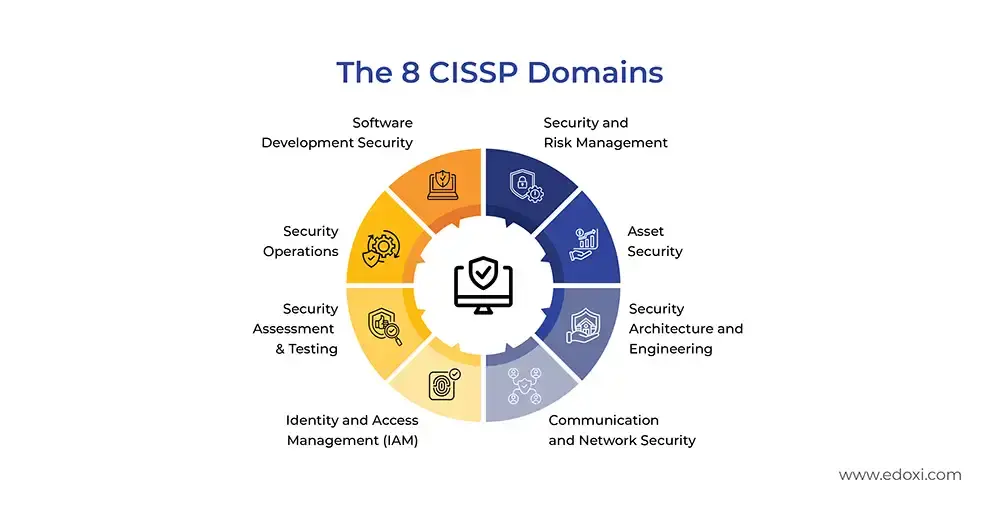
This illustration shows the eight CISSP security domains covered in Edoxi’s CISSP Training Course in Kuwait, including Security & Risk Management, Asset Security, Security Architecture & Engineering, Communication & Network Security, IAM, Security Assessment & Testing, Security Operations, and Software Development Security.

The CISSP Training Course combines theoretical learning with practical implementation through web-based cybersecurity labs and real-world security exercises. Participants gain hands-on experience in vulnerability assessment, penetration testing, security monitoring, and incident response using industry-standard tools such as Kali Linux, Nmap, Wireshark, OpenVAS, Snort, and Metasploit. The training also covers modern cybersecurity concepts, including Zero Trust Architecture, cloud security, AI-driven security practices, IAM frameworks, SIEM implementation, and secure enterprise network design.

Edoxi’s CISSP training methodology focuses on practical application and real-world cybersecurity challenges to help professionals prepare for both the CISSP certification exam and advanced security roles across industries such as banking, telecom, healthcare, government, and critical infrastructure protection.

CISSP Certification Exam Details

The CISSP certification also serves as a pathway to advanced cybersecurity careers and specialised security domains, including cloud security, security architecture, governance, risk management, digital forensics, and security operations.

Exam Criteria Details
Exam Name
Certified Information Systems Security Professional (CISSP)
Duration 3 Hours (Computerised Adaptive Testing)
Number of Questions 100–150 Questions
Question Types
Multiple-choice questions and advanced innovative items
Passing Score 700 out of 1000
Exam Fee USD 749 (Middle East Region)
Certification Validity 3 Years
Recertification
Continuing Professional Education (CPE) Credits and compliance with ISC2 professional ethics
Exam Administration Authority
ISC2 Authorised Pearson VUE Testing Centres

By completing Edoxi’s CISSP Training Course in Kuwait, professionals develop globally recognised cybersecurity skills applicable across multiple industries and enterprise environments.

For detailed information about CISSP course fees, upcoming batch schedules, or corporate cybersecurity training solutions, contact Edoxi in Kuwait.

Key Features of Edoxi's CISSP Training

Web-Based Cybersecurity Labs

Access pre-configured security environments to practise real-world vulnerabilities and security scenarios in a safe, hands-on setting.

Industry-Standard Security Tools Training

Gain practical experience using tools like Kali Linux, OpenVAS, and Snort for security testing, vulnerability assessment, and intrusion detection.

Interactive CISSP Domain Workshops

Participate in group discussions and practical workshops focused on solving real-world cybersecurity challenges across all CISSP domains.

Official ISC2 Study Materials

Learn using official ISC2 CISSP resources, including study guides, presentation materials, practice questions, and mock tests.

Hands-On Security Assessment Practice

Perform vulnerability scanning, penetration testing, and security assessments using industry-recognised methodologies aligned with CISSP objectives.

Practical Security Implementation Exercises

Complete structured exercises focused on risk assessment, security policy development, access control, and incident response planning.

Who Can Join Our CISSP Course in Kuwait?

IT Security Professionals

Experienced IT professionals aiming for ISC2's globally recognised CISSP certification, and manage enterprise security initiatives.

System and Network Administrators

Infrastructure specialists responsible for security architecture and implementation. Administrators looking to expand their security management skills.

Security Consultants and Analysts

Practising security professionals in consulting or analytical roles helps them validate their expertise and prepares them for senior-level positions.

Network Security Engineers

Engineers managing secure communication infrastructures, and for those looking to master enterprise-wide security solutions and advanced architectures.

Risk and Compliance Managers

Professionals overseeing compliance frameworks and asset protection to strengthen their strategic governance capabilities in security.

Cybersecurity Enthusiasts

Individuals with a strong IT foundation and passion for cybersecurity, and for those pursuing long-term careers in the field.

CISSP Course Modules

Module 1: Security and Risk Management
  • Chapter 1.1: Understand, adhere to, and promote professional ethics

    • Lesson 1.1.1: ISC2 Code of Professional Ethics
    • Lesson 1.1.2: Organisational Code of Ethics
  • Chapter 1.2: Understand and apply security concepts

    • Lesson 1.2.1: Confidentiality, Integrity, and Availability (CIA)
    • Lesson 1.2.2: Authenticity and Nonrepudiation (5 Pillars of Information Security)
  • Chapter 1.3: Evaluate and apply security governance principles

    • Lesson 1.3.1: Alignment of the Security Function to Business Strategy, Goals, Mission, and Objectives
    • Lesson 1.3.2: Organisational Processes (e.g., Acquisitions, Divestitures, Governance Committees)
    • Lesson 1.3.3: Organisational Roles and Responsibilities
    • Lesson 1.3.4: Security Control Frameworks (e.g., ISO, NIST, COBIT, SABSA, PCI, FedRAMP)
    • Lesson 1.3.5: Due Care/Due Diligence
  • Chapter 1.4: Understand legal, regulatory, and compliance issues

    • Lesson 1.4.1: Cybercrimes and Data Breaches
    • Lesson 1.4.2: Licensing and Intellectual Property Requirements
    • Lesson 1.4.3: Import/Export Controls
    • Lesson 1.4.4: Transborder Data Flow
    • Lesson 1.4.5: Issues Related to Privacy (e.g., GDPR, CCPA, POPIA)
    • Lesson 1.4.6: Contractual, Legal, Industry Standards, and Regulatory Requirements
  • Chapter 1.5: Understand requirements for investigation types

    • Lesson 1.5.1: Administrative Investigations
    • Lesson 1.5.2: Criminal Investigations
    • Lesson 1.5.3: Civil Investigations
    • Lesson 1.5.4: Regulatory and Industry Standards Investigations
  • Chapter 1.6: Develop, document, and implement security policies

    • Lesson 1.6.1: Alignment of Security Function to Organisational Strategy
    • Lesson 1.6.2: Security Control Frameworks and Governance
    • Lesson 1.6.3: Development of Policies, Standards, Procedures, and Guidelines
  • Chapter 1.7: Identify, analyse, assess, and implement Business Continuity (BC)

    • Lesson 1.7.1: Business Impact Analysis (BIA)
    • Lesson 1.7.2: External Dependencies
  • Chapter 1.8: Contribute to and enforce personnel security policies

    • Lesson 1.8.1: Candidate Screening and Hiring
    • Lesson 1.8.2: Employment Agreements and Policy-Driven Requirements
    • Lesson 1.8.3: Onboarding, Transfers, and Termination Processes
    • Lesson 1.8.4: Vendor, Consultant, and Contractor Agreements and Controls
  • Chapter 1.9: Understand and apply risk management concepts

    • Lesson 1.9.1: Threat and Vulnerability Identification
    • Lesson 1.9.2: Risk Analysis, Assessment, and Scope
    • Lesson 1.9.3: Risk Response and Treatment (e.g., Cybersecurity Insurance)
    • Lesson 1.9.4: Types of Controls (e.g., Preventive, Detection, Corrective)
    • Lesson 1.9.5: Control Assessments and Continuous Monitoring
    • Lesson 1.9.6: Reporting and Continuous Improvement
    • Lesson 1.9.7: Risk Frameworks (e.g., ISO, NIST, COBIT, SABSA, PCI)
  • Chapter 1.10: Understand and apply threat modelling concepts

    • Lesson 1.10.1: Threat Identification
    • Lesson 1.10.2: Threat Modelling Techniques and Tools
  • Chapter 1.11: Apply Supply Chain Risk Management (SCRM) concepts

    • Lesson 1.11.1: Risks in Product and Service Acquisition (e.g., Counterfeits, Tampering)
    • Lesson 1.11.2: Risk Mitigation Strategies (e.g., Third-Party Assessment, Minimum Security Requirements)
  • Chapter 1.12: Establish and maintain a security awareness program

    • Lesson 1.12.1: Methods to Increase Awareness (e.g., Social Engineering, Phishing, Security Champions)
    • Lesson 1.12.2: Periodic Content Reviews (e.g., Emerging Technologies, AI, Blockchain)
    • Lesson 1.12.3: Program Effectiveness Evaluation
Module 2: Asset Security
  • Chapter 2.1: Identify and Classify Information and Assets

    • Lesson 2.1.1: Data Classification
    • Lesson 2.1.2: Asset Classification
  • Chapter 2.2: Establish Information and Asset Handling Requirements

    • Lesson 2.2.1: Handling Sensitive Information
    • Lesson 2.2.2: Secure Asset Management Practices
  • Chapter 2.3: Provision Information and Assets Securely

    • Lesson 2.3.1: Information and Asset Ownership
    • Lesson 2.3.2: Asset Inventory (e.g., Tangible and Intangible Assets)
    • Lesson 2.3.3: Asset Management Strategies
  • Chapter 2.4: Manage Data Lifecycle

    • Lesson 2.4.1: Data Roles (e.g., Owners, Controllers, Custodians, Processors, Users/Subjects)
    • Lesson 2.4.2: Data Collection and Location
    • Lesson 2.4.3: Data Maintenance and Retention
    • Lesson 2.4.4: Data Remanence and Destruction
  • Chapter 2.5: Ensure Appropriate Asset Retention

    • Lesson 2.5.1: End of Life (EOL) Management
    • Lesson 2.5.2: End of Support Strategies
  • Chapter 2.6: Determine Data Security Controls and Compliance Requirements

    • Lesson 2.6.1: Data States (e.g., In Use, In Transit, At Rest)
    • Lesson 2.6.2: Scoping and Tailoring Security Requirements
    • Lesson 2.6.3: Standards Selection and Compliance
    • Lesson 2.6.4: Data Protection Methods (e.g., DRM, DLP, CASB)
Module 3: Security Architecture and Engineering
  • Chapter 3.1: Implement Secure Network Architecture Concepts

    • Lesson 3.1.1: OSI and TCP/IP Models
    • Lesson 3.1.2: Network Segmentation and Zoning
    • Lesson 3.1.3: Network Design Principles (e.g., Defence in Depth, Segregation of Duties)
  • Chapter 3.2: Secure System Design Principles

    • Lesson 3.2.1: Trusted Computing Base (TCB)
    • Lesson 3.2.2: Security Models (e.g., Bell-LaPadula, Biba, Clark-Wilson)
    • Lesson 3.2.3: Trusted and Untrusted Domains
  • Chapter 3.3: Apply Cryptographic Concepts

    • Lesson 3.3.1: Symmetric and Asymmetric Encryption
    • Lesson 3.3.2: PKI Infrastructure, Certificates, and Trust Models
    • Lesson 3.3.3: Quantum Cryptography Basics
    • Lesson 3.3.4: Encryption Standards (AES, RSA, ECC)
  • Chapter 3.4: Apply Secure Design Principles to Software and Hardware

    • Lesson 3.4.1: Secure Software Development Lifecycle (SDLC)
    • Lesson 3.4.2: Threat Modelling for Software and Hardware
    • Lesson 3.4.3: Code Review, Static and Dynamic Analysis
    • Lesson 3.4.4: Hardware Security Modules (HSMs) and TPM
  • Chapter 3.5: Implement Security Principles in Site and Facility Design

    • Lesson 3.5.1: Physical Security Controls
    • Lesson 3.5.2: Environmental Controls (Fire, HVAC, Electrical, Water)
    • Lesson 3.5.3: Redundancy and High Availability Design
Module 4: Communication and Network Security
  • Chapter 4.1: Secure Network Components

    • Lesson 4.1.1: Routers, Switches, and Firewalls
    • Lesson 4.1.2: Load Balancers, Proxies, and Gateways
  • Chapter 4.2: Secure Communication Channels

    • Lesson 4.2.1: Virtual Private Networks (VPNs)
    • Lesson 4.2.2: Secure Protocols (SSL/TLS, IPSec)
    • Lesson 4.2.3: Email and Messaging Security
  • Chapter 4.3: Implement Network Security Measures

    • Lesson 4.3.1: IDS, IPS, and Honeypots
    • Lesson 4.3.2: Network Access Control (NAC)
    • Lesson 4.3.3: Micro-Segmentation and SDN (Software-Defined Networking)
  • Chapter 4.4: Secure Communication Across Different Network Types

    • Lesson 4.4.1: LAN, WAN, Wireless, and Mobile Networks
    • Lesson 4.4.2: Cloud Security Fundamentals
    • Lesson 4.4.3: Industrial Control Systems (ICS) Security
Module 5: Identity and Access Management (IAM)
  • Chapter 5.1: Implement Authentication and Authorisation

    • Lesson 5.1.1: Authentication Methods (Passwords, Biometrics, Tokens)
    • Lesson 5.1.2: Multi-Factor Authentication (MFA) and Single Sign-On (SSO)
    • Lesson 5.1.3: Federated Identity Management
  • Chapter 5.2: Implement Access Control Models

    • Lesson 5.2.1: Role-Based Access Control (RBAC)
    • Lesson 5.2.2: Attribute-Based Access Control (ABAC)
    • Lesson 5.2.3: Discretionary and Mandatory Access Controls
  • Chapter 5.3: Identity Lifecycle Management

    • Lesson 5.3.1: Account Provisioning and Deprovisioning
    • Lesson 5.3.2: Identity Governance and Compliance
    • Lesson 5.3.3: Privileged Access Management (PAM)
  • Chapter 5.4: Implement Identity and Access Services

    • Lesson 5.4.1: Directory Services (Active Directory, LDAP)
    • Lesson 5.4.2: Authentication Protocols (Kerberos, SAML, OAuth)
    • Lesson 5.4.3: Single Sign-On and Federation Services
Module 6: Security Assessment and Testing
  • Chapter 6.1: Plan and Conduct Security Assessments

    • Lesson 6.1.1: Vulnerability Assessments and Scanning Techniques
    • Lesson 6.1.2: Penetration Testing Methodologies
    • Lesson 6.1.3: Red Team vs Blue Team Exercises
  • Chapter 6.2: Implement Security Testing Strategies

    • Lesson 6.2.1: Security Testing Frameworks and Tools (Nmap, Metasploit, Wireshark)
    • Lesson 6.2.2: Network, Application, and Cloud Security Testing
    • Lesson 6.2.3: Social Engineering and Physical Security Testing
  • Chapter 6.3: Analyse and Report Security Findings

    • Lesson 6.3.1: Risk Assessment and Impact Analysis
    • Lesson 6.3.2: Reporting Findings to Stakeholders
    • Lesson 6.3.3: Remediation Planning and Recommendations
  • Chapter 6.4: Continuous Security Monitoring

    • Lesson 6.4.1: Security Information and Event Management (SIEM)
    • Lesson 6.4.2: User and Entity Behaviour Analytics (UEBA)
    • Lesson 6.4.3: Ongoing Compliance and Audit Practices
Module 7: Security Operations (SecOps)
  • Chapter 7.1: Implement and Manage Security Operations

    • Lesson 7.1.1: Security Operations Centres (SOC) Roles and Responsibilities
    • Lesson 7.1.2: Incident Detection and Response
    • Lesson 7.1.3: Threat Intelligence and Analysis
  • Chapter 7.2: Logging and Monitoring

    • Lesson 7.2.1: Centralised Logging Systems
    • Lesson 7.2.2: SIEM Configuration and Use
    • Lesson 7.2.3: Monitoring Network, Systems, and Applications
  • Chapter 7.3: Incident Management

    • Lesson 7.3.1: Incident Response Lifecycle
    • Lesson 7.3.2: Incident Classification and Prioritisation
    • Lesson 7.3.3: Forensic Analysis and Evidence Collection
  • Chapter 7.4: Disaster Recovery and Business Continuity

    • Lesson 7.4.1: Business Continuity Planning (BCP)
    • Lesson 7.4.2: Disaster Recovery Planning (DRP)
    • Lesson 7.4.3: Testing and Maintaining Recovery Plans
Module 8: Software Development Security
  • Chapter 8.1: Understand Secure Software Development

    • Lesson 8.1.1: Software Development Life Cycle (SDLC) Security
    • Lesson 8.1.2: Secure Coding Practices and Standards
    • Lesson 8.1.3: Threat Modelling and Risk Analysis
  • Chapter 8.2: Apply Security Controls in Development

    • Lesson 8.2.1: Input Validation and Output Encoding
    • Lesson 8.2.2: Authentication and Session Management in Code
    • Lesson 8.2.3: Cryptography Implementation in Applications
  • Chapter 8.3: Security Testing in Development

    • Lesson 8.3.1: Static Application Security Testing (SAST)
    • Lesson 8.3.2: Dynamic Application Security Testing (DAST)
    • Lesson 8.3.3: Software Composition Analysis (SCA)
  • Chapter 8.4: Secure Deployment and Maintenance

    • Lesson 8.4.1: DevSecOps and Continuous Security Integration
    • Lesson 8.4.2: Patch Management and Vulnerability Remediation
    • Lesson 8.4.3: Security Monitoring for Deployed Applications

Download CISSP Course Brochure

Lab Activities and Practical Sessions in the CISSP Course in kuwait

Our CISSP training includes practical sessions to build hands-on skills. Below are the key hands-on activities covered in the programme:

Security Policy Development

Develop comprehensive cybersecurity policies addressing organisational security requirements, focusing on practical implementation of security frameworks.

Vulnerability Assessment and Testing

Perform vulnerability assessments and penetration testing simulations using the course lab environment, practising real-world security testing methodologies.

Incident Response Planning

Design and create incident response plans for various security scenarios, incorporating practical response and mitigation strategies.

Risk Assessment Implementation

Conduct thorough risk assessments for critical IT infrastructure, applying the principles and methodologies covered in the course curriculum.

Certified Information Systems Security Professional (CISSP) Course Outcomes and Career Opportunities in Kuwait

Completing our CISSP Training Course equips you with advanced cybersecurity, risk management, and enterprise security skills required for senior-level information security roles. Key outcomes include:

Course Outcome Image
Implement security and risk management frameworks such as NIST, ISO 27001, COBIT, GDPR, and CCPA within enterprise environments.
Design and manage secure network architectures using Zero Trust, SASE, IPSec, SSL/TLS, VPNs, and advanced access control systems.
Perform vulnerability assessments, penetration testing, and security monitoring using tools like Kali Linux, OpenVAS, Wireshark, and Snort.
Develop cybersecurity policies, incident response plans, risk assessment strategies, and governance frameworks for organisational security.
Configure identity and access management solutions using OAuth, SAML, MFA, RBAC, ABAC, and federated identity systems.
Prepare for senior cybersecurity job roles such as Information Security Analyst, Security Architect, SOC Analyst, Cybersecurity Engineer, and Chief Information Security Officer (CISO).

Job Roles After the CISSP Certification in Kuwait

  • Information Security Analyst
  • Network Security Engineer
  • Cybersecurity Analyst
  • Cybersecurity Engineer
  • Security Operations Centre (SOC) Analyst
  • Penetration Tester
  • Chief Information Security Officer (CISO)
  • Security Architect
  • Senior Incident Response Analyst

Companies Hiring CISSP Professionals in Kuwait

  • National Bank of Kuwait
  • Gulf Bank
  • stc Kuwait
  • Zain Kuwait
  • Agility
  • Kuwait Finance House
  • Accenture
  • Deloitte
  • V2X
  • Jazeera Airways

CISSP Training Options

Classroom Training

  • 30 hours of CISSP Training

  • Instructor-led sessions with an experienced CISSP-certified trainer

  • Practical exercises in a web-based lab environment

  • Small group sessions for individual attention

  • Comprehensive coverage of all eight CISSP domains

  • Direct interaction with the trainer for immediate feedback

  • Flexible scheduling options for working professionals

Live Online Training

  • 30 hours of online CISSP Training

  • Real-time virtual learning with a certified instructor

  • Access to cloud-based lab infrastructure

  • Interactive tool demonstrations and practical sessions

  • Flexible scheduling options for working professionals

  • Recordings of sessions for future reference

  • Same small batch size advantage as classroom training

Corporate Training

  • 5 days of CISSP Corporate Training

  • Customisable modules and delivery formats (on-site, online, or hybrid)

  • Full logistics handled, including venue options (hotel, client premises, or our premises)

  • Food and refreshments provided for corporate teams

  • Group pricing benefits for team enrollments

  • Post-training support and certification guidance

Do You Want a Customised Training for CISSP?

Get expert assistance in getting your CISSP Course customised!

How To Get a CISSP Certification in Kuwait?

Here’s a four-step guide to becoming a certified CISSP professional.
Do You Want to be a Certified Professional in CISSP?

Join Edoxi’s CISSP Course

Why Choose Edoxi for the CISSP Course in Kuwait?

Edoxi, a leading CISSP Training Institute in Kuwait, offers comprehensive cybersecurity training programmes designed to help professionals build advanced information security skills. Here are the key reasons to choose Edoxi. 

Certified CISSP Trainers

Learn from experienced CISSP-certified instructors with strong industry and training expertise.

Professional Learning Environment

Train in small batches with personalised attention, web-based labs, and official ISC2 study materials.

Dedicated Certification Support

Get guidance for CISSP exam registration, eligibility verification, endorsement, and experience documentation.

Hands-On Security Labs

Practise vulnerability assessment and security testing using tools like Kali Linux, OpenVAS, and Snort.

Flexible Training Options

Choose from classroom, online, or corporate training with flexible schedules and recorded sessions for online learners.

students-image

Edoxi is Recommended by 95% of our Students

Meet Our Mentor

Our mentors are leaders and experts in their fields. They can challenge and guide you on your road to success!

mentor-image

Maria Mehwish

Maria Mehwish is a forward-thinking and knowledgeable information security leader with a strong background in building, updating, and maintaining digital protections for various organisations. As a certified CEH, CCSP, CCT, and CISSP Trainer, Maria has a proven track record of delivering innovative and immersive coursework, enhancing learning experiences for cyber threats, ethical hacking, security policy, DevSecOps, and cloud security. With excellent verbal and written communication skills, she is also adept at troubleshooting problems and building successful solutions.

Maria is a self-motivated individual with a strong sense of personal responsibility, capable of managing projects from start to finish. Her expertise in Amazon Web Services, Java/Go/Python/C++, DevSecOps, computer security, Linux, penetration testing, and risk analysis, among others, makes her a valuable asset to any organisation. Maria, a British national, is a native English speaker and has intermediate proficiency in Urdu.

Locations Where Edoxi Offers CISSP Course

Here is the list of other major locations where Edoxi offers CISSP Course

FAQ

What are the experience requirements for CISSP certification?

To earn the CISSP certification, candidates need five years of paid work experience in at least two CISSP domains. The requirement reduces to four years with a relevant degree or approved certifications such as CEH, CISA, CISM, CCSP, or CompTIA Security+.

What training formats does Edoxi provide for CISSP training in Kuwait?

Edoxi offers classroom training, live online CISSP training, and corporate training programs with flexible schedules, recorded sessions, and web-based lab access.

What practical skills do I gain from Edoxi’s CISSP Course in Kuwait?

Edoxi’s CISSP Training Course includes hands-on cybersecurity labs where participants practise vulnerability assessment, security testing, intrusion detection, and risk analysis using tools like Kali Linux, OpenVAS, and Snort.

What study materials are included in the CISSP training?

Participants receive the official ISC2 CISSP book, presentation materials, practice questions, mock tests, and domain-wise learning resources for exam preparation.

How is the CISSP certification exam structured?

The CISSP exam is a 3-hour Computerised Adaptive Test (CAT) with 100–150 questions, including multiple-choice and advanced question formats. The passing score is 700 out of 1000.

What career opportunities are available after completing the CISSP Course in Kuwait?

The CISSP certification helps professionals apply for roles such as Information Security Analyst, SOC Analyst, Security Consultant, Security Architect, Risk Manager, and CISO.

How do CISSP professionals maintain their certification?

CISSP certification remains valid for three years. Professionals need Continuing Professional Education (CPE) credits and must follow ISC2 professional ethics guidelines.

Which companies in Kuwait hire CISSP-certified professionals?

Leading organisations such as National Bank of Kuwait, Kuwait Finance House, Zain Kuwait, stc Kuwait, Agility, Deloitte, and Accenture hire CISSP-certified professionals.

What support does Edoxi provide for CISSP certification?

Edoxi provides support for exam registration, eligibility verification, experience documentation, and ISC2 endorsement guidance.

What topics does Edoxi’s CISSP Training Course cover?

The CISSP Course covers all eight CISSP domains, including security and risk management, asset security, network security, security operations, identity management, and software development security.

Who can join Edoxi’s CISSP training in Kuwait?

IT professionals, cybersecurity analysts, network administrators, security engineers, auditors, consultants, and risk management professionals can join the CISSP training.

Is Edoxi’s CISSP Course suitable for beginners?

The CISSP certification is designed for experienced IT and cybersecurity professionals. However, Edoxi helps learners understand complex CISSP concepts through guided training and practical labs.

What is the average salary of CISSP professionals in Kuwait?

CISSP-certified professionals in Kuwait often earn competitive salaries ranging from KWD 1,200 to KWD 3,000+ per month, depending on experience, job role, and organisation.

Which related cybersecurity courses does Edoxi offer along with CISSP training?

Edoxi also offers related cybersecurity certifications such as CEH (Certified Ethical Hacker), CCSP (Certified Cloud Security Professional), CISA (Certified Information Systems Auditor), CHFI (Computer Hacking Forensics Investigator), CISM (Certified Information Security Manager), CompTIA Security+, and CSF (Cybersecurity Framework).

Why choose Edoxi for CISSP training in Kuwait?

Edoxi offers certified trainers, practical cybersecurity labs, official ISC2 study resources, flexible learning options, and dedicated certification support for CISSP aspirants in Kuwait