Leave your message to get our quick response
edoxi automated message icon

CMA Course in Kuwait

Certified Management Accountant professional reviewing financial documents while working on a laptop in a modern office environment
Edoxi’s 120-hour Certified Management Accountant (CMA) training in Kuwait builds advanced financial management and strategic accounting skills for finance professionals. Delivers training in financial reporting, budgeting, cost management, performance evaluation, risk management, & strategic decision-making aligned with global CMA standards. Gain experience through exam-focused practice, real-world financial analysis, & case-based learning. Prepares you for CMA exams and senior roles like Finance Manager, Financial Controller, and CFO. Enrol now to accelerate your career in global finance and leadership.
Course Duration
120 Hours
Corporate Days
15 Days
Learners Enrolled
50+
Modules
6
star-rating-icon1
star-rating-icon2
star-rating-icon3
Course Rating
4.9
star-rating-4.9
Mode of Delivery
Online
Classroom
Certification by

What Do You Learn from Edoxi's CMA Training

Financial Reporting and Analysis
Build strong capabilities in financial reporting and analytical methods essential for management accounting roles.
Strategic Planning and Budget Management
Develop expertise in advanced budgeting techniques and strategic planning to improve organisational effectiveness.
Performance Measurement and Cost Control
Learn to track key performance indicators and apply cost control strategies to enhance operational efficiency.
Investment Evaluation and Financial Decision-Making
Acquire the skills to evaluate investment opportunities and make informed financial decisions that support business growth.

About Our CMA Course in Kuwait

Edoxi’s 120-hour Certified Management Accountant (CMA) training in Kuwait builds advanced expertise in management accounting, financial analysis, strategic planning, and decision-making. It is designed for finance professionals seeking global CMA certification and leadership roles in accounting and financial management. The CMA course is delivered through classroom, live online, and customised corporate training formats to suit individual and organisational needs.

Our CMA curriculum comprehensively covers external financial reporting, budgeting and forecasting, performance management, cost management, internal controls, risk management, technology, and analytics. Participants gain practical exposure through exam-focused problem-solving sessions, case studies, essay simulations, and multiple-choice practice aligned with IMA exam standards. The CMA training emphasises real-world financial decision-making and strategic thinking essential for senior finance roles.
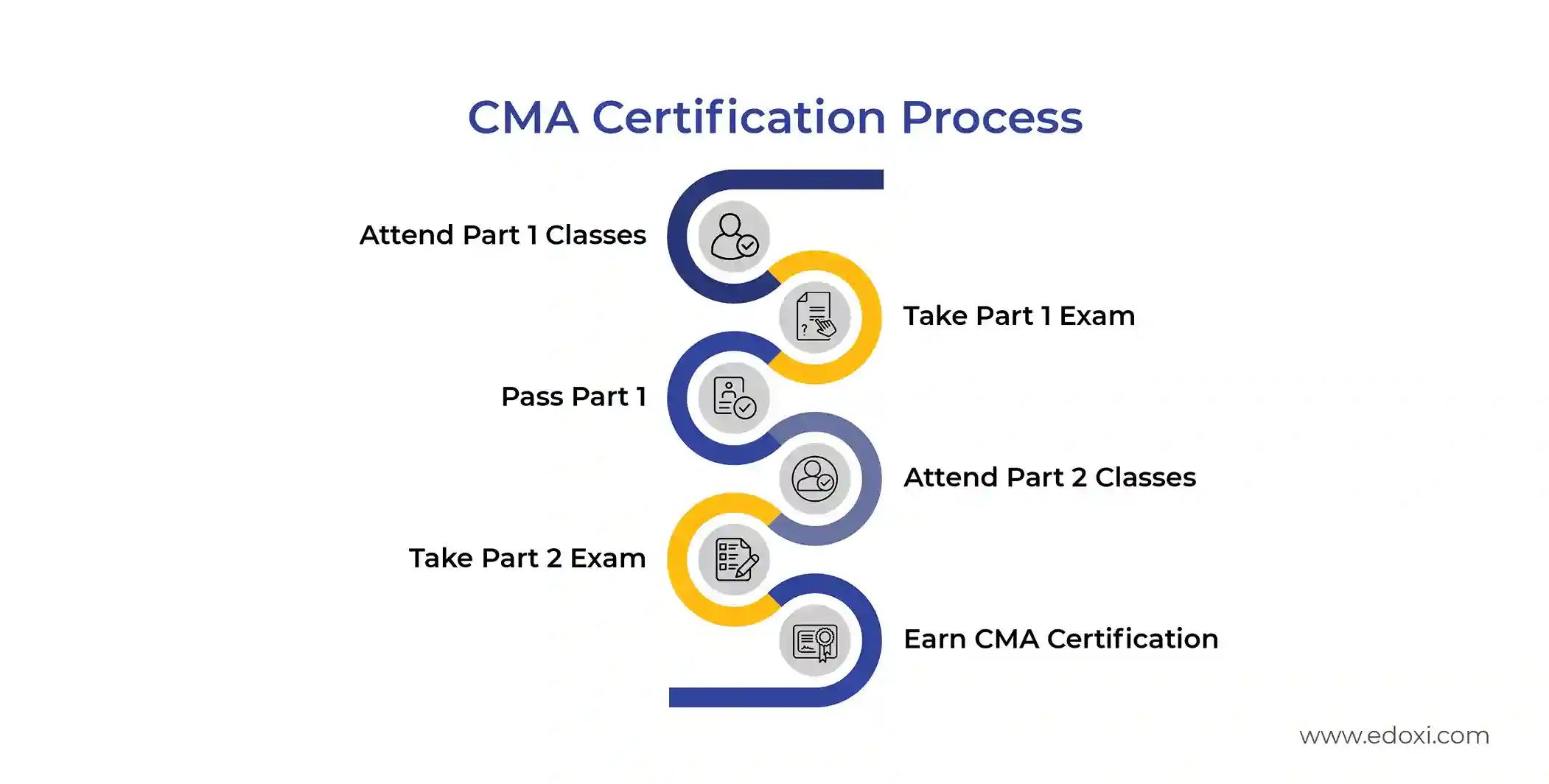
CMA Certification Process for the CMA Course in Kuwait

The CMA program is ideal for accounting graduates, financial analysts, cost accountants, business managers, entrepreneurs, and aspiring financial leaders. Upon completion of our CMA course, participants receive Edoxi’s Certified Management Accountant course completion certificate. Learners are also fully prepared to clear both parts of the CMA exam and earn a globally recognised certification. The credentials gained after passing the exam support career progression into roles such as Finance Manager, Financial Controller, and CFO across diverse industries.

To know more about CMA course fees, syllabus, and personalised classroom, online, or corporate training schedules, contact Edoxi in Kuwait.

Enrol now to advance your finance career in Kuwait with a globally respected CMA credential.

 Certified Management Accountant Course Exam Details  

The Certified Management Accountant (CMA) exam evaluates your expertise in financial planning, analysis, control, decision support, and professional ethics required for advanced management accounting roles. Below is a clear overview of the key CMA exam details:

Exam Criteria Details
Exam Format Two parts, 4 hours each (3 hours MCQ + 1-hour essays).
Questions Each part includes 100 multiple-choice questions and 2 essay questions.
Passing Score
Candidates must score 360 out of 500 on Part 1 to proceed to Part 2 and also on Part 2 to earn certification.
Prerequisites Bachelor's degree or professional qualification and IMA membership.
Certification Validity Lifetime (with ongoing CPE requirements).
Recertification 30 hours annual CPE, including 2 hours of ethics training.
 

Key Features of Edoxi's Certified Management Accountant Training

Extensive Exam Preparation Support

Access comprehensive CMA study guides, textbooks, mock exams, and robust practice question banks for thorough exam readiness.

Interactive Learning Experience

Participate in engaging group discussions and practical problem-solving activities to enhance financial analysis and decision-making skills.

Exam-Focused Practice Sessions

Practice CMA-aligned multiple-choice questions and essay simulations designed to reflect actual exam standards.

Advanced Study Resources

Utilise professional templates, analytical frameworks, and specialised eBooks to strengthen financial management expertise.

Small-Batch Personalised Training

Benefit from focused small-group sessions that provide individual attention and tailored learning support.

Flexible Learning Schedules

Select from classroom or online training options with weekday or weekend sessions to suit your professional commitments.

Who Can Join Our Certified Management Accountant Course in Kuwait?

Accounting Graduates and Graduate Students

Ideal for recent graduates and students seeking a globally recognized certification to build a solid foundation in management accounting and financial expertise.

Business Managers

Designed for professionals aiming to enhance their financial leadership capabilities and implement effective strategies for organisational success.

Entrepreneurs

Perfect for business owners looking to adopt advanced financial strategies, improve decision-making, and drive sustainable business growth.

Financial Analysts

Tailored for analysts wanting to deepen their knowledge of financial analysis and transition into strategic financial management roles.

Cost Accountants

Suited for professionals specializing in cost management who wish to enhance their skills and unlock greater career opportunities.

Aspiring Financial Leaders

For those looking to advance into senior leadership roles in financial management and strategic decision-making within diverse industries.

Certified Management Accountant Course Modules


Part1

Module 1: External Financial Reporting Decisions (15%)
  • Chapter 1.1: Financial Statements

    • Lesson 1.1.1: Balance Sheet
    • Lesson 1.1.2: Income Statement
    • Lesson 1.1.3: Statement of Changes in Equity
    • Lesson 1.1.4: Statement of Cash Flows
    • Lesson 1.1.5: Consolidated Statements
    • Lesson 1.1.6: Integrated Reporting
  • Chapter 1.2: Recognition, Measurement, and Valuation

    • Lesson 1.2.1: Asset Valuation
    • Lesson 1.2.2: Valuation of Liabilities
    • Lesson 1.2.3: Equity Transactions
    • Lesson 1.2.4: Revenue Recognition
    • Lesson 1.2.5: Income Measurement
    • Lesson 1.2.6: Major Differences Between U.S. GAAP and IFRS
Module 2: Planning, Budgeting, and Forecasting (20%)
  • Chapter 2.1: Strategic Planning

    • Lesson 2.1.1: Analysis of External and Internal Factors Affecting Strategy
    • Lesson 2.1.2: Long-Term Mission and Goals
    • Lesson 2.1.3: Alignment of Tactics with Long-Term Strategic Goals
    • Lesson 2.1.4: Strategic Planning Models and Analytical Techniques
    • Lesson 2.1.5: Characteristics of a Successful Strategic Planning Process
  • Chapter 2.2: Budgeting Concepts

    • Lesson 2.2.1: Operations and Performance Goals
    • Lesson 2.2.2: Characteristics of a Successful Budget Process
    • Lesson 2.2.3: Resource Allocation
    • Lesson 2.2.4: Other Budgeting Concepts
  • Chapter 2.3: Forecasting Techniques

    • Lesson 2.3.1: Regression Analysis
    • Lesson 2.3.2: Learning Curve Analysis
    • Lesson 2.3.3: Expected Value
  • Chapter 2.4: Budgeting Methodologies

    • Lesson 2.4.1: Annual Business Plans (Master Budgets)
    • Lesson 2.4.2: Project Budgeting
    • Lesson 2.4.3: Activity-Based Budgeting
    • Lesson 2.4.4: Zero-Based Budgeting
    • Lesson 2.4.5: Continuous (Rolling) Budgets
    • Lesson 2.4.6: Flexible Budgeting
  • Chapter 2.5: Annual Profit Plan and Supporting Schedules

    • Lesson 2.5.1: Operational Budgets
    • Lesson 2.5.2: Financial Budgets
    • Lesson 2.5.3: Capital Budgets
  • Chapter 2.6: Top-Level Planning and Analysis

    • Lesson 2.6.1: Pro Forma Income
    • Lesson 2.6.2: Financial Statement Projections
    • Lesson 2.6.3: Cash Flow Projections
Module 3: Performance Management (20%)
  • Chapter 3.1: Cost and Variance Measures

    • Lesson 3.1.1: Comparison of Actual to Planned Results
    • Lesson 3.1.2: Use of Flexible Budgets to Analyze Performance
    • Lesson 3.1.3: Management by Exception
    • Lesson 3.1.4: Use of Standard Cost Systems
    • Lesson 3.1.5: Analysis of Variation from Standard Cost Expectations
  • Chapter 3.2: Responsibility Centers and Reporting Segments

    • Lesson 3.2.1: Types of Responsibility Centers
    • Lesson 3.2.2: Transfer Pricing
    • Lesson 3.2.3: Contribution Margin
    • Lesson 3.2.4: Reporting of Organizational Segments
  • Chapter 3.3: Performance Measures

    • Lesson 3.3.1: Product Profitability Analysis
    • Lesson 3.3.2: Business Unit Profitability Analysis
    • Lesson 3.3.3: Customer Profitability Analysis
    • Lesson 3.3.4: Return on Investment (ROI)
    • Lesson 3.3.5: Residual Income
    • Lesson 3.3.6: Investment Base Issues
    • Lesson 3.3.7: Key Performance Indicators (KPIs)
    • Lesson 3.3.8: Balanced Scorecard
Module 4: Cost Management (15%)
  • Chapter 4.1: Measurement Concepts

    • Lesson 4.1.1: Types of Cost and Cost Behavior
    • Lesson 4.1.2: Actual and Normal Costs
    • Lesson 4.1.3: Standard Costs
    • Lesson 4.1.4: Absorption (Full) Costing
    • Lesson 4.1.5: Variable (Direct) Costing
    • Lesson 4.1.6: Joint and By-Product Costing
  • Chapter 4.2: Costing Systems

    • Lesson 4.2.1: Job Order Costing
    • Lesson 4.2.2: Activity-Based Costing
    • Lesson 4.2.3: Life-Cycle Costing
    • Lesson 4.2.4: Other Costing Systems
  • Chapter 4.3: Overhead Costs

    • Lesson 4.3.1: Fixed and Variable Overhead Expenses
    • Lesson 4.3.2: Corporate vs. Departmental Overhead
    • Lesson 4.3.3: Determination of Allocation Base
    • Lesson 4.3.4: Allocation of Service Department Costs
  • Chapter 4.4: Supply Chain Management

    • Lesson 4.4.1: Lean Resource Management Techniques
    • Lesson 4.4.2: Enterprise Resource Planning (ERP)
    • Lesson 4.4.3: Capacity Management and Analysis
  • Chapter 4.5: Business Process Improvement

    • Lesson 4.5.1: Value Chain Analysis
    • Lesson 4.5.2: Value-Added Concepts
    • Lesson 4.5.3: Process Analysis, Redesign, and Standardization
    • Lesson 4.5.4: Continuous Improvement Concepts
    • Lesson 4.5.5: Benchmarking and Best Practice Analysis
    • Lesson 4.5.6: Cost of Quality Analysis
Module 5: Internal Controls (15%)
  • Chapter 5.1: Governance, Risk, and Compliance

    • Lesson 5.1.1: Internal Control Structure and Management Philosophy
    • Lesson 5.1.2: Internal Control Policies for Safeguarding and Assurance
    • Lesson 5.1.3: Internal Control Risk
    • Lesson 5.1.4: Testing Methods for Internal Controls
    • Lesson 5.1.5: Control Deficiency Remediation
    • Lesson 5.1.6: Corporate Governance
    • Lesson 5.1.7: External Audit Requirements
  • Chapter 5.2: System Controls and Security Measures

    • Lesson 5.2.1: General Accounting System Controls
    • Lesson 5.2.2: Application and Transaction Controls
    • Lesson 5.2.3: Technology Controls
    • Lesson 5.2.4: Backup Controls
    • Lesson 5.2.5: Business Continuity Planning
Module 6: Technology and Analytics (15%)
  • Chapter 6.1: Information Systems

    • Lesson 6.1.1: Accounting Information Systems
    • Lesson 6.1.2: Enterprise Resource Planning Systems
    • Lesson 6.1.3: Enterprise Performance Management Systems
  • Chapter 6.2: Data Governance

    • Lesson 6.2.1: Data Policies and Procedures
    • Lesson 6.2.2: Life Cycle of Data
    • Lesson 6.2.3: Data Management
    • Lesson 6.2.4: Controls Against Security Breaches
  • Chapter 6.3: Technology-Enabled Finance Transformation

    • Lesson 3.1: System Development Life Cycle
    • Lesson 3.2: Process Automation
    • Lesson 3.3: Innovative Applications
  • Chapter 6.4: Data Analytics

    • Lesson 6.4.1: Business Intelligence
    • Lesson 6.4.2: Data Mining
    • Lesson 6.4.3: Types of Data Analytics
    • Lesson 6.4.4: Data Visualization

Part2

Module 1: Financial Statement Analysis
  • Chapter 1.1: Techniques for Analysing Financial Statements

    • Lesson 1.1.1 Horizontal and vertical analysis
    • Lesson 1.1.2 Common-size financial statements
    • Lesson 1.1.3 Trend analysis
  • Chapter 1.2: Ratio Analysis and Performance Indicators

    • Lesson 1.2.1 Liquidity Ratios
    • Lesson 1.2.2 Profitability Ratios
    • Lesson 1.2.3 Solvency and efficiency ratios
Module 2: Corporate Finance
  • Chapter 2.1: Capital Structure and Financing Options

    • Lesson 2.1.1 Debt vs equity financing
    • Lesson 2.1.2 Optimal capital structure
    • Lesson 2.1.3 Leverage and cost of capital
  • Chapter 2.2: Cost of Capital and Valuation

    • Lesson 2.2.1 Weighted Average Cost of Capital (WACC)
    • Lesson 2.2.2 Discounted Cash Flow (DCF) techniques
    • Lesson 2.2.3 Business valuation methods
Module 3: Decision Analysis
  • Chapter 3.1: Cost-Volume-Profit Analysis

    • Lesson 3.1.1 Break-even analysis
    • Lesson 3.1.2 Contribution Margin Approach
    • Lesson 3.1.3 Sensitivity and scenario analysis
  • Chapter 3.2: Marginal Analysis and Decision-Making Under Uncertainty

    • Lesson 3.2.1 Relevant cost analysis
    • Lesson 3.2.2 Make or buy decisions
    • Lesson 3.2.3 Probability and expected value concepts
Module 4: Risk Management
  • Chapter 4.1: Identifying and Assessing Business Risks

    • Lesson 4.1.1 Types of financial and operational risks
    • Lesson 4.1.2 Risk assessment frameworks
  • Chapter 4.2: Risk Mitigation Strategies

    • Lesson 4.2.1 Risk response planning
    • Lesson 4.2.2 Insurance and hedging techniques
Module 5: Investment Decisions
  • Chapter 5.1: Capital Budgeting Techniques

    • Lesson 5.1.1 Net Present Value (NPV)
    • Lesson 5.1.2 Internal Rate of Return (IRR)
    • Lesson 5.1.3 Payback and discounted payback period
  • Chapter 5.2: Evaluation of Investment Alternatives

    • Lesson 5.2.1 Profitability Index
    • Lesson 5.2.2 Scenario and sensitivity analysis in investment decisions
Module 6: Professional Ethics
  • Chapter 6.1: Ethical Considerations for Finance Professionals

    • Lesson 6.1.1 Principles of ethical behaviour
    • Lesson 6.1.2 Common ethical dilemmas in finance
  • Chapter 6.2: IMA’s Statement of Ethical Professional Practice

    • Lesson 6.2.1 Overview of IMA’s ethical standards
    • Lesson 6.2.2 Application of the IMA ethical framework in real scenarios

Download CMA Course Brochure

Real-World Activities in Our Certified Management Accountant Course in Kuwait

Our Certified Management Accountant course in Kuwait combines expert-led instruction with practical, exam-focused learning activities aligned to real-world financial and business scenarios. Key learning activities include:

Group Discussions

Participate in guided group discussions to analyse and deepen understanding of key financial concepts.

CMA Exam–Aligned Practice Questions

Practise multiple-choice and essay questions structured to match official CMA exam standards.

Problem-Solving Exercises

Engage in practical problem-solving activities to strengthen financial analysis and decision-making capabilities.

Comprehensive Study Materials

Access detailed study guides, mock exams, eBooks, and supplementary resources for complete exam preparation.

CMA Course Outcome and Career Opportunities in Kuwait

By completing our CMA course in Kuwait, you will build advanced financial expertise, enhance strategic decision-making skills, and gain practical knowledge for global finance roles. The key outcomes include:

Course Outcome Image
Develop advanced expertise in financial reporting, budgeting, cost management, and performance evaluation aligned with global CMA standards.
Apply strategic financial analysis, forecasting, and investment appraisal techniques to support effective business decision-making.
Analyse costs, variances, and performance metrics to improve operational efficiency and organisational profitability.
Implement risk management practices and internal control systems to ensure compliance and protect organisational assets.
Achieve full readiness for CMA Part 1 and Part 2 exams through exam-focused training, practice questions, and mock assessments.
Build career-ready skills to progress into finance leadership roles such as Financial Analyst, Finance Manager, Financial Controller, and CFO.

Job Roles After Completing the CMA Training in Kuwait

  • Accountant
  • Financial Analyst
  • Finance Manager
  • Cost Accountant
  • Chief Financial Officer (CFO)
  • Financial Controller
  • Director of Finance

Companies Hiring Certified Management Accountant in Kuwait

  • Kuwait Petroleum Corporation (KPC)
  • Zain Group
  • Agility Logistics
  • KPMG Kuwait
  • Ernst & Young (EY) Kuwait
  • Deloitte Kuwait
  • PwC Kuwait
  • Alghanim Industries
  • Boubyan Bank
  • National Bank of Kuwait (NBK)

Certified Management Training Options

Classroom Training

  • 120 Hours of CMA Training in Kuwait

  • Small group learning with up to 10 students per trainer.

  • Interactive discussions to enhance understanding of key concepts.

  • Problem-solving exercises focused on practical application.

  • Comprehensive study materials provided for exam preparation.

  • Real-time feedback and guidance from expert instructors.

Live Online Training

  • 120 Hours Flexible scheduling to suit individual learning needs.

  • Virtual access to all classroom resources and tools.

  • Interactive sessions designed for effective exam preparation.

  • Full access to study guides, mock tests, and additional resources.

  • One-on-one support available for personalized learning.

Corporate Training

  • Tailored 8-day intensive program with flexible schedules

  • Collaborative group-based learning approach

  • Expert-led exam preparation with real-world case studies

  • Training delivered at a selected hotel, client premises, or Edoxi

  • Fly-Me-a-Trainer Option

  • Complete logistics support including venue arrangements

  • Meals and refreshments included for participants

Do You Want a Customised Training for CMA?

Get expert assistance in getting your CMA Course customised!

How to Get a Certified Management Certification?

Here’s a four-step guide to becoming a certified CMA professional.
Do You Want to be a Certified Professional in CMA?

Join Edoxi’s CMA Course

Why Choose Edoxi for a Certified Management Certification Course in Kuwait?

Among the many options available in Kuwait, Edoxi is a standout choice. Here’s why Edoxi’s CMA training is the perfect fit for your needs:

Course Completion Certificate

Upon completion of the Certified Management certification course, learners can gain a CMA course completion certificate.

Highly Skilled and Experienced Faculty

Gain insights from finance professionals who provide practical strategies for mastering CMA exam concepts.

Comprehensive Study Materials and Resources

Access detailed study guides, textbooks, mock exams, and test banks for thorough exam preparation.

Focused and Interactive Learning Environment

Small group sizes ensure personalised attention and an engaging learning experience.

Dynamic and Practical Learning Methods

Participate in discussions and problem-solving activities that enhance financial analysis and accounting skills.

Convenient and Flexible Scheduling Options

Weekend classes are designed to help balance professional commitments with effective CMA preparation.

students-image

Edoxi is Recommended by 95% of our Students

Meet Our Mentor

Our mentors are leaders and experts in their fields. They can challenge and guide you on your road to success!

mentor-image

Lahiru Prasanna Silva

Lahiru Prasanna Silva is an expert CMA trainer at Edoxi Training Institute, Dubai. He has over 20 years of practical experience in the finance industry and 18 years of dedicated training expertise.Throughout his career, he has successfully trained more than 20,000 students, equipping them with the skills and knowledge needed to excel in their professional journeys.

His deep understanding of finance and passion for teaching have made him a trusted mentor for aspiring CMA candidates.With a special interest in teaching, Lahiru combines his core expertise in education with his extensive finance background to deliver comprehensive training programs. His commitment to student success ensures that participants gain both theoretical knowledge and practical insights, enabling them to excel in their CMA certification exams and build successful careers in financial management.

Locations Where Edoxi Offers CMA Certification Course

Here is the list of other major locations where Edoxi offers CMA Certification Course

FAQ

What are the primary objectives of external financial reporting?
To provide stakeholders with accurate, consistent, and transparent financial information for decision-making.
How do strategic planning processes impact financial performance?
They align financial goals with organisational objectives, ensuring efficient resource allocation and growth.
What are the key differences between fixed and flexible budgets?
Fixed budgets remain constant regardless of activity levels, while flexible budgets adjust with actual performance.
How is variance analysis used in performance management?

It identifies differences between planned and actual performance to uncover inefficiencies and areas for improvement.

What is activity-based costing (ABC), and why is it important?

ABC assigns costs to products/services based on activities, offering more accurate cost insights for decision-making.

Why is internal audit crucial for maintaining internal controls?
It ensures compliance, identifies risks, and strengthens operational efficiency and governance.a
How does financial technology (fintech) enhance financial decision-making?
Fintech enables real-time analytics, automates processes, and provides innovative solutions like blockchain and AI.
What are the main considerations in capital structure decisions?
Balancing debt and equity to minimize costs while maximizing returns and financial stability.
What is the role of ethical decision-making frameworks in financial management?

They guide professionals in resolving conflicts, ensuring compliance, and fostering trust and integrity.

How can benchmarking improve financial performance analysis?
By comparing metrics to industry standards, it helps identify strengths, weaknesses, and opportunities for improvement.
What is the average salary for a Certified Management Accountant (CMA) in Kuwait?
In Kuwait, CMAs typically earn 12,000–17,000 KWD per year, while experienced finance managers and senior professionals can earn 25,000 KWD or more, depending on experience, company, and industry.
What are the main costs associated with the CMA exam?
The primary costs for the CMA certification include the IMA membership fee, the CMA program entrance fee, and the examination fees for both parts of the exam.​ These core fees are mandatory for all candidates.