Request a Callback

+965 65642350
 Jul 10, 2026

|
Quick Answer: Why are Primavera P6 skills important in Dubai? Primavera P6 remains one of the most sought-after project controls skills in Dubai in 2026. Planning Engineers, Project Controls Engineers, and Scheduling Specialists with Primavera expertise are in demand across construction, infrastructure, energy, and data centre projects, with salaries ranging from AED 8,000 to AED 45,000+ per month depending on experience. |
Dubai's construction and infrastructure sectors are expanding fast, and that boom is creating a wave of demand for one specific technical skill: Primavera P6.
According to Mordor Intelligence, the GCC construction market was valued at approximately USD 175 billion in 2025 and is projected to reach approximately USD 222 billion by 2031. A separate report from P&S Intelligence puts it slightly differently, about USD 167 billion in 2025, growing to USD 233 billion by 2032, but the two estimates tell the same story: sustained, multi-year growth backed by initiatives like Dubai's 2040 Urban Master Plan.
That growth needs to be planned, scheduled, and tracked, and Primavera P6 is the tool the industry has standardised on. Across the UAE and wider GCC, it's the de facto standard for project scheduling, project controls, and portfolio management.
Yes, for anyone in construction, infrastructure, oil and gas, or project management, Primavera P6 remains one of the highest-return technical skills in the UAE job market. Often, Primavera P6 is a contractual requirement on many major GCC projects. Employers need people who can produce baseline schedules, manage progress reporting, and support claims in a way that holds up contractually. That demand shows up in the pay. Based on current Dubai job listings and salary data:
|
Level |
Typical Monthly Salary (AED) |
|
Entry-level (assistant planner, junior scheduler) |
10,000 – 13,000 |
|
Senior planning engineer/project controls lead |
28,000 – 32,000+ |
|
Senior project controls/planning management |
Higher still, depending on the company and scope |
Primavera P6 adoption goes well beyond traditional construction. Here are 12 reasons why it has high demand across key UAE and GCC sectors:
Primavera P6 Is a Common Requirement for Major GCC Projects
Dubai's Mega-Projects Require Enterprise-Level Scheduling
FIDIC Contracts, EOT Claims & Forensic Delay Analysis
Built for GCC-Specific Scheduling Requirements
Advanced Cost Control, Cash Flow Forecasting & Payment Certification
Digital Project Controls, Risk Analytics & Oracle Ecosystem Integration
Industry-Wide Adoption Across the GCC
Strong Demand for Planning & Project Controls Professionals
Opportunities with PMCs, Consultants & Major Developers
Growing Demand in Data Centers, Energy & Industrial Projects
Higher Salaries & Career Progression
Certifications Provide a Competitive Advantage
Primavera P6 has become the default scheduling platform across the Gulf's construction and infrastructure sector, and many major tenders now list it as a baseline requirement rather than a “nice to have.”
Where Primavera P6 Is Commonly Required
Common Stakeholders Using Primavera P6
Key Mandates
Worth knowing: on many government-linked infrastructure tenders, technical proposals are strengthened by naming certified P6 planners on the team. Exact scoring weight varies by tender and authority; always check the actual tender documents rather than assuming a fixed rule.
Check Out : How to Choose a Corporate Primavera P6 Training Provider in Dubai?
Enterprise-level scheduling is a strict contractual requirement to manage the extreme financial, physical, and logistics risks of Dubai's multi-billion-dollar master plans. When projects scale to the size of the $55 billion Al Maktoum International Airport expansion or the Dubai Metro expansion, standard project management software crashes under the data load. Without enterprise-grade scheduling systems like the Primavera P6 or PMP, megaprojects face immediate operational failure across five critical dimensions.
Typical Mega-Project Schedule Complexity
Core P6 Features Used
Desktop-scale tools like MS Project were built for single projects, not this scale. They struggle once you hit this kind of data volume and multi-contractor complexity. P6's enterprise database architecture is built for exactly this, which is why large clients standardise on it.
Check Out: Top 5 Benefits of Using Primavera P6 for Project Management
Methodologies You Must Master
Why Employers Value This Skill
Employers seek planners who can:
Career Evolution: Mastering these advanced P6 delay techniques can help a standard Planning Engineer transition into a higher-paying Forensic Planner or Claims Consultant role.
Primavera P6 is widely regarded as the de facto scheduling standard for major projects across the Gulf Cooperation Council (GCC) countries because it supports many regional planning and contractual requirements. Additional GCC Constraints Managed in Primavera P6 include;
Real-World Application: During Ramadan, working hours are typically reduced under UAE labour regulations. P6 allows planners to build a dedicated “Ramadan Calendar” that adjusts the remaining duration of activities without disrupting the logic of the overall project network.
A skilled Primavera P6 professional should know:
As GCC projects increasingly adopt Building Information Modelling (BIM), risk-based planning, and advanced reporting systems, Primavera P6 remains a key platform for integrating project schedules with the broader digital project controls ecosystem.
The Modern Project Controls Technology Stack |
|
|
|
|
Primavera P6 + Primavera Risk Analysis (PRA) |
|
|
Primavera P6 + BIM (4D Scheduling) |
|
This aligns the planner's skillset with current digital transformation trends across construction and infrastructure, including BIM mandates now in place for major public-sector projects in the UAE and wider GCC
|
Sector |
Primary Use Case in P6 |
|
Oil & Gas (e.g., ADNOC, Aramco) |
Shutdowns, Turnarounds & Outages (STO) management |
|
Infrastructure (Rail/Metro) |
Linear scheduling and large-scale logistics constraint modelling |
|
Real Estate (e.g., Emaar, Nakheel) |
Fast-tracked phased handovers and procurement tracking |
|
Utilities |
Power and water project scheduling |
|
Energy |
Solar and renewable project rollouts |
|
Data Centers |
EPC coordination and long-lead procurement tracking |
Read now: Importance of Primavera P6 training in career growth
Primavera P6 is one of the most widely used scheduling tools in construction, infrastructure, energy, and industrial projects. Proficiency in P6 is highly valued by employers, making it an essential skill for planners, schedulers, and project controls professionals seeking career opportunities and advancement in the global project management industry.
As organisations increasingly emphasise schedule performance, risk management, and data-driven decision-making, professionals with Primavera P6 expertise are well-positioned for roles in planning, project controls, and portfolio management across both public and private sector projects.
On the contractor side, you build the schedule. On the PMC/client side (e.g., firms like Jacobs or AECOM), your P6 skill is typically used to audit and spot-check the contractor's schedule, flagging manipulation, hidden constraints, or unrealistic logic.
Data center construction is heavily driven by procurement, long-lead equipment like chillers and generators. P6 skills are highly valued here for tracking complex engineering-procurement-construction (EPC) interfaces, where delays to long-lead items can carry significant cost exposure.
The numbers back this up: the Middle East data center construction market was valued at roughly USD 5.2 billion in 2025 and is projected to grow at a CAGR above 24% through 2032, driven by hyperscale cloud build-outs and government digital-economy programs.
In the UAE, Planning Engineers commonly earn around AED 8,000–15,000 per month, while experienced Senior Planning Engineers typically earn AED 17,000–30,000+ per month, depending on project size, sector, employer, and experience level. Project Controls Managers and Planning Managers on major infrastructure, construction, and energy projects may command significantly higher compensation packages.
Project Management Profession Career Ladder
Site Engineer → Planning Engineer → Senior Planning Engineer → Lead Planner → Project Controls Manager → Planning Manager → PMO Director
Key Insight: Combining P6 expertise with claims management and broader project controls skills can support progression into leadership roles. That kind of advancement is often associated with meaningful salary increases in the GCC market, though the exact percentage varies widely by individual, employer, and sector, so treat any specific figure as a general guide rather than a guarantee.
Check out: Primavera Job Roles: A Comprehensive Guide
Knowing how to navigate Primavera P6 is an excellent start, but in Dubai’s high-stakes job market, global certifications are what separate mid-level planners from senior project control executives. Because Dubai attracts top-tier global talent, employers look for verified credentials to mitigate project risks.
If you want to stand out to major developers and contractors in the UAE, combining hands-on P6 skills with these industry credentials creates an unbeatable competitive advantage:
The GCC is building at a scale that has outgrown spreadsheet-style planning. With the regional construction market tracking toward USD 220–230 billion within the next several years, and with major government, energy, and infrastructure clients writing P6 directly into tender requirements, the tool isn't optional for anyone serious about a career in planning or project controls.
If you're starting, the path is straightforward: build solid P6 fundamentals, pair them with a recognised certification (Oracle, PMI-SP, or AACE PSP, depending on your direction), and look for opportunities to pick up real project experience, whether on the contractor side building schedules or the consultant/PMC side auditing them. From there, the route into senior planning, project controls, or claims roles is well-trodden, and the demand shows no sign of slowing down in 2026 and beyond.
Yes. It is widely used across government, infrastructure, oil & gas, and real estate megaprojects in Dubai and the wider UAE, and many technical proposals require or favour certified P6 planners.
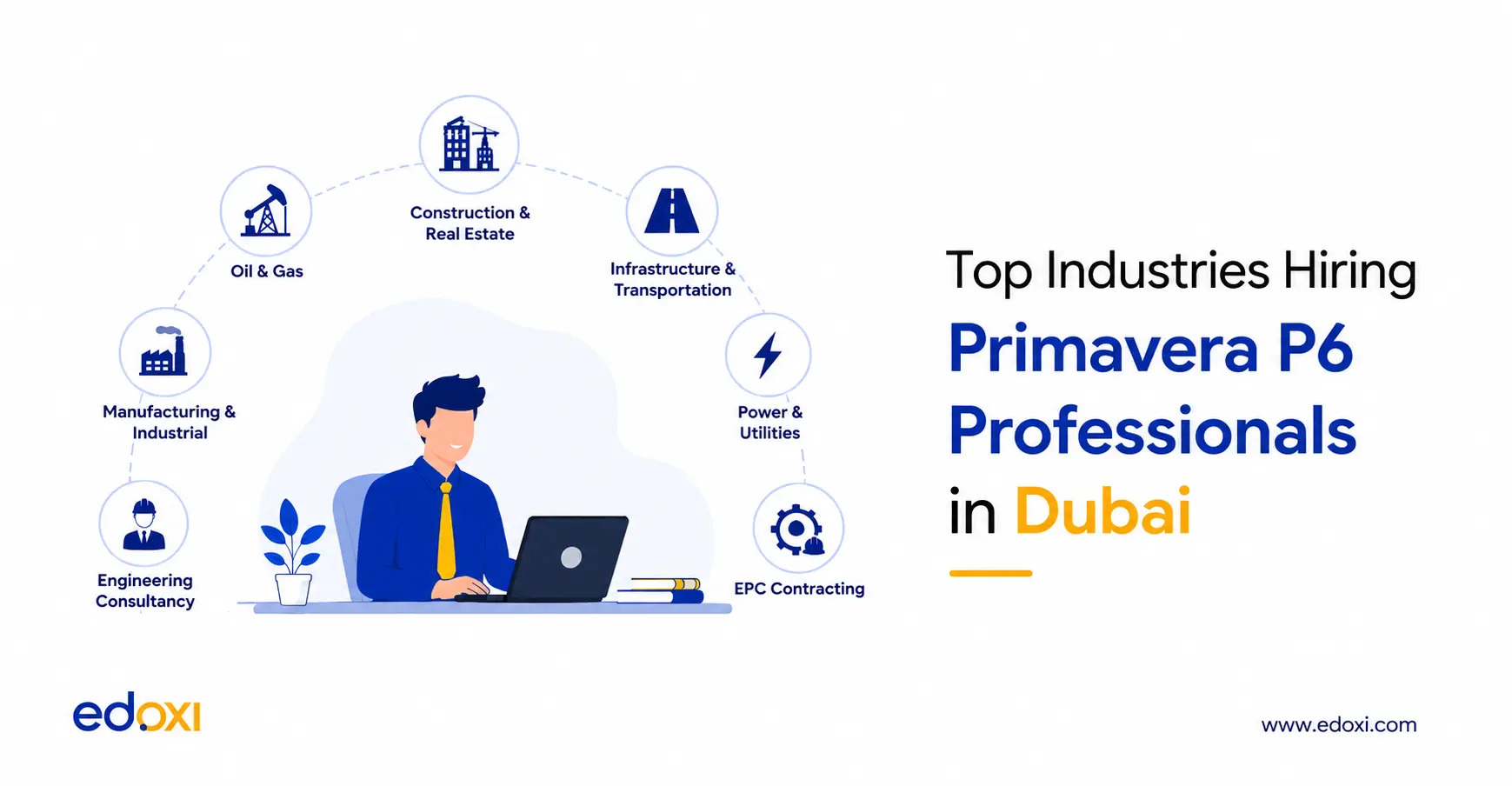
Oil & gas, infrastructure (rail/metro), real estate development, utilities, renewable energy, and data center construction all rely on P6 for scheduling and project controls.
Based on current job market data, entry-level roles typically start around AED 10,000–13,000/month, while senior planning engineers and project controls leads can earn AED 28,000–32,000+/month, with further upside in project controls management roles. Salaries vary by experience, certification, employer, and sector.
For enterprise-scale, multi-year megaprojects with thousands of activities and multiple contractors, P6 is generally preferred because of its enterprise database structure, resource levelling, and portfolio-level reporting — areas where MS Project tends to struggle at scale.
It depends on career direction: Oracle's P6 Professional Certification demonstrates software proficiency, PMI-SP demonstrates scheduling theory, and AACE PSP is widely considered a strong credential for claims and heavy industrial roles.
Yes. Many planning engineers and project controls professionals in the GCC start their careers as civil or site engineers before transitioning into scheduling and project controls roles.