
Leave your message to get our quick response
edoxi automated message icon

CHRM Course in London

Professional HR manager holding documents and showing a thumbs-up gesture in an office setting, representing CHRM certification and human resource management expertise.

Edoxi’s 30-hour CPD UK-accredited CHRM Course in London enhances your HR leadership and workforce management expertise. The course focuses on strategic HR planning, talent acquisition, and organisational development. Participants gain in-depth knowledge of HR analytics, compliance, and employee engagement strategies. Hands-on training to enhance decision-making skills for leadership roles. Enrol now and advance your career to senior-level HR Management roles in the UK

Course Duration
30 Hours
Corporate Days
4 Days
Learners Enrolled
200+
Modules
11
star-rating-icon1
star-rating-icon2
star-rating-icon3
Course Rating
4.9
star-rating-4.9
Mode of Delivery
Online
Classroom
Certification by

What Do You Learn from Edoxi's HR Management Certification Training

Strategic HR Planning and Risk Management
Develop workforce planning models and risk management strategies to align talent objectives with business growth.
HR Analytics and Performance Metrics
Learn to leverage predictive analytics and HR metrics to optimise data-driven decision-making and workforce efficiency.
Talent Acquisition and Workforce Development
Implement recruitment automation, competency mapping, and talent retention strategies for a competitive workforce.
Organisational Development and Change Management
Enhance workplace transformation through structured change management, employee engagement, and leadership development.
Diversity, Equity, and Employee Relations
Strengthen DEI initiatives, ethical HR practices, and employee advocacy programs to foster inclusive workplaces.
HR Technology and Digital Transformation
Explore emerging HR technologies, such as AI-powered tools, HRIS systems, and digital onboarding platforms.

About Our CHRM Course in London

Edoxi’s 30-hour Certified Human Resource Manager (CHRM) course is designed to prepare HR professionals for senior-level roles in London’s fast-evolving business world. Our Certified Human Resource Manager (CHRM) course follows UK professional standards. It is based on the CIPD People Profession Map, UK Employment Law, and modern HR strategies. This course focuses on real-world challenges faced by organisations in London across sectors, including healthcare, education, IT, and finance.

The CHRM course in London covers essential topics such as strategic HR planning, talent acquisition, employee engagement, organisational development, HR analytics, and compliance with UK labour laws. It also explores the impact of digital transformation and emerging technologies, including AI-powered recruitment and data-driven decision-making, to help HR professionals align people strategies with business goals.

Edoxi offer flexible and effective training options to suit the diverse needs of HR professionals. Participants can choose from classroom training and live online training. For organisations, we offer customizable 4-day corporate training tailored to specific business needs. Training can be delivered in a selected hotel, Client Premises or Edoxi.

At Edoxi, our CHRM course combines guided learning, case discussions, and hands-on practice. It helps participants understand ethical and legal HR practices. Learners build strong decision-making and analytical skills. The training promotes inclusive leadership, well-being, and workplace diversity. It also prepares HR professionals to succeed in today’s hybrid and data-driven environment.
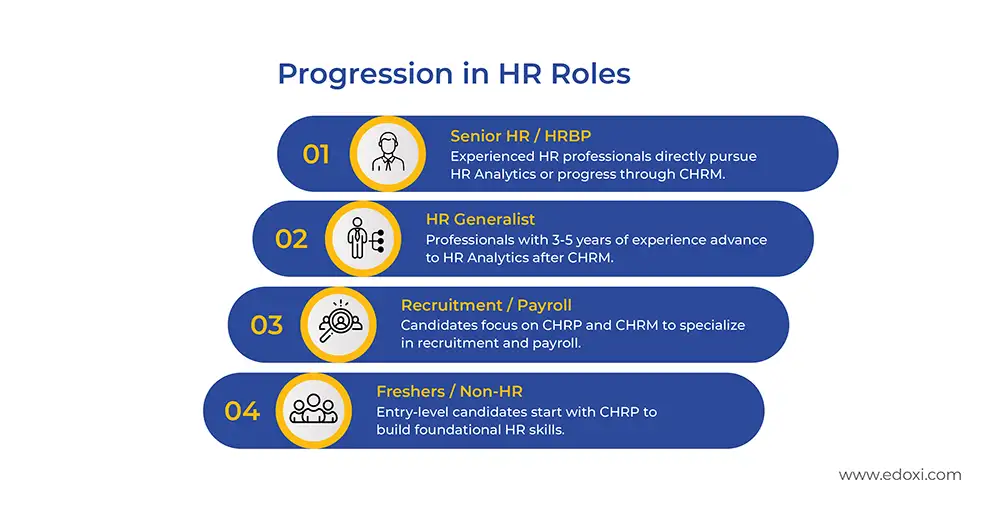
The image illustrates the Progression in HR Roles in four levels

A CHRM (Certified Human Resource Manager) credential is widely recognised in London, including healthcare, construction, hospitality, and IT. Edoxi’s CHRM Course in London enhances your chances of securing mid to senior-level roles such as senior HR Manager, HR Generalist, Talent Acquisition Manager, or HR Business Partner. Enrol now and secure a rewarding career in the UK’s booming economy. 

Key Features of Edoxi's CHRM Training

Hands-On HR Strategy Construction

Engage in interactive sessions covering HR tools, workforce planning, and organisational development strategies.

Industry-Specific Case Study Analysis

Analyse real-world HR scenarios, applying data-driven solutions to workforce challenges across industries.

HR Analytics and Performance Metrics

Master key HR metrics, performance indicators, and compensation analytics for strategic decision-making.

Collaborative HR Leadership Discussions

Participate in expert-led discussions on emerging HR trends, talent management, and compliance strategies.

Comprehensive HR Learning Resources

Gain access to HR strategy guides, research reports, and regulatory frameworks to enhance HR expertise.

Practical HR Implementation Projects

Apply learned concepts through hands-on projects in HR analytics, change management, and talent retention.

Who Can Join Our CHRM Course in London?

HR Leaders and People Management Professionals

HR practitioners aiming to advance in workforce planning, talent strategy, and leadership roles.

Business Leaders and Department Heads

Managers seeking expertise in human capital management, employee engagement, and team performance optimisation.

Talent Acquisition and Recruitment Specialists

Hiring professionals looking to master strategic workforce planning and competency-based hiring techniques.

Organisational Development and HR Consultants

Experts focusing on HR transformation, change management, and corporate restructuring strategies.

Career Switchers Transitioning into HR

Business professionals moving into HR roles with strong analytical, leadership, and communication skills.

HR Professionals Seeking Certification

Industry-experienced professionals aiming to formalise HR expertise with a globally recognised certification.

CHRM Course Modules

Module 1: Understand strategic HR policy alignment and UK compliance
  • Chapter 1.1: Aligning HR Policies with Business Strategy

    • Lesson 1.1.1: Importance of aligning HR policies with organisational goals
    • Lesson 1.1.2: Methods to integrate HR strategy with business strategy
  • Chapter 1.2: Compliance with UK Employment Law & ACAS Codes

    • Lesson 1.2.1: Overview of key labour laws
    • Lesson 1.2.2: Ensuring policy compliance
  • Chapter 1.3: Change Management and Policy Updates

    • Lesson 1.3.1: Change management principles for HR policies
    • Lesson 1.3.2: Updating policies effectively
  • Chapter 1.4: Developing Flexible Work Policies

    • Lesson 1.4.1: Types of flexible work policies
    • Lesson 1.4.2: Implementation considerations
  • Chapter 1.5: Creating Diversity and Inclusion Policies

    • Lesson 1.5.1: Key components of D&I policies
    • Lesson 1.5.2: Strategies for inclusive HR policies
  • Chapter 1.6: Ethical HR and Sustainability (ESG alignment)

Module 2: Recruitment Strategies
  • Chapter 2.1: Workforce Planning

    • Lesson 2.1.1: Strategic workforce planning process
    • Lesson 2.1.2: Aligning workforce planning with recruitment
  • Chapter 2.2: Employer Branding

    • Lesson 2.2.1: Elements of a strong employer brand
    • Lesson 2.2.2: Promoting employer brand in recruitment
  • Chapter 2.3: Recruitment Marketing

    • Lesson 2.3.1: Channels and tools for recruitment marketing
    • Lesson 2.3.2: Designing recruitment campaigns
  • Chapter 2.4: Internal vs. External Recruitment

    • Lesson 2.4.1: Advantages of internal recruitment
    • Lesson 2.4.2: Advantages of external recruitment
  • Chapter 2.5: Diversity Recruitment Strategies

    • Lesson 2.5.1: Inclusive hiring practices
    • Lesson 2.5.2: Overcoming biases in recruitment
    • Lesson 2.5.6: Recruiting for Hybrid and Remote Roles
Module 3: HR Metrics
  • Chapter 3.1: Key HR Metrics

    • Lesson 3.1.1: Overview of essential HR metrics
    • Lesson 3.1.2: Selecting appropriate metrics for the organisation
  • Chapter 3.2: Measuring Employee Performance and Productivity

    • Lesson 3.2.1: Techniques to measure performance
    • Lesson 3.2.2: Productivity analysis
  • Chapter 3.3: HR Analytics

    • Lesson 3.3.1: Introduction to HR analytics
    • Lesson 3.3.2: Data-driven HR decision making
  • Chapter 3.4: Benchmarking

    • Lesson 3.4.1: Benchmarking HR practices
    • Lesson 3.4.2: Tools for HR benchmarking
  • Chapter 3.5: Building an HR Metrics Dashboard

    • Lesson 3.5.1: Designing effective dashboards
    • Lesson 3.5.2: Tools for creating HR dashboards
  • Chapter 3.6: Employee Satisfaction and Engagement Metrics

    • Lesson 3.6.1: Key engagement indicators
    • Lesson 3.6.2: Measuring and improving employee satisfaction
    • Lesson 3.6.3: Data Privacy in HR Analytics (GDPR)
Module 4: HR Audit
  • Chapter 4.1: Types of HR Audits

    • Lesson 4.1.1: Compliance audit
    • Lesson 4.1.2: Strategic audit
    • Lesson 4.1.3: Functional audit
  • Chapter 4.2: Steps in Conducting an HR Audit

    • Lesson 4.2.1: Planning the audit
    • Lesson 4.2.2: Executing and reporting
  • Chapter 4.3: Risk Management through HR Audits

    • Lesson 4.3.1: Identifying HR risks
    • Lesson 4.3.2: Mitigation strategies
  • Chapter 4.4: Legal Compliance Audits

    • Lesson 4.4.1: Ensuring legal compliance
    • Lesson 4.4.2: Corrective actions for compliance issues
  • Chapter 4.5: HR Process Improvement

    • Lesson 4.5.1: Identifying process gaps
    • Lesson 4.5.2: Implementing improvements
  • Chapter 4.6: Documenting Audit Findings and Corrective Action Plans

    • Lesson 4.6.1: Preparing audit reports
    • Lesson 4.6.2: Developing corrective action plans
    • Lesson 4.6.3: Culture & Wellbeing Audits
Module 5: HR Balanced Scorecard
  • Chapter 5.1: Components of the HR Balanced Scorecard

    • Lesson 5.1.1: Financial perspective
    • Lesson 5.1.2: Customer perspective
    • Lesson 5.1.3: Internal process perspective
    • Lesson 5.1.4: Learning and growth perspective
  • Chapter 5.2: Linking HR Metrics to Business and ESG Outcomes

    • Lesson 5.2.1: Establishing linkage frameworks
    • Lesson 5.2.2: Communicating value to leadership
  • Chapter 5.3: Developing Key Performance Indicators (KPIs)

    • Lesson 5.3.1: Identifying effective KPIs
    • Lesson 5.3.2: Aligning KPIs with organisational goals
  • Chapter 5.4: Implementing and Tracking HR Initiatives

    • Lesson 5.4.1: Implementation strategies
    • Lesson 5.4.2: Monitoring and evaluation
  • Chapter 5.5: Continuous Improvement through Scorecard Feedback

    • Lesson 5.5.1: Gathering and analysing feedback
    • Lesson 5.5.2: Improving initiatives based on feedback
Module 6: Competency Model
  • Chapter 6.1: Defining Core Competencies

    • Lesson 6.1.1: Importance of core competencies
    • Lesson 6.1.2: Identifying core competencies for roles
  • Chapter 6.2: Competency Mapping

    • Lesson 6.2.1: Steps in competency mapping
    • Lesson 6.2.2: Applications in HR functions
  • Chapter 6.3: Developing Competency Frameworks

    • Lesson 6.3.1: Structure of competency frameworks
    • Lesson 6.3.2: Designing frameworks aligned to strategy
  • Chapter 6.4: Competency-Based Assessments

    • Lesson 6.4.1: Assessment techniques
    • Lesson 6.4.2: Integrating assessments in HR processes
  • Chapter 6.5: Building Leadership Competencies

    • Lesson 6.5.1: Key leadership competencies
    • Lesson 6.5.2: Developing leaders through competency frameworks
  • Chapter 6.6: Future HR Skills

    • Lesson 6.6.1: Digital, Analytical & Ethical Competencies (CIPD alignment)
Module 7: Compensation Management
  • Chapter 7.1: Developing a Fair and Competitive Compensation Structure

    • Lesson 7.1.1: Job evaluation methods
    • Lesson 7.1.2: Designing pay structures
  • Chapter 7.2: Total Rewards Strategy

    • Lesson 7.2.1: Components of total rewards
    • Lesson 7.2.2: Building an effective rewards strategy
  • Chapter 7.3: Pay-for-Performance Plans

    • Lesson 7.3.1: Designing incentive plans
    • Lesson 7.3.2: Linking performance to pay effectively
  • Chapter 7.4: Salary Benchmarking

    • Lesson 7.4.1: Conducting salary surveys
    • Lesson 7.4.2: Market competitiveness analysis
  • Chapter 7.5: Compliance with UK Pay Regulations

    • Lesson 7.5.1: Overview of wage laws
    • Lesson 7.5.2: Ensuring compliance in compensation practices
    • Lesson 7.5.3: National Minimum Wage, Gender Pay Gap, Holiday Pay
    • Lesson 7.5.4: Pay Transparency and Fair Pay Practices
Module 8: Employee Engagement and Talent Management
  • Chapter 8.1: Defining Employee Engagement

    • Lesson 8.1.1: Importance of employee engagement
    • Lesson 8.1.2: Drivers of engagement
  • Chapter 8.2: Creating a Positive Workplace Culture

    • Lesson 8.2.1: Elements of positive culture
    • Lesson 8.2.2: Building and sustaining workplace culture
  • Chapter 8.3: Talent Acquisition vs. Talent Development

    • Lesson 8.3.1: Differences and linkages
    • Lesson 8.3.2: Strategic approaches for both
  • Chapter 8.4: Succession Planning

    • Lesson 8.4.1: Steps in succession planning
    • Lesson 8.4.2: Identifying high-potential employees
  • Chapter 8.5: Employee Feedback Mechanisms

    • Lesson 8.5.1: Designing feedback systems
    • Lesson 8.5.2: Utilising feedback for improvement
  • Chapter 8.6: Linking Engagement with Organisational Performance

    • Lesson 8.6.1: Impact of engagement on performance
    • Lesson 8.6.2: Metrics and case examples
    • Lesson 8.6.3: Mental Health and Wellbeing Strategies
    • Lesson 8.6.4: Employee Voice and Consultation (ACAS guidance)
Module 9: HR Business Partner (HRBP)
  • Chapter 9.1: Role of the HRBP

    • Lesson 9.1.1: Definition and significance of HRBP
    • Lesson 9.1.2: Evolution of the HRBP role
  • Chapter 9.2: Strategic HR Consulting

    • Lesson 9.2.1: Consulting skills for HRBPs
    • Lesson 9.2.2: Driving strategic initiatives
  • Chapter 9.3: Collaboration with Management

    • Lesson 9.3.1: Building relationships with leadership
    • Lesson 9.3.2: Effective communication strategies
  • Chapter 9.4: Developing Strategic HR Initiatives

    • Lesson 9.4.1: Identifying strategic priorities
    • Lesson 9.4.2: Designing impactful HR initiatives
  • Chapter 9.5: HRBP Competencies

    • Lesson 9.5.1: Core competencies for HRBPs
    • Lesson 9.5.2: Competency development plans
  • Chapter 9.6: HRBP Case Studies

    • Lesson 9.6.1: Global HRBP case examples
    • Lesson 9.6.2: Lessons learned and best practices
Module 10: Employment Law, DEI & Wellbeing (NEW)
  • Chapter 10.1: Overview of UK Employment Rights (Employment Rights Act 1996)

    • Lesson 10.1.1: Understanding employee rights and employer obligations
    • Lesson 10.1.2: Key provisions under the Employment Rights Act 1996
    • Lesson 10.1.3: Practical implications for HR professionals
  • Chapter 10.2: Equality Act 2010 and Protected Characteristics

    • Lesson 10.2.1: Overview of the Equality Act 2010
    • Lesson 10.2.2: Protected characteristics and anti-discrimination principles
    • Lesson 10.2.3: Ensuring fair treatment and equal opportunities
  • Chapter 10.3: Health & Safety at Work Act 1974

    • Lesson 10.3.1: Employer and employee responsibilities
    • Lesson 10.3.2: Implementing workplace safety policies
    • Lesson 10.3.3: HR’s role in compliance and wellbeing
  • Chapter 10.4: ACAS Codes of Practice & Case Law Examples

    • Lesson 10.4.1: Understanding ACAS guidelines
    • Lesson 10.4.2: Applying best practices in employee relations
    • Lesson 10.4.3: Case studies and real-world examples
  • Chapter 10.5: DEI and Workplace Accessibility

    • Lesson 10.5.1: Principles of Diversity, Equity, and Inclusion (DEI)
    • Lesson 10.5.2: Legal and ethical aspects of accessibility
    • Lesson 10.5.3: Building inclusive recruitment and retention strategies
  • Chapter 10.6: Building Wellbeing and Inclusion Frameworks

    • Lesson 10.6.1: Creating wellbeing policies and initiatives
    • Lesson 10.6.2: Integrating wellbeing into organisational culture
    • Lesson 10.6.3: Measuring the impact of inclusion and wellbeing programs
Module 11: Digital HR, AI & Future Workforce (NEW)
  • Chapter 11.1: Digital HR Systems and HRIS

    • Lesson 11.1.1: Introduction to HRIS and digital tools
    • Lesson 11.1.2: Streamlining HR processes with technology
    • Lesson 11.1.3: Selecting and implementing HR software
  • Chapter 11.2: Leveraging AI and Automation in HR

    • Lesson 11.2.1: Understanding AI applications in HR
    • Lesson 11.2.2: Benefits and challenges of HR automation
    • Lesson 11.2.3: Case studies of AI-driven HR solutions
  • Chapter 11.3: Data Ethics and Bias Mitigation

    • Lesson 11.3.1: Understanding data privacy and security in HR
    • Lesson 11.3.2: Identifying and reducing algorithmic bias
    • Lesson 11.3.3: Ethical decision-making in digital HR
  • Chapter 11.4: Managing Remote and Hybrid Teams

    • Lesson 11.4.1: Best practices for remote team management
    • Lesson 11.4.2: Tools for collaboration and communication
    • Lesson 11.4.3: Maintaining engagement and productivity
  • Chapter 11.5: The Future of Work — Reskilling and Continuous Learning

    • Lesson 11.5.1: Emerging skill trends and future readiness
    • Lesson 11.5.2: Developing reskilling and upskilling programs
    • Lesson 11.5.3: Promoting a culture of lifelong learning
  • Chapter 11.6: Building a Digital HR Strategy

    • Lesson 11.6.1: Components of a digital HR strategy
    • Lesson 11.6.2: Aligning digital HR with organisational goals
    • Lesson 11.6.3: Measuring success and ROI of digital initiatives

Download CHRM Course Brochure

Real-World Projects and Case Studies in Our CHRM Course in London

Edoxi’s CHRM course in London features interactive workshops on organisational development, workforce analytics, and HR strategy execution. We offer practical sessions focused on talent optimisation, succession planning, and data-driven decision-making. The training equips HR professionals with the skills to implement effective human capital management strategies. The following are some of the projects and case studies in the CHRM training in London;

Projects

  • HR Metrics and Workforce Analytics Development

    Create HR dashboards, analyse key workforce performance indicators, and benchmark compensation strategies.

  • Strategic Workforce Planning and Talent Optimisation

    Develop data-driven talent acquisition, succession planning, and workforce retention strategies.

  • Performance Management Framework Implementation

    Design and implement performance evaluation models integrating continuous feedback and productivity tracking.

Case Studies

  • Organisational Change and Employee Engagement Strategies

    Evaluate case studies on corporate restructuring, cultural transformation, and employee engagement initiatives.

CHRM Course Outcomes and Career Opportunities in London

Edoxi’s CHRM certification course accelerates career progression in London’s evolving business landscape. The training will develop your expertise in strategic workforce planning, talent acquisition, and HR analytics. Here are a few outcomes that you can expect after completing our course in London;

Course Outcome Image
Gain hands-on experience in compensation modelling and predictive HR analytics.
Build leadership capabilities in organisational development, employee engagement, and compliance.
Develop the ability to align HR strategies with organisational goals to drive business success.
Learn effective techniques for recruitment, selection, onboarding, and retention of top talent.
Develop skills to design and implement performance appraisal systems that boost productivity.
Understand key labour laws and ethical HR practices to ensure compliance and fairness in the workplace.

Career Opportunities After Completing the CHRM Course in London

  • HR Coordinator
  • Employee Relations Specialist
  • HR Manager
  • HR Director
  • HR Generalist

Companies Hiring HR Professionals in London

  • IG Group
  • Informa Festivals (part of Informa PLC)
  • WEX, Inc.
  • Diligent
  • Energy Aspects
  • The Harris Federation
  • Capgemini
  • MSI Reproductive Choices
  • Bloomberg
  • TLT LLP

CHRM Training Options

Classroom Training

  • 30-Hour CHRM Course in London

  • Interactive in-person sessions at our London training centre.

  • Engaging discussions on contemporary HR challenges.

  • Hands-on exercises and real-world case studies.

  • Direct engagement with experienced HR trainers.

  • Structured learning environment with peer collaboration.

Live Online Training

  • 30-hour Online CHRM Training

  • Comprehensive virtual sessions covering the full CHRM curriculum.

  • Real-time discussions, case analyses, and practical exercises.

  • Flexible learning format for professionals with busy schedules.

  • Personalised instructor support and peer interaction.

  • Access to digital study materials and recorded sessions.

Corporate Training

  • Customizable 4-day HR training tailored to business needs.

  • Focused learning on industry-specific HR challenges.

  • Flexible delivery formats (on-site, online, or hybrid)

  • Practical applications with company-relevant case studies.

  • Food and refreshments provided for corporate teams

Do You Want a Customised Training for CHRM?

Get expert assistance in getting you CHRM Course customised!

How to get CHRM Certified in London?

Here’s a four-step guide to becoming a certified CHRM professional.
Do You Want to be a Certified Professional in CHRM?

Join Edoxi’s CHRM Course

Why Choose Edoxi for CHRM Course in London?

Here are a few reasons why you should choose Edoxi for the CHRM Course in London;

CPD-UK-Accredited HR Management Certification

Edoxi offers a CPD-UK-accredited CHRM program designed to meet evolving industry standards and HR compliance frameworks in the UK.

Practical, Data-Driven HR Learning

Our curriculum incorporates HR analytics, digital transformation, and real-world applications to enhance strategic workforce planning.

Expert-Led Training with Personalised Attention

The training is offered in small batch sizes to ensure focused learning. This enables you to master advanced HR methodologies and leadership skills.

Comprehensive Study Resources & Performance Assessments

Gain access to HR strategy guides, workforce planning models, and project-based learning assessments.

Industry-Relevant Networking & Career Growth

We have strong corporate connections in London that provide valuable networking opportunities for HR professionals.

Flexible Training Formats for HR Professionals

Our course is available in classroom and online formats. The program is structured to accommodate working professionals without compromising learning quality.

students-image

Edoxi is Recommended by 95% of our Students

Meet Our Mentor

Our mentors are leaders and experts in their fields. They can challenge and guide you on your road to success!

mentor-image

Maninder Kaur

Maninder Kaur is a seasoned Business Management and Soft Skills Trainer with over seven years of experience. Her area of expertise includes business communication, English Language training, interactive learning, student progress analysis, and corporate training. She specializes in IELTS and PTE preparation and excels in enhancing students' business communication and management skills.

Maninder Kaur is certified by Pearson and the British Council and is adept at training diverse groups and tailoring linguistic strategies to individual needs. She has successfully conducted corporate training sessions for esteemed organizations, including the Ministry of Education (UAE), Dolphin Energy, and Sanad Aviation. With a strong foundation in business writing and effective communication techniques, Ms. Kaur is committed to empowering professionals and students to achieve their career aspirations.

Locations Where Edoxi Offers CHRM Course

Here is the list of other major locations where Edoxi offers CHRM Course

FAQ

What are the prerequisites for joining Edoxi’s CHRM Course in London?

There are no strict entry requirements for Edoxi’s CHRM Course in London. However, having at least five years of experience in human resources is recommended. This ensures that learners can fully engage with advanced concepts. A working knowledge of core HR functions such as recruitment, selection, performance management, payroll, employee relations, HR strategy, and UK labour law is beneficial.

Can I join the CHRM Course in London with only two years of HR experience?

If you have around two years of HR experience, you can still start your professional HR journey with Edoxi’s Certified Human Resource Professional (CHRP) Course in London. This foundational program helps you build essential HR skills before progressing to the advanced CHRM level.

What career opportunities are available after completing the CHRM Course in London?

After completing the CHRM Course in London, you can pursue senior-level HR positions such as HR Manager, HR Business Partner, Talent Development Manager, or Strategic HR Consultant. The certification enhances your credibility and opens opportunities across UK-based organisations that value strategic and compliant HR leadership.

What is the salary of a certified Human Resource Manager in London, UK?

The salary for a certified Human Resource Manager in London, UK, is around £45,400, and senior roles earn around £63,700 annually. However, salary can vary depending on the factors like the specific industry and company size.

Will I receive certification after completing Edoxi’s CHRM Course in London?

Yes. Upon successful completion, participants will receive one of the following certificates:

    • CDP UK Authorised Course Completion Certificate from Edoxi
    • Edoxi Course Completion Certificate

Both certifications validate your professional achievement and can strengthen your HR credentials in the UK job market.