Leave your message to get our quick response
edoxi automated message icon

Python Course in Riyadh

A professional Python course certification concept image showing a software developer coding on a desktop computer in a modern workspace, representing Python programming, scripting skills, and software development training.

Edoxi's 40-hour Python Course in Riyadh will teach you to code using the Python programming language. The course consists of two parts: a 20-hour Python Beginner and a 20-hour Python Advanced. Python Beginner covers core programming foundations like Python syntax and data types. Python Advanced level builds on this with sophisticated programming training. Learn advanced OOP, MySQL database integration and CGI. Enrol now and get started!

Course Duration
40 Hours
Corporate Days
5 Days
Level
Beginner to Expert
Modules
11
star-rating-icon1
star-rating-icon2
star-rating-icon3
Course Rating
4.9
star-rating-4.9
Mode of Delivery
Online
Classroom
Certification by

What Do You Learn from Edoxi's Python Training

Python Programming Fundamentals
Master core Python concepts, including data types, control structures, and functions.
Object-Oriented Programming Mastery
Learn basic syntax, advanced OOP concepts and create efficient, reusable code using classes, inheritance, and polymorphism.
Data Structure Implementation
Master basic lists and dictionaries, then advance to complex data structures and optimisation techniques for data handling.
Database and GUI Development
Start with file handling basics, then move to MySQL integration. Create sophisticated graphical interfaces using TKinter.
Advanced Python Applications
Develop from simple programs to complex applications. Also, Master multithreading, decorators, and advanced Python libraries.
Professional Development Skills
Learn basic IDE usage in professional development environments. Learn industry-standard practices using PyCharm and Visual Studio Code.

About Our Python Certification Course in Riyadh

Edoxi’s 40-hour Python Course offers a strategic learning path designed to help students transition from foundational coding to professional-grade expertise. The training consists of two specialised 20-hour modules: a Python Beginner Course and a Python Advanced Course. This ensures a balanced focus on core syntax and sophisticated application development. By mastering both levels, learners build a future-proof skill set aligned with the latest industry standards, including the AI-integrated frameworks now becoming essential in certifications like CEH v13.

The Python Beginner course provides a 20-hour deep dive into essential programming logic, covering Python syntax, data structures, and file handling. Students learn to build, debug, and optimise scripts using industry-leading IDEs like PyCharm and Visual Studio Code. This foundational stage is critical for those entering software development, as it establishes the core principles of control flow and exception handling required for more complex automation tasks.

The Python Advanced course elevates learner expertise through 20 hours of intensive training in Object-Oriented Programming (OOP), multithreading, and database integration via MySQL Workbench. Participants explore high-level concepts such as GUI development with Tkinter and advanced library management, which are vital for creating scalable software solutions. This advanced curriculum is specifically engineered to meet the demands of modern data analysis and complex system architecture. 

Edoxi distinguishes itself through personalised one-to-one Python training, classroom, online and corporate training. Enrol now to get tailored mentorship that targets specific career goals in data science, automation, or cybersecurity. 

Details of the Python Beginner and Python Advanced Course in Riyadh, SA

Course Details Python Beginner
Python Advanced
Duration 20 hours 20 hours
Course Focus Programming basics, IDEs, file handling, functions, exception handling, control flow statements and Python data structures.
OOP concepts, GUI development, database handling, multithreading, TKinter and advanced Python libraries.
Ideal for Complete beginners starting their programming journey
Programmers with Python fundamentals knowledge
 

Application of Python in Riyadh's Key Sectors

During the Python course, participants will learn about the various applications of Python in different industries. The table below lists key industry sectors, their main Python applications, and advanced Python solutions.

Industry Core Python Applications
Advanced Python Solutions
Technology & Software Development Web development fundamentals, Basic automation scripts
Enterprise applications, Full-stack web solutions
Data Science & Analytics Data cleaning and preprocessing, Basic Pandas operations
Advanced data manipulation with NumPy, Complex analytics pipelines
Finance & Accounting Basic financial calculations, Report automation
Quantitative analysis models, Advanced financial modeling
Education & Training Basic programming exercises, Learning modules
Curriculum development tools, Educational platforms
Research & Development Data collection scripts, Basic scientific calculations
Advanced scientific computing, Research automation systems
Artificial Intelligence & ML Basic data preprocessing, Simple ML models
Advanced AI algorithms, Neural network implementations
Civil & Structural Engineering Basic design calculations, Data visualization
Design optimization systems, Advanced modeling solutions
For details about our Python course fees (which vary by requirements), syllabus, and scheduling of personalised corporate, online, or classroom training, please contact our team at Edoxi!

Key Features of Edoxi's Python Training

Personalised One-to-One Training

Individualised instruction with focused mentor guidance ensures adaptive learning at a pace suited to each learner’s background and career objectives.

Professional Development Environment

Hands-on training using industry-standard tools such as PyCharm, Visual Studio Code, and MySQL Workbench, including a complete IDE setup for real-world development exposure.

Dual-Level Learning Path

A structured learning progression through Python Beginner and Python Advanced courses, enabling systematic knowledge building from core concepts to advanced applications.

Practical Project Portfolio

Learners develop real-world projects, including ATM systems at the beginner level and Employee Management Systems at the advanced level, strengthening practical and portfolio-ready skills.

Hands-On Database Integration

Comprehensive exposure to file operations and MySQL-based data management, preparing learners to work with real-world datasets and enterprise database systems.

Complete Development Toolkit

Access to curated study materials, guided practice exercises, and continuous learner support from beginner to advanced levels, ensuring consistent skill development.

Who Can Join Our Python Course in Riyadh?

Complete Programming Beginners

Individuals with no prior coding experience can join the course and learn programming concepts

University Students and Fresh Graduates

Students and recent graduates who want to build a strong foundation in the Python programming language.

Career Transitioners

Professionals from non-technical backgrounds can use this course to transition into IT or data-related roles

Python Basics Practitioners

Learners who already understand Python fundamentals and want to strengthen their knowledge through advanced concepts and real-world applications.

IT Professionals

IT professionals can leverage advanced Python skills to automate tasks, improve system efficiency, and expand their technical capabilities.

Software Developers

Developers deepen their expertise by learning advanced frameworks, performance optimisation techniques, and scalable application development practices.

Python Course Modules


Python Beginner

Module 1: Getting Started with Python
  • Chapter 1.1: Introduction to Python

    • Lesson 1.1.1: History & Need of Python
    • Lesson 1.1.2: Applications of Python
    • Lesson 1.1.3: Advantages and Disadvantages of Python
  • Chapter 1.2: Setting Up Python

    • Lesson 1.2.1: Installing Python
    • Lesson 1.2.2: Program Structure in Python
    • Lesson 1.2.3: Interactive Shell and Script Files
    • Lesson 1.2.4: User Interface or IDEs for Python
Module 2: Python Fundamentals
  • Chapter 2.1: Modes of Python

    • Lesson 2.1.1: Working with Interactive Mode
    • Lesson 2.1.2: Working with Script Mode
  • Chapter 2.2: Basics of Python Syntax

    • Lesson 2.2.1: Python Character Set and Tokens
    • Lesson 2.2.2: Keywords, Identifiers, and Literals
    • Lesson 2.2.3: Operators and Variables
    • Lesson 2.2.4: Input and Output in Python
Module 3: Data Handling in Python
  • Chapter 3.1: Python Data Types

    • Lesson 3.1.1: Numbers and Strings
    • Lesson 3.1.2: Lists, Tuples, and Dictionaries
    • Lesson 3.1.3: Set, FrozenSet, and Bool Types
    • Lesson 3.1.4: Mutable and Immutable Data Types
Module 4: List Manipulation
  • Chapter 4.1: Working with Lists

    • Lesson 4.1.1: Introduction to Python Lists
    • Lesson 4.1.2: Creating and Accessing Lists
    • Lesson 4.1.3: Joining and Replicating Lists
    • Lesson 4.1.4: List Slicing Techniques
Module 5: String Manipulation
  • Chapter 5.1: String Handling in Python

    • Lesson 5.1.1: Introduction to Python Strings
    • Lesson 5.1.2: Accessing Individual Elements
    • Lesson 5.1.3: String Operators and Slicing
    • Lesson 5.1.4: String Functions and Methods
Module 6: Tuples and Dictionaries
  • Chapter 6.1: Working with Tuples

    • Lesson 6.1.1: Introduction to Tuples
    • Lesson 6.1.2: Creating and Accessing Tuples
    • Lesson 6.1.3: Joining, Replicating, and Slicing Tuples
  • Chapter 6.2: Working with Dictionaries

    • Lesson 6.2.1: Introduction to Dictionaries
    • Lesson 6.2.2: Accessing Values and Working with Dictionaries
    • Lesson 6.2.3: Dictionary Properties
Module 7: Sets and Frozensets
  • Chapter 7.1: Introduction to Sets

    • Lesson 7.1.1: Creating and Accessing Sets
    • Lesson 7.1.2: Joining, Replicating, and Slicing Sets
    • Lesson 7.1.3: Overview of Frozensets
Module 8: Operators in Python
  • Chapter 8.1: Types of Operators

    • Lesson 8.1.1: Arithmetic and Relational Operators
    • Lesson 8.1.2: Logical and Membership Operators
    • Lesson 8.1.3: Identity and Bitwise Operators
    • Lesson 8.1.4: Assignment Operators and Precedence
  • Chapter 8.2: Expressions and Type Casting

    • Lesson 8.2.1: Evaluating Expressions
    • Lesson 8.2.2: Type Casting in Python
Module 9: Program Control Flow
  • Chapter 9.1: Conditional Statements

    • Lesson 9.1.1: The If Statement
    • Lesson 9.1.2: The If-Else and if-elif Statements
    • Lesson 9.1.3: Nested if Statements and Python Indentation
  • Chapter 9.2: Looping and Iteration

    • Lesson 9.2.1: The For Loop
    • Lesson 9.2.2: The While Loop
    • Lesson 9.2.3: Loop Else and Nested Loops
    • Lesson 9.2.4: Break and Continue
  • Chapter 9.3: The Range Function

    • Lesson 9.3.1: Introduction to range()
    • Lesson 9.3.2: Types and Uses of range() Function
Module 10: User-Defined Functions
  • Chapter 10.1: Function Basics

    • Lesson 10.1.1: Structure of Python Programs with UDF
    • Lesson 10.1.2: Invoking UDF and Flow of Execution
    • Lesson 10.1.3: Arguments and Parameters in Functions
  • Chapter 10.2: Advanced Functions

    • Lesson 10.2.1: Default and Named Arguments
    • Lesson 10.2.2: Scope of Variables and Lambda Functions
    • Lesson 10.2.3: Recursion in Python
Module 11: Modules and Packages
  • Chapter 11.1: Working with Modules

    • Lesson 11.1.1: Importing Built-in Modules
    • Lesson 11.1.2: Examples: builtins, os, time, datetime, etc.
  • Chapter 11.2: User-Defined Modules

    • Lesson 11.2.1: Structure of Python Modules
Module 12: File Operations
  • Chapter 12.1: Handling Files in Python

    • Lesson 12.1.1: Text and Byte Files
    • Lesson 12.1.2: Reading and Writing Files
    • Lesson 12.1.3: Other File Tools
Module 13: Classes and Objects
  • Chapter 13.1: Object-Oriented Programming Basics

    • Lesson 13.1.1: Classes as User-Defined Data Types
    • Lesson 13.1.2: Creating and Using Classes and Objects
  • Chapter 13.2: Advanced OOP Concepts

    • Lesson 13.2.1: Encapsulation, Inheritance, and Polymorphism
Module 14: Projects
  • Chapter 14.1: Console Project

    • Lesson 14.1.1: Implementing Learned Concepts in a Project

Python Advanced

Module 1: Exception Handling
  • Chapter 1.1: Understanding Exceptions

    • Lesson 1.1.1: Default Exceptions and Errors
    • Lesson 1.1.2: Catching Exceptions
    • Lesson 1.1.3: Raising Exceptions
  • Chapter 1.2: Advanced Exception Handling

    • Lesson 1.2.1: Try-Except Statement
    • Lesson 1.2.2: Raise, Assert, and Finally Blocks
    • Lesson 1.2.3: User-Defined Exceptions
Module 2: Detailed OOP Concepts
  • Chapter 2.1: Programming Paradigms

    • Lesson 2.1.1: Procedural vs Modular Programming
    • Lesson 2.1.2: Introduction to Object-Oriented Programming
  • Chapter 2.2: Core OOP Principles

    • Lesson 2.2.1: Data Abstraction and Data Hiding
    • Lesson 2.2.2: Encapsulation and Modularity
    • Lesson 2.2.3: Inheritance and Polymorphism
Module 3: Database Integration with Python
  • Chapter 3.1: Working with MySQL

    • Lesson 3.1.1: Introduction to MySQL
    • Lesson 3.1.2: Installing and Setting up Workbench
  • Chapter 3.2: PyMySQL Integration

    • Lesson 3.2.1: Establishing Connections
    • Lesson 3.2.2: Executing Queries and Transactions
    • Lesson 3.2.3: Error Handling in Databases
Module 4: GUI Programming with Tkinter
  • Chapter 4.1: Introduction to GUI Programming

    • Lesson 4.1.1: Basics of Tkinter Programming
  • Chapter 4.2: Tkinter Widgets

    • Lesson 4.2.1: Frame and Button Widgets
    • Lesson 4.2.2: Label and Entry Widgets
    • Lesson 4.2.3: Notebook Widgets
Module 5: Turtle Programming
  • Chapter 5.1: Getting Started with Turtle

    • Lesson 5.1.1: Introduction to Turtle
    • Lesson 5.1.2: Controlling the Turtle
  • Chapter 5.2: Advanced Turtle Features

    • Lesson 5.2.1: Animation Programming with Turtle
Module 6: Multithreading in Python
  • Chapter 6.1: Introduction to Multithreading

    • Lesson 6.1.1: Threads and Processes
    • Lesson 6.1.2: Starting Threads and the Threading Module
  • Chapter 6.2: Advanced Thread Management

    • Lesson 6.2.1: Synchronizing Threads
    • Lesson 6.2.2: Multithreaded Priority Queue
Module 7: Networking in Python
  • Chapter 7.1: Socket Programming

    • Lesson 7.1.1: Understanding the Socket Module
    • Lesson 7.1.2: Server-Client-Socket Communication
  • Chapter 7.2: Networking Applications

    • Lesson 7.2.1: Connecting Client and Server
    • Lesson 7.2.2: Creating a Client-Server Chatting Program
Module 8: Regular Expressions
  • Chapter 8.1: Basics of Regular Expressions

    • Lesson 8.1.1: Match and Search Functions
    • Lesson 8.1.2: Grouping and Matching at the Beginning or End
  • Chapter 8.2: Advanced Regular Expressions

    • Lesson 8.2.1: Match Objects and Flags
Module 9: Advanced Python Concepts
  • Chapter 9.1: Iterators and Generators

    • Lesson 9.1.1: Working with Generators
    • Lesson 9.1.2: Understanding Iterators
  • Chapter 9.2: Additional Advanced Concepts

    • Lesson 9.2.1: Decorators
    • Lesson 9.2.2: Coroutines
Module 10: CGI (Common Gateway Interface)
  • Chapter 10.1: Basics of CGI

    • Lesson 10.1.1: CGI Architecture and Environment Variables
    • Lesson 10.1.2: GET and POST Methods
  • Chapter 10.2: Advanced CGI Features

    • Lesson 10.2.1: Handling Cookies
    • Lesson 10.2.2: File Uploads in CGI
Module 11: Projects
  • Chapter 11.1: Practical Applications

    • Lesson 11.1.1: Console-Based Project
    • Lesson 11.1.2: GUI-Based Project

Download Python Course Brochure

Real-time Activates in Python Programming course in Riyadh, SA

The Python Beginner and Advanced course includes multiple real-time activities. Here is a glimpse of the activities you will work on during the course.

BMI Calculator

Calculate BMI and interpret results.

Voting Eligibility Checker

Check voting eligibility based on age.

Multiplication Table and Dice Roll Game

Generate a multiplication table and simulate dice rolls.

Number Guessing Game

Create a number guessing game using loops.

Console-based Calculator

Perform basic arithmetic using functions.

Division with Exception Handling

Handle division errors like division by zero.

ATM Banking System

Simulate ATM transactions using global and local variables.

Employee Management System

Manage employee records with add, update, and delete features.

Student Grades File Management

Read and write student grades to a file.

OOP Vehicle Class

Demonstrate inheritance types with a Vehicle class.

Bank Account Polymorphism

Use operator overloading and method overriding for account operations.

ATM Encapsulation

Encapsulate withdraw and deposit functions in an ATM class.

Payment Abstraction System

Design abstract methods for payment options.

Tkinter GUI Form Design

Create a user form with Tkinter.

Library Management System

Manage books and users with database integration.

Pizza Ordering System

Save and manage pizza orders using MySQL.

Flight Ticket Booking System

Implement multithreaded ticket booking with synchronisation.

Python Course Outcomes and Career Opportunities in Riyadh

Our Python Programming training offers strong foundational knowledge. It prepares participants for diverse roles across various industries. Key Python Course Outcomes include;

Course Outcome Image
Understand and apply Python syntax, data types, and control flow structures effectively.
Develop structured and modular programs using functions, modules, and packages.
Implement object-oriented programming concepts, including encapsulation, inheritance, and polymorphism.
Handle exceptions, file operations, and error management in real-world applications.
Work with Python data structures for efficient data processing and manipulation.
Develop GUI applications and automation scripts using Python libraries.

Job Roles to Pursue After Completing the Python Course in Riyadh

  • Junior Python Developer
  • Python Developer Intern
  • Associate Python Developer
  • Python Developer
  • Software Engineer (Python)
  • Backend Developer (Python)
  • Senior Python Developer
  • Lead Python Developer
  • Principal Software Engineer (Python)

Companies Hiring Python Developers in Riyadh

  • STC (Saudi Telecom Company)
  • Aramco Digital
  • IBM Saudi Arabia
  • Accenture Saudi Arabia
  • Oracle Saudi Arabia
  • Lucidya
  • Mozn
  • Noon
  • Elm Company
  • Sahaba Technology

Python Training Options

Classroom Training

  • 40 Hours (20-hour Beginner and 20-hour Advanced) Python Training

  • Exclusive lab for Python programming courses

  • Benefit from direct instructor interaction

  • Receive personalised 1:1 guidance

  • Practice hands-on coding with immediate support

Online Training

  • 40 Hours Online (20-hour Beginner and 20-hour Advanced) Python Training

  • Join live interactive sessions from any location

  • Experience the same curriculum as classroom training

  • Get individual attention through a 1:1 virtual format

Corporate Training

  • Customised training programs

  • Content adapted to business requirements

  • Choice of online or classroom delivery

  • Venue arrangement at Hotel, Client Premises

  • Food and Refreshments included

Do You Want a Customised Training for Python?

Connect with our expert trainer and get Python training tailored to your goals

How to Get Python Certification in Riyadh?

Here’s a four-step guide to becoming a certified Python professional.
Do You Want to be a Certified Professional in Python?

Join Edoxi’s Python Course

Why Choose Edoxi for Python Programming Training in Riyadh?

Edoxi is a premier training institute offering Python Programming courses for beginners and experienced professionals. Here are some compelling reasons why you should choose us for your training needs;

Personalised One-to-One Training

Receive tailored guidance with focused instructor attention, allowing you to progress at your own learning pace.

Customised Learning Pathway

Enrol in the Beginner and Advanced Python courses together or independently, based on your existing knowledge and career goals.

Real-World Hands-On Projects

Build practical applications and real-time solutions using Python, reinforcing concepts through experiential learning.

Specialised Lab Facility

Gain hands-on practice in a dedicated, fully equipped lab environment designed to support effective learning.

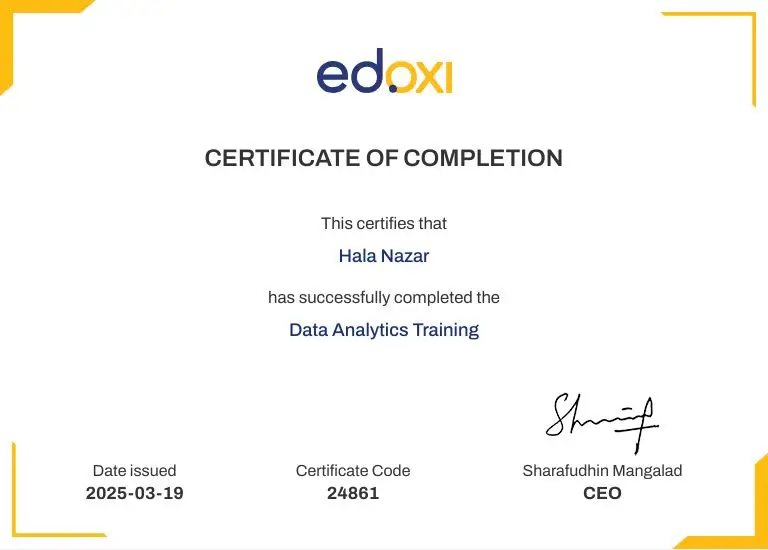
Course Completion Certification

Validate your Python skills with an official course completion certificate from Edoxi, enhancing your professional credibility

students-image

Edoxi is Recommended by 95% of our Students

Meet Our Mentor

Our mentors are leaders and experts in their fields. They can challenge and guide you on your road to success!

mentor-image

Afreen M

Afreen, with four years of dedicated teaching experience, has successfully trained over 100 students in programming languages like Python, SQL, and Java. She combines her technical expertise with a passion for education, tailoring her instruction to suit the unique needs of young learners. Her interests in reading and working on coding projects help her design engaging and practical learning experiences for her students.

Afreen’s teaching philosophy emphasizes hands-on learning, guiding children through projects like game development and calculator applications. Her balanced approach helps students build confidence in technology while mastering essential programming skills. By staying actively engaged with personal coding projects, she ensures her teaching remains current, practical, and effective, creating an encouraging environment where children can explore and understand coding concepts with ease.

Locations Where Edoxi Offers Python Course

Here is the list of other major locations where Edoxi offers Python Course

FAQ

Can I develop a robot after learning the Python programming course in Riyadh?
Yes, to some extent. We teach Python fundamentals. You'll need additional robotics libraries for complete robot development.
Can I create a website after learning the Python programming course in Riyadh?

Yes, to some extent. You'll need additional frameworks like Django or Flask. HTML, CSS, and JavaScript knowledge is also required.

Can I develop Games after learning the Python programming course in Riyadh?
Yes, to some extent. The course covers fundamentals. Game development requires additional Python gaming libraries.
Do I need programming experience to start the beginner course in Riyadh?

No programming experience needed for the Python Beginner course. Basic computer knowledge is enough to start.

Can I join the Python Advanced course in Riyadh directly?
Yes, you can. You need basic Python knowledge. Complete our beginner course or show equivalent Python skills.
What industries hire professionals with Python skills in Saudi Arabia?
Python is in demand across industries like IT, finance, healthcare, oil and gas, telecommunications, and education.
What are the prerequisites needed to join Edoxi’s Python Course in Riyadh?

For Beginner Level:

    • Basic computer knowledge
    • No programming experience required

For Advanced Level:

    • Completion of the Python Beginner course or equivalent knowledge
    • Understanding of basic Python syntax and control structures
    • Familiarity with fundamental programming concepts
What is the average monthly salary for Python Developers in Riyadh?
Python developers can expect to earn an average monthly salary ranging from SAR 15,000 to SAR 20,000 in Riyadh, Saudi Arabia. Highly experienced professionals often earn more than SAR 25,000. Entry-level positions typically start at around SAR 14,000, while senior developers with over 8 years of experience frequently command salaries of approximately SAR 25,000 per month.