Request a Callback

+971 4380 1666
 Sep 25, 2026
|
Quick Answer: What Is ChatGPT and How Does It Work? ChatGPT is an AI assistant developed by OpenAI. It is designed to understand instructions and generate responses in a conversational format. ChatGPT works by:
|
Artificial intelligence has moved from research labs into everyday life. One of the most visible examples is ChatGPT, an AI assistant that can answer questions, explain concepts, summarise information, write content, help with coding, analyse files, and support many other tasks. Today, roughly 10% of the global adult population (and ~16% of the global population across all generative AI tools) uses ChatGPT regularly, accounting for over 1 billion weekly active users (Instant Press).
But how does ChatGPT actually produce a response that sounds human? The answer involves several technologies, including artificial intelligence (AI), machine learning, deep learning, natural language processing (NLP), neural networks, transformer architecture, large language models (LLMs), tokenisation, and next-token prediction.
This guide explains how ChatGPT works in simple terms. It also covers how it is trained, what it can do, where it can make mistakes, and how you can use it effectively.
ChatGPT is an artificial intelligence-based service developed by OpenAI. It is designed to interact with users through conversation and follow instructions provided in a prompt. ChatGPT was publicly introduced by OpenAI on November 30, 2022, as a research preview. Its conversational format was designed to support follow-up questions and dialogue. You can use ChatGPT for tasks such as:
OpenAI describes ChatGPT as an AI assistant that can help with everyday tasks, including writing, studying, planning, mathematics, coding, and analysing files and images. ChatGPT training involves using machine learning techniques to help models learn patterns in language and information, enabling them to generate relevant and useful responses based on user prompts and conversational context.
If you want to understand the wider technology behind ChatGPT, our guide on what generative AI is and how it works provides additional context.
No. ChatGPT and a traditional search engine work differently. A search engine primarily helps you find information from indexed web pages. ChatGPT generates responses using an AI model. However, ChatGPT can also have web-search capabilities in supported experiences. When web search is used, it can retrieve current information and provide citations.
This distinction matters because an AI-generated answer should not automatically be treated as a verified source of current information. For users looking to build practical skills in using AI tools, an AI Course can also provide structured learning on how AI systems work, how to use them effectively, and when to verify their outputs.
The name ChatGPT combines “Chat” with GPT, the name used for a family of generative AI models. GPT is commonly expanded as Generative Pre-trained Transformer. The important term here is Transformer. It refers to a neural-network architecture that is highly effective at processing relationships between elements in sequences, including language.
The name “ChatGPT” reflects its conversational purpose and the underlying GPT model technology. Today, ChatGPT is used across many industries and business functions. You can explore broader examples in our guide to the top 10 artificial intelligence applications.
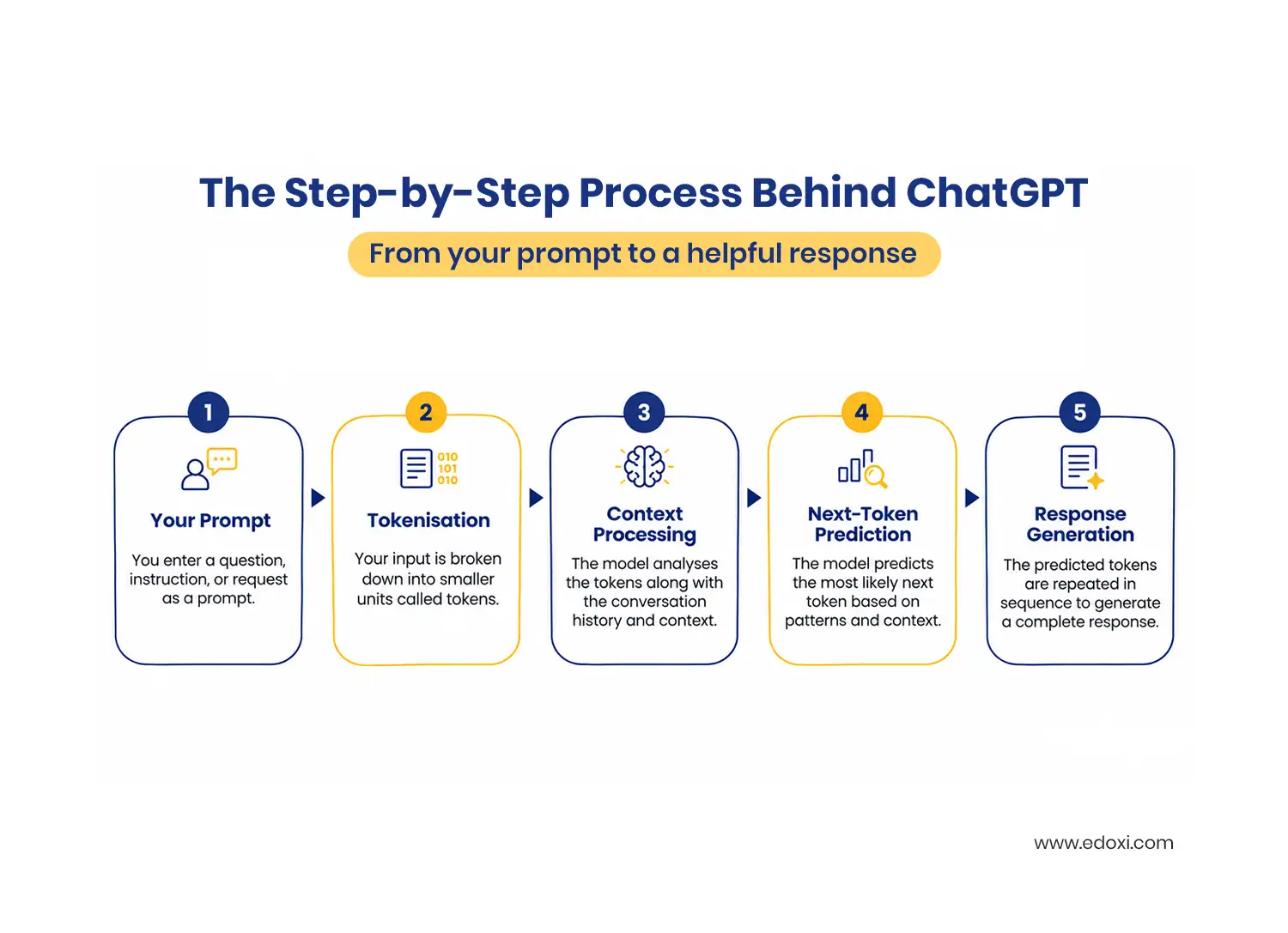
To understand how ChatGPT works, it helps to break the process into several stages.
Everything begins with your prompt. A prompt can be a question, instruction, request, or description.
For example:
“Explain photosynthesis to a 10-year-old”
ChatGPT analyses the words in your prompt along with relevant conversation context. The clearer your prompt is, the easier it is for the model to understand what you want. If you want to thrive in this field, a Prompt Engineering Training can help you learn how to structure clear, specific, and effective prompts to get more relevant and accurate responses from AI tools.
Before a language model processes text, the text is converted into tokens.
A token can represent:
For example, a long word may be divided into multiple tokens. Tokenisation allows the model to process language in a numerical format that its neural network can work with.
ChatGPT does not treat every word in isolation. It considers relationships between tokens and the surrounding context. This helps it interpret what you mean and produce a relevant response.
For example, the meaning of a word can change depending on the sentence around it. This ability to use context is an important part of modern natural language processing (NLP).
The transformer architecture is a core technology behind modern language models. Transformers use mechanisms that allow models to consider relationships between tokens in a sequence. This helps the model determine which parts of the input are important when generating an answer.
This is one reason a language model can handle longer and more complex instructions than a simple rule-based chatbot.
One of the most important ideas behind a language model is next-token prediction. The model estimates which token is most appropriate to generate next based on the information available in the context.
It then generates another token. This process continues until the response is complete. OpenAI explains that its models learn relationships within training data and use those patterns to predict the next most likely word when generating a response.
Although this sounds simple, performing this prediction across a very large neural network allows the model to produce sophisticated language.
When you send a prompt, the trained model is used to produce an answer. This stage is known as inference. During inference, the model applies what it learned during training to your current input. The model is not being fully retrained every time you ask a question. Instead, it uses its existing parameters and the context available in the conversation to generate the response.
A large language model (LLM) is a type of AI model trained to work with language at a large scale. LLMs learn statistical patterns and relationships from training data. They can then use those patterns to generate and transform text. ChatGPT is powered by OpenAI models that belong to this broader category of foundation and language models. The scale of these models allows them to perform many different language-related tasks without requiring a separate traditional program for every task.
Training a modern AI model involves multiple stages. OpenAI states that its foundation models are developed using three primary sources of information:
OpenAI also describes several stages in model development, including training data preparation, pre-training, post-training, evaluation, and ongoing improvement.
During pre-training, a model processes large amounts of information. The model learns patterns in the data. It does not learn by memorising a simple list of questions and answers.
Instead, the training process adjusts the model's parameters so it becomes better at predicting tokens and recognising relationships in the training data. This is a major application of machine learning.
ChatGPT's underlying models use deep learning, a branch of machine learning based on neural networks. A neural network contains many interconnected mathematical operations. During training, their parameters are adjusted to improve performance. Large language models contain a very large number of parameters. These parameters help encode patterns learned during training.
If you are interested in developing expertise in this field, our guide on how to build a career in artificial intelligence explains some of the skills and career paths associated with AI.
Pre-training is only part of the process. Models can undergo post-training to improve how they respond to instructions and behave in conversations.
Human trainers and researchers can contribute to this process by providing examples, feedback, evaluations, and other signals that help improve model behaviour. The goal is not only to produce fluent text. It is also to make responses more useful, aligned with instructions, and safer.
Natural language processing (NLP) is the field of AI concerned with enabling computers to work with human language. ChatGPT uses language-model technology to process prompts and generate natural-language responses. NLP-related capabilities can include:
Modern generative AI systems combine NLP with deep learning and large-scale neural networks to perform these tasks.
ChatGPT can support a wide range of activities, including;
You can use ChatGPT to:
It can be useful for students, professionals, marketers, researchers, developers, and business teams.
ChatGPT can assist with:
However, generated code should be reviewed and tested before being used in production. AI, along with ChatGPT, is also changing how IT teams work. Our guide on how AI will transform the IT industry explores some of these changes in more detail.
ChatGPT can help organise information, compare concepts, summarise material, and support research workflows. When current information is required, use a web-search capability or verify important facts against authoritative sources.
In supported experiences, ChatGPT can work with uploaded files and images. OpenAI lists file and image analysis among ChatGPT's capabilities. This can be useful for tasks such as summarizing documents, extracting information, or interpreting visual material.
ChatGPT can provide several practical benefits, including;
You can also learn more about practical workplace applications in our guide on how to utilise AI to increase employee productivity.
ChatGPT is powerful, but it is not infallible.
An AI hallucination occurs when a model produces information that sounds convincing but is incorrect, unsupported, or fabricated. This is one of the most important limitations to understand. A fluent response is not proof that the information is accurate.
The model can misunderstand a question or make reasoning errors. For important decisions, verify the output with reliable sources or qualified professionals.
AI models have limitations around what they know directly from training. Current information may require a web search or another up-to-date source.
A model can only process a certain amount of information within its available context. Very large or complicated inputs may require careful organisation.
Users can mistake confident language for certainty. A better approach is to treat ChatGPT as an assistant rather than an unquestionable authority.
For a wider discussion of AI's strengths and weaknesses, see the advantages and disadvantages of AI.
ChatGPT can provide highly useful answers, but accuracy is not guaranteed. Its reliability depends on factors such as:
For low-risk tasks, ChatGPT can be a useful productivity tool. For high-stakes topics such as medical, legal, financial, academic, or professional decisions, verify important claims with authoritative sources.
ChatGPT includes safety and privacy controls, but users should still use good data-security practices. OpenAI provides Data Controls that allow users to choose whether their conversations are used to improve models. Users can also export their data and delete their accounts.
OpenAI also provides Temporary Chat. According to OpenAI, Temporary Chats do not appear in chat history, do not create memories, and are not used to train models. They are retained for a limited period for safety purposes.
You should still avoid entering passwords, confidential business information, financial credentials, or other sensitive information unless you understand the relevant privacy settings and policies.
Read more about the impact of artificial intelligence on HR roles.
ChatGPT and search engines can both help you find information, but they serve different purposes.
| ChatGPT |
Traditional Search Engine
|
| Generates conversational responses |
Primarily finds relevant web pages
|
| Can follow instructions |
Primarily matches searches with indexed content
|
| Can rewrite and summarise content |
Provides links to sources
|
| Can maintain conversational context |
Usually treats each search as a separate query
|
| Can assist with creative and technical tasks |
Strong for discovering current web information
|
The distinction is becoming less absolute because modern AI assistants can also use web search. The best choice depends on your goal. Learn AI Tools to choose the right tools for specific tasks and workflows.
You can get better results by writing better prompts.
Instead of:
Write about marketing.
Try:
Explain five digital marketing strategies for a small online business. Use simple language and give one example for each strategy.
Tell ChatGPT who the audience is, what the goal is, and what format you need.
Specify ConstraintsYou can specify:
You do not always need to create a new prompt. You can refine the response by asking ChatGPT to explain, shorten, expand, compare, or revise it. OpenAI specifically notes that ChatGPT can handle follow-up questions within a conversation.
For important work, check factual claims against primary or authoritative sources. This is especially important when the answer involves current statistics, laws, regulations, financial information, or scientific claims.
Generative AI is developing beyond simple text generation. AI assistants are increasingly being designed to work across different types of information and tools. These capabilities can include text, images, audio, files, web information, software tools, and multi-step workflows.
OpenAI describes its current foundation models as supporting tasks that extend beyond text, including image analysis and generation and multi-step tasks across tools. The broader direction of generative AI is toward systems that can understand instructions, work across multiple data types, use external tools, and assist with increasingly complex tasks. At the same time, accuracy, transparency, privacy, security, and AI safety will remain important challenges.
For a deeper discussion, see the 10 jobs most at risk of being replaced by AI and whether artificial intelligence will take over human jobs by 2030.
ChatGPT is an AI assistant powered by advanced language models. It uses machine learning, deep learning, neural networks, transformer architecture, tokenisation, and next-token prediction to generate responses.
The basic process is easier to understand when broken down:
Your prompt → tokenisation → context processing → model prediction → response generation.
Behind this process is extensive model training and post-training designed to improve capability, usefulness, and safety. For you as a user, the most important point is simple: ChatGPT is a powerful AI assistant, not an infallible source of truth. Use it to generate ideas, explain concepts, analyse information, and improve productivity. For important claims and decisions, verify the information independently. Or get AI Training to develop the judgment needed to use AI responsibly in workplace settings.
Here is the list of other major locations where Edoxi offers Artificial Intelligence Course
Artificial Intelligence Course in Dubai|Artificial Intelligence Course in Qatar