Leave your message to get our quick response
edoxi automated message icon

Certified Ethical Hacker Course in Riyadh

Cybersecurity professional coding on multiple screens for ethical hacking and network security
Edoxi’s 40-hour Certified Ethical Hacker (CEH) Training in Riyadh equips you with practical cybersecurity skills through a hands-on learning approach using the EC-Council iLab platform. Gain real-world experience with AI-powered ethical hacking tools such as ShellGPT, ChatGPT, WormGPT, FraudGPT, and DeepExploit to automate security testing, detect advanced threats, and respond to cyber incidents effectively. Aligned with EC-Council’s latest official syllabus, the course prepares you for globally recognised CEH certification and in-demand cybersecurity roles. Enrol now and advance your career in ethical hacking.
 
Course Duration
40 Hours
Corporate Days
5 Days
Learners Enrolled
200+
Modules
20
star-rating-icon1
star-rating-icon2
star-rating-icon3
Course Rating
5
star-rating-5
Mode of Delivery
Online
Classroom
Certification by

What Do You Learn from Our Certified Ethical Hacker Training in Riyadh

Ethical Hacking Fundamentals with AI Integration
Learn the cyber kill chain and MITRE ATT&CK framework. You also gain practical experience using tools like ShellGPT and FraudGPT.
Advanced Scanning and Vulnerability Assessment
Master network scanning and enumeration techniques to improve vulnerability detection and analysis.
System and Network Attack Techniques
Develop expertise in hacking, malware analysis, and sniffing. You also learn to automate threat detection for better efficiency.
Web Application and Cloud Security
Learn to secure web applications, cloud environments, and databases. You also learn to enhance defences by analysing attack patterns.
Mobile and IoT Security
Learn to strengthen security for mobile platforms and IoT devices with advanced assessment techniques.
Modern Security Technologies
Get hands-on with cryptography, wireless security, and next-generation AI-powered tools.

About Our CEH Certification Course in Riyadh

Edoxi’s 40-hour Certified Ethical Hacker training in Riyadh is designed for IT professionals and cybersecurity aspirants who want to build strong, practical skills in ethical hacking and cyber defence. As an EC-Council Accredited Training Centre, Edoxi delivers a structured, lab-intensive programme aligned with EC-Council’s latest official curriculum. The course combines core ethical hacking concepts with real-world simulations, enabling learners to understand both offensive and defensive cybersecurity strategies in line with current industry demands. We also provide a customised CEH corporate training format to empower organisations with performance-driven cybersecurity teams.

The training follows a practice-driven approach using EC-Council’s iLab platform, where learners work on unpatched systems and vulnerable applications in a controlled environment. The curriculum also integrates advanced AI-powered tools such as ShellGPT, ChatGPT, WormGPT, FraudGPT, and DeepExploit to enhance penetration testing, threat analysis, vulnerability assessment, and incident response capabilities. You gain hands-on experience across the five phases of ethical hacking: Reconnaissance, Vulnerability Scanning, Gaining Access, Maintaining Access, and Clearing Tracks, while performing guided exercises that reflect real cyberattack scenarios. 
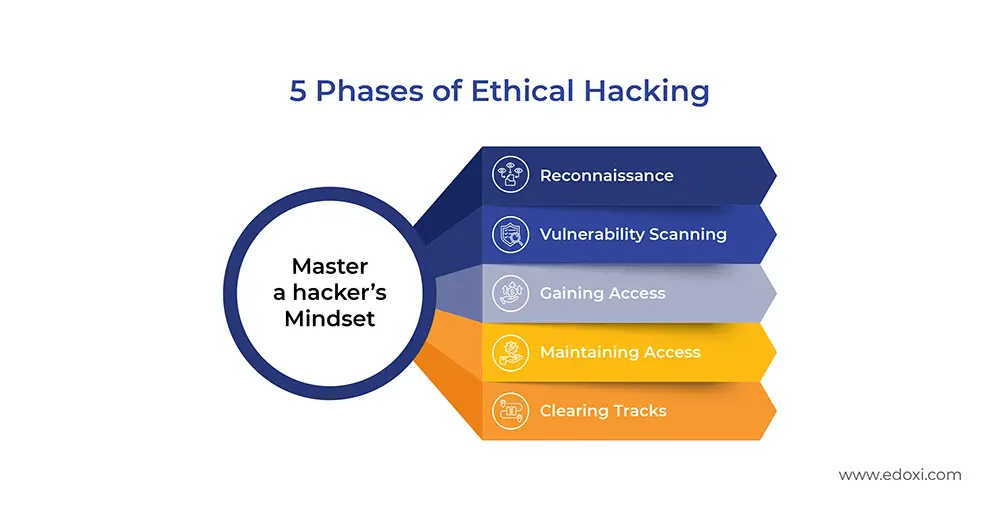
The image given above illustrates the 5 core phases of ethical hacking.

AI Tools and Their Application in Ethical Hacking

Our CEH v13 training in Riyadh integrates advanced AI tools from EC-Council’s latest CEH v13 curriculum, enhancing your ethical hacking expertise.

AI Tool Application in Ethical Hacking
ShellGPT • Command-line automation for penetration testing
• Rapid exploit development
• Automated security assessment workflows
ChatGPT • Security report generation
• Threat intelligence analysis
• Code vulnerability assessment
FraudGPT • Advanced social engineering detection
• Fraud pattern recognition
• Automated threat modelling
WormGPT • Malware behaviour analysis
• Automated vulnerability scanning
• Security control testing
DeepExploit • Zero-day vulnerability discovery
• Exploit automation
• Advanced penetration testing

Industry Application of the CEH v13 Course

Industry Sector Security Focus Areas Practical Applications
Information Technology - AI-powered penetration testing
- Advanced malware detection
- Automate network security protocols.
- Detect malware in real time.
Oil & Gas - OT/ICS security
- APT protection
- Secure ICS and SCADA systems.
- Mitigate APT risks effectively.
Financial Services - Payment gateway security
- Compliance frameworks (PCI DSS, GDPR)
- Ensure PCI DSS and GDPR compliance.
- Prevent fraud with AI tools.
Healthcare - Medical IoT security
- Patient data protection
- Safeguard EHRs and connected devices.
- Address IoT vulnerabilities.
E-Commerce - Transaction security
- DDoS protection
- Secure payments with encryption.
- Prevent DDoS attacks.
Government - Critical infrastructure protection
- Classified data protection
- Protect infrastructure and sensitive data.
- Use PKI encryption for access control.
Edoxi’s CEH v13 training in Riyadh empowers professionals to tackle industry-specific cybersecurity challenges with advanced AI tools and technologies. By completing this CEH course in Riyadh, you can be fully prepared to apply ethical hacking techniques across diverse industries. You can gain the skills to secure networks, applications, and critical infrastructure using AI-driven cybersecurity methods, while also being ready to attempt the official CEH v13 exam, as detailed in the table below.


EC-Council’s CEH v13 Exam Details

The table below shows the CEH v13 exam details that you need to know. 

Component Knowledge-Based Exam Practical Exam (Optional)
Exam Code 312-50 (ECC/VUE) Via ASPEN iLabs
Duration 4 hours 6 hours
Format 125 multiple-choice questions Hands-on practical assessments
Passing Criteria 60%–85% (varies by question weight)
At least 50% of practicals have been completed
Certification CEH v13 CEH Master designation
Validity 3 years 3 years
Recertification 120 CECs or retake the exam 120 CECs or retake the exam

For more information regarding the Certified Ethical Hacker course fee and enrollment, contact us.  


Key Features of Edoxi's CEH Training

Cloud-Based Practice Environment

Practice on EC-Council's iLab platform with live networks and real vulnerabilities in a secure setting.

Real-World Cybersecurity Simulations

Engage in scenarios replicating threats like APTs, malware, and network breaches to develop practical skills.

Hands-On Labs with Advanced Tools

Complete structured exercises like password cracking and exploit testing. You also use AI-powered tools for tasks such as vulnerability scanning and malware analysis.

Role-Based Security Training

Learn attacker and defender methodologies to secure systems and mitigate threats effectively.

Case Studies and Incident Analysis

Analyse notable cyberattacks to understand vulnerabilities, attack vectors, and response strategies.

Threat Detection and Response Skills

Learn to identify, analyse, and respond to cybersecurity incidents using advanced tools and methodologies.

Who Can Join Our CEH v13 Course in Riyadh?

IT Professionals and System Administrators

Network administrators, system engineers, or IT infrastructure specialists who want to enhance their career with advanced ethical hacking and AI-driven security skills.

Cybersecurity Analysts and Enthusiasts

Security analysts, ethical hackers, and cybersecurity specialists who want to upgrade their expertise with the latest AI-powered tools and techniques.

Students and Fresh Graduates

Individuals with basic IT knowledge and an interest in cybersecurity who want to build a strong foundation for a career in ethical hacking.

Career Changers

Professionals interested in transitioning to cybersecurity who want to develop essential skills and industry-recognised credentials through this comprehensive program.

Software Engineers and Developers

Technical professionals working in software development who want to expand their security expertise to build and maintain secure applications.

IT Auditors and Compliance Professionals

Individuals responsible for security audits and compliance, who want to gain hands-on technical skills for more effective security assessments.

CEH Course Modules

Module 1: Introduction to Ethical Hacking
  • Chapter 1.1: Fundamentals of Information Security

    • Lesson 1.1.1: Elements of Information Security
    • Lesson 1.1.2: Classification of Attacks
    • Lesson 1.1.3: Hacker Classes and Their Roles
  • Chapter 1.2: Ethical Hacking Essentials

    • Lesson 1.2.1: Definition and Scope of Ethical Hacking
    • Lesson 1.2.2: CEH Ethical Hacking Framework
    • Lesson 1.2.3: Cyber Kill Chain Methodology
    • Lesson 1.2.4: MITRE ATT&CK Framework
  • Chapter 1.3: AI and Ethical Hacking

    • Lesson 1.3.1: AI-Driven Ethical Hacking
    • Lesson 1.3.2: ChatGPT-Powered AI Tools for Ethical Hackers
  • Chapter 1.4: Legal and Regulatory Frameworks

    • Lesson 1.4.1: Information Assurance (IA) and Risk Management
    • Lesson 1.4.2: Threat Intelligence Lifecycle and Incident Management
    • Lesson 1.4.3: Compliance Standards: PCI DSS, HIPAA, SOX, GDPR, DPA
Module 2: Footprinting and Reconnaissance
  • Chapter 2.1: Fundamentals of Reconnaissance

    • Lesson 2.1.1: Understanding Reconnaissance and Its Importance
    • Lesson 2.1.2: Footprinting Using Advanced Google Hacking Techniques
  • Chapter 2.2: Advanced Footprinting Techniques

    • Lesson 2.2.1: Footprinting Through People Search Services
    • Lesson 2.2.2: Dark Web Footprinting
    • Lesson 2.2.3: Competitive Intelligence Gathering
    • Lesson 2.2.4: Footprinting Through Social Networking Sites
  • Chapter 2.3: Technical Footprinting Methods

    • Lesson 2.3.1: Whois Lookup and DNS Footprinting
    • Lesson 2.3.2: Traceroute Analysis
    • Lesson 2.3.3: Email Footprinting
  • Chapter 2.4: Social Engineering and AI-Powered Tools

    • Lesson 2.4.1: Footprinting Through Social Engineering
    • Lesson 2.4.2: AI-Powered OSINT Tools
Module 3: Scanning Networks
  • Chapter 3.1: Fundamentals of Network Scanning

    • Lesson 3.1.1: Overview of Network Scanning
    • Lesson 3.1.2: Host Discovery Techniques
    • Lesson 3.1.3: Port Scanning Techniques
  • Chapter 3.2: Advanced Scanning Techniques

    • Lesson 3.2.1: Service Version Discovery
    • Lesson 3.2.2: OS Discovery and Banner Grabbing
    • Lesson 3.2.3: Scanning Beyond IDS and Firewalls
  • Chapter 3.3: AI-Driven Scanning

    • Lesson 3.3.1: Host Discovery and Port Scanning with AI
    • Lesson 3.3.2: AI-Powered Tools for Enhanced Scanning
  • Chapter 3.4: Countermeasures and Defence Mechanisms

    • Lesson 3.4.1: Scanning Detection Techniques
    • Lesson 3.4.2: Scanning Prevention Methods
Module 4: Enumeration
  • Chapter 4.1: Fundamentals of Enumeration

    • Lesson 4.1.1: What is Enumeration and Its Importance
    • Lesson 4.1.2: Types of Enumeration Techniques
  • Chapter 4.2: Network Enumeration Techniques

    • Lesson 4.2.1: NetBIOS Enumeration
    • Lesson 4.2.2: SNMP and LDAP Enumeration
    • Lesson 4.2.3: NTP and NFS Enumeration
  • Chapter 4.3: Advanced Enumeration Methods

    • Lesson 4.3.1: DNS Cache Snooping and DNSSEC Zone Walking
    • Lesson 4.3.2: IPsec and VoIP Enumeration
    • Lesson 4.3.3: RPC and SMB Enumeration
    • Lesson 4.3.4: Unix/Linux User Enumeration
  • Chapter 4.4: AI and Enumeration

    • Lesson 4.4.1: Enumeration Using AI-Powered Tools
    • Lesson 4.4.2: Enumeration Countermeasures
Module 5: Vulnerability Analysis
  • Chapter 5.1: Introduction to Vulnerability Analysis

    • Lesson 5.1.1: Understanding Vulnerability Classification
    • Lesson 5.1.2: Vulnerability Scoring Systems and Databases
    • Lesson 5.1.3: Vulnerability-Management Life Cycle
  • Chapter 5.2: Vulnerability Research and Scanning

    • Lesson 5.2.1: Conducting Vulnerability Research
    • Lesson 5.2.2: Vulnerability Scanning and Analysis
    • Lesson 5.2.3: Common Vulnerability Assessment Tools
  • Chapter 5.3: AI-Powered Vulnerability Analysis

    • Lesson 5.3.1: Using AI to Identify Vulnerabilities
    • Lesson 5.3.2: AI-Powered Vulnerability Assessment Tools
  • Chapter 5.4: Reporting and Mitigation

    • Lesson 5.4.1: Crafting Vulnerability Assessment Reports
    • Lesson 5.4.2: Implementing Vulnerability Mitigation Strategies
Module 6: System Hacking
  • Chapter 6.1: Fundamentals of System Hacking

    • Lesson 6.1.1: Password Cracking Techniques
    • Lesson 6.1.2: Vulnerability Exploitation
    • Lesson 6.1.3: Metasploit Framework Basics
  • Chapter 6.2: Advanced Hacking Techniques

    • Lesson 6.2.1: Buffer Overflow Exploitation and Detection
    • Lesson 6.2.2: Active Directory Enumeration
    • Lesson 6.2.3: Privilege Escalation Techniques
  • Chapter 6.3: Steganography and Track Covering

    • Lesson 6.3.1: Hiding Data Using Steganography
    • Lesson 6.3.2: Detecting Steganography
    • Lesson 6.3.3: Covering Tracks and Clearing Logs
  • Chapter 6.4: AI in System Hacking

    • Lesson 6.4.1: Exploiting Vulnerabilities with AI Tools
    • Lesson 6.4.2: AI-Assisted Track Covering Techniques
Module 7: Malware Threats
  • Chapter 7.1: Understanding Malware

    • Lesson 7.1.1: Types of Malware
    • Lesson 7.1.2: APT Lifecycle
    • Lesson 7.1.3: Fileless Malware
  • Chapter 7.2: Malware Analysis

    • Lesson 7.2.1: Static Malware Analysis
    • Lesson 7.2.2: Dynamic Malware Analysis
    • Lesson 7.2.3: Malware Detection Techniques
  • Chapter 7.3: AI and Malware

    • Lesson 7.3.1: AI-Based Malware Detection
    • Lesson 7.3.2: AI for Malware Defence
  • Chapter 7.4: Malware Countermeasures

    • Lesson 7.4.1: Anti-Trojan and Ransomware Defence
    • Lesson 7.4.2: Malware Prevention Best Practices
Module 8: Sniffing
  • Chapter 8.1: Basics of Network Sniffing

    • Lesson 8.1.1: What is Sniffing
    • Lesson 8.1.2: Passive and Active Sniffing
  • Chapter 8.2: Sniffing Techniques

    • Lesson 8.2.1: MAC Flooding and ARP Poisoning
    • Lesson 8.2.2: DHCP Starvation
    • Lesson 8.2.3: VLAN Hopping and STP Attacks
  • Chapter 8.3: Advanced Sniffing and AI

    • Lesson 8.3.1: DNS Poisoning
    • Lesson 8.3.2: AI-Powered Sniffing Tools
    • Lesson 8.3.3: Sniffer Detection Techniques
  • Chapter 8.4: Sniffing Countermeasures

    • Lesson 8.4.1: Sniffing Mitigation Strategies
    • Lesson 8.4.2: ARP Poisoning Prevention
Module 9: Social Engineering
  • Chapter 9.1: Fundamentals of Social Engineering

    • Lesson 9.1.1: Social Engineering Concepts
    • Lesson 9.1.2: Types of Social Engineering
    • Lesson 9.1.3: Human-Based Attacks
  • Chapter 9.2: Techniques and Tools

    • Lesson 9.2.1: Impersonation
    • Lesson 9.2.2: Computer-Based Social Engineering
    • Lesson 9.2.3: Phishing Techniques
  • Chapter 9.3: AI-Driven Social Engineering

    • Lesson 9.3.1: AI Impersonation
    • Lesson 9.3.2: AI-Based Phishing
  • Chapter 9.4: Countermeasures

    • Lesson 9.4.1: Social Engineering Prevention
    • Lesson 9.4.2: Anti-Phishing Tools
Module 10: Denial-of-Service (DoS) and Distributed Denial-of-Service (DDoS)
  • Chapter 10.1: Understanding DoS and DDoS Attacks

    • Lesson 10.1.1: What are DoS and DDoS Attacks?
    • Lesson 10.1.2: Botnets and Their Role in DDoS Attacks
    • Lesson 10.1.3: DoS/DDoS Attack Techniques
  • Chapter 10.2: Tools and Techniques for DoS/DDoS Attacks

    • Lesson 10.2.1: DoS/DDoS Attack Toolkits
    • Lesson 10.2.2: Advanced Techniques for Launching DoS/DDoS Attacks
    • Lesson 10.2.3: AI-Powered Analysis of DoS/DDoS Attack Patterns
  • Chapter 10.3: Detection and Mitigation

    • Lesson 10.3.1: DoS/DDoS Detection Techniques
    • Lesson 10.3.2: Tools and Services for Protecting Against DoS/DDoS
    • Lesson 10.3.3: Best Practices for Mitigating DoS/DDoS Threats
Module 11: Session Hijacking
  • Chapter 11.1: Fundamentals of Session Hijacking

    • Lesson 11.1.1: What is Session Hijacking?
    • Lesson 11.1.2: Application-Level Session Hijacking
    • Lesson 11.1.3: Network-Level Session Hijacking
  • Chapter 11.2: Techniques for Session Hijacking

    • Lesson 11.2.1: TCP/IP Hijacking
    • Lesson 11.2.2: RST Hijacking
    • Lesson 11.2.3: Blind Hijacking
    • Lesson 11.2.4: Compromising Session IDs
  • Chapter 11.3: Tools and AI in Session Hijacking

    • Lesson 11.3.1: Session Hijacking Tools and Their Use
    • Lesson 11.3.2: Detecting and Preventing Session Hijacking with AI
  • Chapter 11.4: Countermeasures Against Session Hijacking

    • Lesson 11.4.1: Session Hijacking Detection Methods
    • Lesson 11.4.2: Implementing Countermeasures and Best Practices
Module 12: Evading IDS, Firewalls, and Honeypots
  • Chapter 12.1: Understanding Security Mechanisms

    • Lesson 12.1.1: Overview of Intrusion Detection Systems (IDS) and Intrusion Prevention Systems (IPS)
    • Lesson 12.1.2: Types and Functions of Firewalls
    • Lesson 12.1.3: Honeypots and Their Role in Network Security
  • Chapter 12.2: Evasion Techniques

    • Lesson 12.2.1: IDS/Firewall Evasion Techniques
    • Lesson 12.2.2: NAC and Endpoint Security Evasion Techniques
    • Lesson 12.2.3: Advanced Tunnelling and Packet Manipulation Methods
  • Chapter 12.3: Tools and Techniques

    • Lesson 12.3.1: IDS/Firewall Evading Tools
    • Lesson 12.3.2: Honeypot Detection and Bypassing
    • Lesson 12.3.3: Using AI for Advanced Evasion Strategies
  • Chapter 12.4: Countermeasures and Security Strategies

    • Lesson 12.4.1: Intrusion Detection and Prevention Tools
    • Lesson 12.4.2: Honeypot Deployment and Monitoring
    • Lesson 12.4.3: Strengthening Firewalls Against Advanced Threats
Module 13: Hacking Web Servers
  • Chapter 13.1: Introduction to Web Server Hacking

    • Lesson 13.1.1: Web Server Architecture and Components
    • Lesson 13.1.2: Common Web Server Vulnerabilities
    • Lesson 13.1.3: Web Server Attack Methodologies
  • Chapter 13.2: Techniques for Web Server Hacking

    • Lesson 13.2.1: DNS Server Hijacking and Web Cache Poisoning
    • Lesson 13.2.2: Web Server Footprinting and Banner Grabbing
    • Lesson 13.2.3: Directory Brute Forcing and Vulnerability Scanning
  • Chapter 13.3: Tools and AI Integration

    • Lesson 13.3.1: Tools for Web Server Attacks
    • Lesson 13.3.2: AI-Powered Methods for Web Server Exploitation
    • Lesson 13.3.3: Automated Web Server Attack Detection
  • Chapter 13.4: Web Server Security

    • Lesson 13.4.1: Web Server Security Best Practices
    • Lesson 13.4.2: Countermeasures for Web Server Attacks
    • Lesson 13.4.3: Web Server Security Testing Tools
Module 14: Hacking Web Applications
  • Chapter 14.1: Introduction to Web Application Security

    • Lesson 14.1.1: Overview of Web Applications
    • Lesson 14.1.2: OWASP Top 10 Application Security Risks (2021)
    • Lesson 14.1.3: Web Application Attack Methodologies
  • Chapter 14.2: Web Application Hacking Techniques

    • Lesson 14.2.1: Footprinting Web Infrastructure
    • Lesson 14.2.2:Analysingg and Bypassing Client-Side Controls
    • Lesson 14.2.3: Attacking Access Controls and Web Services
  • Chapter 14.3: Advanced Web Application Exploits

    • Lesson 14.3.1: Web API Hacking Methodology
    • Lesson 14.3.2: Web Application Fuzz Testing and Encoding Schemes
    • Lesson 14.3.3: API Security Risks and Solutions
  • Chapter 14.4: Web Application Security and Countermeasures

    • Lesson 14.4.1: Web Application Security Testing Tools
    • Lesson 14.4.2: Countermeasures for Web Application Attacks
    • Lesson 14.4.3: Best Practices for Web Application Security
Module 15: SQL Injection
  • Chapter 15.1: Fundamentals of SQL Injection

    • Lesson 15.1.1: Understanding SQL Injection
    • Lesson 15.1.2: Types of SQL Injection Attacks
  • Chapter 15.2: SQL Injection Methodologies

    • Lesson 15.2.1: Information Gathering and Vulnerability Detection
    • Lesson 15.2.2: Launching SQL Injection Attacks
    • Lesson 15.2.3: Advanced SQL Injection Techniques
  • Chapter 15.3: Tools and AI in SQL Injection

    • Lesson 15.3.1: SQL Injection Tools and Their Applications
    • Lesson 15.3.2: Using AI to Identify and Exploit SQL Injection Vulnerabilities
    • Lesson 15.3.3: Evasion Techniques in SQL Injection
  • Chapter 15.4: Countermeasures Against SQL Injection

    • Lesson 15.4.1: SQL Injection Detection Tools
    • Lesson 15.4.2: Implementing SQL Injection Countermeasures
    • Lesson 15.4.3: Securing Databases Against SQL Injection
Module 16: Hacking Wireless Networks
  • Chapter 16.1: Fundamentals of Wireless Networks

    • Lesson 16.1.1: Understanding Wireless Network Standards and Protocols
    • Lesson 16.1.2: Types of Wireless Encryption
    • Lesson 16.1.3: Wireless Network Threats and Vulnerabilities
  • Chapter 16.2: Wireless Hacking Methodologies

    • Lesson 16.2.1: Wi-Fi Discovery and Wireless Traffic Analysis
    • Lesson 16.2.2: Cracking Wi-Fi Encryption (WEP/WPA/WPA2)
    • Lesson 16.2.3: Creating Rogue Access Points for Exploitation
  • Chapter 16.3: Tools and Techniques for Wireless Attacks

    • Lesson 16.3.1: Wireless Hacking Tools and Utilities
    • Lesson 16.3.2: Using AI for Wireless Network Analysis and Attacks
    • Lesson 16.3.3: Conducting Advanced Wireless Attacks
  • Chapter 16.4: Wireless Security Countermeasures

    • Lesson 16.4.1: Best Practices for Wireless Network Security
    • Lesson 16.4.2: Wi-Fi Security Auditing Tools
    • Lesson 16.4.3: Implementing Wireless Attack Prevention Strategies
Module 17: Hacking Mobile Platforms
  • Chapter 17.1: Mobile Platform Security Overview

    • Lesson 17.1.1: Anatomy of a Mobile Attack
    • Lesson 17.1.2: OWASP Top 10 Mobile Risks (2024)
    • Lesson 17.1.3: Mobile Threat Vectors and Vulnerabilities
  • Chapter 17.2: Android Hacking Techniques

    • Lesson 17.2.1: Exploiting Android Platforms Through ADB
    • Lesson 17.2.2: Creating Binary Payloads for Android Devices
    • Lesson 17.2.3: Hacking Android Devices Using APK Files
  • Chapter 17.3: iOS Hacking Techniques

    • Lesson 17.3.1: Jailbreaking iOS Devices
    • Lesson 17.3.2: Hacking iOS Devices with Specialised Tools
    • Lesson 17.3.3: iOS Device Security Tools and Countermeasures
  • Chapter 17.4: Mobile Security Best Practices

    • Lesson 17.4.1: Mobile Device Management (MDM) and Guidelines
    • Lesson 17.4.2: Countermeasures Against Mobile-Specific Attacks
    • Lesson 17.4.3: AI-Powered Mobile Security Tools
Module 18: IoT and OT Hacking
  • Chapter 18.1: Fundamentals of IoT and OT Security

    • Lesson 18.1.1: IoT Architecture and Protocols
    • Lesson 18.1.2: OWASP Top 10 IoT Threats
    • Lesson 18.1.3: Overview of Operational Technology (OT) and IT/OT Convergence
  • Chapter 18.2: IoT and OT Vulnerabilities

    • Lesson 18.2.1: IoT Device Vulnerabilities and Threats
    • Lesson 18.2.2: OT Technologies and Protocol Vulnerabilities
    • Lesson 18.2.3: Threats Specific to Industrial IoT (IIoT)
  • Chapter 18.3: Hacking IoT and OT Systems

    • Lesson 18.3.1: IoT Hacking Methodology
    • Lesson 18.3.2: Capturing and Analysing IoT Device Traffic
    • Lesson 18.3.3: Exploiting OT Systems and Networks
  • Chapter 18.4: Countermeasures and Security Strategies

    • Lesson 18.4.1: IoT Security Tools and Techniques
    • Lesson 18.4.2: OT Security Best Practices and Tools
    • Lesson 18.4.3: AI-Driven IoT and OT Security Solutions
Module 19: Cloud Computing
  • Chapter 19.1: Cloud Computing Fundamentals

    • Lesson 19.1.1: Cloud Computing Concepts and Models
    • Lesson 19.1.2: Introduction to Fog and Edge Computing
    • Lesson 19.1.3: Container and Serverless Technologies (Docker, Kubernetes)
  • Chapter 19.2: Cloud Security Risks and Threats

    • Lesson 19.2.1: OWASP Top 10 Cloud Security Risks
    • Lesson 19.2.2: Common Cloud Threats and Vulnerabilities
    • Lesson 19.2.3: Kubernetes and Container Vulnerabilities
  • Chapter 19.3: Hacking Cloud Environments

    • Lesson 19.3.1: Cloud Hacking Methodology
    • Lesson 19.3.2: Exploiting Open S3 Buckets and Misconfigured Policies
    • Lesson 19.3.3: Escalating IAM User Privileges
  • Chapter 19.4: Cloud Security Countermeasures

    • Lesson 19.4.1: Cloud Security Controls and Tools
    • Lesson 19.4.2: Cloud Network Security Best Practices
    • Lesson 19.4.3: AI-Powered Cloud Security Solutions
Module 20: Cryptography
  • Chapter 20.1: Cryptography Fundamentals

    • Lesson 20.1.1: Introduction to Cryptography and Cyphers
    • Lesson 20.1.2: Symmetric vs. Asymmetric Encryption Algorithms
    • Lesson 20.1.3: Message Digest Functions and Their Applications
  • Chapter 20.2: Advanced Cryptographic Techniques

    • Lesson 20.2.1: Quantum Cryptography and Blockchain
    • Lesson 20.2.2: Public Key Infrastructure (PKI) and Digital Signatures
    • Lesson 20.2.3: Encryption Techniques for Email and Disk Security
  • Chapter 20.3: Cryptanalysis and Attacks

    • Lesson 20.3.1: Cryptanalysis Methods and Tools
    • Lesson 20.3.2: Cryptographic Attacks on Blockchain and Quantum Computing
    • Lesson 20.3.3: Evasion Techniques Against Encryption
  • Chapter 20.4: Cryptography in Practice

    • Lesson 20.4.1: Implementing Secure Certificates and Self-Signed Keys
    • Lesson 20.4.2: Using AI for Cryptographic Analysis
    • Lesson 20.4.3: Cryptography Best Practices for Modern Security

Download CEH Course Brochure

Hands-On Labs and Practical Training in the CEH v13 Course in Riyadh

Edoxi’s CEH course in Riyadh offers hands-on training to master real-world security skills. Learn through interactive labs, practical exercises, and industry-relevant projects given below.

Cloud-Based Practice Environment

Get access to EC-Council's iLab platform with live networks and unpatched systems. You can also perform vulnerability analysis and penetration testing in secure, pre-configured environments.

Practical Security Exercises

Simulate real-world cybersecurity challenges, including SIEM systems management and Zero Trust Architecture implementation.

Interactive Training Scenarios

Role-play attacker and defender perspectives while analysing historical cyber-attacks. You also develop skills in threat detection and incident response.

Advanced Security Toolkit

Master tools like Nmap, Nessus, and Wireshark for network scanning. Also, learn to perform vulnerability assessments using Burp Suite, Acunetix, and OWASP ZAP.

AI-Powered Security Tools

Use advanced tools like ShellGPT for penetration testing, FraudGPT for threat detection, and DeepExploit for vulnerability assessment.

Specialised Training Projects

Complete real-world projects in penetration testing, malware analysis, cloud security, IoT assessments, and incident response.

Certified Ethical Hacker (CEH v13) Certification Outcomes and Career Opportunities in Riyadh

Edoxi’s CEH v13 training in Riyadh helps you gain hands-on cybersecurity skills and prepares you for multiple career opportunities in the field. Here are the major course outcomes. 

Course Outcome Image
Gain access to career opportunities across sectors such as IT services, finance, government, healthcare, and critical infrastructure in Saudi Arabia and globally.
Build in-demand skills in ethical hacking and AI-powered cybersecurity for roles like Ethical Hacker, SOC Analyst, and Penetration Tester.
Gain hands-on expertise in vulnerability assessment, penetration testing, web, mobile, cloud, IoT security, and AI-driven threat detection.
Accelerate career growth with high global demand, competitive salaries, and international or remote work opportunities.
Gain proficiency in industry-standard tools and platforms such as EC-Council iLabs, Nmap, Nessus, Burp Suite, and AI-powered tools like ShellGPT and FraudGPT.
Develop critical problem-solving and incident response skills, enabling you to proactively detect, analyse, and mitigate real-world cyber threats.

Career Opportunities After the CEH Certification Course in Riyadh

  • Ethical Hacker
  • Penetration Tester
  • Security Analyst
  • SOC (Security Operations Center) Analyst
  • Cybersecurity Consultant
  • Vulnerability Assessment Specialist
  • Network Security Engineer
  • Information Security Auditor
  • Threat Hunting Analyst
  • Cybersecurity Manager

Companies Hiring Certified Ethical Hackers in Riyadh

  • Saudi Aramco
  • Help AG
  • Solutions by STC (STC Group)
  • IBM Saudi Arabia
  • Elm Company
  • Zoom IT Solutions Co.
  • Looptech Co.
  • Factosecure
  • Security Matterz
  • Innovative Solutions

CEH Training Options

Classroom Training

  • 40 hours of classroom CEH V13 training

  • Instructor-led sessions with experienced trainers

  • Practical exercises in EC-Council's iLab environment

  • Small group sessions with 8-10 participants

  • Comprehensive coverage of ethical hacking concepts

  • Direct interaction with trainers for immediate feedback and clarification

Live Online Training

  • 40 hours of live online CEH V13 training

  • Real-time virtual learning with certified instructors

  • Access to cloud-based lab infrastructure

  • Interactive tool demonstrations and practical sessions

  • Flexible scheduling options for working professionals

  • Recordings of sessions for future reference

Corporate Training

  • 5-day intensive programme customised to organisational needs

  • Customisable modules and delivery formats (on-site, online, or hybrid)

  • Fly Me A Trainer option for tailored on-site training anywhere in the world

  • Full logistics handled, including venue options (hotel, client premises, or our premises)

  • Food and refreshments provided for corporate teams

Do You Want a Customised Training for CEH?

Get expert assistance in getting you CEH Course customised!

How To Get Certified in The CEH Course in Riyadh?

Here’s a four-step guide to becoming a certified CEH professional.
Do You Want to be a Certified Professional in CEH?

Join Edoxi’s CEH Course

Why Choose Edoxi for the Certified Ethical Hacker (CEH v13) Course in Riyadh?

Edoxi, the best CEH training institute in Riyadh, offers hands-on, industry-aligned cybersecurity education to help you master ethical hacking and achieve professional certifications. Here are the major reasons to choose us

Award-Winning Training Centre

Edoxi recognised as EC-Council ATC of the Year for 2023 and 2024, reflecting our commitment to delivering top-quality cybersecurity education.

CEH Exam Success Support

Edoxi guide you through structured learning, expert instruction, and hands-on practice so you can confidently pass the CEH certification exam.

Cost-Effective Certification

We provide discounted CEH exam vouchers and special rates for the practical certification exam, helping you save money while achieving your goals.

Advanced Cloud Labs

At Edoxi, you can access cloud-based labs with real-world scenarios, pre-configured security tools, and simulated vulnerabilities to gain practical experience.

Comprehensive Learning Support

We follow EC-Council’s official curriculum and enhance it with AI tools, practical exercises, and expert guidance so you can learn efficiently and effectively.

Proven Track Record

We have trained over 10,000 professionals, helping you join a community with a strong record of certification success and career growth.

students-image

Edoxi is Recommended by 95% of our Students

Meet Our Mentor

Our mentors are leaders and experts in their fields. They can challenge and guide you on your road to success!

mentor-image

Satendra K

Satendra Singh Khari is a renowned cybersecurity expert and the Chief Technology Officer at Edoxi, where he leads the CEH v13 AI program. With over 12 years of experience, he has trained more than 10,000 professionals and earned recognition in the Circle of Excellence for 2023 and 2024. Mr. Khari holds multiple industry certifications, including CISSP, CISM, CEH, CPENT, and CREST, which showcase his expertise in vulnerability assessment, penetration testing, and incident handling.

His practical insights, gained during his tenure as Head of Information Security in Malaysia, enhance the learning experience by providing students with essential technical skills and a clear path to career advancement. Recognized as a leader in his field, he has received the Internet 2.0 Outstanding Leadership Award for three consecutive years (2022-2024), reflecting his dedication to empowering the next generation of cybersecurity professionals.

FAQ

What is the Certified Ethical Hacker Certification program powered by AI?
The CEH course, also known as the Certified Ethical Hacker program, integrates AI into all phases of ethical hacking. CEH training automates tasks, improves efficiency by up to 40%, and provides extensive hands-on coverage to strengthen both defensive and offensive cybersecurity skills. Completing this CEH certification equips you with practical and industry-recognised skills.
Do I need prior ethical hacking experience to join the CEH course?
 No prior ethical hacking experience is required. Our CEH training curriculum and expert trainers guide all participants to confidently progress, whether you are a beginner or have some IT background.
What are the prerequisites for Edoxi’s CEH training in Riyadh?
To get the most from the CEH course, the following are helpful:
 
 
  • Basic IT Knowledge: Familiarity with computer systems and fundamental networking concepts.
  • Operating System Experience: Comfortable using Windows, Linux, or MacOS at a basic level.
  • Willingness to Learn: A strong interest in Cybersecurity and AI-integrated tools, along with readiness to explore new concepts. 
Why should I take CEH training from Edoxi in Riyadh?
 Edoxi is an EC-Council Accredited Training Centre offering CEH courses and CEH certification training in Riyadh. Students benefit from discounted exam vouchers, official courseware, and expert instruction. Recognised as EC-Council ATC of the Year (2023 & 2024), Edoxi ensures top-quality CEH training and certification support.
Can I pass the CEH certification exam through this training?
Yes. Our CEH course is aligned with EC-Council's exam objectives. CEH training includes hands-on labs, practice tests, and focused preparation to help you successfully achieve your Certified Ethical Hacker certification.
What skills will I develop through the CEH course?
 Through CEH training, you will gain expertise in:
 
 
  • Ethical hacking fundamentals
  • AI-powered security tools
  • Vulnerability assessment
  • System hacking
  • Web and mobile security
  • Advanced scanning techniques
What practical experience will I gain from CEH training?
 Extensive practice on EC-Council's iLab platform allows you to conduct penetration testing, analyse vulnerabilities, and work with advanced security tools. This hands-on CEH training ensures you are ready for real-world scenarios and the CEH certification exam.
How does the CEH certification process work?
 
  • Pass the CEH knowledge-based exam (312-50) with 125 multiple-choice questions in 4 hours.
  • For the CEH Master credential, complete the CEH (Practical) exam via ASPEN iLabs.
  • CEH certification is valid for three years and is renewable with 120 CECs or by retaking the exam.
What career opportunities are available after CEH training and certification?
 After completing CEH training and obtaining your Certified Ethical Hacker certification, you can start as a Junior Security Analyst or Penetration Tester and progress to roles like Security Consultant or Network Security Engineer. CEH-certified professionals are in high demand in IT, banking, government, and healthcare sectors, including Riyadh.
What is the duration of Edoxi’s CEH training program?
 The CEH course in Riyadh offers 40 hours of comprehensive CEH training, available in classroom, online, or corporate formats.
What is the average salary for a CEH-certified professional in Riyadh?
The salary of CEH-certified professionals in Riyadh is listed below. The salary may vary depending on the experience and role
 
 
  • Entry-level / Junior Security Analyst: SAR 8,000 – 12,000 per month
  • Mid-level / Penetration Tester or Security Consultant: SAR 12,000 – 20,000 per month
  • Senior / Network Security Engineer or Security Manager: SAR 20,000 – 30,000+ per month
Is the CEH certification recognised internationally?
 Yes. The Certified Ethical Hacker (CEH) credential is globally recognised and valued by organisations across cybersecurity, finance, government, healthcare, and IT sectors.
Does the CEH course include real-world hacking simulations?
Yes. CEH training includes live labs, simulated cyberattack scenarios, and real-world case exercises to build practical penetration testing and threat analysis skills.
Can working professionals manage CEH training alongside their jobs?
 Absolutely. Edoxi offers flexible weekday, weekend, and online CEH training schedules designed to suit working professionals.
What support is provided after completing the CEH training?
 Participants receive exam guidance, career mentoring, resume support, and continued learning resources to help transition into cybersecurity roles confidently.