Request a Callback

+971 43801666
 Jun 04, 2026

The average salary for internal auditors in Dubai ranges from AED 4,480 to AED 6,500 per month. Dubai’s popularity is continuing to grow for finance and accounting professionals in 2026
If you’re thinking about working in auditing or are considering relocating to the UAE, understanding the average internal auditor salary in Dubai by 2026 can help you make a well-informed decision.
This blog provides an overview of internal auditor salaries in Dubai, including salary ranges, how various factors may affect your earning potential, certifications that can help you earn more, and the outlook for the internal auditor career in Dubai.
An internal auditor is a professional individual who reviews and assesses an organisation's internal systems and processes to enhance performance and ensure the organisation operates in compliance with applicable laws, regulations, codes of ethics, and policies.
Internal auditors are employed by organisations to evaluate, review, and test financial practices and activities to identify any potential risks.
The average internal auditor salary in Dubai in 2026 depends largely on experience, qualifications, and industry.
Internal auditors in Dubai earn between AED 8,000 and AED 30,000 per month.
|
Experience Level |
Years of Experience |
Average Monthly Salary |
|
Entry-level |
0-2 years |
AED 8,000 – AED 12,000 |
|
Mid-level |
3-7 years |
AED 12,000 – AED 20,000 |
|
Senior Internal Auditor |
8+ years |
AED 20,000 – AED 30,000 |
Senior professionals working in multinational companies or financial institutions may earn even higher salaries, especially when bonuses and allowances are included.
Let’s get deep into each level of internal auditor experience and understand the key responsibilities they handle in an organisation.
The entry-level internal auditor salary in Dubai is between 8,000 and 12,000 AED per month. As a general rule, these positions are filled by people who have recently graduated from university or have less than 2 years of experience in the workforce.
Common responsibilities associated with this position include:
Most entry-level auditors start out working for either an accounting firm or the corporate finance department of a company.
Auditors with approximately three to seven years' experience generally earn between monthly salaries of AED 12,000 and AED 20,000 monthly.
At this level of experience, auditors typically handle several responsibilities, including:
Auditors working at the mid-level would typically work within industries including banking, construction, and retail.
With 8+ years of experience, senior internal auditors can expect to earn between AED 20,000 and AED 30,000 (or more based on their level of experience) per month.
The senior auditor's primary responsibility includes the following tasks:
The Big Four auditor salary in the UAE (ie, Deloitte & PwC) for senior internal auditors tends to be significantly higher than that of the respective companies.
Read More : What are the Top Career Opportunities for Internal Auditors in Dubai 2026
Salary rates can be impacted by many factors, including the type of work performed. Regulatory complexity and financial risk often influence how much an individual earns in a specific industry. Larger companies usually pay larger salaries, so that auditors who have more experience typically receive higher compensation. Smaller firms and industries with less regulation tend to pay lower salaries.
|
Industry |
Average Monthly Salary |
|
Banking & Financial Services |
AED 18,000 – AED 30,000 |
|
Oil & Gas |
AED 20,000 – AED 35,000 |
|
Big Four Accounting Firms |
AED 12,000 – AED 25,000 |
|
Government Sector |
AED 15,000 – AED 28,000 |
|
Multinational Organisations |
AED 18,000 – AED 32,000 |
Professional certifications can greatly enhance your earning potential as a professional. If you hold a certification that is internationally recognised in Dubai, employers tend to value your qualification and see it as a sign of credibility. The highly recommended certifications to increase an internal auditor's job in the UAE are:
Certified Internal Auditor (CIA): A Certified Internal Auditor (CIA) qualification from the Institute of Internal Auditors (IIA). The CIA is one of the most respected credentials for internal auditors internationally. CIA-certified professionals are typically paid an additional 15 to 30% more than their non-certified colleagues.
Association of Chartered Certified Accountants (ACCA): The ACCA qualification is widely recognised in the UAE. ACCA professionals are often recruited into financial, auditing, or risk management positions.
Certified Public Accountant (CPA): A CPA qualification from a globally accredited training institute is another globally recognised certification that adds significant value to salaries.
Certified Management Auditor (CMA): Internal auditors with a CMA certification add tremendous value to any organisation because they offer internal auditing and understand how to perform both financial analyses and business strategy; and as a result, they contribute to an organisation's ability to make better decisions and operate more efficiently.
Finance and Accounting courses: Finance and accounting courses majorly deal with financial reporting, auditing, taxes, and corporate finance. Graduates from these educational backgrounds are equipped to read financial statements, evaluate the internal environment, and identify potential risk in an organisation.
Understanding the key factors affecting internal auditor jobs in Dubai can help professionals identify opportunities to increase their earning potential and advance their careers in the auditing field. Here are some factors affecting internal auditor jobs in Dubai:
Experience: Salary growth is primarily based on experience, so having extensive prior experience in auditing can command a significant amount of money.
Professional Certification: Professional certifications such as CIA, CPA, and ACCA add more credibility to your resume and increase your chances of being hired.
Industry Sector: Industries such as banking, oil and gas, and financial services offer higher salaries, typically because there are more regulatory requirements governing their operations.
Technical Skills: Increasingly, employers want auditors who have specialised knowledge or skill in the following areas:
Possessing a combination of the four different technical skills above can greatly increase salary potential. You can go through our blog on the top 8 skills required for finance professionals for more clarity.
In addition to receiving competitive pay, Internal Audit professionals working in Dubai usually receive extra perks as well. The major benefits of being an internal auditor in Dubai can be stated as:
These kinds of benefits create opportunities for many finance professionals to experience great financial success while living in the UAE.
| Internal audit isn't the brakes, it's part of the navigation system - Richard Chambers |
Maximise your earnings as an internal auditor in Dubai with these strategies:
|
|
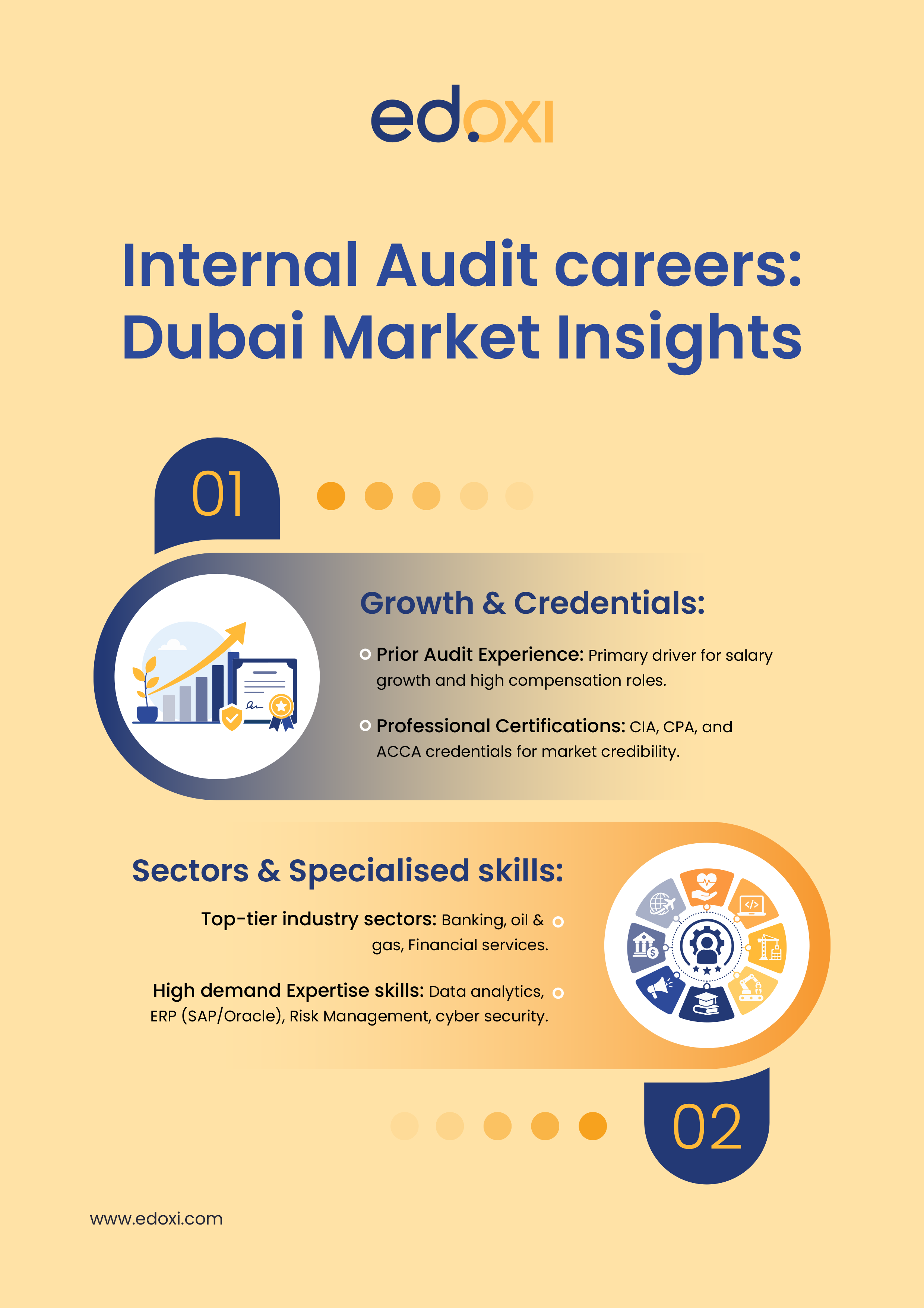
Due to enhanced regulations from government oversight bodies like the DFSA (Dubai Financial Services Authority), the need for Internal Auditors in Dubai has increased throughout 2026.
With ongoing improvements in Corporate Governance Laws and Regulations, there will be ongoing needs for companies to implement effective Internal Controls and Risk Management Systems to meet these requirements.
As businesses continue to expand in areas such as:
The demand for qualified internal audit professionals continues to increase at a very high rate in 2026.
 Note: Market demand and the complexity of the auditing role can also impact salary levels. Professionals with specialised skills in risk management, data analytics, and regulatory compliance often earn higher compensation.