Request a Callback

+971 43801666
 Aug 10, 2026

To become a tax consultant in Dubai, you need a bachelor’s degree in accounting, finance, or law, and 3+ years of experience, as required by the UAE Federal Tax Authority (FTA). The FTA is the regulatory apex body responsible for maintaining the integrity of the UAE’s evolving tax system. Becoming a successful tax consultant in Dubai is a widely aspirational goal for many young people. As a hub for international businesses, Dubai offers significant opportunities for tax consultants and related professionals.
The Federal Tax Authority (FTA) reported that nearly 40% of corporate tax returns filed in 2024-2025 contained errors requiring extensive modifications. This gap in compliance remains a concerning issue and has driven the demand for qualified tax professionals, which didn’t exist three years ago. The introduction of VAT and corporate tax in the UAE has also led to an unprecedented increase in demand for qualified tax consultants in Dubai.
This comprehensive guide will explain exactly how to become a tax consultant in Dubai in 2026, a step-by-step, complete roadmap for degrees that offer new prospects, certifications that lead to higher salaries, official FTA registration prerequisites, and elevated career stages.
The 6 major steps to becoming a tax consultant in Dubai can be presented as a complete go-to guide to become unstoppable in your tax consultancy career:
Let’s deep-dive into each step to better understand the path to becoming a tax consultant in Dubai.
A bachelor's degree in a related discipline is the minimum entry requirement for tax consultant roles in Dubai. The employers from Big Four firms like Deloitte LLP (Deloitte), PricewaterhouseCoopers (PwC), Ernst & Young (EY), and Klynveld Peat Marwick Goerdeler (KPMG), to in-house MNC finance teams, use this as an initial screening filter to select the best of the candidates from the wide pool.
The most accepted degree disciplines include the following:
It is very important to know the accredited university options, as well as to understand the career trajectory after graduation.
Knowing about a high scope educational background is not enough; belonging to highly reputed universities also counts for being a successful tax consultant in Dubai. Several universities in the UAE are now offering tax-focused modules oriented to FTA requirements:
Why is this information important? It is due to the fact that graduates from these programmes set foot in the market with clear, direct knowledge of the UAE VAT and CT frameworks, which reduces the high learning curve that most international graduates face in this field.
Note: A degree alone is rarely sufficient for skill-oriented roles in Dubai's 2026 market. Professional certification is what converts academic knowledge into negotiating power.
Your pricing power in Dubai’s 2026 market is your certification. Employers consistently pay more for internationally recognised credentials over uncertified professionals at the same experience level, creating a great margin of 20–35%. A list of highly recognised certifications and their salary premium, with their suitability and UAE market recognition, is given below:
|
Certification |
Salary Premium |
Best For |
UAE Market Recognition |
|
CTA (Chartered Tax Adviser) |
+25–35% |
Pure tax specialist roles, Big Four tax practices |
The highest for specialist positions is very rare in the UAE market |
|
ACCA (Assoc. Chartered Certified Accountants) |
+20–30% |
General tax and finance across all UAE employers |
Widest acceptance for the de facto standard qualification |
|
CPA (Certified Public Accountant) |
+15–25% |
US-parent MNCs, Big Four advisory |
High recognition in US-linked organisations |
|
ADIT (Advanced Diploma in International Tax) |
+20–28% |
International tax, TP, cross-border advisory |
Growing rapidly in specialist international roles |
|
UAE Tax Diploma / FTA Training |
+10–20% |
Local compliance, FTA-facing roles, audit work |
Fast-growing post-CT reform FTA mandates for agents |
|
CA (India / UK / Australia) |
+15–25% |
Consulting firms, MNC finance teams |
Strong in South Asian-staffed and global firms |
The answer to the question of which certification you should choose depends highly on your target role and skill expectations. Let’s analyse each possible situation related to your journey to become a tax consultant in Dubai.
International qualifications are highly regarded as valuable add-ons. UAE-specific knowledge is what converts them into a successful job offer. Employers pay a direct premium of 15-25% on candidates with hands-on UAE compliance experience, as it creates the notion of region-specific skills that help to perform better in the workplace.
The core knowledge areas and their importance are stated below to elaborate on the in-depth knowledge about the UAE’s tax regimes and related domain expertise. This can help you in understanding how crucial it is to remain updated and aligned with the AE’s tax sector for becoming a professional tax consultant in Dubai, as you aspire to be.
|
Knowledge area |
Why does it matter in 2026? |
Where to learn it? |
|
EmaraTax Portal Navigation |
Baseline interview expectation, used for all CT and VAT filings |
FTA e-learning, Edoxi UAE CT courses |
|
UAE Corporate Tax Law |
9% CT on profits >AED 375K — every employer needs this covered |
FTA official guides, Edoxi CT Professional programme |
|
VAT Compliance (5%) |
Introduced in 2018, returns, zero-rating, and the reverse charge mechanism |
FTA VAT guides, ACCA UAE tax papers |
|
Free Zone QFZP Rules |
0% qualifying rate, complex conditions, and economic substance tests |
FTA Decision No. 139 of 2023, advisory firm publications |
|
Transfer Pricing (OECD 3-tier) |
Master file, local file, CbCR required for MNC intercompany transactions |
OECD BEPS guidelines, CTA / ADIT TP modules |
|
DMTT / Pillar 2 |
Master file, local file, CbCR, required for MNC intercompany transactions |
PwC/Deloitte Pillar 2 guides, Chambers & Partners 2025 |
If you have recently migrated abroad or are new to the UAE tax sector, please go through this quick recap.
|
Hiring managers in Dubai screen resumes against UAE-specific terminology to select the most successful skill-matching candidates. Make the translation explicit:
HMRC disputes → FTA audit defence
Candidates who make this translation prominent on their CV and in interviews are significantly more likely to progress past initial screening. |
As a tax consultant practising in Dubai, whether employed or independent, one requires a clear understanding of the UAE's regulatory structure. The pathway may differ depending on how you intend to work. The relevant options available include:
This is the most common route young professionals choose. You can work for a Big Four firm, mid-tier consultancy, boutique tax firm, or in-house MNC finance team to gain relevant experience. Your employer holds the relevant licences. Your commitment is to maintain your professional certification and ensure your residence visa and work permit are in order.
If you want to legally represent clients in FTA dealings, focus on including signing returns, filing objections, and attending audits, and you must register as an FTA Tax Agent under Cabinet Resolution No. 74 of 2023, Article 12.
The official FTA registration requirements for a natural person are stated below to better understand the core differences and related procedures.
Bachelor's or Master's degree in tax, accounting, or law from a recognised UAE institution, or a tax certification from an internationally recognised tax body if your degree is in another field.
Minimum 3 years of recent practical experience in tax, accounting, or law.
Language proficiency in both Arabic and English (written and spoken).
Certificate of good conduct (issued within the last 3 months).
Medical fitness certificate.
UAE residence (you must be a UAE resident to register).
IELTS or TOEFL certificate if opting for English.
A diploma certificate in VAT or Corporate Tax.
Pass the FTA Tax Agent examination.
Pay the registration fee of AED 3,000 (renewable every 3 years via EmaraTax).
Knowing the FTA Tax Agent registration laws in the UAE is important for a tax consultant to ensure client compliance, avoid heavy fines, and manage complex tax requirements to excel in this industry. The FTA Tax Registration process is stated below :
Creating an account on the EmaraTax portal at tax.gov.ae is the first step.
Select 'Tax Agent (Natural Person)' and complete the registration requirements.
Submit your application to the FTA.
Receive preliminary approval once the FTA reviews your related credentials.
Pay the registration fee of AED 3,000 after approval.
Connect yourself to a registered Tax Agency so that your status is activated only after this step is completed.
The vital compliance point
Source: Federal Tax Authority tax.gov.ae (Cabinet Resolution No. 74 of 2023) |
Tax professionals with an experience of 5+ years can operate independently in Dubai. This requires:
Contract rates for experienced tax professionals in Dubai range from AED 800–1,500 per day, making independent practice one of the highest-earning options for senior specialists.
Source: JobSeekers.AE Corporate Tax Jobs UAE 2026.
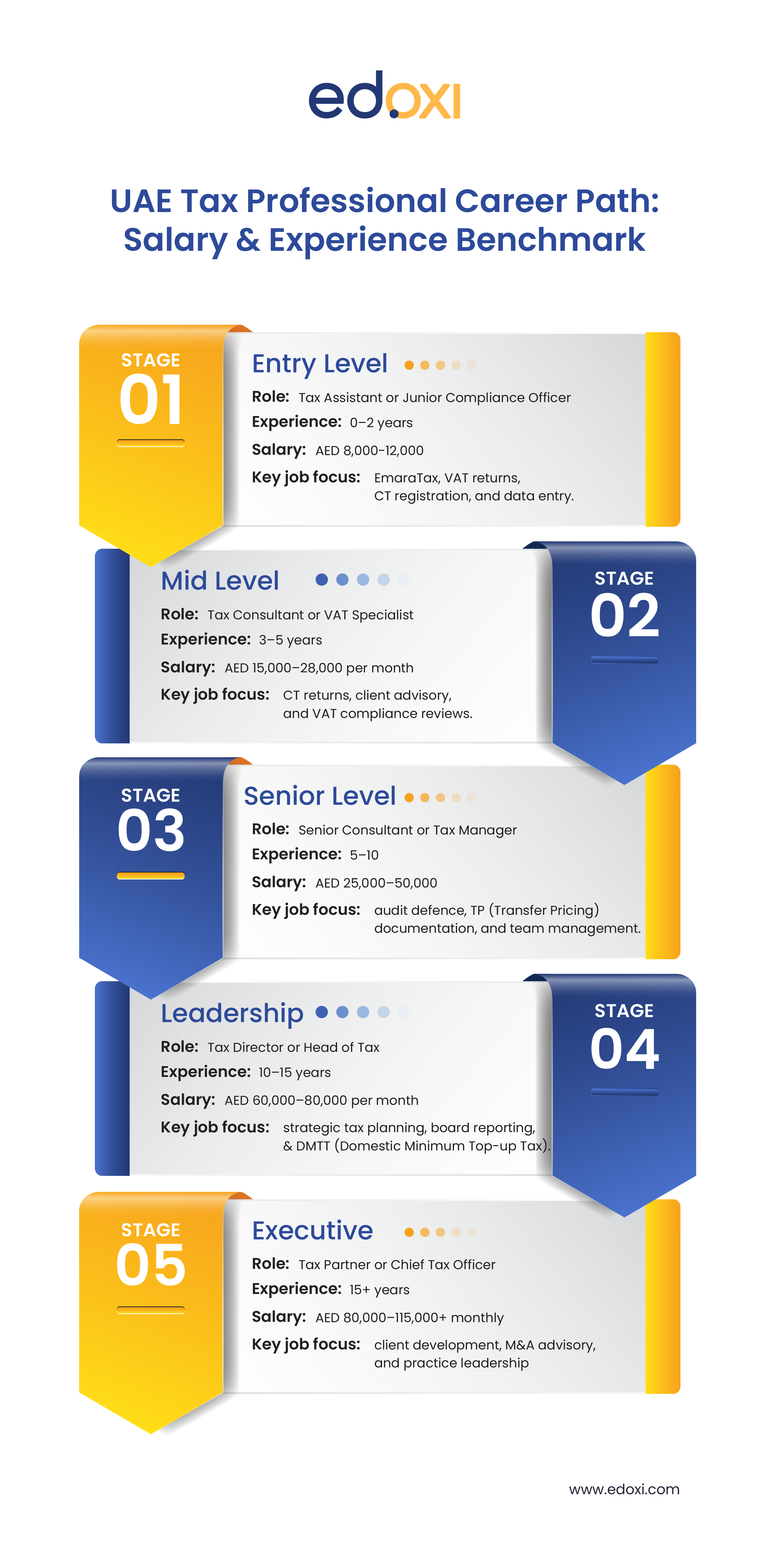
The UAE tax market rewards a clear progression in career. Each stage offers salary benchmarks, role expectations, and skill requirements. It is crucial to understand the market expectations at each level before you negotiate for a position.
The 2026 UAE market prefers specialists over generalists. Choosing the right specialisation earlier determines your pay ceiling and career trajectory. The most preferred and highly competitive specialisations are stated below:
OECD alignment has built demand for TP specialists that far exceeds supply in the UAE. Transfer pricing professionals receive a 25-40% premium over general tax consultants at the same experience level.
(Source: GLVS Dubai, 2025)
Over 400,000 entities have registered for UAE corporate tax. Many are still navigating their first return cycles. CT compliance specialists who understand the EmaraTax portal, deferred tax calculations, and FTA audit defence are in sustained high demand.
(Source: JobSeekers.ae, 2026)
The UAE's e-invoicing mandate and AI adoption curve have created a new category of tax professional: the Tax Technology Consultant. This role sits at the intersection of traditional tax compliance and digital implementation.
The term ‘tax consultant’ spans a vast array of roles in the UAE. It is better to understand the variance before choosing your specialisation. The major job titles, along with core responsibilities and hiring teams, are discussed here:
A general tax consultant is responsible for VAT compliance, CT registration, and client advisory. They are hired by an expert team of SMEs, boutique firms, and mid-tier consultancies. They mainly help with tax planning, strategising, audit presentation, tax filing, and documentation support.
A corporate tax specialist focuses on CT return preparation, deferred tax, and small business relief. They are primarily hired by Big Four, MNCs, and in-house finance teams.
A VAT specialist works on VAT returns, audit defence, FTA dispute resolution, and is prominently hired by retail, real estate, and e-commerce businesses.
The transfer pricing analyst or manager works on OECD TP documentation, benchmarking studies, and CbCR. They are on-boarded by multinationals, Big Four, and TP practices.
An FTA tax agent helps with legally representing clients before the FTA, and they are hired by tax agencies, law firms, and independent practices.
The role of a tax technology consultant is focused on ERP-to-FTA integration, e-invoicing, and AI compliance tools. They are taken on by Big Four tech practices and MNC digital teams.
Becoming a tax consultant in Dubai is an emerging opportunity in 2026 due to the UAE’s total upgradation from a tax-neutral environment to a highly successful financial centre. Dubai runs on with the zero personal income tax policy on individuals, and that sole fact reshapes the take-home pay (net pay or net income) comparison between Dubai and every other global financial capital.
For example, a Dubai-based tax consultant who earns AED 40,000 per month takes home 100% of that amount. On the other hand, a London peer earning the same gross salary has only 65% of their income after income tax deductions and National Insurance.
The entry-level monthly salary ranges from AED 8K-12K, which now has approximately 400,000 UAE CT-Registered entities according to 2025 data insights. The current FTA Tax Agent registration fee is AED 3,000, and the UAE corporate tax rate from FY 2023 is 9% due to the update on June 1, 2023, that became the first all-inclusive tax on business profits in the UAE’s financial history.
The FTA has transitioned from its educational phase into proactive policing. The delayed corporate tax registration entails an automatic penalty of AED 10,000, regardless of company size. The FTA field audits are escalating in H2 2026.
The UAE Ministry of Finance estimates tax revenue for FY 2025 to be over 12% i.e about AED 12.6 billion annually. The governance framework to support this requires highly qualified tax consultant professionals at every level.
Note: The Basic Difference between FTA Tax Agent & Tax Consultant
- Alibaba
The major takeaways regarding the UAE’s tax consultancy sector can be summarised as follows:
The short and crisp answer for becoming a tax consultant in Dubai in 2026 requires a relevant degree, a professional certification, UAE-specific knowledge, and (for independent practice) FTA Tax Agent registration.
The more important answer is that this is one of the strongest career investments you can make in the UAE right now. The regulatory environment includes corporate tax, DMTT, transfer pricing, and e-invoicing, which is not simplified. Every new rule creates a new layer of advisory work. The professionals who will capture the highest salaries are those who specialise early, build UAE-specific experience fast, and combine traditional tax expertise with digital fluency.
Start with the right certification and experienced mentors. Build UAE-specific experience as fast as possible. Position yourself in the specialisation that the market is paying the most to fill.
If you are employed by a licensed firm (Big Four, mid-tier consultancy, or in-house MNC), no separate personal licence is required. If you want to practise independently or represent clients before the FTA, you need FTA Tax Agent registration (per Cabinet Resolution No. 74 of 2023) and a UAE freelance permit or free zone company licence.
The FTA requires a minimum of 3 years of recent practical experience in tax, accounting, or law. 'Recent' is interpreted as experience within the last several years — not experience from decades ago. You must also hold a relevant degree or tax certification, pass the FTA exam, and demonstrate language proficiency in both Arabic and English.
Yes, with caveats. If your degree is in a field other than accounting, tax, or law, you will need a tax certification from an internationally recognised institution to qualify for FTA Tax Agent registration. For employed roles (not representing clients before FTA), a non-accounting degree combined with a strong professional certification (ACCA or CTA) is accepted by many mid-tier employers and boutique firms.
A realistic timeline: 3-4 years for a relevant degree + 2-3 years to complete ACCA or CTA while working + 1-2 years of UAE-specific experience before reaching a mid-level consultant role. For international professionals joining with an existing tax background, the UAE-specific component can be compressed to 12-18 months with targeted training and employer support.
Significantly. Over 400,000 entities registered for corporate tax by the end of 2025. The FTA reported 40% error rates on initial returns, driving sustained demand for CT compliance specialists. The introduction of DMTT (Pillar 2) from January 2025, transfer pricing rules from FY 2024, and the e-invoicing phased rollout from 2026 mean demand will increase, not decrease, through 2028 and beyond.
The FTA Tax Agent exam tests in-depth knowledge of UAE VAT and Corporate Tax Law, FTA procedures, and regulatory obligations. Edoxi's FTA Tax Agent Exam Preparation programme provides structured training aligned to the exam syllabus, covering all key areas, including EmaraTax portal operations, tax return preparation, audit defence, and objection procedures.
Banking and finance (DIFC/ADGM) command the highest premiums, 25-40% above the base market rate, due to wealth management complexity and QFZP audited financials requirements. Energy and oil & gas follow at 20–35% above base for cross-border structures and OECD transfer pricing. Tech and AI infrastructure is the fastest-growing premium sector at 20–35% above base.
 Fresher Abroad? Upskill Your Experience to UAE Equivalents