Request a Callback

+971 43801666
 Jun 22, 2026

Dubai's project landscape is demanding.
Construction projects worth AED 675.74 billion are planned from now through 2030, and a 29.2% increase in the federal infrastructure budget has created tremendous pressure for organisations in construction, engineering, oil and gas, and government to deliver projects on time, within budget, and to specifications.
The response from leading companies has been consistent: invest in techniques and tooling to ensure precise project control.
The scheduling and control standard in Dubai for the most complex construction projects is Oracle's Primavera P6 Enterprise Project and Portfolio Management (PPM) System.
What Is Primavera P6 Training?Primavera P6 training is a structured programme that teaches professionals how to use Oracle's Primavera P6 software to plan, schedule, manage, and control projects. Training covers project creation, Work Breakdown Structure (WBS) development, critical path method (CPM) scheduling, resource levelling, cost management, and earned value management (EVM). It is designed for planning engineers, project managers, project controllers, and project coordinators working on large-scale, complex projects across industries such as construction, oil and gas, infrastructure, and engineering. |
However, software cannot be effectively utilised without properly trained resources. Therefore, project teams must invest in Primavera P6 training in Dubai as a strategic necessity, not as a discretionary expenditure.
Table of Contents |
| Why Are Dubai Companies Investing in Primavera P6 Training for Project Teams? 1.1 Delays and Schedule Slippages Directly Impact Project Profitability 1.2 Effective Resource Planning Reduces Project Costs 1.3 Large-Scale Projects Require Advanced Schedule and Cost Control 1.4 Employers Need Industry-Ready Project Controls Professionals 1.5 The Growing Demand for Project Controls Talent Makes Upskilling Essential 1.6 Client Contracts and International Standards Require Robust Project Reporting 2. Conclusion 3. FAQs (Why Companies in Dubai Invest in Primavera P6 Training for Project Teams?) |
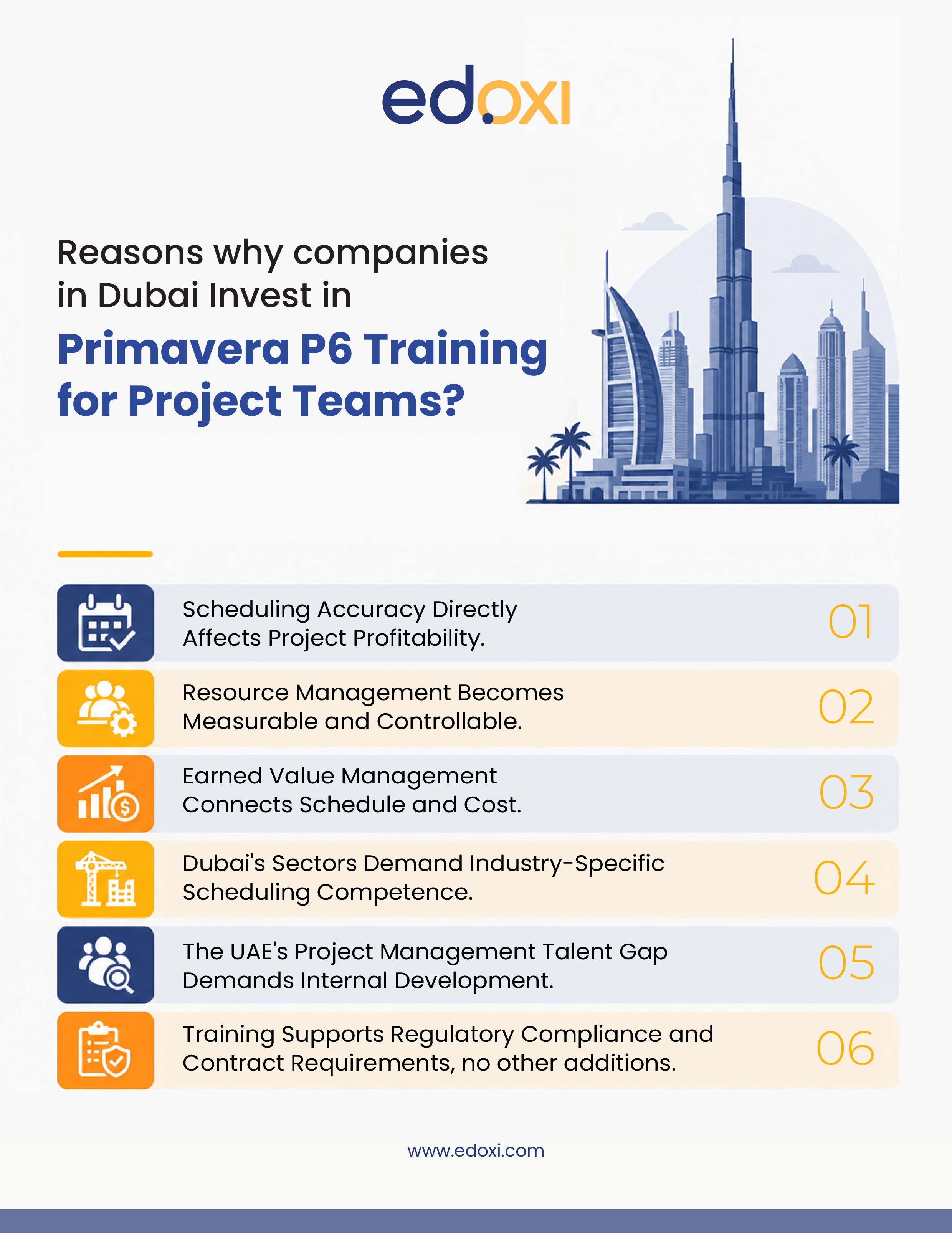
The top 6 reasons why Dubai companies are investing in Primavera P6 training for project teams are:
In project-based industries, time is money; delays mean dirhams lost.
In Dubai's construction industry, where contracts, subcontractors' fees, and clients' requirements take on great financial significance, a project management team that fails to create, manage, and convey a reliable schedule is a serious drawback.
Primavera P6 enables planning engineers to build multi-level schedules using the Critical Path Method (CPM), a technique that identifies the longest sequence of dependent activities, allowing teams to understand exactly which tasks cannot slip without delaying overall completion.
Unless teams have undergone proper training, they can often misapply relationships, misuse constraints, or not adhere to the schedule baseline, thereby ruining its effectiveness as a management tool.
Corporate Primavera P6 training in Dubai teaches teams to build schedules that reflect project reality, update them accurately during execution, and use schedule data to drive decision-making. The result is fewer surprises, more reliable forecasts, and better client reporting.
Before vs After Training: Schedule Management
|
Capability |
Before Training |
After Training |
|
Schedule accuracy |
Activity relationships often incorrect |
Properly sequenced with CPM logic |
|
Baseline management |
Baselines rarely maintained |
Baselines set, protected, and monitored |
|
Delay identification |
Reactive — identified after the fact |
Proactive — flagged through schedule analysis |
|
Client reporting |
Manual, inconsistent |
Generated directly from P6 with a consistent format |
|
Schedule updates |
Ad hoc, irregular |
Structured update cycles with progress tracking |
Large construction and engineering projects in Dubai routinely involve hundreds of resources across multiple concurrent work fronts. Without systematic resource planning, project managers operate largely on intuition, which is a poor substitute for data.
Primavera P6 allows teams to load resources onto activities, identify over-allocation, apply resource levelling techniques to smooth demand, and track actual versus planned utilisation.
For organisations running multiple projects simultaneously, which is common among Dubai's engineering consultancies and main contractors, this capability is transformative.
Training in resource management within Primavera P6 enables project controllers to answer with confidence:
These questions matter enormously in Dubai's resource-constrained market, where competition for skilled labour and specialist subcontractors is intense.
One of the most effective and also one of the most frequently misused project control methodologies is Earned Value Management (EVM). EVM brings together scope, scheduling, and costing data.
This allows objective assessment of the project status in terms of how much has been accomplished, at what cost, and whether the project will be completed on time and within budget.
Increasingly, Dubai-based customers, especially in government departments, the oil and gas industry, and in the infrastructure sector, insist that contractors and consultants report their progress in EVM terms, using measures such as the Schedule Performance Index (SPI) and the Cost Performance Index (CPI). Without training, people either eschew EVM completely or use it badly.
"Primavera P6 remains one of the most sought-after project management tools in Dubai's construction, infrastructure, and EPC sectors. Companies value professionals who can effectively plan, schedule, monitor, and control complex projects using Primavera P6."
Corporate Primavera P6 training equips project teams to implement EVM correctly, setting budgeted costs, recording actual progress, and generating performance reports that provide genuine insight into project health. This strengthens stakeholder confidence and improves decision-making at every level of the organisation.
Want to build a successful Primavera P6 career in Dubai? Discover the skills, certifications, and career path employers are looking for.
Read: How to Become a Primavera P6 Professional in Dubai
Primavera P6 is not generic project management software. It is an enterprise-grade platform built for complex, multi-project environments.
Using Primavera P6 effectively in construction differs meaningfully from using it in oil and gas maintenance or government infrastructure programmes.
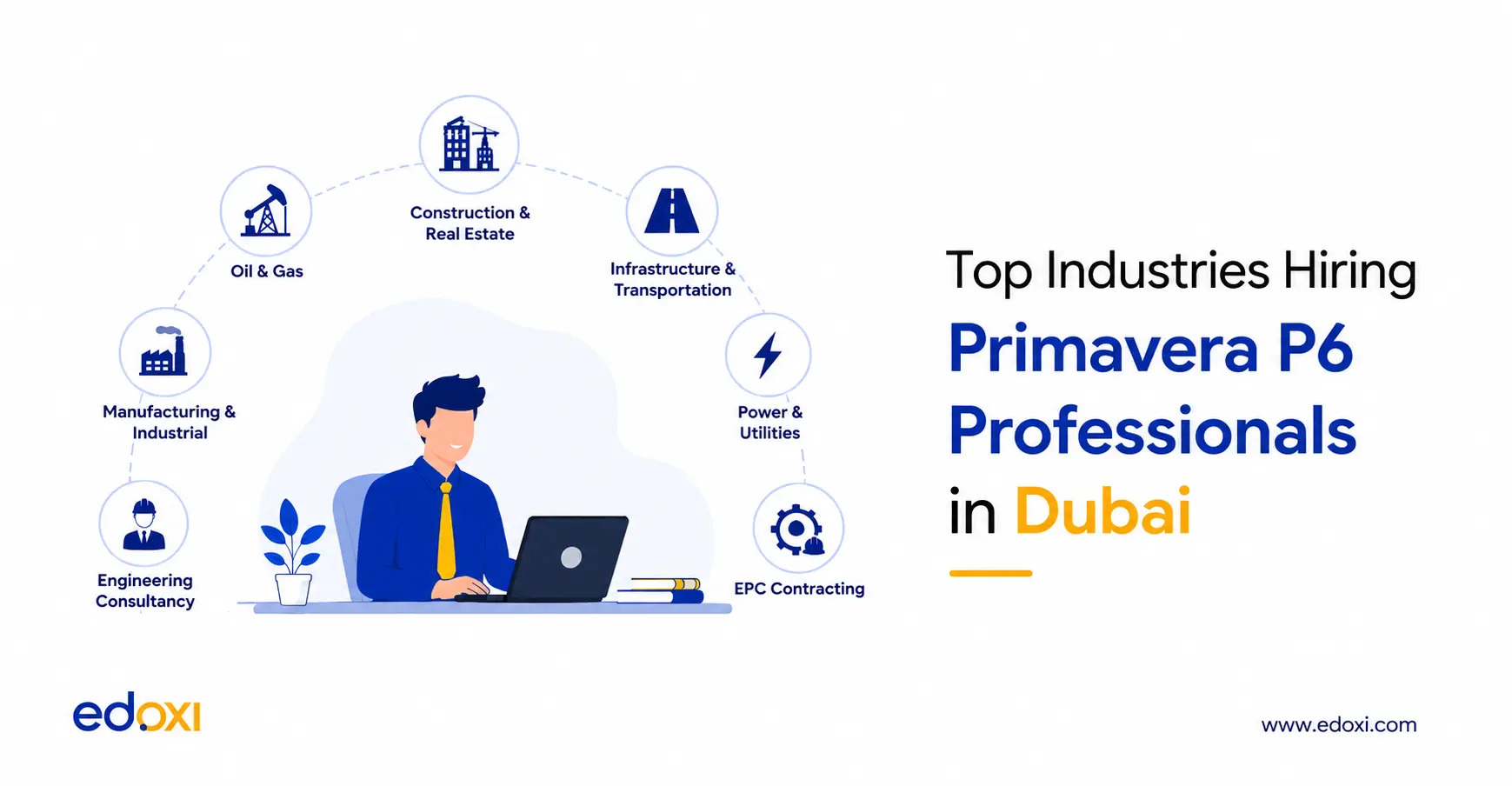
Industries in Dubai using Primavera P6 benefits
|
Sector |
Key P6 Scheduling Requirements |
Training Focus |
|
Construction |
Multi-level WBS, subcontractor packages, MEP sequencing |
Activity coding, baseline control, progress measurement |
|
Oil & Gas |
Shutdown planning, turnaround management, resource levelling |
Hourly tracking, resource histograms, cost loading |
|
Infrastructure |
Stage-gated delivery, interface management, and regulatory milestones |
Programme scheduling, interface management, reporting |
|
Engineering Consultancy |
Multi-project portfolio management |
Portfolio views, resource allocation across projects |
|
Government Projects |
Governance reporting, progress certificates, and stage approvals |
EVM reporting, dashboard outputs, stakeholder reporting |
The construction sector alone faces a talent growth requirement of up to 66%. The global project management workforce currently stands at approximately 40 million, already larger than the global populations of nurses and software developers, yet demand is accelerating sharply.
"Our world is in flux: economically, politically, and environmentally. The need for change is everywhere. And change only happens through successful projects. That makes this a defining moment for project professionals."
- Pierre Le Manh, PMP, President and CEO, Project Management Institute (PMI)
In the UAE context, this talent constraint is acute. Dubai's construction headcount is projected to grow by 11–14% by 2030, yet the availability of credentialled planning engineers and project controllers does not match that trajectory. For companies, this creates a straightforward strategic choice: recruit from an increasingly competitive market at increasing cost, or develop internal capability through structured training programmes.
"Estimate the challenge, analyse the facts, find the appropriate strategy and act."
Corporate training in Primavera P6 is among the most effective forms of internal development. It builds transferable, measurable scheduling skills that organisations own as institutional capability.
Dubai and UAE government contracts, international engineering frameworks, and FIDIC-based construction contracts increasingly specify project controls requirements as deliverables. Contractors and consultants may be required to submit Level 3 or Level 4 Primavera P6 schedules, monthly progress reports with earned value metrics, resource-loaded schedules, and recovery programmes following delays.
Failure to comply is not merely an inconvenience; it can constitute a contract breach, trigger penalty provisions, or weaken a company's position in dispute resolution.
Organisations that invest in Primavera P6 training ensure that their teams understand not only the software but the project controls standards that their clients and contracts require. This directly reduces compliance risk and strengthens organisational credibility.
The illustration of the major reasons for the promotion of Primavera P6 skills in Dubai is given below:
Consider a mid-sized construction contractor in Dubai operating across three simultaneous residential projects. Before structured training, the planning team produced schedules with incorrect activity relationships, maintained no approved baseline, and submitted progress reports manually compiled in spreadsheets.
Following corporate Primavera P6 training covering WBS development, CPM scheduling, resource loading, and baseline management, the same team was able to establish
The outcomes were tangible: scheduling conflicts between subcontractors were identified three weeks in advance rather than on the day, resource redeployment decisions were data-driven, and client reporting improved in accuracy and consistency.
The investment in training paid back demonstrably within the first project cycle.
Business Benefits of Primavera P6 Corporate Training: At a Glance
|
Business Outcome |
Impact of Primavera P6 Training |
|
Schedule reliability |
More accurate forecasts, fewer surprises |
|
Resource utilisation |
Reduced over-allocation, better workforce deployment |
|
Cost control |
EVM metrics enable earlier identification of cost variances |
|
Client reporting |
Faster, more accurate, professionally formatted reports |
|
Contract compliance |
Teams capable of meeting project controls and deliverable requirements |
|
Risk management |
Schedule risk analysis and float monitoring to reduce project risk |
|
Staff competence |
Measurable improvement in planning engineer capability |
|
Retention |
Workforce development investment supports staff loyalty |
Dubai's 2040 Urban Master Plan, the AED 27 billion Roads and Transport Authority (RTA) budget for 2024–2026, and active megaproject pipelines, including the expansion of Al Maktoum Airport and the Route 2020 Metro extension, have created a construction and infrastructure environment operating at maximum complexity.
According to MEED Projects data, approximately AED 1.13113 trillion in construction project value is tracked across the UAE pipeline through 2030. Of this, roughly AED 675.74 billion sits within Dubai alone.
The base-case forecast from a 2026 UAE construction workforce study projects the sector's headcount growing from 1.42 million in Q1 2026 to between 1.58 and 1.62 million by 2030, with the structural shift clearly towards skilled and certified professionals.
Yet the industry faces a paradox: growing project volumes alongside a recognised shortage of skilled planning and project controls talent. This is precisely the environment in which corporate Primavera P6 training becomes a competitive differentiator rather than merely a training exercise.
For planning engineers and project managers, Primavera P6 proficiency is increasingly a prerequisite rather than an advantage.
Understanding its importance for career growth is something many professionals are now actively pursuing. You can read more on the importance of Primavera P6 training in career growth to understand the full professional impact.
Primavera P6 vs Other Scheduling Tools: Why P6 Dominates in Dubai
|
Feature |
Primavera P6 |
MS Project |
Other Tools |
|
Designed for large-scale, complex projects |
Yes |
Limited |
Varies |
|
Multi-project portfolio management |
Yes |
Basic |
Varies |
|
Enterprise resource management |
Yes |
Limited |
Varies |
|
EVM reporting |
Full support |
Basic |
Varies |
|
Industry adoption in the UAE construction |
Dominant |
Supplementary |
Niche |
|
Contract-compliance scheduling |
Industry standard |
Partial |
Varies |
|
Integration with the Oracle ecosystem |
Native |
No |
Varies |
Dubai's major contractors, government authorities, and engineering consultancies have standardised on Primavera P6 precisely because of its enterprise capability. This means P6 skills are not a niche; they are a professional baseline requirement across project-driven sectors.
For a deeper perspective on what this means for professionals, the top 5 benefits of Primavera P6 certification are worth reviewing.
Dubai's project economy is operating at a scale and complexity that demands more than ambition; it demands precision. With USD 184 billion of construction project value in Dubai's pipeline through 2030, and a federal budget growing at 29.2% year-on-year, the organisations that will consistently win work, retain clients, and deliver profitably are those whose project teams have the technical capability to match that environment.
Primavera P6 is the scheduling and controls backbone of Dubai's most significant projects. Corporate training in P6 is not a cost; it is an investment that pays back through better schedules, stronger resource management, improved EVM reporting, and a project team capable of meeting the controls standards that clients, contracts, and regulators require.
The global project management talent gap, forecast at up to 30 million by 2035, only sharpens this imperative. Dubai companies that invest in building internal Primavera P6 capability today are positioning themselves to lead, not follow, in the project decade ahead.
Primavera P6 is the industry-standard scheduling and project controls tool in Dubai's construction, engineering, infrastructure, and oil and gas sectors. It handles complex, large-scale schedules with thousands of activities, supports multi-project portfolio management, and meets the project controls deliverable requirements specified in government and FIDIC-based contracts across the UAE.
General project management training covers methodologies, frameworks, and principles (such as PMP or PRINCE2). Primavera P6 training is software-specific — it teaches professionals how to use P6 to build schedules, manage resources, apply CPM, track progress, and generate earned value reports.
Construction project teams with Primavera P6 training can produce accurate CPM schedules, manage subcontractor interfaces, maintain approved baselines, identify critical path activities, and generate professional client reports.
Primavera P6 skills are in demand across construction, civil engineering, infrastructure, oil and gas, MEP contracting, government project authorities, engineering consultancies, and real estate development firms. Any organisation managing large-scale, complex, or multi-project programmes in the UAE will typically require Primavera P6-proficient planning engineers and project controllers.
Yes. Structured corporate training programmes, such as those offered by Edoxi, are designed to take participants from foundational concepts through to advanced scheduling and cost management techniques. Programmes are tailored to the team's existing proficiency level and aligned to the specific project environment — construction, oil and gas, infrastructure, or engineering.
UAE government contracts increasingly require contractors to submit Primavera P6 schedules as formal project controls deliverables. These may include resource-loaded schedules, progress S-curves, earned value reports, and recovery programmes. Primavera P6 training ensures that project teams can produce these deliverables to the required standard, reducing contract compliance risk and supporting transparent project governance.