Request a Callback

+971 43801666
 Aug 28, 2026
Key Takeaways
|
Saudi Arabia's Skill Verification Program (SVP) is a mandatory government initiative under Saudi Vision 2030 that requires expatriate workers in the private sector to pass a Saudi skill test to prove their technical competence before working in, or continuing to work in, the Kingdom. Administered by the Ministry of Human Resources and Social Development (MHRSD), the SVP covers more than 1,000 specialised professions across 23 sectors.
As of 2026, the program has moved from phased rollout to strict digital enforcement via the Qiwa platform. Residency renewals and visa approvals are now contingent upon valid professional certification. This guide covers everything you need to know: the exam schedule, eligibility rules, assessment format, the 2026 work permit classification system, and how to check your status.
|
Quick Answer: The SVP is a two-stage mandatory assessment, theoretical (computer-based) and practical (hands-on), that certifies the technical competency of expatriate workers in Saudi Arabia's private sector. The certificate issued by MHRSD is valid for five years. All phases of the program are fully active as of 2026. |
Introduced by the MHRSD in cooperation with the Ministry of Foreign Affairs and the Technical and Vocational Training Corporation (TVTC), the SVP ensures that only qualified workers are employed in the Saudi labour market. The Qiwa SVP exam operates on two tracks:
For further reading: Introduction to Skills Verification Program in Saudi Arabia
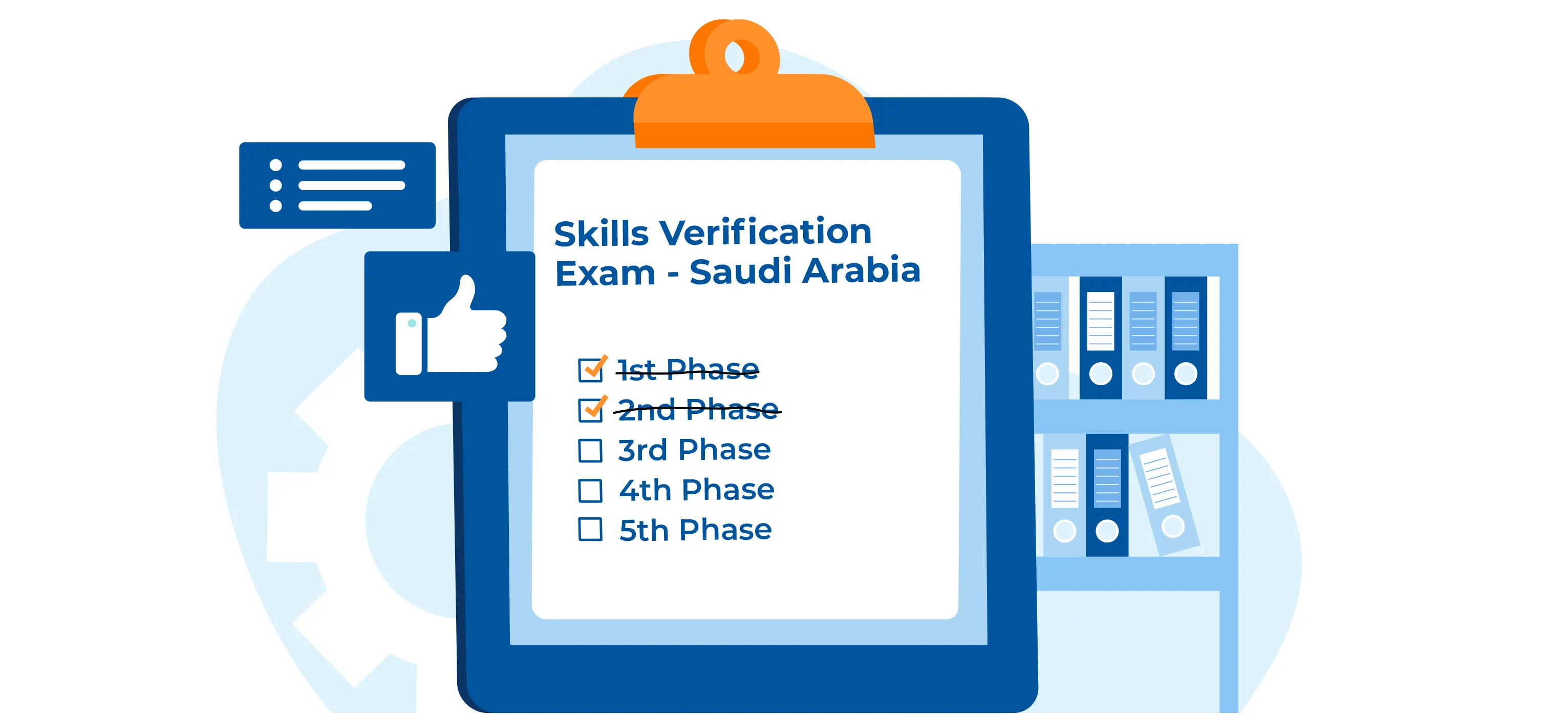
The program was rolled out in five phases based on establishment size. All five phases are now active and fully enforced.
| Phase | Establishment Size | Start Date | Status (2026) |
| Phase 1 | 3,000+ workers | July 1, 2021 | Active / Enforced |
| Phase 2 | 500–2,999 workers | September 1, 2021 | Active / Enforced |
| Phase 3 | 50–499 workers | October 1, 2021 | Active / Enforced |
| Phase 4 | 6–49 workers | November 3, 2021 | Active / Enforced |
| Phase 5 | Less than 6 workers | January 2, 2022 | Active / Enforced |
Important (2026 Update): Phase information beyond the original launch dates should be verified directly with MHRSD or via the Qiwa platform, as enforcement mechanisms and deadlines may have been updated.
The Saudi Skill Verification Exam is conducted in two mandatory stages. Candidates must pass the theoretical stage before they are permitted to sit the practical assessment.
| Module | Duration | Format | Key Topics |
| Theoretical Exam | ~30 minutes | Computer-Based Test (CBT) | OHS, tools, industry regulations |
| Practical Exam | 90–120 minutes | Hands-on workshop/trade lab | Technical dexterity, PPE usage, methodology |
Languages Available: The theoretical CBT is available in multiple languages, including Arabic, Hindi, Urdu, and Tagalog, making it accessible to the diverse expatriate workforce.
The Saudi Skill Verification Program applies to eligible expatriate workers employed in Saudi Arabia’s private sector. Candidates must meet specific professional, employment, and certification requirements before appearing for the Skill Verification Exam.
The SVP external track is most commonly used by workers travelling from South Asia. Here is how the process works for the most represented nationalities in Saudi Arabia's private sector:
Regardless of nationality, all external-track candidates must pass both the theoretical and practical stages before a Saudi work visa can be issued.
Expatriate workers holding an Iqama (Saudi Residence Permit) can check their eligibility to take the Professional Verification Exam through the official SVP Qiwa portal. Enter your Iqama number to instantly confirm whether your profession is subject to the SVP requirement. This Saudi work permit verification step is mandatory before any exam booking can be confirmed.
Professions subject to SVP testing are regularly updated by MHRSD and announced via official channels. Always verify your specific profession's status at https://www.qiwa.sa/en/ before applying.
Whether you are applying from inside Saudi Arabia or from your home country, the Qiwa SVP exam registration process follows the same core steps.
Step 1: Check Your Eligibility
Visit qiwa.sa and enter your Iqama number (for internal track) or passport details (for external track) to confirm whether your profession is subject to SVP testing.
Step 2: Create or Log In to Your Qiwa Account
Register on the Qiwa platform using your National ID or Iqama number. If you already have an account, log in directly.
Step 3: Select Your Profession and Exam Centre
Choose the occupational category that matches your current job role under the SSCO classification. Select an approved testing centre near you or, for the external track, in your home country.
Step 4: Book Your Theoretical Exam Slot
Schedule your 30-minute computer-based theoretical exam (CBT). The test is available in Arabic, Hindi, Urdu, and Tagalog. Choose a date and time that suits you.
Step 5: Sit the Theoretical Exam
Appear at the designated centre on your exam date. The CBT covers occupational health and safety, tools, and industry regulations. You must pass this stage before proceeding.
Step 6: Book and Sit the Practical Assessment
Once you clear the theoretical exam, book your 90–120 minute practical hands-on assessment. This evaluates real-world technical dexterity, PPE handling, and methodology in a workshop or trade lab setting.
Step 7: Receive Your SVP Certificate
Candidates who pass both stages receive an MHRSD-issued SVP certificate valid for five years. The certificate is automatically linked to your Qiwa profile and your employer's compliance record.
Remember: You have a maximum of three attempts across both stages. Plan adequate preparation time before your first sitting.
A major skill-based work permit system update that took effect last year is now fully enforced in 2026 for existing employees and new hires. Saudi Arabia replaced the old 'professional vs. non-professional' classification with a data-driven, three-tier hierarchy aligned to the Saudi Standard Classification of Occupations (SSCO). This classification is now enforced through AI-assisted audits on the Qiwa platform.
| Skill Tier | Target Professions | Min. Requirements | Monthly Salary Threshold |
| High-Skilled | Doctors, Engineers, IT Specialists, Executives | Bachelor 's+, 5 yrs exp, HRSD score ≥70 | ≥ SAR 15,000 |
| Skilled | Technicians, Supervisors, Craftsmen, HVAC Mechanics | Secondary/vocational cert, 2 yrs exp, SVP pass | SAR 7,000 – 14,999 |
| Basic | Manual Labour, Entry-level Service | No formal education; under 60 years | SAR 3,000 – 6,999 |
Source: MHRSD - Work Permit Classification Framework
Work permit tier placement is determined by five official criteria:
Educational Qualifications: Alignment of the academic degree with the SSCO occupational category.
Professional Experience: Verified years of experience in the specific occupational field.
Professional Skills: Successful completion of the SVP or relevant professional accreditation.
Remuneration: Adherence to the minimum monthly salary threshold for the designated tier.
Age: Specifically relevant for the Basic tier (upper cap: 60 years of age).
Not all verification requirements in Saudi Arabia are handled under the SVP. Here is how the two primary systems compare:
| Criteria | Skill Verification Program (SVP) | Professional Accreditation |
| Target Workforce | Technical & vocational trades | Licensed professionals (engineers, doctors, accountants) |
| Exam Type | Practical dexterity + theoretical CBT | Degree verification + professional exam |
| Regulatory Body | MHRSD / Qiwa Platform | SCE, SCFHS, SOCPA (sector-specific) |
| Certificate Validity | 5 years | Varies by body |
| Max Attempts | 3 attempts | Varies by body |
Professional accreditation for licensed professions is handled by sector-specific bodies: the Saudi Council of Engineers (SCE), the Saudi Commission for Health Specialities (SCFHS), and the Saudi Organisation for Chartered and Professional Accountants (SOCPA).
A clarification stating that white-collar and IT professions are subject to Saudization quotas (currently hovering between 25% to 35% for tech roles) and Professional Accreditation (e.g., Saudi Council of Engineers), not the SVP trade test. Emphasise that SVP targets blue-collar and grey-collar workers (welders, carpenters, electricians, mechanics).
The MHRSD has designated more than 30 professions in the Communications and Information Technology (CIT) sector for nationalisation at a 25% Saudization rate. This means that for every four workers in these roles, at least one must be a Saudi national.
This list is illustrative, not exhaustive. For the complete and current list of professions subject to SVP and Saudization quotas, refer to the official MHRSD announcements at https://hrsd.gov.sa/en.
The Qiwa platform is the central digital hub for all Saudi labour market activities, from eligibility checks and exam booking to work permit renewals and employer compliance.
By 2026, the Qiwa platform will use AI-driven audits to detect mismatches between a worker's recorded job title and their actual SSCO-classified role. Employers face the following consequences for non-compliance:
As of January 2026, the MHRSD confirmed that more than 18,000 employer violations were detected and penalised through AI-assisted Qiwa audits, underscoring how seriously non-compliance is being treated under the current enforcement regime.
(Source: MHRSD Labour Market Compliance Report)
Recruiter Advisory (MHRSD, 2026): 'Waiting until a candidate is identified to begin the SVP process will lead to deployment delays of 2 to 6 weeks. Effective strategy requires mapping every hire to the SSCO occupational library immediately upon job approval.'
The Saudi Skill Verification Program (SVP) has become a critical compliance requirement for expatriate professionals and employers operating in Saudi Arabia. With stricter enforcement through the Qiwa platform and the introduction of the new skill-based work permit system, workers must stay professionally verified to secure employment, renew permits, and remain compliant with Saudi Vision 2030 workforce regulations. Staying updated with the latest SVP requirements can help professionals avoid delays, penalties, and employment restrictions.
The certificate is valid for five years from the date of issue. After five years, the certificate holder must retake the exam to renew their certification.
If a candidate fails all three permitted attempts, internal-track workers (already in Saudi Arabia) may face deportation. External-track applicants may be ineligible to proceed with their Saudi work visa application.
Yes. Visit the Qiwa platform and enter your Iqama number to instantly check whether your profession requires SVP certification.
No. The SVP is specifically designed for expatriate (non-Saudi) workers employed in the private sector. Saudi nationals are not required to sit the skill verification exam.
No. The program covers over 1,000 designated professions across 23 sectors. The list is updated periodically by the MHRSD. Check the current list on the MHRSD official website or the Qiwa platform.