Request a Callback

+971 4380 1666
 Nov 03, 2026
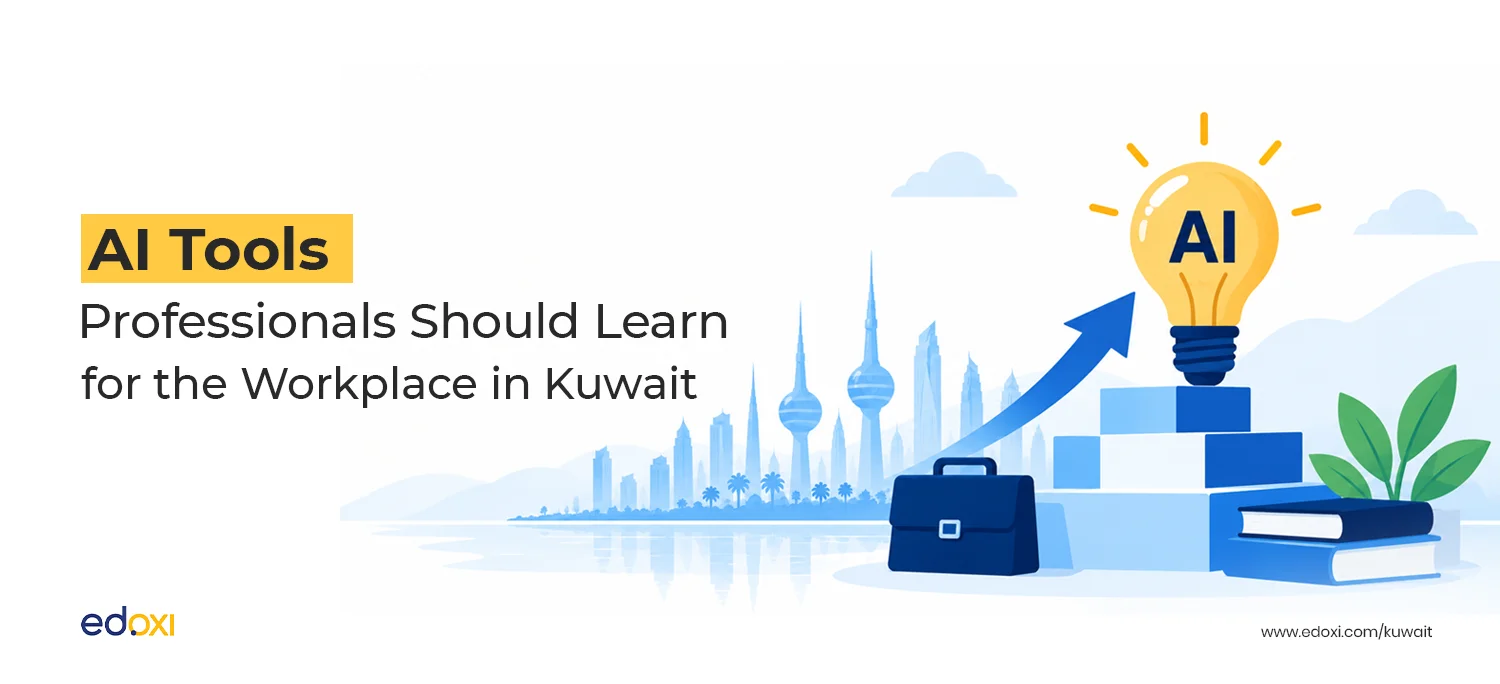
The best AI tools for professionals in Kuwait are ChatGPT or Gemini for writing, Microsoft Copilot for Office work, Perplexity for research, Claude for long documents, Power BI for data, and Canva for slides.
Start with one. Learn it well. Then add the next.
It’s Monday morning in Kuwait City. Your team has a report to finish before the next meeting. One colleague gets it done in 10 minutes. Another spends two full days on almost the same task.
What makes the difference? Often, it’s how they use AI tools.
From drafting reports and analysing data to preparing presentations and automating routine tasks, the right AI tools can transform the way professionals work in Kuwait.
The real question is: Are you working harder than you need to, or working smarter with AI?
You do not need every app. You need the right few.
This blog shows which ones, who should use them, and how to stay safe.
Table of Contents
| Nos | Contents |
|---|---|
| 1 | What Are the Best AI Tools for Professionals in Kuwait? |
| 2 |
Which AI Tool Should You Learn First?
a) Which AI Tools Help With Office Work and Research?
|
| 3 | Which AI Tools Suit Which Jobs in Kuwait? |
| 4 |
Why Do AI Tools Matter More in Kuwait Workplaces Now?
a) What Does the Kuwait Skills Programme Mean for You?
|
| 5 |
What AI Skills Should You Learn Alongside the Tools?
a) How Do You Write a Good Prompt?
b) How Can You Use AI Tools Safely at Work in Kuwait?
|
| 6 |
How Will AI Agents Change Workplace Tools Next?
a) What Are AI Agents?
b) How Are AI Agents Changing Jobs?
|
| 7 | How Can You Build AI Skills Step by Step in Kuwait? |
| 8 | Key Takeaways |
| 9 | AI Tools for Professionals in Kuwait: Common Questions Answered |
ChatGPT, Microsoft Copilot, Google Gemini, Claude, Perplexity, Power BI, and Canva AI cover most office tasks. Pick by task, not by hype.
AI tools for the workplace are apps that write, summarise, search, analyse, or automate work. Many run on large language models (LLMs).
That simply means software trained on huge amounts of text. Anyone can use them, not only IT staff. Our guide on who should learn AI in Kuwait explains why.
Best AI Tools for Professionals in Kuwait: Uses and Key Benefits
| AI tool | Best for | Who benefits |
|---|---|---|
| ChatGPT | Drafts, ideas, summaries | Most office staff |
| Microsoft Copilot | Word, Excel, Outlook, Teams | Microsoft 365 users |
| Google Gemini | Gmail, Docs, Sheets | Google Workspace teams |
| Claude | Long documents, careful analysis | Consultants, analysts |
| Perplexity | Research with sources | Marketers, researchers |
| Power BI | Dashboards and reports | Finance, analysts |
| Canva AI | Slides and visuals | Marketing, managers |
Features and limits change with your plan and your employer's licence. Check before you rely on them.
Learn one general assistant first, such as ChatGPT or Gemini. It helps with almost every desk task, so your skill grows fast.
Start small. Ask it to shorten a long email. Ask it to turn rough meeting notes into a clean summary. Then read the result before you send it. These tools can sound sure and still be wrong.
Use Copilot or Gemini inside your office software, Perplexity for sourced research, and Claude for long files.
If your company uses Microsoft 365, Copilot sits inside Word, Excel, PowerPoint, Outlook, and Teams. Google teams get similar help from Gemini. Perplexity shows its sources, so you can open and check them.
Claude copes well with long reports. Power Automate handles repeat jobs, like sending reminders.
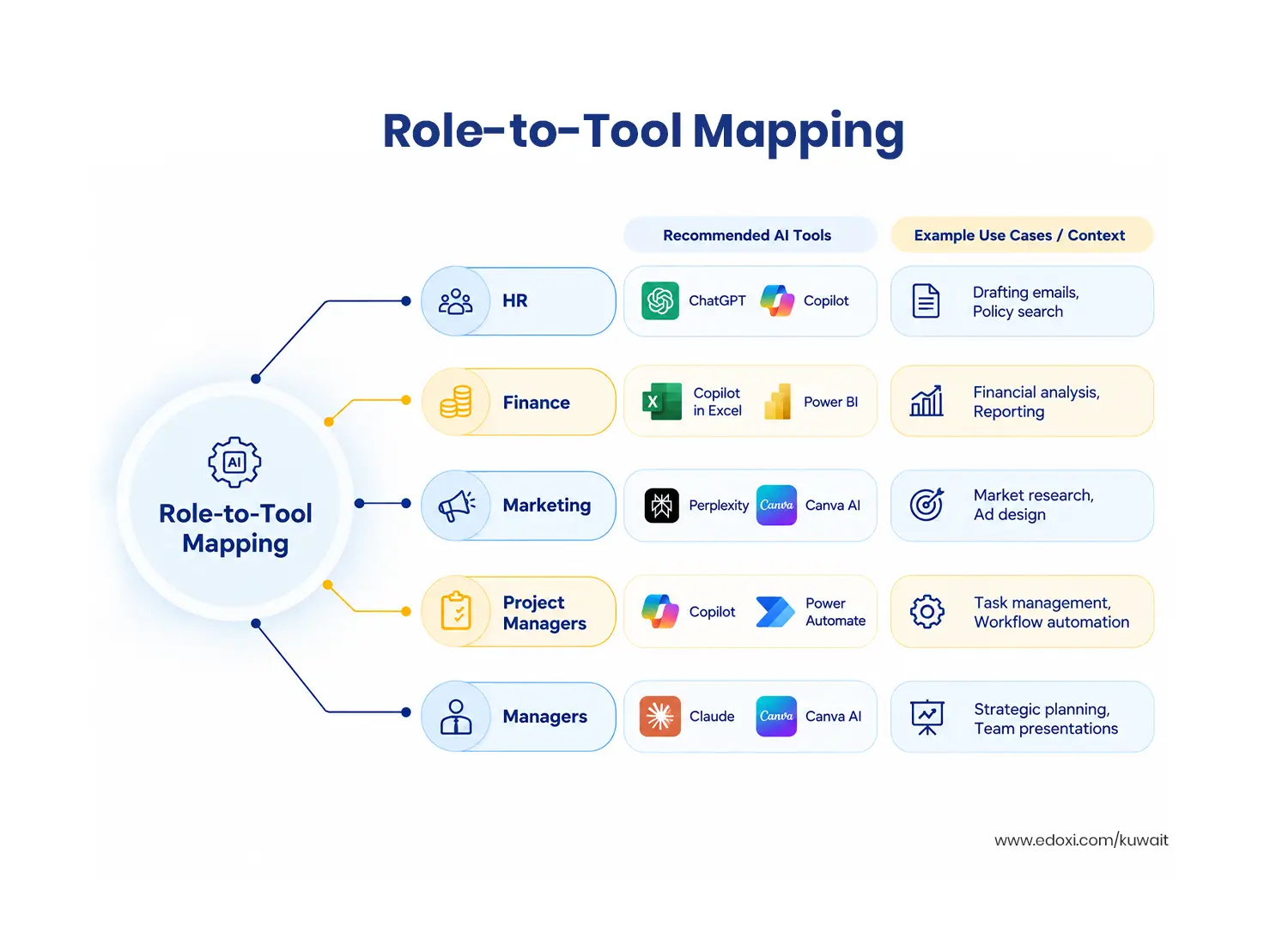
Match the tool to your daily task. HR, finance, marketing, and management each have a different best starting point.
| Role | Daily task | Start with |
|---|---|---|
| HR | Job ads, policy summaries | ChatGPT or Copilot |
| Finance | Spreadsheets, variance checks | Copilot in Excel, Power BI |
| Marketing | Research, content plans | Perplexity, Canva AI |
| Project managers | Meeting notes, status reports | Copilot, Power Automate |
| Managers | Briefs, presentations | Claude, Canva AI |
Developers use AI daily too. So the question of whether AI will replace software engineers comes up often in tech teams.
One rule applies to every role. Hiring, money, and other big decisions need a person to approve them. AI can prepare the work. A human decides.
A simple presentation of which AI tools perfectly match your job is given in the infographics below:
Kuwait is pushing AI skills through national plans and training programmes, and workers across the region already use AI. Employers now expect staff to keep up.
The numbers are clear. PwC's Middle East Workforce Hopes and Fears Survey 2025 found that 75% of respondents in the region used AI at work in the past 12 months. The global figure was 69%.
Policy points the same way. Kuwait's draft National AI Strategy 2025–2028 lists workforce empowerment as a core pillar. Companies are also thinking about AI-ready teams in Kuwait, not only about buying tools.
Advanced skills are "essential for positioning Kuwait as a leader in the digital and knowledge economy."
Omar Al-Omar, Minister of State for Communications Affairs, on the Kuwait Skills programme (November 2025)
Employers are already training staff on AI and Copilot. Building these skills early puts you ahead of colleagues who wait.
The programme, run by CAIT with Microsoft, aims to train 30,000 public-sector employees. It also plans to help over 100,000 users adopt Copilot.
Consultant Abdulilah Annous told Kuwait Times that about 80% of employed Kuwaitis work in the public sector.
That is a big group moving from paperwork to analysis. It is also why professional AI training in Kuwait is gaining attention across industries, since tool access alone does not build skill.
Learn prompt writing, fact-checking, basic data reading, and privacy habits. Tools change. These skills stay useful.
Employers keep asking for the same core AI skills for professionals. Four matter most:
Prompt writing: Tell the tool its role, task, and format.
Checking: Verify every number, name, and date.
Data basics: Read a chart and spot an odd figure.
Privacy habits: Know what never goes into a public tool.
Checking may be the big one. Annous told Kuwait Times that once anyone can produce a report in seconds, "knowing whether it is correct becomes the valuable one."
He added that much Kuwaiti work runs in Arabic, where AI mistakes are harder to catch. People who can check both Arabic and English output stand out.
Say who the AI should act as, what to do, who it is for, and the format. Short and clear works best.
Try this: "Act as an HR officer in Kuwait. Write a job ad for an accountant. Keep it under 150 words. Use simple English." Read the answer. Edit it. Then ask a follow-up to improve it.
Use only employer-approved tools, never paste private data, and check every output before you share it.
Annous also says Kuwait's CITRA privacy rules are narrower than many people assume. So your company policy matters even more. A good AI course in Kuwait should teach these rules from day one.
AI agents take a goal and finish several steps with little help. They will handle more routine work while people review the results.
An AI agent is software that plans steps, uses tools, and completes a task. Think of an assistant that does the booking, not only the advice.
A chatbot answers. An agent acts. For the basics, start with what AI agents are and how they work.
They take over routine steps like reporting and data entry. People spend more time on judgement, service, and review.
Annous expects managers to supervise both people and specialised agents within five to ten years, with humans checking the work. See how AI agents are changing jobs in more detail.
Learn basic prompting, practise on real tasks, add one role tool, then save a small folder of checked work.
Week one: Learn basic prompting with a general assistant.
Weeks two and three: Use it on real emails, reports, and notes.
Month two: Add one role tool, such as Power BI or Copilot.
Ongoing: Keep a folder of reviewed examples to show your manager.
Guided learning speeds this up. An artificial intelligence course in Kuwait gives you labs, feedback, and a certificate for your CV.
PwC's Khalid AlShatti wrote that "productivity gains only materialise when people have the skills to apply digital and AI tools" in PwC's Kuwait skills article. Practice beats theory. Start small and keep going.